

Story Structure Template for Fiction Writers | SeaBell
Use this story structure template when the premise is promising but the shape is still unclear. It helps you choose the kind of pressure your story needs before you build a novel outline or force the draft into someone else's beat sheet.
The point is not to obey a famous framework. The point is to choose a structure that fits the story's promise: where pressure begins, where the terms change, what the protagonist is forced to admit, and what the ending has to prove.
🧭 Quick answer: what is a story structure template?
A story structure template is a reusable pressure map for fiction. It helps you track the main turns, transformation, setup, payoff, and climax before you build a full outline, chapter plan, scene card, timeline, or story bible.
A novel outline tells you what happens in this book. A story structure template helps you decide what shape this book should take before you assign events to that shape.
Three-Act Structure, the Save the Cat! method, and the Hero's Journey are useful for different reasons. Three-Act Structure gives you a flexible escalation spine; Save the Cat! gives you sharper pacing checkpoints; the Hero's Journey helps when the story depends on leaving one world, surviving trials, and returning changed.
Most structure problems first show up as pacing complaints. A writer says, "the middle is slow," but the deeper problem is often that the conflict has stopped changing. The characters are busy, but the story is not becoming harder, stranger, or more costly.
📝 Copy-paste story structure template
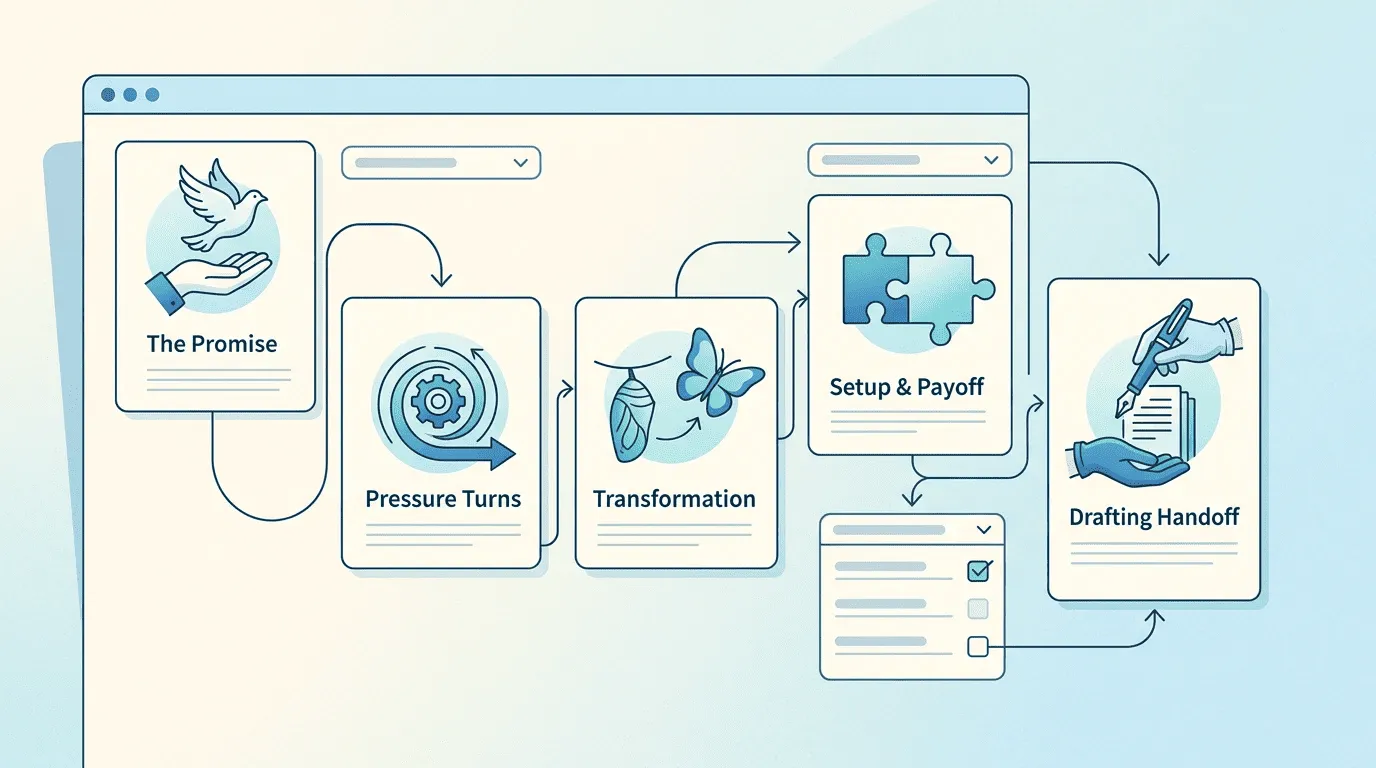
Copy this into your planning document and answer in one or two sentences per field. Stay at structure level. If a field turns into a chapter summary, park that material for the outline stage and come back to the pressure question.
How specific should the answers be?
Reader promise: A political fantasy about a mapmaker whose drawings change real borders.
What the story must not become: A puzzle-box magic system with no human cost.
Structure problem it should solve: Make every map change raise the public consequence, not only the mystery.
Story structure template
1. Story promise
- Working title:
- Genre / subgenre:
- Reader promise:
- Central dramatic question:
- What the story should feel like:
- What the story must not become:
2. Structure model choice
- Main structure to test: Three-Act / Save the Cat! / Hero's Journey / hybrid:
- Why this model fits:
- What problem it should solve:
- Where it may not fit:
- What you are allowed to change:
3. Major pressure turns
- Opening pressure:
- Disrupting event:
- First commitment:
- Midpoint change:
- Crisis / false defeat:
- Climax choice:
- Final consequence:
4. Transformation map
- Protagonist's starting belief:
- What the plot keeps testing:
- Midpoint shift:
- Final choice:
- Ending state:
5. Setup and payoff map
- Promise or clue:
- Where it first appears:
- How it escalates:
- Where it pays off:
- What must not be forgotten:
6. Sagging middle diagnostic
- What gets harder after the first turn:
- What new information changes the goal:
- What relationship or subplot complicates the pressure:
- What false solution fails:
- Why the climax is now unavoidable:
7. Adaptation notes
- Beat or stage to compress:
- Beat or stage to expand:
- Beat or stage to skip:
- Reason for breaking the model:
- Risk to check during revision:
8. Drafting handoff
- Structure decision to preserve:
- Next outline step:
- Chapter or chapter group affected:
- Scene pressure to carry forward:
- Continuity or reveal risk:
- AI drafting note:
⚖️ Three-Act Structure vs. Save the Cat! vs. Hero's Journey
Choose the framework that exposes the problem your draft actually has.
| Framework | Best for | Strength | Risk | Use it when |
|---|---|---|---|---|
| Three-Act Structure | Clear beginning, middle, and ending | Gives the story a simple escalation spine | Can stay too broad if Act II has no real reversals | You need a flexible foundation. |
| Save the Cat! | Beat-level pacing and midpoint / ending checks | Makes contrast and payoff easier to inspect | Can become formulaic if copied mechanically; it is a named method, not SeaBell's template | Your draft has a sagging middle, weak contrast, or unsupported payoff. |
| Hero's Journey | Quest, departure, return, and mythic transformation | Connects the external journey with inner change | Can force a non-quest story into "chosen one" language | Your protagonist crosses a threshold, faces trials, and returns changed. |
Pick the framework that solves the draft's problem.
- Choose Three-Act Structure if events happen but consequence does not escalate.
- Study Save the Cat! if the midpoint, dark moment, or ending image feels unsupported.
- Test the Hero's Journey if the story depends on departure, trial, return, and identity change.
- Be careful with the Hero's Journey if the main pressure is social, political, romantic, or investigative rather than threshold-and-return transformation.
Save the Cat! can make pacing visible, but the full official beat sheet belongs to the official method. For this article, use the lesson rather than copying the worksheet: every major turn should change the pressure, not merely occupy the right slot.
🏗️ When to use Three-Act Structure
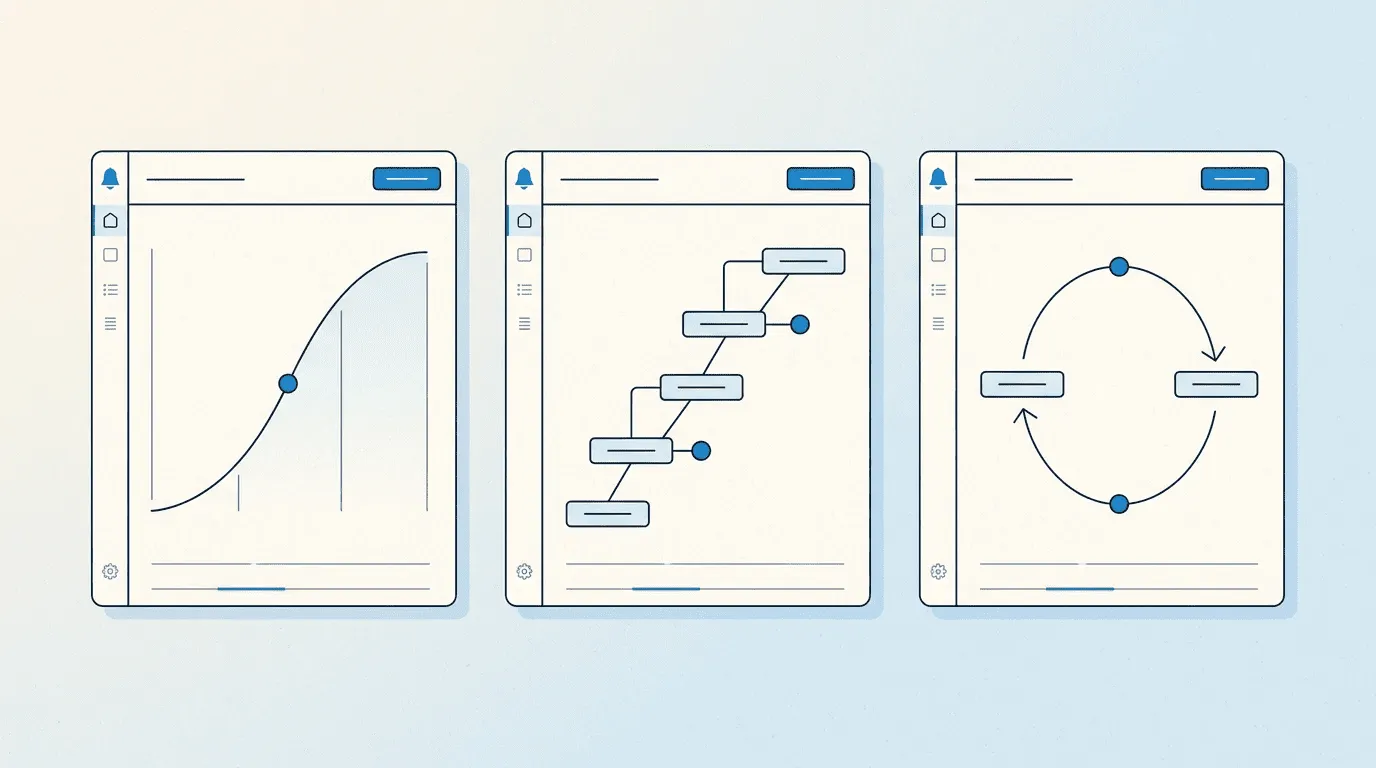
Use Three-Act Structure when the story needs a clean cause-and-effect spine. It works for novels, serial arcs, and genre fiction because it asks three durable questions:
- Act I: What pressure knocks the protagonist out of normal?
- Act II: What makes the goal harder and changes what the protagonist believes?
- Act III: What final choice proves the story has changed?
If you already know Three-Act Structure is the right shape for your novel, use our three-act structure template to turn Act I, Act II, and Act III into a draftable plan. Reedsy's Three-Act Structure guide is useful background if you need a refresher, but the important part is not the label. It is whether each act changes the cost of the story.
Three-Act Structure becomes weak when Act II turns into "more events happen." The middle needs reversals, discoveries, costs, and false solutions. If nothing changes except the page count, the structure is not doing enough work.
A practical test: if you can remove three middle chapters and the climax still works the same way, those chapters probably are not structural turns. They may contain good scenes, but the story has not made them necessary yet. Rewrite the midpoint change, crisis, and climax choice before adding more chapters.
⏱️ When to use Save the Cat!
Use Save the Cat! when broad act breaks are not specific enough. In the official method, the story is checked through 15 major beats from opening image to final image, which is why many writers use the Save the Cat! beat sheet to inspect contrast, midpoint pressure, and ending payoff.
For novels, a beat is not a scene by default. One beat may take a paragraph, one scene, a chapter, or several chapters. That is why Save the Cat! can help with pacing without becoming a chapter-by-chapter command.
Mechanical obedience usually shows up in the draft before it shows up in the outline. A writer moves a reveal earlier because a beat sheet says the midpoint needs a surprise, but the protagonist has not made a choice that earns the reveal yet. The draft looks structured on paper and false on the page.
Use Save the Cat! to ask sharper questions: what changes at the midpoint, what false solution fails, and what final image proves the ending has moved from the opening? If the answer serves the method but not the story promise, change the beat.
🛤️ When to use the Hero's Journey
Use the Hero's Journey when the story is built around crossing a threshold and returning changed. Fantasy, adventure, portal fantasy, coming-of-age, and some science fiction stories often benefit from that shape.
- Ordinary pressure:
- Call or disruption:
- Threshold:
- Tests and allies:
- Deepest ordeal:
- Return or changed world:
The Hero's Journey becomes less useful when the story is not really a journey. A fantasy novel with maps, guild politics, and border consequences may still work better as pressure escalation. Do not let fantasy scenery push you into a quest structure if the strongest conflict is political cost, investigation, or moral responsibility.
🧪 Filled example: choosing a structure for one story
Use one premise and test it three ways:
Premise: A disgraced apprentice cartographer discovers that every map she draws changes the borders of a hidden kingdom.
Three-Act version
Act I: The apprentice corrects a map to prove she still deserves her place. The border changes in the real world.
Act II: Each new map creates political fallout, personal guilt, and pressure from factions that want her gift controlled. The midpoint reveals that the old borders were false for a reason.
Act III: She must choose whether to restore the old border, protect herself, or draw a truthful map that exposes the hidden kingdom and hurts people she cares about.
Save the Cat! inspired version
Here, the useful pieces are contrast and payoff. The opening image might show her copying safe, approved maps. The catalyst is the first border change. The midpoint turns the gift from accident into responsibility. The dark moment comes when a "correct" map destroys a refuge. The final image shows her drawing with full knowledge of the cost.
This is not a full Save the Cat! beat sheet. It is a way to test whether the ending answers the opening.
Hero's Journey version
The ordinary world is the mapmaker's guild. The threshold is a forbidden archive where maps do not record geography; they negotiate reality. The ordeal is learning who benefits from false borders. The return is not a simple homecoming. She comes back with a map that changes the kingdom and her place inside it.
Template filled for this premise

Story promise: A political fantasy where a mapmaker's craft changes who has land, safety, and power.
Main structure to test: Three-Act escalation with a Save the Cat!-style midpoint contrast.
Midpoint change: She learns the false borders protected a hidden kingdom, not just a corrupt guild secret.
Crisis / false defeat: Her "correct" map saves one community and erases another from official record.
Climax choice: Restore the safe lie, protect herself, or draw a truthful border with public consequences.
Adaptation note: Skip a full quest-return shape unless the forbidden archive becomes the story's central journey.
Drafting handoff: Carry the current border consequence, faction pressure, and reveal limit into the next chapter plan.
Which structure fits best?
Three-Act gives this premise the cleanest foundation because the story depends on escalation and consequence. Save the Cat! helps test the contrast between the first and final image. The Hero's Journey works only if the draft leans into forbidden-world discovery and return. If the novel is really about political fallout and moral cost, a pure quest shape may make the outline heavier without making the story clearer.
This is where many outlines go wrong: the most interesting framework is not always the best drafting framework. A Hero's Journey version may sound grand in a pitch, but if the writer keeps returning to border disputes, guilt, and public consequence, the story is asking for pressure turns more than mythic stages.
🧩 Story structure vs. novel outline vs. chapter outline vs. scene card
Keep the planning layers separate. Otherwise a "template" turns into a giant document that feels productive while it delays the draft.
| Planning layer | Question it answers | How deep it should go |
|---|---|---|
| Story structure | What shape should the story take? | Major pressure, turns, transformation, and payoff. |
| Novel outline | What happens in this specific book? | Whole-book plan, major plot movement, subplots, and chapter-group direction. |
| Chapter outline | What must the next chapter accomplish? | Chapter purpose, conflict, turn, continuity, and ending hook. |
| Scene card | What dramatic job does this scene perform? | Scene goal, pressure, reveal limit, turn, and drafting brief. |
| Story timeline | What happens when, and when does the reader learn it? | Chronology, clue order, reveal timing, and continuity risks. |
| Story bible | What facts must stay consistent while drafting? | World rules, cast facts, relationship states, timeline notes, and open threads. |
For this workflow, story structure comes first. Once the broad structure is stable, move into SeaBell's novel outline template for premise, ending direction, subplot pressure, and chapter-group movement. When one structural turn becomes the next drafting unit, the chapter outline template translates it into purpose, conflict, turn, and hook. For one scene, the scene card template carries pressure, reveal limit, and turn into the writing session.
Some structure decisions create continuity work. A mystery, dual timeline, or delayed reveal may need a story timeline template to keep chronology and reveal order clear. A rule, promise, relationship state, or border change that must stay consistent belongs in a story bible template. Those tools support the structure decision. They do not replace it.
➡️ How to turn a story structure into a novel outline
Once you choose the structure, translate only the major turns into your novel outline. Do not jump straight from "midpoint" to twenty chapter summaries.
- Name the structure decision. Example: "This story uses Three-Act escalation with a Save the Cat!-style midpoint contrast."
- Convert pressure turns into book sections. Opening pressure, first commitment, midpoint change, crisis, climax choice, final consequence.
- Add story-specific facts. For the cartographer story, the midpoint is not just "big reveal." It is the discovery that official borders were designed to hide a living kingdom.
- Leave chapter detail for later. If you solve every chapter now, you may lock the story before you understand its best pressure.
This article stops at structure because the search question is framework fit. The novel outline stage begins when you are ready to assign story-specific events, subplot pressure, genre promises, and chapter-group movement to the shape you have chosen.
🎬 How to turn structure beats into chapter outlines and scene cards
A structure beat is not automatically a chapter or a scene. "Midpoint change" may take one scene in a short novel, three chapters in a fantasy novel, or an entire arc in a web serial.
Turn a beat into a chapter outline when you know what the chapter must accomplish. Turn it into a scene card when you know the dramatic job of one scene: who wants what, what pressure interrupts them, what turns, and what the reader understands afterward. If the beat still spans several decisions, keep it at chapter-outline level. If it has one dramatic turn, make it a scene card.
When a structure beat refuses to become a scene, do not force it. The beat may still be too abstract. "The heroine accepts her power" is not yet a scene; "she redraws a border to save a village and realizes another village will vanish from the official map" is closer to something you can draft.
🤖 How to use a story structure template with AI
AI can compare structure options quickly, but it often defaults to familiar beats unless you give it the real structure problem. Do not ask only for a structure. Ask for alternatives, risks, and tradeoffs.
Weak prompt: Give me a story structure for a fantasy novel.
Better prompt: Compare three possible story structures for a fantasy novel about a disgraced apprentice cartographer whose maps change political borders. Show a Three-Act version, a Hero's Journey version, and a looser hybrid. For each, explain what the structure helps, where it may feel forced, and what the midpoint and final choice should test.
Generic AI structure usually looks polished because the labels are in the right place. The warning signs are smaller: the midpoint is only "the stakes get higher," the climax solves a problem the opening never promised, or the framework language could fit any fantasy premise if you swapped the nouns. When that happens, send the answer back through the template fields "where this model may not fit" and "risk to check during revision."
A romance structure test might ask whether trust changes before the confession. A mystery version might ask whether each reveal changes the reader's theory instead of merely adding clues. A web serial version might ask whether the current arc has a pressure turn strong enough to carry readers into the next update.
After AI gives you options, choose the version that creates the clearest pressure, not the version with the most impressive terminology. Ask follow-up questions such as:
- Where does this structure feel forced?
- Which beat is doing the least work?
- What setup does the ending need earlier?
- What does the protagonist believe at the start that the climax must test?
Keep human judgment over genre promise, character change, and payoff. AI can compare options and identify risks, but it cannot guarantee that the final choice pays off the promise the reader bought in the first act.
🔔 Where SeaBell fits into story structure workflows
The structure decision is easy to understand in a planning document and easy to lose once you are drafting a chapter. In the cartographer story, the next scene is not just "she investigates the archive." The writer needs the active pressure turn, the border consequence, the faction that wants the map, the character state, and the reveal the reader is not allowed to know yet.
SeaBell fits after that decision. It can keep the current pressure turn, reveal boundary, and character state beside the drafting session instead of leaving them buried in a separate planning file. SeaBell does not choose the best framework for you, and it cannot guarantee a stronger plot. It is useful at the handoff point, when the structure has to survive contact with chapter and scene drafting.
Choose the structure first. Then use SeaBell as the drafting workspace where the current structural turn, reveal boundary, and character state stay visible, so the broad framework does not disappear when planning turns into prose.
❓ FAQ
What is a story structure template?
It is a reusable planning tool for the major shape of a story. It tracks pressure, turns, transformation, setup, payoff, and climax before you build a full outline.
Is story structure the same as a novel outline?
No. Story structure is the framework. A novel outline is the specific plan for one book. Structure helps you decide the shape; the outline fills that shape with actual plot movement.
What is the best story structure for a novel?
Start with the problem your draft has. Three-Act Structure is flexible; Save the Cat! gives beat-level checkpoints; the Hero's Journey fits quest and transformation stories. The best choice is the one that makes the midpoint, crisis, and final choice clearer.
How is Save the Cat! different from Three-Act Structure?
Three-Act Structure gives a broad beginning, middle, and ending. Save the Cat! adds more detailed beat checkpoints inside a story's movement, which can help diagnose pacing and payoff.
Is the Hero's Journey good for every story?
No. It is strongest for quest, adventure, portal, transformation, and departure / return stories. If your story's pressure is mainly social, romantic, political, or investigative, another structure may fit better.
Can I use this story structure template for short stories?
Yes, but compress it. A short story may only need one pressure turn, one reversal, and one payoff. Do not force every major framework beat into a short piece.
Can I use AI to create a story structure?
Yes. Ask AI to compare options, identify risks, and explain where a framework may feel forced. Reject labels that do not change the midpoint, crisis, or climax.
Can I download this story structure template as a PDF?
This draft does not include a PDF asset. You can copy the template into your own document. If a downloadable version is created later, the publishing page can say so then.
Related Posts
Novel Outline Template for Fiction Writers| SeaBell
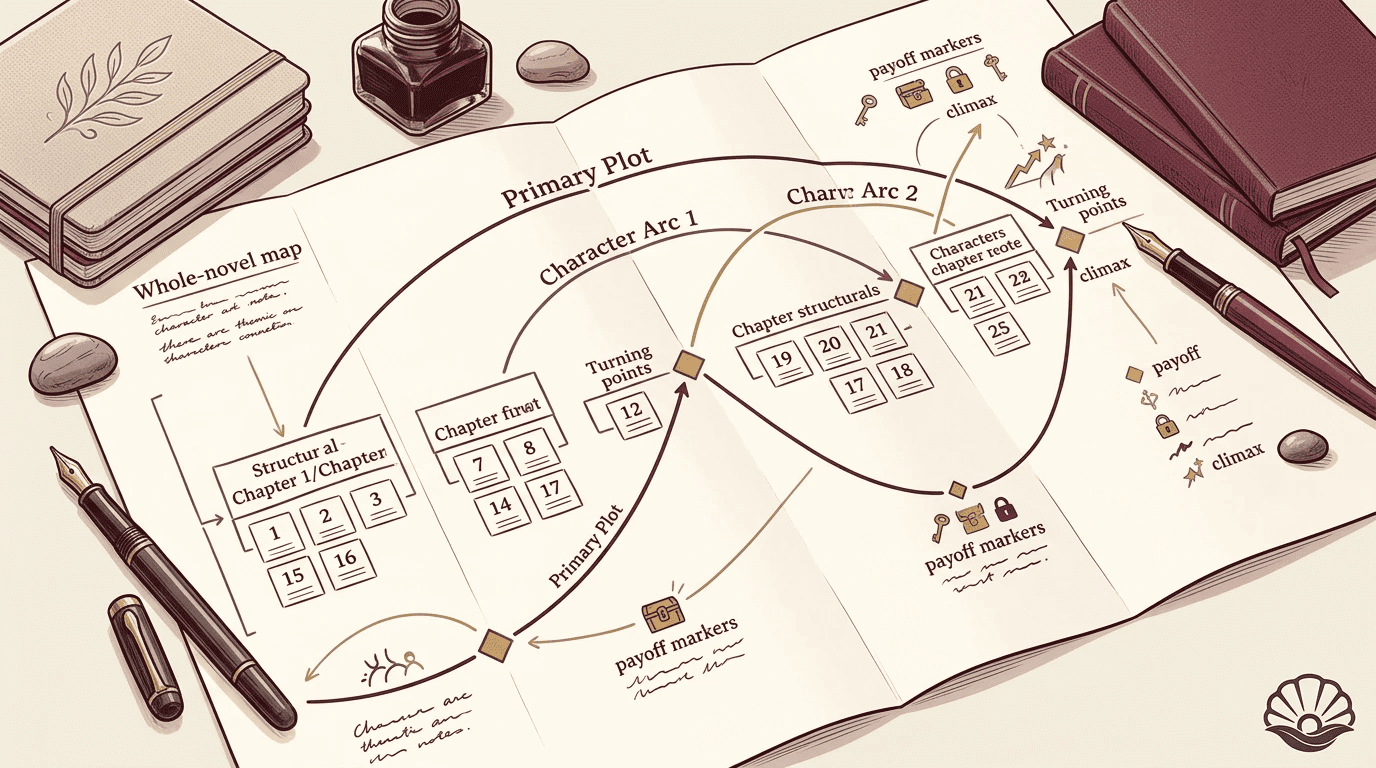
Copy a practical novel outline template for premise, acts, turning points, character arcs, subplots, and the handoff into chapter planning.
Story Timeline Template for Fiction Writers
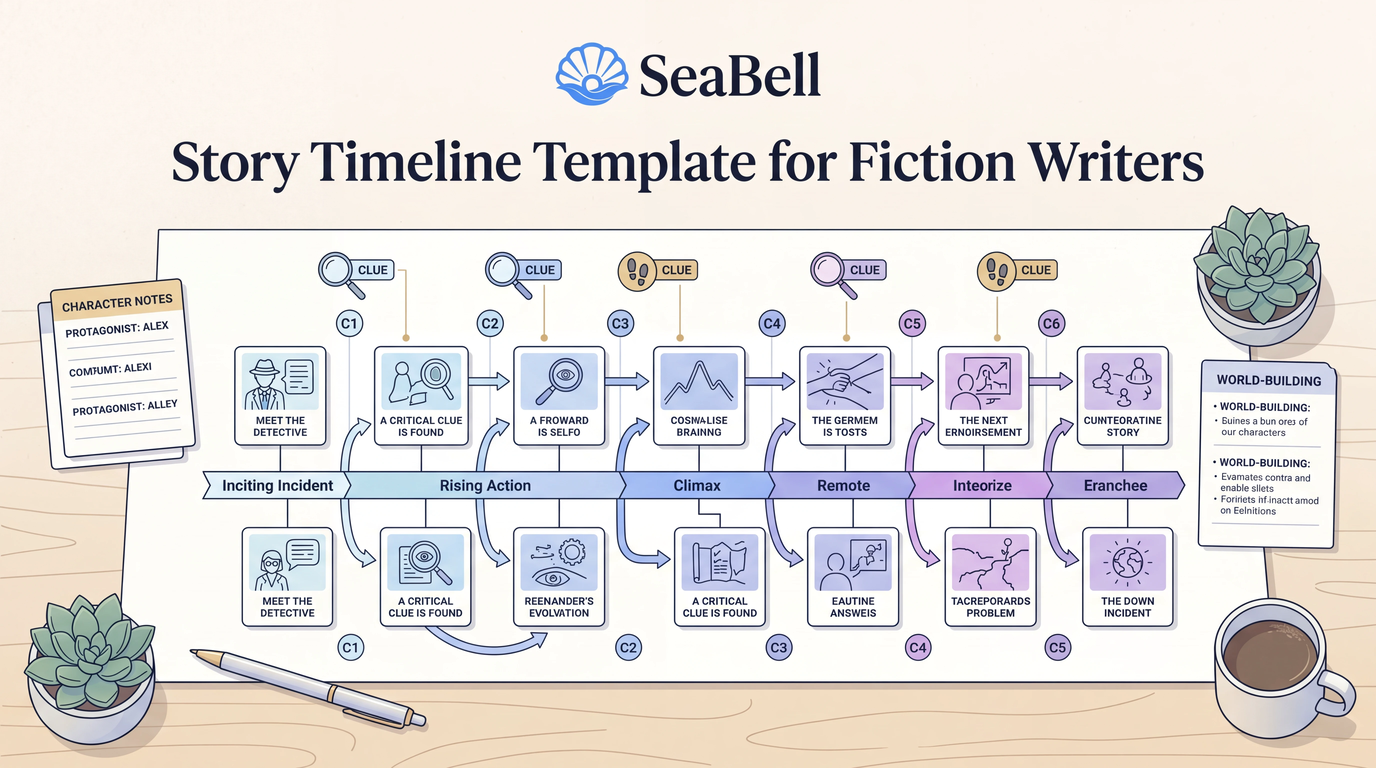
Copy a practical story timeline template for fiction writers and learn how to track chronology, reveal order, character knowledge, clues, and revision continuity.
Scene Card Template for Novel Writers | SeaBell
Copy a scene card template for fiction writing, see a filled example, and turn your scene plan into a focused AI drafting brief

Story Bible Template for Novel Writers: AI-Ready Guide
Use this story bible template to organize characters, world rules, timelines, plot threads, and AI drafting notes before your novel gets messy.