

Three-Act Structure Template for Novel Writers | SeaBell
A three-act structure template is only useful if Act II does more than hold the pages between the opening and the climax. For a novel, the three acts should show cause and effect: what forces the protagonist to commit, what makes the goal more costly, and what final choice proves the story has changed.
Use this page when you already know Three-Act Structure is the shape you want and need to make it draftable. If you still need to compare Three-Act Structure with other frameworks, start with SeaBell’s broader story structure template. Here, the job is narrower: turning Act I, Act II, and Act III into a working structure map you can later move into a novel outline, chapter groups, and scene cards.
⚡ Quick Answer: What Is a Three-Act Structure Template?
A Three-Act Structure template maps a story into setup, confrontation, and resolution. For novel writers, the practical value is not the labels themselves. Each act has to change the protagonist’s options.
Act I pushes the character into commitment. Act II makes the first solution more expensive or less honest. Act III forces a final choice that could not have happened at the beginning.
That makes a three-act structure template broader than a chapter outline, but more specific than a loose premise. Copy the worksheet below first, fill it in quickly, then use the later sections to test whether each act is actually doing its job.
A quick test: if every middle chapter could happen in a different order and the story would still mean the same thing, Act II is probably not escalating. The midpoint should make the old plan stop working, not just add another event.
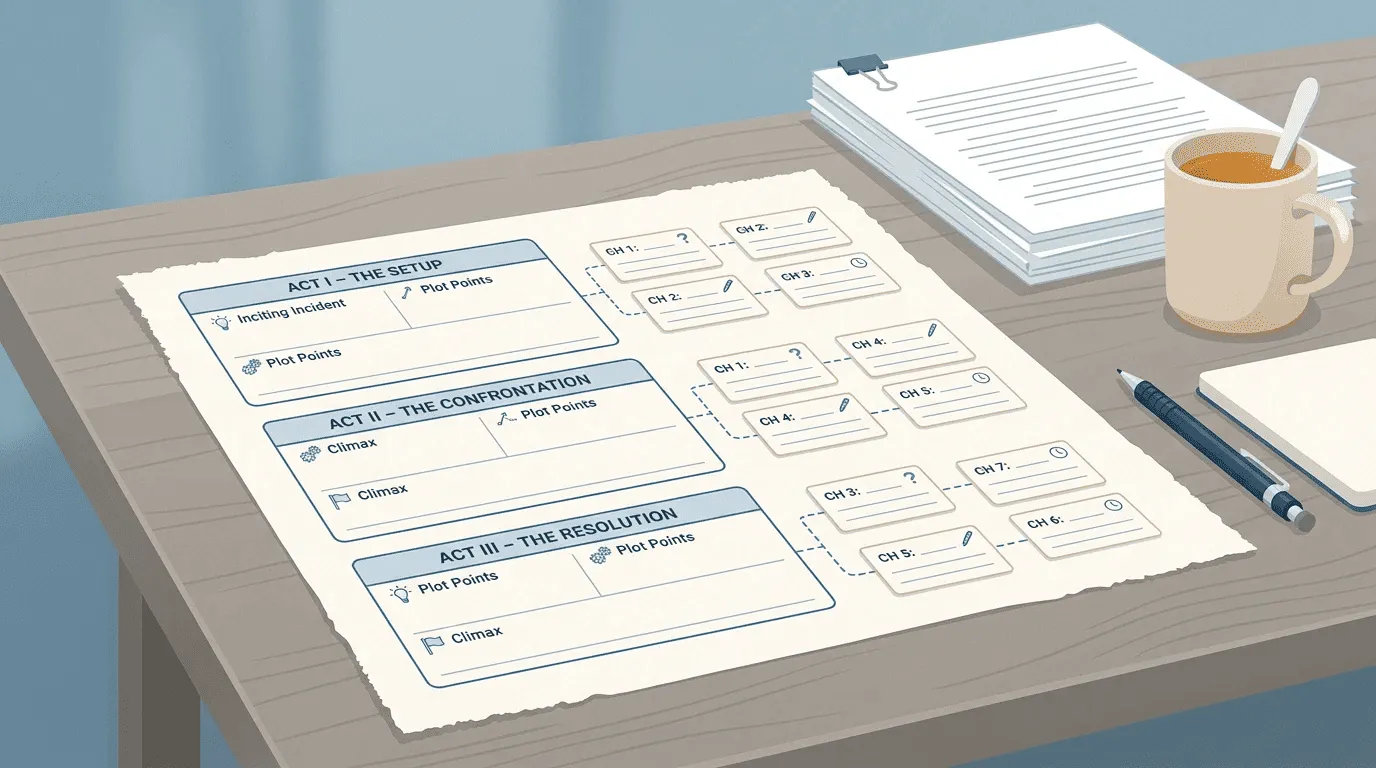
🧩 Copy-Paste Three-Act Structure Template
Use this as a working worksheet. Keep the answers short at first. A sentence or two per field is usually enough for the first pass; if a field needs a paragraph, it may belong later in your novel outline.
Story Setup
Fill this section before you name the act turns. It keeps the template from becoming a clean structure pasted onto a vague story.
- Working title:
- Genre / subgenre:
- Story promise: What kind of payoff does the reader expect?
- Protagonist:
- Opening normal: What does everyday life look like before the disruption?
- What is missing or unstable: What is already under strain before the plot starts?
- Main external problem: What visible problem must be solved?
- Main internal pressure: What fear, belief, wound, desire, or contradiction makes this problem personal?
Act I: Setup and Commitment
Act I is complete only when the protagonist has lost the easy option of staying the same.
- Opening image / opening state:
- Inciting disruption: What event breaks the old pattern?
- Why the protagonist cannot ignore it: Why this character, and why now?
- First wrong response: What do they try because they misunderstand the problem?
- Key relationship or opposition introduced:
- First major choice:
- Act I turning point / commitment: What action crosses a line?
- What changes after this point: What is no longer recoverable, safe, hidden, or deniable?
Act IIA: Escalation and False Progress
This is the part where the protagonist thinks the first plan might work. The key is to make the progress real enough to tempt them, but incomplete enough to break later.
- New goal after commitment:
- First plan:
- Complication that raises the cost:
- Relationship or subplot pressure:
- Information the protagonist misunderstands:
- Temporary win:
- What this act tests: What belief, tactic, or relationship is being stress-tested before the midpoint?
Midpoint: The Story Changes Shape
The midpoint should change what the protagonist understands about the problem. If it does not change the next tactic, it is probably only another event.
- Midpoint event:
- New information or reversal:
- What the protagonist now understands:
- What gets harder:
- What old plan no longer works:
- How the stakes become more personal:
Act IIB: Crisis and Collapse
After the midpoint, the protagonist should not be able to solve the story with the old method. This section tracks the damage created by the next, more desperate tactic.
- New tactic after midpoint:
- False solution: What answer looks useful but makes the deeper problem worse?
- Pressure that exposes the character’s flaw:
- Relationship damage or sacrifice:
- Lowest point:
- Choice the protagonist avoids:
- Crisis question: What must they finally choose, admit, risk, or give up?
Act III: Final Choice and Consequence
Act III pays off the story promise by making the protagonist act differently under maximum pressure.
- Final plan:
- Climax pressure:
- Final choice:
- What the protagonist risks:
- What changes because of the choice:
- Final consequence:
- Ending state:
- What promise is paid off: Which opening instability, genre expectation, or emotional question has been answered?
Drafting Handoff
Do not leave the act map as a separate document. Use this section to decide where each structural turn goes next.
- Novel outline section affected:
- Chapter group affected:
- Scene pressure to carry forward:
- Character change to track:
- Timeline/reveal risk:
- AI drafting note: What should AI remember, test, or challenge when helping with this part later?
The drafting handoff matters because structure can look complete while still being hard to write. If the midpoint says “the hero learns the truth,” the next question is: which chapter group reveals it, which scene turns because of it, and what does the protagonist do differently afterward?
I’ve seen many early outlines fail in exactly that gap: the act labels are correct, but the writer cannot tell which decision belongs in the next chapter. The fix is not adding more structure terminology. It is translating each major turn into a smaller writing job.
🎬 Three-Act Structure for Novels vs. Screenplays
Three-Act Structure is often discussed through film, but novel writers do not need to treat it as a strict page-count system. A novel act can contain multiple chapter groups, side relationships, internal reversals, and slower emotional payoffs.
For a novel, judge an act by what changes, not by the percentage of pages it takes.
| Screenplay Habit | Novel-Friendly Adjustment |
|---|---|
| Fixed page beats | Flexible chapter groups |
| Tight scene economy | Room for subplots and relationship pressure |
| One visible midpoint turn | A midpoint that may unfold across several chapters |
| Fast final act | Space for climax, reversal, consequence, and emotional resolution |
This matters for fantasy, romance, web novels, and serial fiction. A long novel may need smaller arcs inside Act II so the middle does not become a waiting room for the climax. Those sub-arcs should still push toward the same midpoint, crisis, and final choice.
A midpoint can take several chapters and still function as one structural turn if all those chapters deliver the same discovery, reversal, or consequence. The question is not “Is my midpoint at the exact center?” but “Does the midpoint make the old plan unusable?”
🚪 Act I: Make the Protagonist Commit
Act I is not background. It is the section that proves the protagonist cannot stay in the old life.
Return to these template fields first: “What is missing or unstable,” “Inciting disruption,” “Why the protagonist cannot ignore it,” and “Act I turning point / commitment.” If those answers are vague, the act may read like setup even when a lot is happening.
The opening should show what is already unstable before the inciting disruption arrives. That instability might be personal, social, magical, romantic, financial, political, or emotional. The disruption then pushes on that weakness until avoidance is no longer possible.
Useful Act I questions:
- What is unstable before the story starts?
- What event makes avoidance impossible?
- Why does this character respond, not someone else?
- What do they misunderstand when they commit?
- What changes at the Act I turn?
The Act I turning point should be a commitment, not simply a new location or a louder event. The protagonist chooses, refuses, lies, accepts, escapes, joins, steals, reveals, or risks something that makes the old normal harder to recover.
For example, “she leaves home” is not automatically a commitment. It becomes one if leaving means exposing a family secret, accepting a debt, betraying a rule, or choosing a dangerous ally. In the template, that difference belongs in “Act I turning point / commitment” and “What changes after this point.”
In practice, Act I often feels slow when the writer explains the world before the character has a reason to collide with it. A cleaner Act I usually lets the reader learn the world through constraint: what rule blocks the protagonist, what relationship complicates the choice, and what consequence makes waiting impossible.
🔥 Act II: Make the Middle Change the Cost
Act II is where many three-act outlines become vague. “The protagonist faces obstacles” is not enough. Obstacles only matter if they change the cost of the goal.
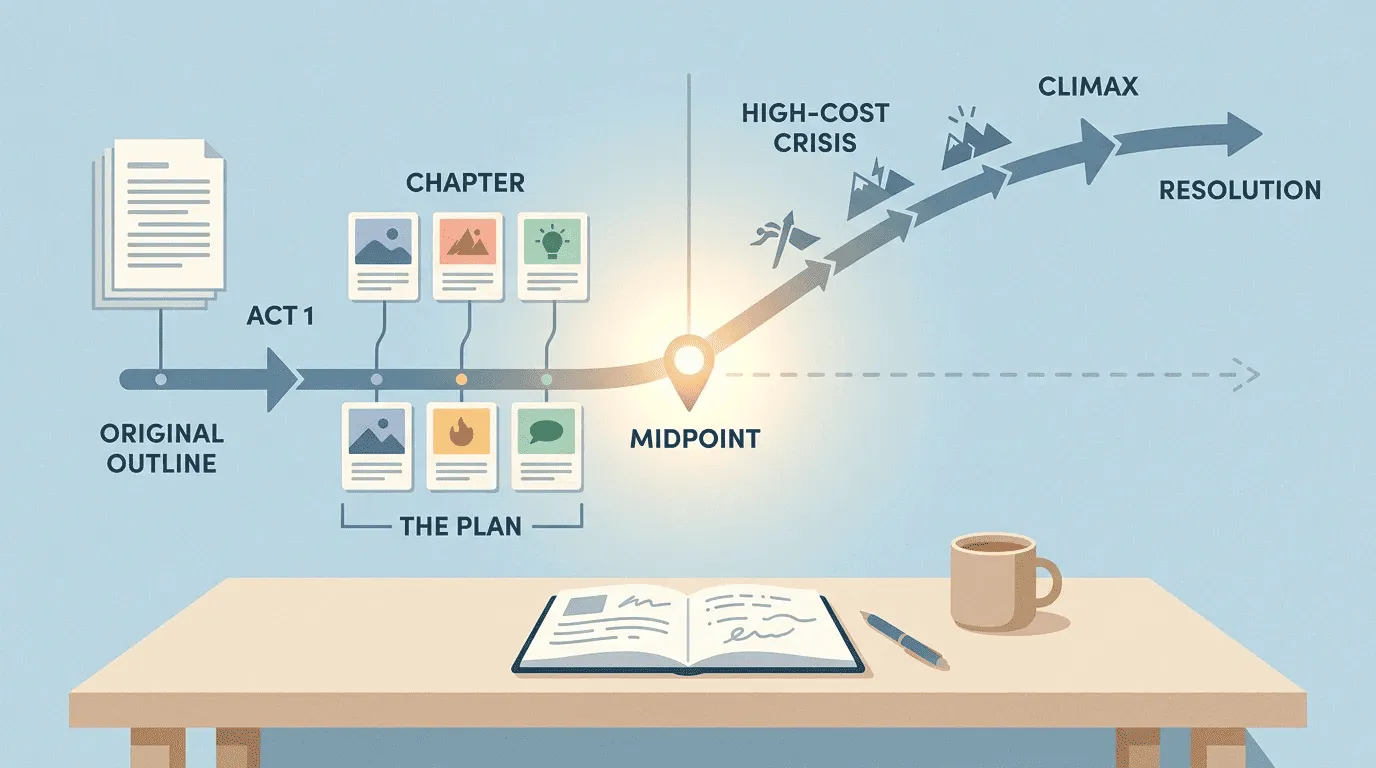
A useful Act II has two halves with a midpoint hinge:
- Act IIA: the protagonist tries a first plan and mistakes progress for control.
- Midpoint: new information, reversal, or consequence changes what the story is really about.
- Act IIB: the protagonist keeps going, but the old tactic now creates worse damage.
Use the template fields as a diagnostic chain. “First plan” and “Temporary win” show why the protagonist believes they are gaining control. “New information or reversal” should break that belief. “What old plan no longer works” should force the new tactic in Act IIB.
That split is the simplest way to diagnose a sagging middle. If the first half and second half of Act II could be swapped without changing the story, the middle is probably not escalating. If the midpoint does not force a different tactic, it is probably just another event.
Act II questions:
- What is the protagonist’s first plan?
- Why does that plan seem to work?
- What new information breaks the first plan?
- What false solution makes the problem worse?
- What relationship pressure makes the goal harder?
- What choice does the protagonist keep avoiding?
Most sagging middles are not empty; they are overfilled with events that all apply the same kind of pressure. The reader sees travel, arguments, clues, training, attraction, or danger, but the protagonist’s understanding of the problem does not change. The midpoint should end that pattern.
For example, if a romance heroine spends Act IIA trying to keep emotional distance, the midpoint should not merely be “they almost kiss.” It should reveal why distance is no longer a safe strategy. If a fantasy hero spends Act IIA chasing a stolen relic, the midpoint should change what the relic means, who benefits from it, or what using it will cost. Those answers belong in “New information or reversal,” “What old plan no longer works,” and “How the stakes become more personal.”
🏁 Act III: Force a Final Choice With Consequences
Act III is not only the climax. It is the section where the story tests whether the protagonist has changed enough to make a different choice.
The most useful Act III fields are “Final choice,” “What the protagonist risks,” “What changes because of the choice,” and “What promise is paid off.” If those fields do not connect to the opening instability, the ending may stop the plot without completing the story.
The final act should pay off what the story promised earlier. If the opening promised political intrigue, the climax should not be solved only through a random duel. If the opening promised a character who cannot trust anyone, the final choice should require trust, confession, sacrifice, or a new kind of vulnerability.
Useful Act III questions:
- What must the protagonist risk to solve the problem?
- What old belief no longer works?
- What setup pays off in the climax?
- What relationship or world consequence remains afterward?
- What final image proves movement from the opening?
A strong final choice could not have happened in Act I. The protagonist might have lacked the knowledge, courage, humility, anger, trust, or moral clarity to make it. That difference is what turns the ending from “the conflict stops” into “the story arrives somewhere.”
The ending state should also show consequence. The world does not need to be fully healed, and the character does not need to be perfect. But the reader should understand what changed because of the final choice.
🗺️ Filled Example: A Fantasy Novel in Three Acts
Here is a compact example using the same template. The goal is not to write a full synopsis. The goal is to show how the act map carries pressure from beginning to end.
Premise: A disgraced apprentice cartographer discovers that her maps can redraw political borders.
| Template Field | Filled Example |
|---|---|
| Opening state | The apprentice copies border maps for the court after a public disgrace ruined her chance at a royal post. |
| What is unstable | Her family depends on the court’s favor, but the border system has started erasing villages from legal records. |
| Main internal pressure | She wants to restore her family’s status, but she also knows the court’s map system is harming people who cannot defend themselves. |
| Inciting disruption | She redraws one disputed line to save a village from taxation, and the village vanishes from the royal archive. |
| First wrong response | She tries to secretly repair the map before anyone notices. |
| Act I commitment | She steals the master atlas after realizing the court will blame the village, not the map system. |
| Act IIA false progress | She restores one village and gains rebel allies, believing each border can be corrected one at a time. |
| What this act tests | Whether she can keep treating the atlas as a repair tool instead of a political weapon. |
| Midpoint change | She learns the map does not move land; it rewrites who is legally allowed to exist there. |
| Act IIB false solution | She uses the atlas to protect her brother’s district, but the correction erases a rebel settlement’s legal protection. |
| Crisis question | Will she protect her family’s rank by returning the atlas, or expose the system that gave her family power? |
| Crisis | The rebels turn on her, her family disowns her, and the court offers her status if she returns the atlas. |
| Final choice | She burns the archive that gives the borders authority, losing her family rank but exposing the system. |
| Ending consequence | The borders become politically unstable, but erased communities can finally testify and be recognized. |
| What promise is paid off | The story began with maps deciding who counts; it ends with the authority behind those maps being broken open. |
| Drafting handoff | Act I becomes the court-and-village opening chapters; the midpoint anchors the second major chapter group; the crisis needs scene cards for the brother, rebels, and court offer. |
Notice how the midpoint changes the meaning of the premise. Before it, the story looks like a problem-solving adventure: fix the map, save the village, avoid punishment. After it, every fix creates ethical damage somewhere else. That is the kind of turn Act II needs.
📚 How to Turn a Three-Act Template Into a Novel Outline
A three-act template gives you the spine: the major turns and what each one changes. A novel outline turns that spine into a book plan by adding chapter groups, subplot movement, character change, genre promises, setup/payoff, and drafting notes.
The difference matters. The act map tells you what changes. The novel outline tells you how the reader experiences that change across chapters.
Use this handoff:
- Act I becomes the opening chapters, the disruption, and the commitment point.
- Act IIA becomes the first plan, early complications, and apparent progress.
- The midpoint becomes a major chapter-group turn.
- Act IIB becomes crisis, false solution, pressure, and cost.
- Act III becomes climax, resolution, consequence, and final image.
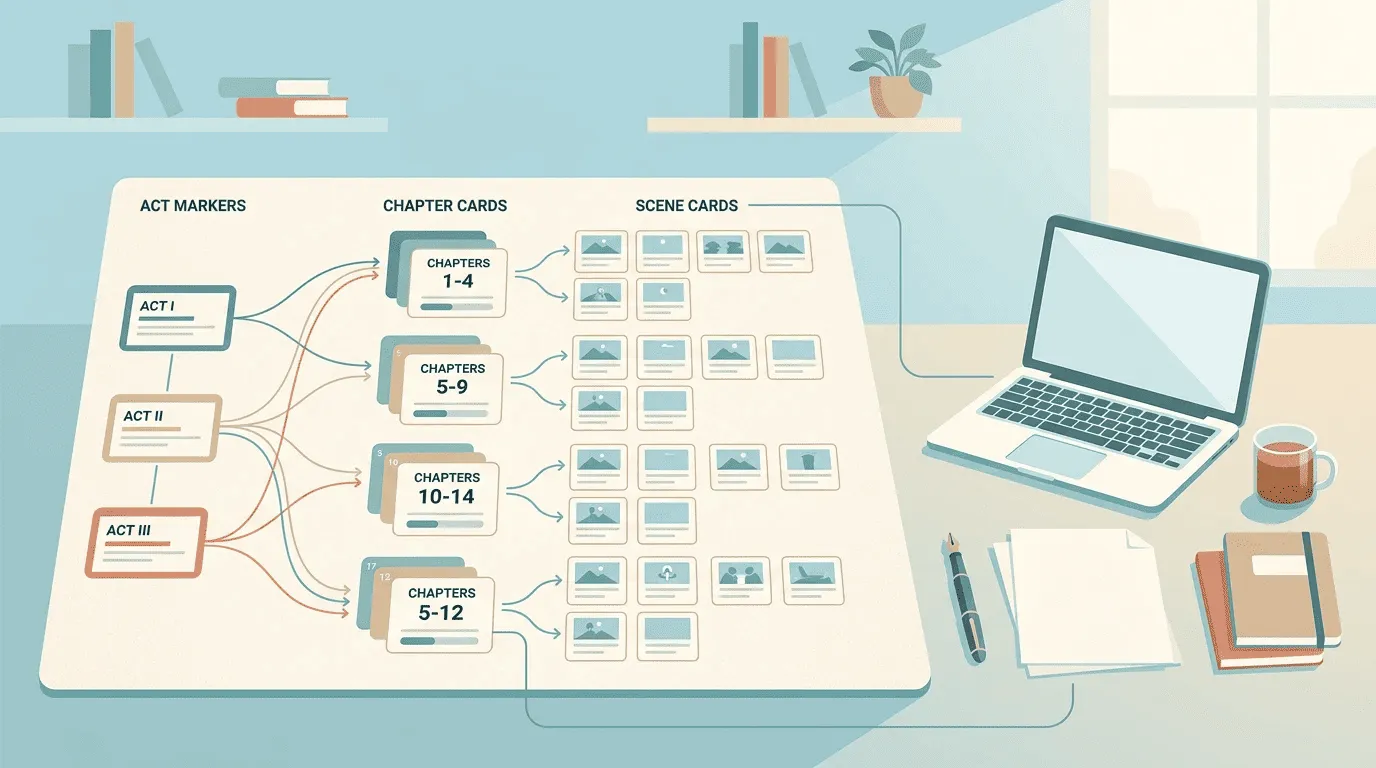
After you fill the act map, choose three to five chapter groups and assign each major turn to one group. Then move anything too detailed for the act template—backstory, world rules, timeline notes, subplot beats, dialogue fragments—into outline notes instead of cramming it into the worksheet.
If your act map feels strong but the book still feels hard to draft, move next into a novel outline template. That is where you can add chapter groups, subplot movement, protagonist change, genre expectations, and continuity notes without overloading the act worksheet.
The warning sign is when your act template starts collecting everything: character backstory, world rules, scene ideas, chapter titles, timeline notes, and dialogue fragments. At that point the template is no longer clarifying structure. It is trying to become the whole writing system.
📝 How to Break the Act Map Into Chapters and Scenes
A structural beat is not automatically one chapter. A midpoint may be one scene, one chapter, or several chapters, depending on how much discovery, confrontation, and consequence it requires.
Use this decision rule:
| If the beat... | Use... |
|---|---|
| Changes the whole direction of the story | A novel outline or chapter group |
| Needs several scenes to unfold | A chapter outline |
| Has one goal, pressure point, and turn | A scene card |
| Depends on chronology, flashbacks, or reveal order | A story timeline check |
A chapter outline manages a multi-scene movement: what the chapter group must reveal, complicate, or pay off. A scene card sharpens one dramatic unit: goal, obstacle, pressure point, turn, and consequence.
For example, “she steals the master atlas” may be one scene if the dramatic unit is simple: goal, obstacle, choice, escape. But “she learns every correction transfers harm somewhere else” may require several chapters if the evidence appears through a village record, a family confrontation, and a rebel accusation.
This is where a chapter outline template and a scene card template serve different jobs. The chapter outline helps you manage a larger movement. The scene card helps you sharpen one dramatic turn.
⚠️ Common Three-Act Structure Mistakes
The most common mistakes are not about naming the acts incorrectly. They are about letting the labels hide weak cause and effect.
Mistake 1: Treating Act I as background
If Act I mainly explains the world, the reader may understand the setting but not feel the story moving. Symptom: the inciting disruption could be removed and the first chapters would still play almost the same way. Fix it by starting with instability, then letting exposition appear where the protagonist hits pressure.
Mistake 2: Making Act II a bucket for events
Act II should not mean “more things happen.” It should mean the protagonist’s first way of solving the problem becomes more expensive, less honest, or less possible. Symptom: the middle contains plenty of travel, clues, fights, arguments, or romantic tension, but the protagonist’s tactic never changes.
Mistake 3: Placing a midpoint that does not change the options
A midpoint should change the story’s information, pressure, goal, or moral cost. If the protagonist would make the same next move with or without the midpoint, the midpoint is not doing enough. Fix it by asking what old plan becomes unusable after this point.
Mistake 4: Letting subplots decorate the middle
Subplots should complicate the main pressure. A friendship, rivalry, romance, family duty, or political bargain should make the protagonist’s next choice harder, not simply provide variety.
Mistake 5: Making the climax solve a different problem
The climax should pay off the promise the story has been building. If the story has been about public truth, a private victory may feel too small. If the story has been about trust, a purely tactical win may feel emotionally thin.
Mistake 6: Asking AI for a finished outline too early
AI can produce a clean-looking three-act outline from almost any premise. That neatness is the risk. If the prompt does not include the real structure problem, the midpoint often becomes a generic reveal and the climax becomes a convenient victory. Ask AI to find weak cause-and-effect links before asking it to polish the outline.
🤖 How to Use a Three-Act Structure Template With AI
AI can help test a three-act structure, but it should not be the source of the story’s pressure logic. The writer still needs to decide what the story is really testing.
A better AI workflow is to ask for diagnosis, alternatives, and weak links.
Before prompting AI, provide:
- premise;
- protagonist pressure;
- genre promise;
- intended ending;
- Act I commitment;
- midpoint change;
- crisis question;
- final choice.
Then ask AI to challenge the structure, not simply complete it.
Example prompt:
> Build a three-act structure for a fantasy novel about a disgraced apprentice cartographer whose maps can change political borders. For each act, show the main pressure, the protagonist’s mistaken plan, the midpoint change, the crisis, and the final choice. Then list two places where the structure may feel generic or where cause and effect may be weak.
You can also ask:
- Which part of Act II repeats the same pressure instead of escalating it?
- What would make the midpoint force a new tactic?
- Does the final choice pay off the opening instability?
- Which subplot increases the cost of the main goal?
When AI gives you a polished answer too quickly, slow it down. Ask for two weaker alternatives and one stronger alternative. The comparison often shows which part of the structure is doing real work and which part is only using familiar story language.
AI alone can be enough for a quick premise test, a few alternative midpoint ideas, or a short one-off rewrite. A shared workspace matters more once the act map has to stay beside chapter plans, scene cards, character notes, and revision decisions.
Once the act map is working, SeaBell can help turn those choices into a drafting workflow: the act-level turns become a novel outline, chapter briefs, and scene cards instead of a separate document you forget once drafting begins.
🌊 Where SeaBell Fits Into Three-Act Planning
A three-act template helps you decide the shape of the story. After that decision, SeaBell is most useful when you need the act map, chapter goals, character pressure, and scene notes close to the draft.
Keep that boundary clear. SeaBell does not need to “invent” the structure for you. The stronger use is to carry your decisions forward: Act I commitment into the opening chapter group, midpoint change into chapter briefs, crisis pressure into scene cards, and final choice into the drafting context.
For long-form fiction, the real problem is rarely that the writer forgot the phrase “Act II.” The problem is that the best structural insight often lives in one document while the chapter draft lives somewhere else. By chapter twelve, the midpoint note may be too distant to shape the scene.
A practical handoff looks like this:
- Use the template to decide what each act changes.
- Move the act map into a novel outline.
- Turn major turns into chapter briefs.
- Turn one-beat moments into scene cards.
- Attach character pressure, timeline risk, and AI drafting notes to the sections where they matter.
In SeaBell, start the next step by moving the midpoint, crisis question, final choice, and drafting handoff notes first. Those are the pieces most likely to disappear when planning turns into chapters.
❓ FAQ
What are the three acts in Three-Act Structure?
The three acts are setup, confrontation, and resolution. For novel writers, Act I creates commitment, Act II escalates conflict and changes the cost, and Act III forces the final choice and consequence.
Is Three-Act Structure only for screenplays?
No. Novel writers can use Three-Act Structure flexibly as an act-level pressure map. A novel does not need to follow screenplay page counts; it can use chapter groups, subplots, relationship turns, and slower emotional payoff while still keeping a clear act spine.
Is Three-Act Structure the same as Save the Cat?
No. Three-Act Structure is a broader story structure model, while Save the Cat! is a named beat-sheet method with more specific beat checkpoints. This article focuses on the general Three-Act Structure rather than reproducing an official Save the Cat! beat sheet. If you want the official Save the Cat! beat sheet or mapper, use the official resources.
How many chapters should each act have?
There is no fixed chapter count for each act. Use chapter groups based on structural turns, not percentages. A short novel may have only a few chapters in Act I, while a long fantasy or web novel may need multiple chapter groups inside Act II.
Can I use this as a three act story structure template for a novel?
Yes. You can use it as a three act structure novel template because it includes flexible act sections, midpoint diagnosis, chapter-group handoff, and scene-level follow-through. It can also support shorter fiction, but its main use is helping novel writers move from premise to draftable structure.
Can I download this three-act structure template as a PDF?
If no downloadable version is provided on the page, copy the template into your writing document or SeaBell project, then fill it in as a working structure map.
✅ Next Step
Start with the copy-paste template, but do not stop at filling the boxes. Check whether Act I creates commitment, Act II changes the cost, and Act III forces a final choice with consequence. Once those turns are clear, move the structure into your novel outline, chapter groups, and scene cards so the pressure map can guide the actual draft.
Related Posts
Story Structure Template for Fiction Writers | SeaBell
Use this story structure template to compare Three-Act Structure, Save the Cat!, and the Hero's Journey before turning your framework into an outline.
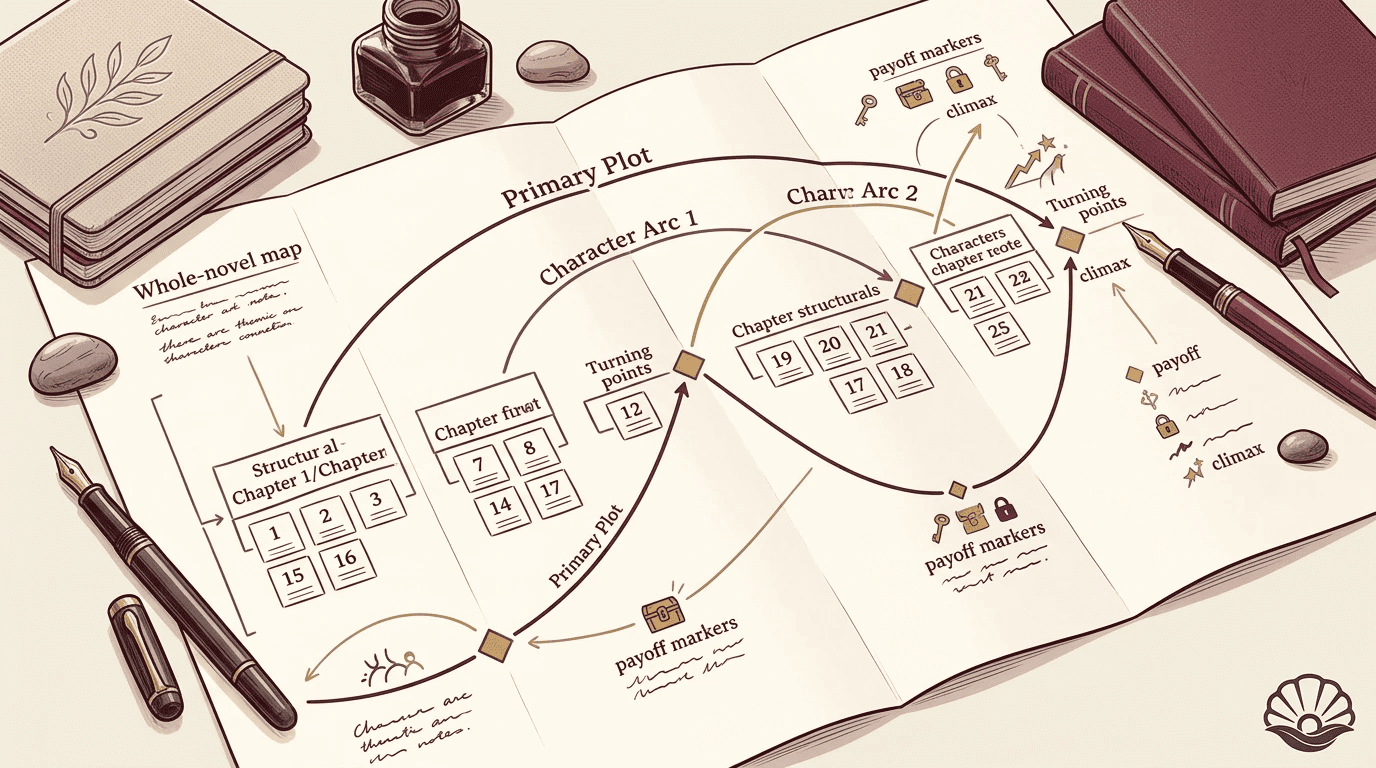
Novel Outline Template for Fiction Writers| SeaBell
Copy a practical novel outline template for premise, acts, turning points, character arcs, subplots, and the handoff into chapter planning.
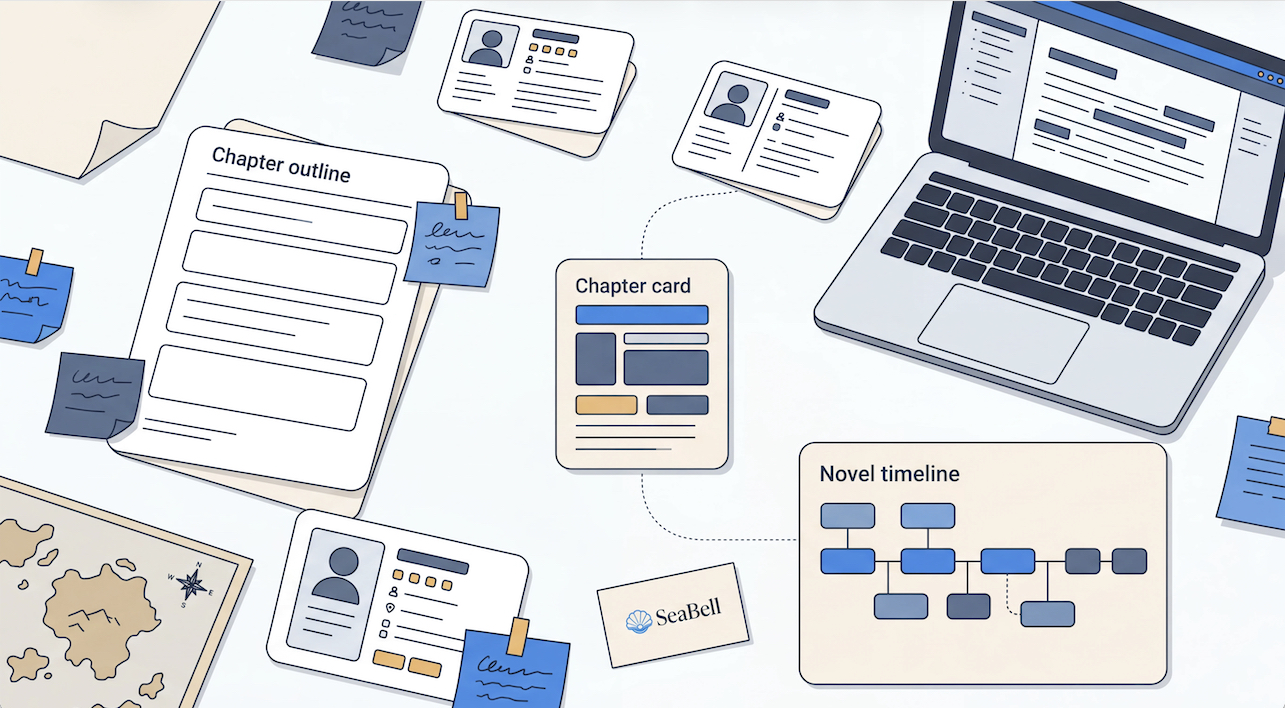
Chapter Outline Template for Novel Writers
Use this chapter outline template to plan POV, conflict, character change, continuity notes, and ending hooks before drafting your next novel chapter.
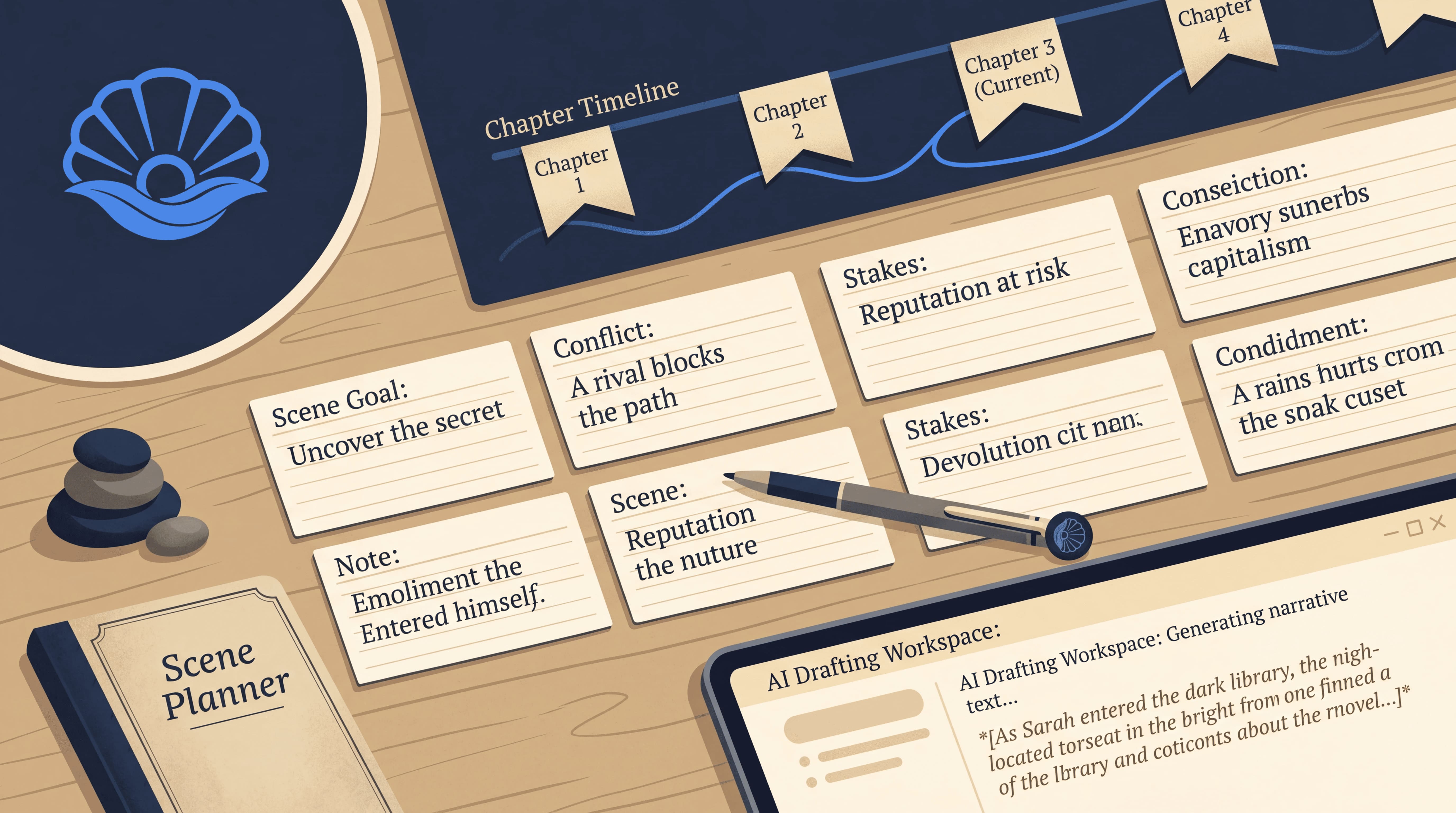
Scene Card Template for Novel Writers | SeaBell
Copy a scene card template for fiction writing, see a filled example, and turn your scene plan into a focused AI drafting brief