

Chapter Outline Template for Novel Writers
If you know what happens in your novel but freeze at the next chapter, the problem may be smaller than the whole outline. The next chapter may not have a job yet.
Use this chapter outline template when a chapter wanders, repeats an emotional beat, rushes a reveal, or ends by stopping instead of turning. It gives you a short brief for POV, pressure, change, and continuity before you draft.
⚡ Quick Answer: What Should a Chapter Outline Include?
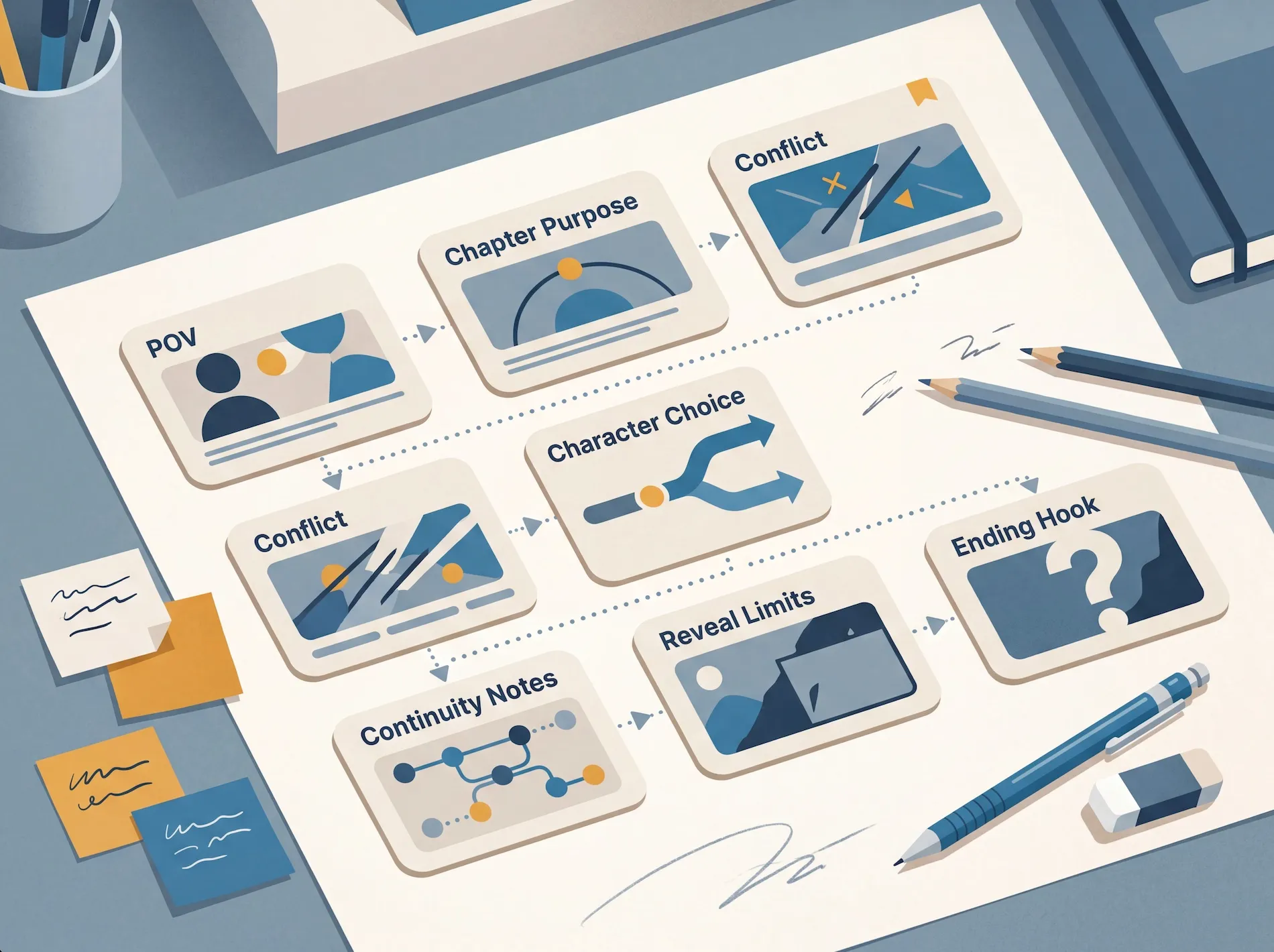
A chapter outline for fiction should include the chapter's purpose, POV character, time and location, opening situation, main conflict, character choice, new information, continuity notes, ending hook, and drafting notes.
The most important field is change. By the end of the chapter, something should be different for the POV character, the reader, the relationship, or the plot state. If you cannot name that change, you may have a scene idea, not a chapter plan.
🧩 Copy-Paste Chapter Outline Template
Copy this into your notes, writing app, or drafting workspace. Keep each answer short enough that you will use the template before writing.
Chapter basics
Chapter number and working title: [Example: Chapter 8 - The Door Under the Archive]
POV character: [Whose eyes and emotional filter shape this chapter? What would this character notice that another character would miss?]
Time and location: [When and where does it happen? Note any time jump, travel gap, or location detail that affects the scene.]
Scene goal
Chapter purpose: [What does this chapter need to do: advance the plot, test a relationship, reveal a secret, raise the stakes, recover after a loss, or set up the next turn? Avoid weak purposes like "show them traveling" or "prepare for the next scene."]
Opening situation: [What is already true when the chapter begins? Name the pressure already in the room before anyone speaks.]
POV and character state
Character state at the start: [What does the POV character want, fear, misunderstand, or refuse to admit?]
Character choice: [What decision does the character make under pressure? Would this person choose it because of what they want or fear now, or only because the plot needs it?]
Conflict and turning point
Main conflict or pressure: [What blocks the character: an enemy, rule, deadline, secret, social risk, physical limit, or emotional contradiction? If the pressure does not force a choice, it is only background tension.]
New information revealed: [What does the reader or character learn? What should still remain unsaid?]
Turning point: [What moment changes the direction of the chapter?]
Continuity notes
Continuity notes from previous chapters: [Track injuries, promises, clues, objects, relationship tension, world rules, and unanswered questions.]
Relationship or subplot movement: [What shifts between characters, even if the main plot is elsewhere?]
Ending hook
Ending hook or turn: [What makes the reader want the next chapter? A cliffhanger image is not enough by itself; something should have changed, been exposed, or become harder to avoid.]
Drafting notes for AI or human writing: [Tone, pacing, sensory focus, dialogue limits, reveal limits, and style notes. Replace "make it emotional" with a usable instruction: hold back the explanation, keep dialogue restrained, let the object carry the clue, or slow the paragraph at the choice.]
Before drafting, give the filled template a quick editor pass. If you cannot name what changes by the end, fix that first. Then narrow any purpose that could fit almost any chapter, sharpen conflict that does not force action, make the ending an actual turn, and replace mood-only notes with instructions about pacing, POV, reveal boundaries, and continuity.
🗺️ Chapter Outline Example for a Fantasy Novel
Here is the same novel chapter outline template filled for a fantasy scene. It does not summarize the whole book; it gives the next chapter a job.
Chapter number and working title: Chapter 12 - The False Law
POV character: Mara, an apprentice mapmaker who can see hidden routes when she touches old ink.
Time and location: Midnight, inside the royal archive beneath the east tower, after Mara steals the bronze archive key from her mentor.
Chapter purpose: Reveal that one accepted rule of the magic system is false, and force Mara to decide whether to keep trusting the Academy.
Opening situation: Mara enters the forbidden archive looking for a missing map. She believes the Academy's rule: magic cannot cross saltwater.
Character state at the start: She is frightened but proud. She wants proof that her missing brother reached the western islands.
Main conflict or pressure: The archive erases memory from anyone who reads restricted maps. The longer Mara stays, the more details she loses.
Character choice: Instead of fleeing after the first memory slip, Mara writes clues on her own skin and keeps searching.
New information revealed: She finds a naval map marked with magical routes across saltwater. The Academy did not fail to cross the sea; it hid the crossings.
Continuity notes from previous chapters: Mara's left hand is burned. She carries the stolen bronze key. Joren does not know where she is. The silver compass from Chapter 4 should react to the forbidden map.
Relationship or subplot movement: Mara's trust in her mentor breaks, but her dependence on Joren increases because he is the only person who might believe her.
Ending hook or turn: As Mara copies the map, the archive door opens from the outside and her mentor says, "I hoped you would never find that shelf."
Drafting notes for AI or human writing: Keep the scene tense and quiet: paper dust, candle smoke, cold stone, ink moving under Mara's fingers. Do not explain the entire magic system yet.
Why this works:
- The memory-erasing ward gives the scene a clock, so the pressure is not decorative.
- Mara's skin-writing choice turns fear into action; the reveal does not simply happen to her.
- The ending changes both plot and trust, which is stronger than ending on a mysterious object alone.
A fantasy novel outline template often fails when it lists lore before pressure. Here, the lore matters because Mara has to risk something for the truth.
💞 Chapter Outline Example for a Romance Novel
A romance chapter outline needs control over emotional pacing. Forced proximity is only the setup. The chapter still needs a task that changes how the leads read each other without paying off the attraction too soon.
The outline below holds the attraction back without stopping the story from moving.
Chapter number and working title: Chapter 9 - One Kitchen, Two Knives
POV character: Elena, a restaurant consultant hired to save a failing family bistro.
Time and location: Friday afternoon in the bistro kitchen, three days before the soft reopening.
Chapter purpose: Force Elena and Marco to cooperate and deepen romantic tension before either admits it.
Opening situation: The supplier cancels the seafood delivery. Marco wants to close. Elena insists they redesign the menu with what they have.
Character state at the start: Elena is guarded. She believes Marco sees her as an outsider with a clipboard. She is attracted to him but annoyed by his pride.
Main conflict or pressure: They have two hours to build a new menu before the local food columnist arrives. Marco resists changing family recipes.
Character choice: Elena stops arguing from expertise and asks Marco to teach her the story behind one dish. Marco chooses to adapt the dish instead of defending it unchanged.
New information revealed: Elena learns Marco fears that changing the food means admitting his family is losing the restaurant.
Continuity notes from previous chapters: Elena still has the bad review draft in her bag. Marco noticed it in Chapter 8 but did not confront her. The broken oven timer should remain a small running detail.
Relationship or subplot movement: They begin the chapter as opponents and end as reluctant partners. The attraction grows through competence, not a sudden confession.
Ending hook or turn: The food columnist arrives early and recognizes Elena from the review site she has been hiding from Marco.
Drafting notes for AI or human writing: Keep the banter sharp but not cruel. Let proximity happen through cooking tasks, not forced flirting. Do not resolve the attraction yet.
Why this works:
- The shared task creates movement; they must solve a public problem together instead of circling the same argument.
- The hidden review draft is stronger than a vague private doubt because it is physical, discoverable, and already part of continuity. Marco has seen it but has not confronted her, so the chapter can build trust while leaving a live object in the room.
- The columnist's early arrival links the external deadline to Elena's secret. The turn threatens the new partnership before either character can enjoy it.
- Attraction comes through competence and changed behavior, not instant confession or physical payoff.
A romance novel outline template should protect delayed gratification: the relationship moves, but the story does not cash in the tension too early.
🔍 Chapter Outline vs. Chapter Summary vs. Novel Outline
Writers often use these terms interchangeably, then wonder why the planning document does not help the next scene. A novel outline tells you the larger shape of the book. A chapter outline tells you what the next chapter must accomplish before you write it. A chapter summary records what changed after the draft exists.
A chapter outline is the page you use before drafting or before a serious rewrite. Choose it when the next chapter is close enough to write but still needs a purpose, pressure, character choice, reveal boundary, and ending turn. It is narrower than a novel outline because it focuses on today's scene-level decisions instead of mapping the entire route of the book.
A chapter summary is the record you make after a draft exists. Choose it when you need to track what actually happened: clues planted, promises made, injuries carried forward, timeline shifts, relationship changes, or objects that must return later. A chapter summary template is useful during revision, but it should not replace the outline that guides a new scene.
A novel outline gives the larger shape of the book: acts, beats, parts, a 24 chapter novel outline, or a loose sequence of turning points. Choose it when you need to see the whole route before deciding which chapter comes next. Britannica defines the novel as a connected prose narrative involving people in a specific setting; a chapter outline works one level below that, turning the larger narrative into the next draftable unit. A novel outline template chapter by chapter can name the major job of each chapter, but it usually cannot hold every scene-level choice, reveal limit, and continuity note without becoming too heavy to use.
For many writers, the cleanest workflow is layered: keep the big novel outline flexible, summarize finished chapters so continuity stays visible, then use a chapter outline template for novel chapters when the next section is ready to draft.
🤖 How to Use a Chapter Outline With AI
Once the chapter outline exists, an AI writing agent for chapter-by-chapter fiction writing is less likely to solve the wrong problem. Without the outline, many prompts ask for "the next chapter" and get polished prose that sounds busy but has no clear turn.
AI alone can be enough for a quick rewrite or short premise test. Longer fiction needs more control because each draft has to carry old choices forward: injuries, promises, hidden objects, relationship tension, and reveal boundaries.
Give the AI a narrow chapter brief
A weak prompt often looks like this:
Write the next fantasy chapter where Mara goes into the archive and finds something shocking. Make it mysterious and emotional. Continue the story and make the ending exciting.
That prompt gives mood, but not story control. It does not say what Mara believes at the start, what pressure she faces, what must be revealed, what continuity matters, or what should remain unsaid.
The same chapter, outlined first, produces a stronger AI novel generator brief:
Draft Chapter 12 from Mara's close third-person POV. The scene takes place at midnight in the forbidden royal archive after she steals the bronze key. Mara wants proof that her brother crossed the western sea. She believes the Academy's rule that magic cannot cross saltwater. The archive wards slowly erase recent memory, so she writes clues on her skin and keeps searching. Reveal hidden magical sea routes, but do not explain the whole system yet. Include the burned left hand, the stolen key, the silver compass reacting to the map, and the fact that Joren does not know where she is. End when her mentor opens the archive door and says, "I hoped you would never find that shelf."
The second version gives the draft a spine. It reduces the chance that the model will over-explain the magic system, shift attention to the wrong character, ignore continuity objects, or turn the ending into a generic shock.
Keep continuity notes attached
Continuity is where chapter-by-chapter drafting often breaks. If the character was injured, hiding a letter, angry at a friend, or confused about a clue, carry that forward.
For human drafting, these notes keep you honest. For AI drafting, put them directly in the brief instead of assuming the model will infer them from "continue the story." A chapter by chapter outline template becomes more useful when each chapter carries the small facts the next draft may forget. This is the same reason writers need a system to keep a long novel consistent once characters, objects, and unresolved promises start crossing chapters.
Review the draft against the outline
After the draft exists, compare it to the outline before polishing the sentences. Check in this order: chapter purpose first, character choice second, continuity and reveal limits third. If those layers fail, smoother prose will only hide the problem.
Ask:
- Did the draft stay in the intended POV and emotional filter?
- Did the chapter purpose actually happen on-page, or did the scene only gesture toward it?
- Did the character make the planned choice under pressure?
- Did the reveal land without explaining material you meant to hold back?
- Did continuity objects, injuries, promises, and relationship tension carry forward?
- Did the ending create a real turn, or did it only stop the scene?
If the draft misses the purpose, rewrite the brief before editing sentences. If the purpose works but the choice feels unearned, adjust the pressure or opening situation. If continuity breaks, repair the outline notes and run a targeted revision instead of asking for a fresh chapter. A better brief often fixes the next draft faster than line edits.

✍️ Should You Outline Every Chapter Before Drafting?
No. Use the outline only as far as it keeps the draft alive.
Some writers draft best with a full chapter-by-chapter plan. Others outline only the next two or three chapters so the story can breathe. If you write serial fiction or borrow a light novel writing style, that smaller rolling outline can protect pace and chapter hooks without freezing the whole book. Discovery writers may use the template after a messy draft to diagnose what the chapter is doing.
The template is not a rule that every writer must outline an entire book before Chapter 1. Treat it as a working page for the next chapter, especially when a scene wanders, has too many events, loses the POV character's pressure, or needs a stronger AI brief.
If you use a larger structure, such as a 24 chapter novel outline, this template can sit underneath it. Let the big outline hold the route of the book, then use this worksheet only when you need drafting-level control over the next chapter's pressure, continuity, reveal limits, and ending turn.
🌊 Where SeaBell Fits Into Chapter-by-Chapter Fiction Writing
After you have a workable chapter outline, treat it as the chapter brief rather than starting from a vague prompt again. The next challenge is keeping that brief beside the story context while you draft, compare, and revise.
In SeaBell, you can plan story elements for the next chapter, choose an AI model for the draft you need, and generate chapter drafts from the same brief. For example, keep Mara's archive goal, memory-erasing pressure, hidden sea-route reveal, and mentor ending hook attached before asking for Chapter 12.
For longer fiction, the harder problem is not generating one chapter; it is keeping the fourth draft consistent with the second. A long-context AI model for fiction writing gives you more room, but the outline still needs organized notes beside each new brief: prior injuries, promises, objects, relationship tension, and reveal limits. That makes each generated or revised chapter easier to check against the plan instead of treating it as an isolated prompt.
❓ FAQ
What is a chapter outline template?
A chapter outline template is a repeatable worksheet for planning one chapter before you draft or revise it. For fiction, it covers POV, purpose, conflict, character state, continuity, new information, and the ending hook.
How detailed should a novel chapter outline be?
Detailed enough to define the chapter's job, but not so detailed that drafting feels like transcription. Most chapters only need one to three bullets per field; add more for continuity-heavy chapters, reveal chapters, battle scenes, or delicate emotional turns.
What is the difference between a chapter outline and a chapter summary?
A chapter outline guides the scene before drafting. A chapter summary records what happened after drafting. The outline creates direction; the summary helps you remember what the draft changed. If you only have time for one before writing, make the outline first; after the draft, turn the finished chapter into a short summary so continuity is easier to carry forward.
Should I outline every chapter before writing?
Only if it helps your process. Some novelists plan every chapter; others outline the next chapter when they reach it. If full planning makes the story feel dead, use the template only at stuck points or after a messy draft.
Can I use a chapter outline template with AI?
Yes. Put the filled fields directly into the prompt, then check the draft for purpose, POV, character choice, reveal boundaries, continuity carryover, and whether the ending turn happened.
What should I include in a chapter-by-chapter outline?
Include the chapter number, POV, location, purpose, opening situation, conflict, character choice, reveal, continuity notes, subplot movement, and ending hook. For fiction, do not reduce the outline to events only; include the emotional or relationship movement that makes the chapter matter.
How is a novel outline template chapter by chapter different from this worksheet?
A novel outline template chapter by chapter maps the book-level route: chapter order, act breaks, major turns, pacing checkpoints, and the rough job of each section. This worksheet sits underneath that plan and focuses on one chapter at drafting depth: pressure, choice, reveal limits, continuity details, and the ending turn.
How many chapters should a novel outline have?
There is no required number. A 24 chapter novel outline can be useful as a planning frame if you like clear structural checkpoints, but it becomes restrictive if you force every story beat into the same shape. Use chapter count as scaffolding, not a rule.