

Story Timeline Template for Fiction Writers
The first warning sign is usually small. A character is nineteen in chapter two, then eighteen in a flashback that should put them at nine. A clue appears before anyone could have left it. Two characters start joking one scene after a betrayal that should still be poisoning the room.
When I audit a messy draft, I rarely start by asking for more dates. I look for the moment when a character knows too much, forgives too fast, travels too far, or reacts without carrying the last scene's damage.
A story timeline template tracks what truly happened, when the reader learns it, who knows or misunderstands it, and what consequence has to carry into the next scene. If you only need the template, copy the blank version below. The rest of this guide shows how to use it for drafting, revision, flashbacks, and reveal order.
🧩 Copy-and-Paste Story Timeline Template
Copy this into a document, spreadsheet, Notion database, or writing app. Use one row for each event that changes cause and effect, not one row for every chapter summary.
Simple 7-Field Version
Do not start with all fifteen fields just because the sheet looks more complete. I would use the Simple Version while drafting fast, then switch to the Full Version when a subplot, clue chain, dual timeline, or long arc starts pushing back.
Event:
Actual chronology:
Chapter or scene:
What changes:
Who knows:
Reveal order:
Reveal limit:
Add advanced fields when the story starts carrying clues, travel, illness, injury, flashbacks, dual timelines, or emotional delay.
Full Version
Event:
Story layer:
Presentation on page:
Actual chronology:
Duration / time elapsed:
Chapter or scene:
Characters involved:
Character state:
Location:
What changes:
Who knows:
Reveal order:
Evidence / source of truth:
Reveal limit:
Continuity notes:
Field Guide
If you are using this as a novel timeline template, start with the fields that catch continuity risk: chronology, chapter placement, knowledge, reveal order, evidence, and consequence.
| Field | What to Track | Example |
|---|---|---|
| Event | What happens in one clear sentence. | Mara finds ash in the west tower hearth. |
| Story layer | Present action, backstory, world history, character history, or a hidden event. | Present clue with backstory pressure. |
| Presentation on page | How the reader encounters the event: scene, reference, flashback, memory, document, rumor, or reconstruction. | Shown as a present scene; later reinterpreted by a guard log. |
| Actual chronology | When the event truly happens in the story world. | Late night, after the treaty letter is burned. |
| Duration / time elapsed | How much time passes before or after related events. | Less than an hour after the fire. |
| Chapter or scene | Where the event appears, is referenced, or affects the draft. | Chapter 6, archive search. |
| Characters involved | Who is present, absent, injured, lying, hiding something, or affected. | Mara; the guard captain is absent but implicated. |
| Character state | Age, injury, grief, suspicion, attraction, exhaustion, or recovery. | Mara is tired and still protecting the queen. |
| Location | Where it happens, including travel constraints. | West tower hearth; bridge blocked by storm damage. |
| What changes | The new problem, clue, promise, wound, lie, relationship shift, or danger. | Mara gains proof that a document was destroyed. |
| Who knows | Which characters know, suspect, misunderstand, hide, or act on this event. | Mara sees the ash but misreads it as a love-letter clue. |
| Reveal order | When the reader learns the truth, not when the truth happens. | The reader sees ash now but learns about the treaty in Chapter 18. |
| Evidence / source of truth | The clue, witness, record, object, memory, or scene that proves the event. | Warm ash, missing archive entry, later guard log. |
| Reveal limit | What this scene must not say yet. | Do not connect the ash to the treaty or the rebel envoy. |
| Continuity notes | Age, travel, season, object location, clue chain, injury, recovery, or emotional-state issue. | The hearth is warm enough to show recent burning, not fresh enough to identify the letter. |
Spreadsheet Header Version
If you are building the template in Google Sheets, Excel, or Notion, paste this as the first row.
Event,Story layer,Presentation on page,Actual chronology,Duration / time elapsed,Chapter or scene,Characters involved,Character state,Location,What changes,Who knows,Reveal order,Evidence / source of truth,Reveal limit,Continuity notes
The timeline writers keep using is rarely the longest one. If a sheet asks for twelve decorative details per event, it often dies by Chapter 3. If it asks what changed, who knows, and what must stay hidden, it stays close enough to the draft to survive revision.
One Filled Template Row
Here is the same template filled at a realistic level of detail. Notice that most cells are short. The row is meant to guide the next draft, not become a scene summary.
Weak row: "Mara finds ash in Chapter 6."
Useful row: "Mara finds warm ash in Chapter 6, less than an hour after someone burned the treaty letter. Mara thinks it was a love letter. The reader must not learn about the treaty until Chapter 18."
| Field | Filled Example |
|---|---|
| Event | Mara finds warm ash in the west tower hearth. |
| Story layer | Present clue with hidden backstory pressure. |
| Presentation on page | Shown directly in Chapter 6; reinterpreted after a later guard log. |
| Actual chronology | Less than an hour after someone burns the treaty letter. |
| Duration / time elapsed | Same night as the storm; before the bridge reopens. |
| Chapter or scene | Chapter 6, late-night archive search. |
| Characters involved | Mara is present; the guard captain is absent but implicated. |
| Character state | Mara is exhausted, suspicious, and still protecting the queen. |
| Location | West tower hearth; bridge blocked by storm damage. |
| What changes | Mara gains physical proof that a document was destroyed. |
| Who knows | Mara knows about the ash; the queen knows what burned; the reader does not. |
| Reveal order | The reader sees ash now but learns about the treaty in Chapter 18. |
| Evidence / source of truth | Warm ash, missing archive entry, later guard log. |
| Reveal limit | Do not connect the ash to the treaty or rebel envoy yet. |
| Continuity notes | The hearth must be warm enough to prove recent burning, not fresh enough to identify the letter. |
🧭 What a Story Timeline Tracks That an Outline Does Not
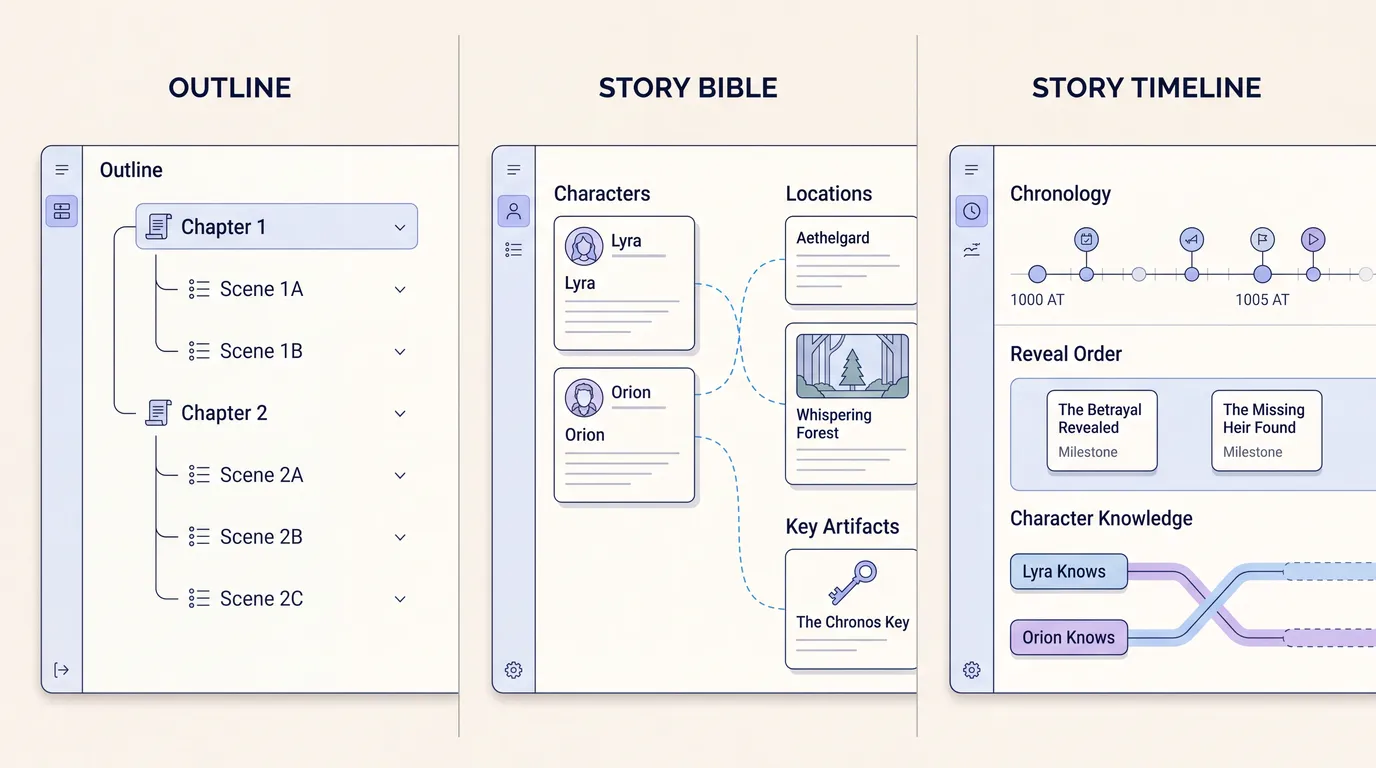
An outline tells you what the story will cover. A story timeline tells you whether the order still makes sense.
A chapter outline might say: "Chapter 8: Mara finds the burned letter." Useful, but not enough. When was the letter written? Who burned it? Did Mara know the handwriting? Could the messenger physically reach the city in time?
A story bible stores stable facts: character profiles, settings, family trees, factions, recurring objects, and rules of the world. The timeline pulls time-sensitive facts from that archive and puts them in order.
| Tool | Primary Job | What It Misses Alone |
|---|---|---|
| Outline | Plans the sequence of chapters or scenes. | May not track true chronology, hidden events, delayed reveals, or emotional lag. |
| Story bible | Stores stable world, character, and setting information. | Can become too broad to guide the next scene quickly. |
| Story timeline | Tracks chronology, consequence, reveal order, evidence, and character knowledge. | Does not replace scene design, prose drafting, or full worldbuilding notes. |
If you came here for a book timeline template, this distinction matters: you are not planning a publication schedule. You are protecting the story's internal logic.
🔍 The Four Timeline Questions Fiction Writers Actually Need
Most timeline mistakes happen when the writer tries to force every event into one neat sequence. I would separate the clocks before sorting anything: story truth, reader access, character knowledge, and consequence.
1. What really happened?
Start with chronological truth: the actual order of events in the story world. Add backstory or world history only when it changes what characters do now.
2. When does the reader learn it?
Then track reveal order. In mystery, fantasy, romance, and dual-timeline fiction, the murder may happen before chapter one, while the true motive waits until chapter twenty.
3. Who knows or misunderstands it?
Character knowledge tracks who knows the truth, who has the wrong explanation, who hides a fact, and who acts from a partial version of events. Many plot holes are knowledge errors, not date errors.
4. What consequence carries forward?
Continuity pressure tracks age, travel, injury, grief, suspicion, attraction, recovery, object location, and emotional lag. Without it, characters heal too quickly, travel impossibly fast, or change their minds without enough pressure.
Emotional continuity often breaks more quietly than date continuity. A reader may forgive a vague calendar, but they notice when a betrayed character starts joking comfortably two pages later.
Where Flashbacks Fit
A flashback is usually a presentation method, not a separate time layer. The old event belongs where it truly happened in chronological truth. The chapter where the reader sees it belongs under reveal order. If the flashback changes a present decision, also mark the consequence it creates in character knowledge or continuity pressure.
Two Views to Keep in Your Spreadsheet
If you build the timeline in a spreadsheet or Notion database, keep two saved views:
- True chronology view: sort by actual chronology. Use this to catch cause-and-effect errors, travel problems, age mismatches, and events that happen before their setup exists.
- Reveal order view: sort by chapter or scene. Use this to check what the reader knows at each point, whether clues arrive too early, and whether the draft spoils its own mystery.
When a scene feels impossible, read true chronology. When a scene feels flat or spoiled, read reveal order. A continuity problem usually appears in one view; a suspense problem usually appears in the other.
The same event can sit in both views. The treaty letter is burned before Mara finds the ash, but the reader understands the treaty much later. That gap is the point of the timeline.
📚 Filled Story Timeline Example: Chronology vs. Reveal Order
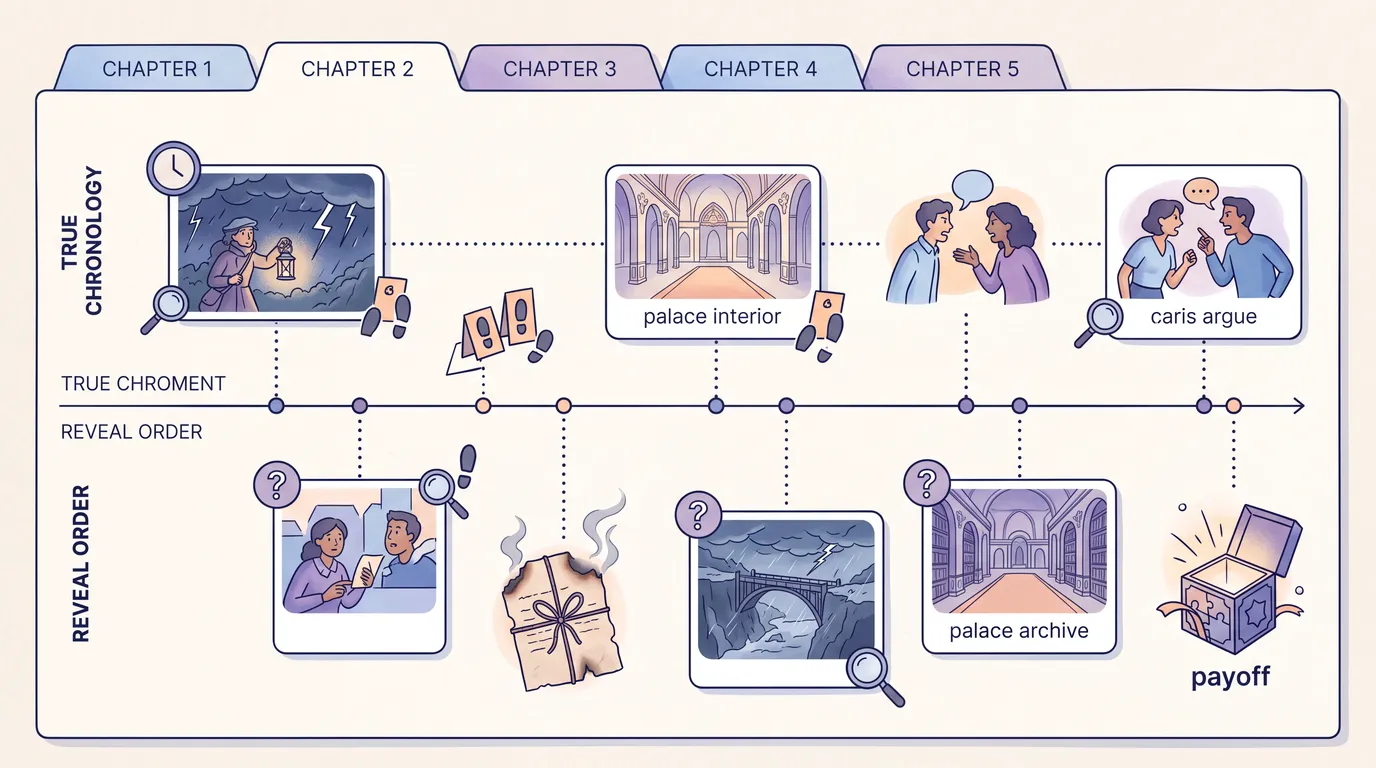
Here is a compact mystery/fantasy example. Mara, a palace archivist, investigates the death of Prince Cael. The true chronology and the reader's reveal order do not match, so the template needs both.
| True Chronology | Event | Appears on Page | Reader Learns / Why It Matters |
|---|---|---|---|
| Ten years before the story | Queen Isera signs a secret treaty with the northern rebels. | Chapter 18 | The reader must not know the treaty exists too early. |
| Before Cael dies | Isera meets the rebel envoy in the west tower. | Chapter 14 | The missing guard record can appear early, but the envoy's identity should stay hidden. |
| Before the murder | Cael hides the treaty letter after realizing the queen plans to deny it. | Chapter 4 reference | The hiding place can point to the tower without explaining the treaty. |
| Night before Mara finds the ash | Someone burns the treaty letter in the west tower hearth. | Chapter 18 reconstruction | The burned letter is the cause; the ash is the evidence. |
| Chapter 1 present | Cael is found dead after a storm cuts off the bridge to the palace. | Chapter 1 | No one from the north gate can arrive before dawn. |
| Chapter 6 present clue | Mara finds ash from the destroyed letter. | Chapter 6 | Mara thinks it points to a love letter; the reader should not know about the treaty yet. |
| Chapter 10 present event | The queen accuses the rebel envoy in front of the court. | Chapter 10 | The accusation misdirects the reader, but bridge timing should quietly weaken it. |
| Chapter 18 payoff | Mara learns the treaty was real and Cael died because he was about to reveal it. | Chapter 18 | The political conflict replaces the fake personal motive. |
Same Events, Two Orders
True chronology:
Secret treaty → hidden meeting → letter hidden → letter burned → death → ash found → public accusation → truth revealed
Reveal order:
Death → missing archive entry → ash → public accusation → hidden letter location → treaty truth
The important point is that the secret does not move on the true chronology. Only the reader's access to it moves. That is why a story timeline needs both chronology and reveal order.
The burned letter and the ash clue also need separate timeline entries. The letter is the cause. The ash is the evidence. Collapse them into one row and the draft loses the difference between what happened, what was found, and what the reader can understand.
In clue-heavy scenes, the problem is often not that the clue is too subtle. The writer has not decided whether it is evidence, misdirection, or payoff.
✍️ How to Use a Story Timeline Before Drafting a Chapter
Before drafting a chapter, resist the urge to bring the whole timeline into your notes or prompt. Pull only the active events that can change the scene's behavior, tension, reveal limit, or physical possibility.
For the next scene, choose five pieces of timeline context:
- Last relevant event: what just happened that changes the character's behavior.
- Hidden event: what happened earlier that affects the scene, even if the character or reader does not know it.
- Who knows the truth: which characters act from knowledge, guilt, suspicion, or misunderstanding.
- Reveal limit: what the scene may imply, and what must stay hidden.
- Consequence in force: what injury, travel delay, emotional wound, clue, promise, or pressure still matters.
Long context often feels safer, but the next scene may come out blurrier. The practical test is simple: if a fact cannot change behavior, pressure, or disclosure in this chapter, leave it out.
🛠️ How to Build Your First Story Timeline From a Draft
If you already have chapters written, I would not try to backfill every scene at once. Build the timeline from the events that create pressure.
- Skim the draft and list only events that change cause, knowledge, location, body state, character goal, or relationship pressure.
- Add hidden backstory events that affect current decisions.
- Sort everything by true chronology first.
- Add the chapter or scene where the reader learns each event.
- Mark reveal limits before drafting or revising the next chapter.
- Review the list for continuity gaps before you draft forward.
The first usable timeline is usually smaller than expected. It only needs the events the draft keeps leaning on.
✅ How to Use the Timeline During Revision
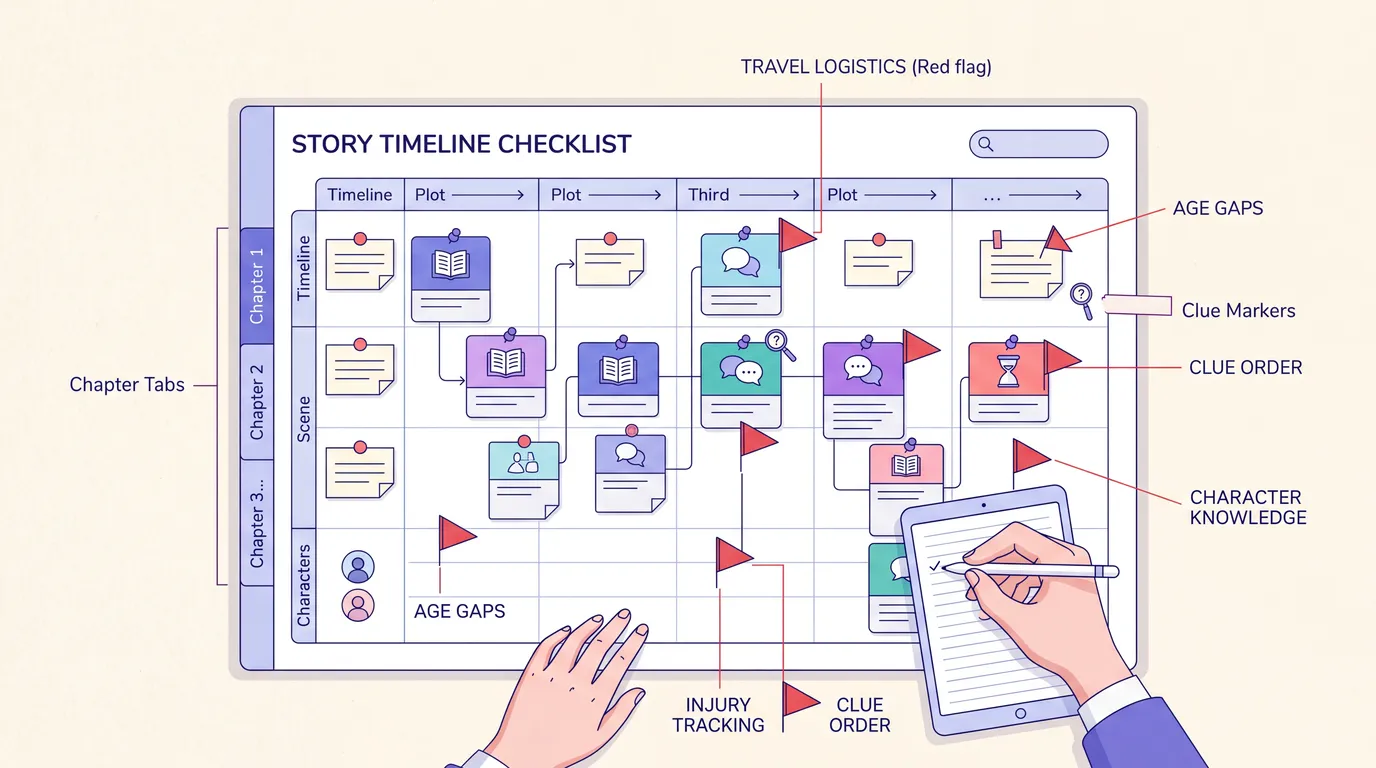
Revision is where a story timeline earns its keep. You are no longer asking, "What happens next?" You are asking, "Could this have happened this way?"
Use your timeline to check for:
- Impossible travel.A character leaves the capital at sunset, reaches a mountain shrine by dawn, and returns before court opens. Fix it by adding travel time, changing the communication method, or giving the shortcut a cost.
- Inconsistent ages.Flashbacks often hide age errors because the prose focuses on mood instead of math. Anchor the birth year, then recalculate every time jump.
- Injury or recovery drift.A wound, illness, exhaustion, or imprisonment disappears when the next scene needs speed. Mark the physical consequence until the story earns recovery.
- Clue order breaks.A clue gets explained before it is planted, or repeated until the solution becomes obvious. Split cause, evidence, and payoff into separate rows.
- Emotional whiplash.Betrayal turns into friendly banter too fast. Add a pressure beat, keep resistance in the next scene, or move the reconciliation later.
- Flashbacks with no payoff.A flashback should change a present decision, reveal, conflict, or emotional reading. If it does not, keep it in the story bible or cut it.
- Character knowledge contradictions.A character reacts to information they have not learned, hides a fact they never received, or forgets a truth they would absolutely know.
Read the timeline twice during revision: once in true chronological order and once in reveal order. The first pass catches logic. The second catches suspense, pacing, and accidental spoilers.
When to Update the Timeline
Update the affected row after any change that alters time, knowledge, location, body state, or emotional pressure.
- After a major reveal, clue discovery, confession, lie, or public accusation.
- After travel, injury, illness, death, recovery, imprisonment, or escape.
- After a time jump, flashback, prophecy, historical discovery, or age-related change.
- After a relationship shift, betrayal, promise, breakup, alliance, or forgiveness beat.
- After moving, deleting, or rewriting a chapter that affects cause and effect.
🎭 How Different Genres Use This Template
Every genre uses time differently. Keep the same template, but let the genre tell you which fields deserve the closest watch.
| Genre | Fields to Watch | Common Failure |
|---|---|---|
| Mystery / Thriller | Who knows, reveal limit, evidence / source of truth, false interpretation, true payoff. | The reader solves the twist too early, or the protagonist reacts to information they never received. |
| Epic Fantasy | Story layer, location, actual chronology, travel limits, political consequences, inherited secrets. | Old events become decorative lore instead of pressure on the present plot. |
| Romance | Character state, what changes, who knows, recovery time, trust level, relationship consequence. | Characters forgive, trust, or confess before the emotional timeline supports it. |
| Dual Timeline | Story layer, presentation on page, actual chronology, reveal order, mirrored consequence. | The past timeline becomes interesting but does not change the present story. |
| Serial / Web Novel | Chapter or scene, character state, what changes, unresolved promise, reveal carried forward. | An old promise, injury, clue, or relationship shift disappears between arcs. |
🤖 Turning a Story Timeline Into an AI Drafting Brief
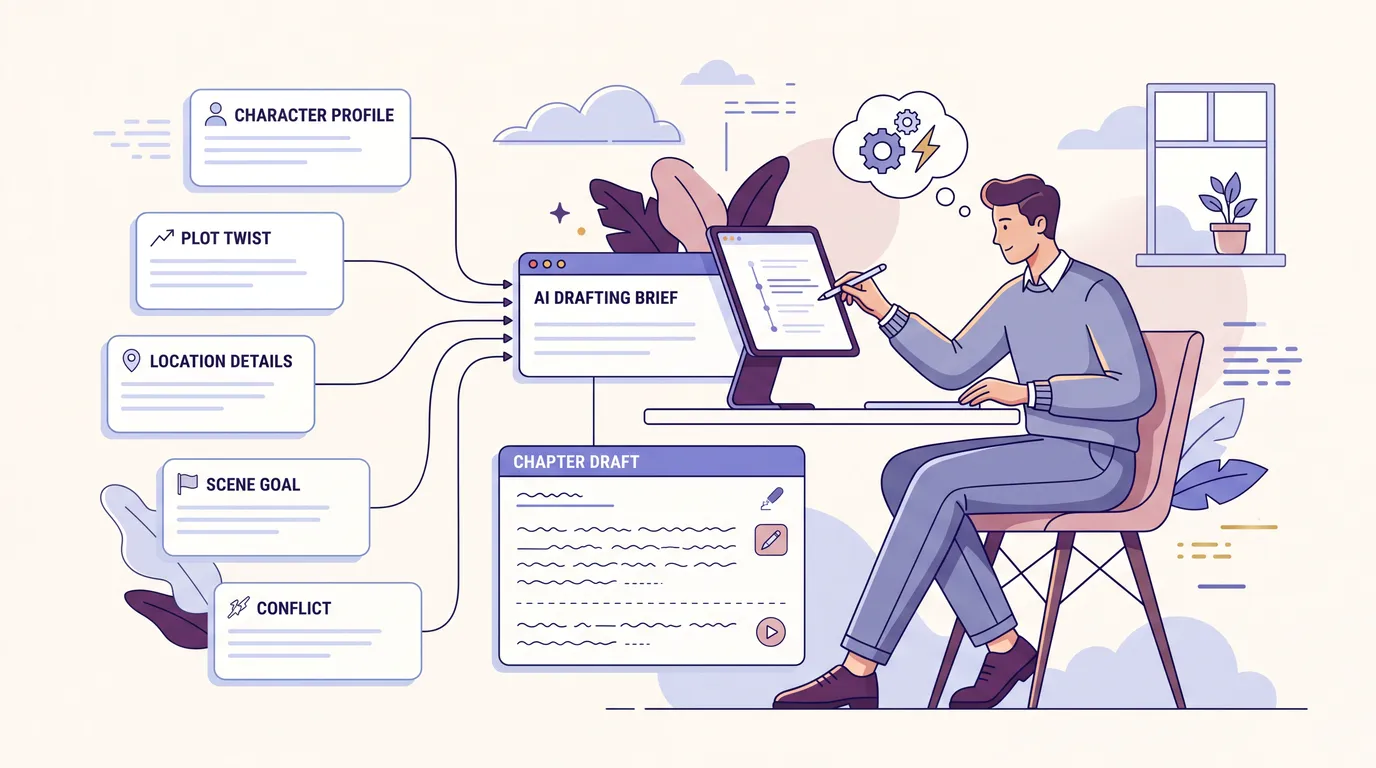
Once the timeline is clear, it becomes a chapter-planning document. Each row already holds the context an AI writing assistant needs: chronology, character state, known facts, and reveal limits.
I distrust any prompt that says "continue the story using the timeline" without saying which part of the timeline matters now. For Chapter 11 of the mystery/fantasy example, the AI does not need every royal treaty date. It needs the ash clue, the bridge timing, who suspects the queen, what the reader still believes, and what the scene must not reveal about the envoy.
Weak prompt: "Continue the story using the timeline."
Better context pack: "Draft Chapter 11 after the queen publicly accuses the envoy. Mara knows about the ash but thinks it came from a love letter. The reader should still believe the envoy is suspicious, but the scene must hint that the bridge timing makes the accusation impossible. Do not reveal the treaty yet."
The same context pack also works as a small continuity audit. Ask a focused question: "Based on these five events, does Mara know anything in Chapter 11 that she should not know yet?" Keep the check narrow so the tool judges active facts, not the whole book.
Treat the timeline as a context filter, not a full archive dump. In SeaBell's AI Writing Agent, bring the five active constraints beside the chapter draft so timing, knowledge, and reveal limits stay in view. If the plot is still taking shape, SeaBell's plot generator fits the earlier planning step.
⚠️ Common Story Timeline Mistakes
- Tracking dates but not consequences.Add a "what changes" field so every entry has a narrative function, not only a calendar position.
- Mixing chronology and reveal order.Keep true order and reader access separate. Otherwise the reader may learn the answer before the protagonist has earned it.
- Forgetting who knows what.Track who knows, suspects, misunderstands, and hides each event. Knowledge errors often look like plot holes.
- Letting backstory become decorative history.Put world history in the timeline only when it affects present conflict, character choices, or reveal order.
- Updating the outline but not the timeline.When you move a scene, kill a character later, change a clue, or add a flashback, update the timeline before the outline and timeline start giving different instructions.
- Giving AI the archive instead of the active events.Send the five to seven timeline facts that can change the chapter you are drafting.
❓ FAQ
What is a story timeline template?
A story timeline template tracks fiction events across true chronology, chapter placement, character knowledge, reveal order, evidence, and continuity notes.
What should a novel timeline template include?
At minimum, include the event, actual chronology, chapter or scene, what changes, who knows, reveal order, and reveal limit. For longer novels, add duration, character state, location, evidence, and continuity notes.
Is a story timeline the same as a plot outline?
No. A plot outline plans the order of scenes or chapters. A story timeline tracks when events truly happen, when the reader learns them, who knows about them, and how consequences carry across scenes.
How do I track flashbacks in a story timeline?
Put the flashback event where it truly happened on the chronological timeline, then record the chapter where the reader sees it under reveal order. If the flashback changes a present decision, add that consequence too.
How often should I update my story timeline?
Update it whenever you add, delete, move, or reinterpret an event that changes cause and effect: a reveal, injury, death, clue, confession, betrayal, relationship shift, time jump, or flashback.
Do I need exact dates for a story timeline?
No. Many fiction timelines work better with relative markers: "Day 0," "Year -10," "before the coronation," "after the duel," or "three days after the storm." Use the smallest time marker that keeps cause and effect clear.
What is the difference between a novel timeline template and a book timeline template?
A novel timeline template usually tracks fictional events, reveal order, character knowledge, and continuity inside the story. A book timeline template sometimes means a publishing schedule, project plan, or reading timeline. For fiction drafting, focus on the story timeline, not the production calendar.
Can I use a story timeline with AI writing tools?
Yes. Use it as a context filter. Give the tool the active facts for the current chapter rather than the whole archive: current event, hidden event, who knows what, reveal limit, and consequence still in force.
🏁 Final Takeaway
A scene list tells you what happens. A story timeline tells you whether the draft can survive it.
Use the template to separate what truly happened from what the reader knows, track who carries each secret or consequence, and keep a small set of active facts beside each chapter. That is the difference between a tidy timeline and one that protects the story.