

Novel Outline Template for Fiction Writers| SeaBell
A chapter outline helps when the next chapter is ready to draft. A novel outline comes earlier: it shows why each chapter belongs in the book at all.
The template below is for that earlier stage. It does not ask you to plan every scene. It asks you to define the book's promise, ending direction, pressure shifts, character change, subplot payoff, and handoff into chapter planning.
If the outline holds every reveal and line of dialogue, it becomes brittle. If it only says "the hero grows stronger," it is too vague to draft from. A good novel outline sits between those extremes.
🧭 Quick answer: what should a novel outline include?
A novel outline should include the premise, reader promise, ending direction, act or part map, major turns, protagonist arc, antagonist pressure, subplot movement, genre setups and payoffs, continuity risks, and a chapter-group plan.
It should show what changes between the opening and ending, why the middle escalates, and how the story will pay off its promise. It does not need every scene yet.
Use this test: if you cannot explain what changes by the end, the outline is not ready. If you are debating chapter 19 dialogue, you have moved past the novel-outline stage.
📋 Copy-paste novel outline template
Copy this into Google Docs, Word, Scrivener, Notion, or your writing workspace. Fill it in roughly first. The goal is not a perfect planning document; it is to expose weak spots before you have written 40,000 words around them.
1. Core premise and reader promise
Start with the fields that actually control the book. The working title can be temporary; the premise, dramatic question, reader promise, and drift warning are the decisions that keep the outline from becoming a list of events.
- Working title: temporary is fine.
- Genre / subgenre: fantasy romance, cozy mystery, progression fantasy, etc.
- One-sentence premise: who wants what, and what makes it difficult?
- Main dramatic question: what pressure must the book answer?
- Reader promise: what experience should the book deliver?
- What the story should not become: name the drift you want to avoid.
2. Opening state, ending state, and major change
- Opening image or starting situation:
- Protagonist's false belief, limitation, or avoidance pattern:
- Ending image or changed situation:
- What must be proven by the end:
- What the protagonist gains, loses, or understands:
Many weak outlines have events but no transformation. They tell you what happens, not why the book needed to happen. The problem often appears here first: the opening and ending differ in scale, but not in meaning.
3. Act or part map
- Act I / setup:
- First major turn or point of no return:
- Act II-A / complications:
- Midpoint shift:
- Act II-B / escalation:
- Crisis or lowest point:
- Act III / climax and resolution:
You can adapt this to three acts, four parts, the Hero's Journey, Save the Cat, a seven-point structure, or a looser serial arc. The model is a measuring tool, not a law. Ask whether a reader can feel the pressure changing.
4. Major turning points
- Inciting incident:
- Point of no return:
- Midpoint:
- Reversal or reveal:
- Dark moment:
- Climax choice:
- Final consequence:
Write these as choices and consequences whenever possible. "The city is attacked" is an event. "The apprentice redraws the city boundary, saving one district and condemning another" is a story turn.
5. Character arc map
- Protagonist external goal:
- Private want:
- Fear, wound, or false belief:
- Pressure that tests the false belief:
- Midpoint change:
- Final choice:
- Arc result:
This is not a full character card. Keep it focused on change. "Pressure that tests the false belief" should not repeat the external conflict. If the external conflict is a royal inspection, the arc pressure might be the choice to hide a mistake again or finally admit that her map harmed someone.
If you need a deeper record of voice, motivation, relationship state, or recurring character context, keep that in a separate AI character card for novel writing. The novel outline should map the arc; the character card should preserve the details that keep the character consistent while drafting.
6. Subplots and relationship threads
- Subplot or relationship thread:
- Why it exists:
- First appearance:
- Midpoint movement:
- Crisis pressure:
- Payoff or unresolved state:
- Do-not-resolve-too-early note:
Subplots often disappear because the outline never gave them a job. "Friendship subplot" is easy to abandon. "The rival is the only person who understands the map's cost, but admitting that would weaken the protagonist's public claim" is harder to lose. A useful do-not-resolve-too-early note might say: "Do not reveal the mentor's betrayal before the protagonist has trusted the map archive."
7. Genre promises, setups, and payoffs
- Required genre pleasure:
- Setup:
- Escalation:
- Payoff:
- What must not be skipped:
Fantasy may need a rule, cost, reveal, and consequence. Romance may need attraction, obstacle, trust shift, dark moment, and earned choice. Mystery may need clue, false explanation, knowledge gap, and final reveal. Genre promise is structure, not decoration.
8. Chapter group map
- Part / act:
- Chapter range:
- Main job of this section:
- Major turn:
- POV focus:
- Subplot movement:
- Continuity risk:
Use chapter groups before individual chapter worksheets: setup chapters, escalation chapters, midpoint fallout, crisis, climax. Once the route is stable, you can move into a detailed chapter outline template for the next chapter you actually plan to draft.
9. Drafting handoff notes
- Next chapter to draft:
- Context this chapter needs:
- Character state:
- Relationship state:
- World rule or timeline fact:
- Reveal boundary:
- What must not be resolved yet:
This final section keeps the outline from staying theoretical. A reveal boundary should be specific enough to stop the draft from racing ahead: "The reader can see the border change, but not yet know the mentor caused the first false map."
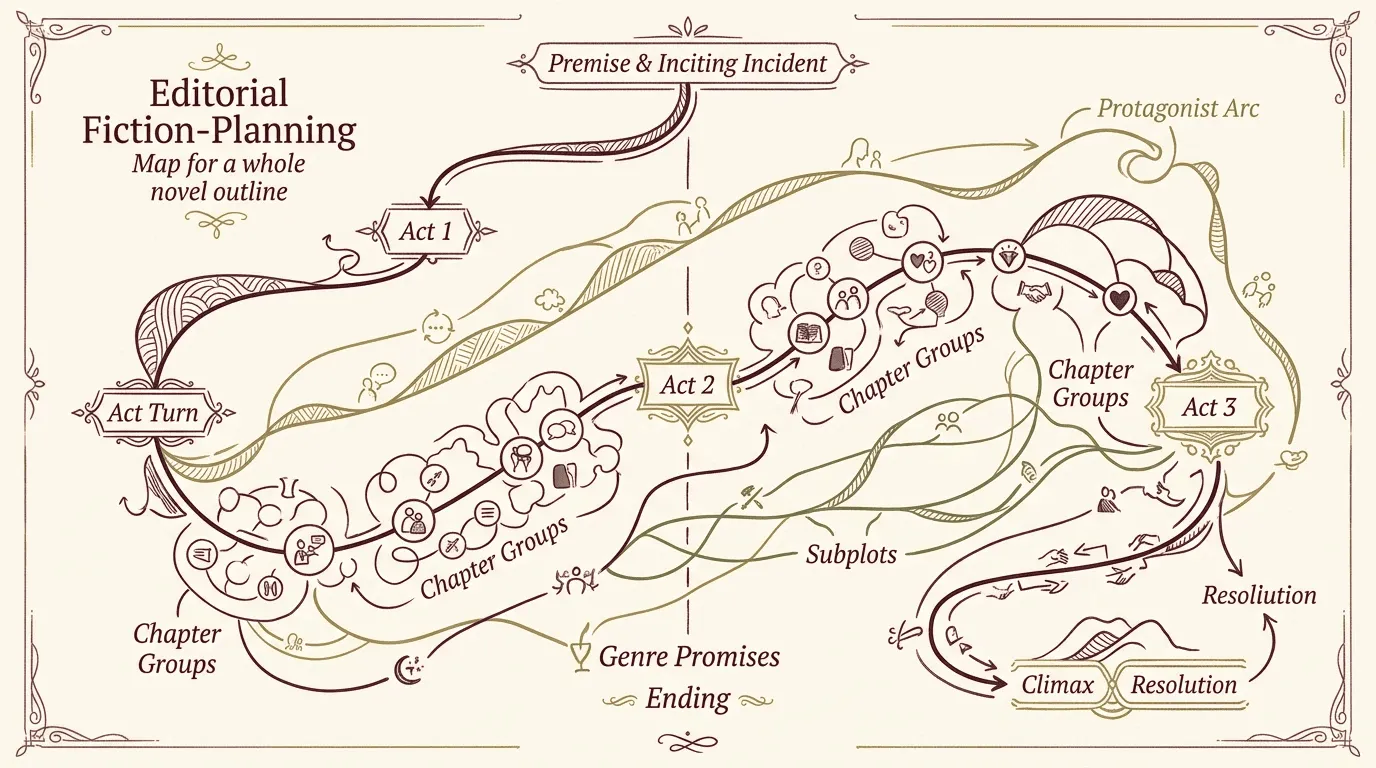
🛠️ How to fill this template without overplanning
Do not fill the template from top to bottom as if it were an exam. Start with the decisions that control everything else, then work outward.
Premise and ending direction come first. Then name the major change. After that, sketch the act or part turns, add arc and subplot pressure, and build chapter groups last.
The fields you should not perfect in the first pass are chapter ranges, POV focus, timeline facts, and world-rule details. Those depend on the route. The fields you should not skip are ending direction, reader promise, major change, and the pressure behind each turn.
When writers abandon templates, the problem is often not laziness. The template asks them to make scene, timeline, chapter, character, and worldbuilding decisions all at once, so the document becomes a filing cabinet instead of a map. Fill the route first. Store the finer details later.
✍️ Filled novel outline example: fantasy
Premise: A disgraced apprentice cartographer discovers that every map she draws changes the borders of a hidden kingdom.
Reader promise: Map magic, political danger, and personal redemption. The story should not become a travelogue where the magic has no cost.
Why this works: The promise tells the writer what the book must keep testing: borders, power, truth, and responsibility.
Opening state: The apprentice has been publicly blamed for a failed royal survey and now copies maps in silence.
Ending state: She chooses one true border at personal cost, knowing that the corrected map will expose both the kingdom and her mentor's betrayal.
Major turns: Her first accidental map change moves a border village overnight. A royal inspection turns the mistake into a political threat. The mentor who protected her is revealed to have hidden earlier border changes. At the midpoint, she learns the maps do not create truth; they choose which truth becomes visible. The climax forces her to decide whether safety matters more than an honest map.
Event vs. turn: "A road changes overnight" is only an event. It becomes a turn when the changed road harms a village, gives the apprentice evidence she cannot ignore, and makes secrecy morally expensive.
Character arc: She moves from avoiding responsibility to accepting that accuracy can hurt people and still matter.
Subplot: A rival cartographer wants to expose her, but he also understands the cost of lying maps. Their thread exists to pressure her secrecy, not to add random banter.
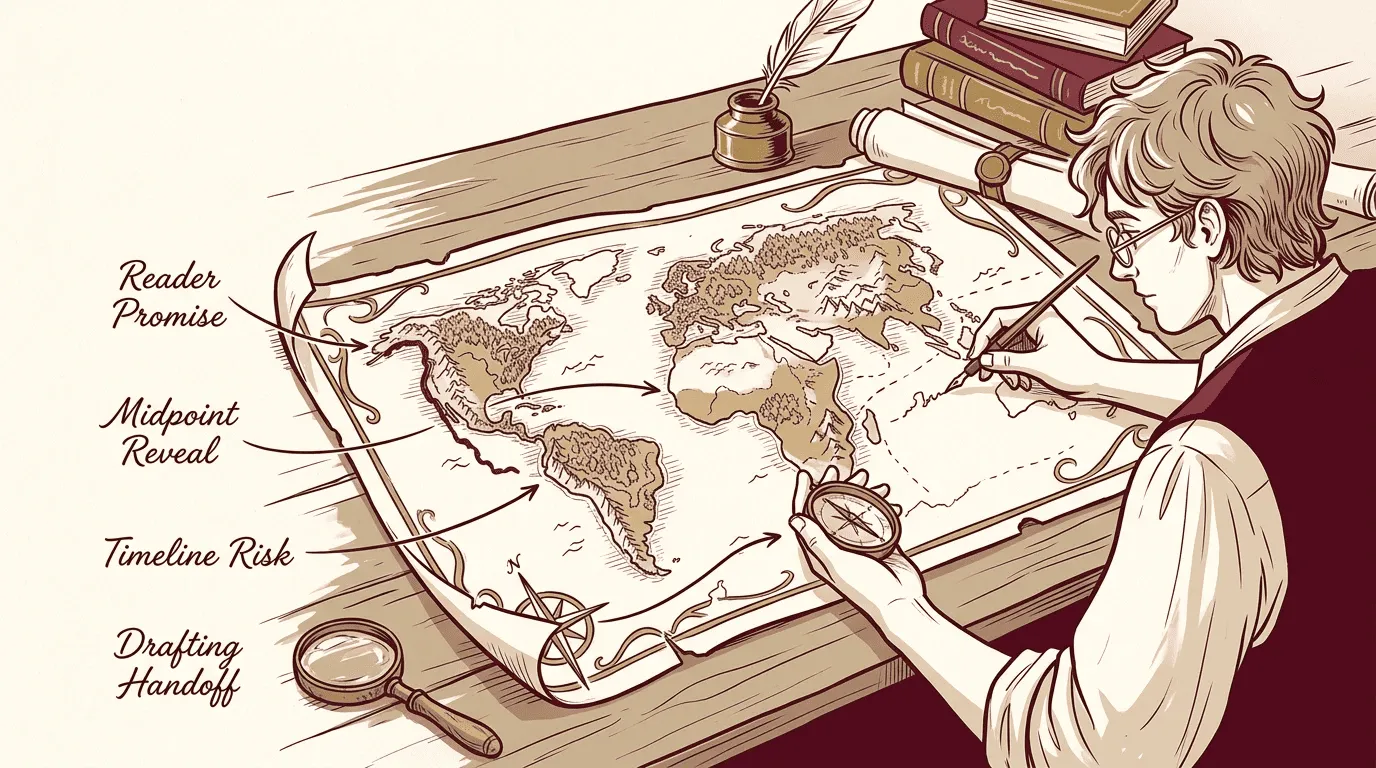
Timeline risk: Border changes must affect travel, public records, and who remembers which version of the kingdom existed. If those effects drift, the magic stops feeling real.
Outline vs. timeline: The novel outline should flag the risk; it does not need to track every date, route, and memory state. If the border changes become complicated, that is the point where the story should hand off into a timeline document.
Drafting handoff note: Next chapter context: the apprentice follows an altered road to the harmed village, still believes the map change was an accident, must not learn the mentor's role yet, and should leave the chapter with one piece of evidence she cannot explain away.
Drafting handoff limit: Give the next chapter only the slice it needs: current goal, character state, reveal boundary, and continuity risk.
A compact worked example is enough for the novel-outline stage. You can see the book's route, pressure, and payoff without writing a full scene list. The outline should make the next planning layer easier, not replace every future decision.
🔍 Novel outline vs. chapter outline vs. scene card vs. story timeline vs. story bible
A planning document becomes confusing when it starts solving every problem in the book. Let each layer do one job well.
| Planning Tool | Best Used For | What It Should Not Do |
|---|---|---|
| Novel outline | Whole-book route, acts, turns, arc, subplot payoff | Carry every scene-level decision |
| Chapter outline | Making the next chapter draftable | Replace the whole-book plan |
| Scene card | Giving one scene a dramatic job | Store the entire plot |
| Story timeline | Tracking chronology, reveal order, and who knows what | Decide every chapter's purpose |
| Story bible | Keeping continuity facts current | Become a static archive no one updates |
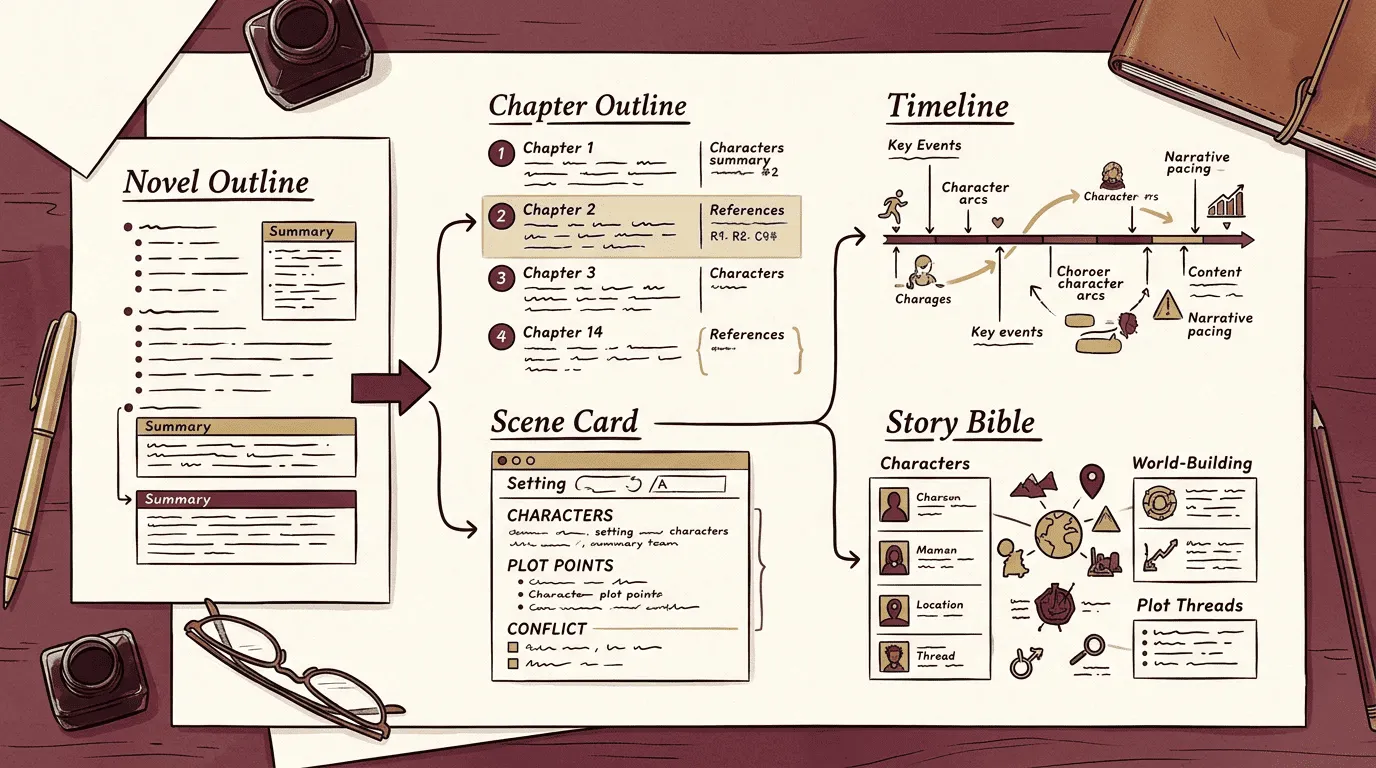
A clean handoff order: use the novel outline until the whole-book route is visible. Use a chapter outline when the next chapter is ready to draft. Use a scene card template when a scene has no turn, pressure, or consequence. Use a story timeline template or story bible template when chronology, reveal order, character state, or continuity facts become risky.
For the cartographer story, the novel outline says the midpoint reveals what the maps really do. A chapter outline would decide what the midpoint chapter must accomplish. A scene card would make the archive confrontation turn. A timeline would track who remembers which border. A story bible would preserve the current rules of the map magic.
📝 How to turn a novel outline into chapter outlines
Do not expand every chapter at full depth before the whole-book shape is stable. Start with chapter groups: setup, escalation, midpoint fallout, crisis, climax. Name the job of each group before naming the job of each chapter.
This prevents two common problems. You stop polishing early chapters that may disappear once the ending changes, and you can see whether the middle actually escalates or simply adds incidents. A chapter-by-chapter outline is useful, but it works best after the larger route has stopped wobbling.
Weak chapter group
Chapters 6-10: travel to the hidden kingdom.
Better chapter group
Chapters 6-10: the apprentice follows the altered road, learns the border change harmed a village, and chooses whether to hide the evidence or confront the royal surveyor.
The stronger version names pressure, consequence, and choice. It still does not write every chapter for you, but it tells the next planning layer what kind of movement the section needs.
- Group the book by pressure shifts. For example: "public failure," "first map consequences," "political trap," "mentor betrayal," "final border choice."
- Give each group one job. If a group has no job, it may be a sequence of scenes rather than a section of the novel.
- Expand only the next few chapters. Use a detailed chapter outline when those chapters are ready to draft.
- Update the whole-novel outline after major discoveries. Discovery is not a failure; pretending the outline did not change is the failure.
⚠️ Common mistakes when using a novel outline template
Filling every chapter before the ending is clear
If changing the midpoint would force you to rewrite thirty chapter summaries, you probably outlined too far at the wrong layer. Lock the route before you lock the chapter list.
Listing events without protagonist change
An outline can look full and still feel empty. "Attack, escape, betrayal, battle" gives motion. It does not tell you what the protagonist is learning, avoiding, losing, or choosing.
A useful editorial test is whether the same ending could belong to a different opening. If it could, the outline probably has plot movement but no transformation engine yet.
Treating subplots as decoration
A subplot that only adds variety will vanish under drafting pressure. Give each thread a job: test a belief, reveal a cost, delay a payoff, or force a choice the main plot cannot force alone.
Building lore before defining story pressure
Worldbuilding matters most when it changes what characters can do. In fantasy, the cost of magic may belong beside every major turn. In romance, the same "cost" field might become what each character risks emotionally by trusting too soon.
Asking AI for a complete outline without guardrails
AI can produce a fluent outline that quietly erases the sharp choices. If the prompt lacks reader promise, ending direction, arc pressure, and reveal boundaries, the result may sound polished while becoming less specific to your book.
🎭 How different genres use the same template
The same template can serve several fiction genres, but each genre puts pressure on different fields. Use these as quick adjustments, not separate templates.
Fantasy novel outline template
Fantasy outlines need the world rule, the cost of using that rule, the public truth, the hidden truth, and the timing of the reveal. In the cartographer example, map magic changes borders, travel, memory, and political power. The outline must track consequences before the magic becomes convenient. If the world rules become dense, keep the novel outline focused and move the supporting lore into a worldbuilding template.
Romance novel outline template
Romance outlines need attraction, obstacle, trust shift, false belief, dark moment, and earned choice. The danger is resolving the relationship too early because the plot needs forward motion. A useful field might read: "Do not let the rivals confess trust until one of them has had a practical reason to betray the other and chooses not to."
Mystery or thriller novel outline template
Mystery and thriller outlines need a clue chain, false explanation, escalation pattern, reveal order, and final truth. The outline should separate what happened from what the detective knows, what the reader knows, and what the villain thinks is still hidden. When those tracks blur, twists feel less like discoveries and more like withheld information.
Web serial or long-form AI drafting outline
Serial fiction needs arc-level planning, recurring promises, cliffhanger spacing, and state tracking after each chapter batch. The outline should name what the current arc is paying off and what it is saving for later.
🤖 How to use a novel outline template with AI
The prompt that fails most often is also the most tempting: "Outline my whole novel." It invites a generic structure because it gives the model no reason to protect your ending, genre promise, or protagonist arc.
AI can brainstorm structure, test alternatives, and turn a messy premise into act-level routes. Treat the output as planning material. AI outlines often sound complete because the beats are familiar; the weakness is usually in the story's specific promise, character pressure, and reveal timing.
Weak prompt
Outline a fantasy novel about a magical map.
Better prompt
Build a flexible novel outline for a fantasy story about a disgraced apprentice cartographer whose maps change political borders. Preserve a redemption arc, delayed reveal about the mentor, and a final choice where the protagonist must decide whether truth matters more than safety. Give act-level turns first, not a full chapter-by-chapter worksheet.
This prompt works because it borrows from the novel outline template: premise, protagonist arc, delayed reveal, final choice, and chapter-group boundary. It gives AI a route and a limit instead of asking it to invent the whole structure from a thin premise.
After AI returns options, revise the outline against your own promise and arc. Ask: does the ending pay off the opening? Does the midpoint change the problem? Does each subplot have a reason to exist? Are there reveal boundaries the draft must not cross too early?
🌊 Where SeaBell fits into novel outlining
The outline is useful only if it survives contact with the draft. Many writers build a strong planning document, then stop using it once chapter writing begins. The next-chapter context gets separated from the character state, reveal boundary, world rule, and continuity risk that made the outline valuable in the first place.
At that point, a drafting workspace earns its place. SeaBell fits as the handoff layer between the static whole-novel map and the next piece of writing. The value is not that a tool "fixes" the plot for you. The value is keeping the planning notes near the writing moment, where they can shape the chapter before the draft drifts away from the book's route.
When the outline finally shows the route, do not paste the whole thing into every prompt. Carry only the next useful slice: chapter goal, current character state, reveal boundary, and continuity risk. In SeaBell's drafting workflow, treat the novel outline as the upstream map and the chapter brief, scene plan, timeline note, and story bible entry as downstream pieces.
Build the outline first, then use SeaBell to turn the next chapter's context into a draftable brief.
❓ Novel outline template FAQ
What is a novel outline template?
A novel outline template is a planning structure for the whole novel. It maps the premise, acts, turns, character arc, subplot movement, and payoff timing before the story is broken into chapters.
How does a novel outline differ from a chapter outline?
A novel outline decides the book's route: promise, ending direction, major turns, arc, and payoff. A chapter outline makes one chapter draftable by narrowing the focus to POV, conflict, reveal limits, continuity notes, and the chapter's ending movement.
How detailed should a novel outline be?
A novel outline should be detailed enough to show the route through the book and flexible enough to draft. If you are writing scene dialogue or every chapter beat, you have probably moved into chapter or scene planning.
Is a novel outline the same as a chapter outline?
No. A novel outline maps the whole book. A chapter outline makes one chapter draftable by focusing on POV, conflict, reveal limits, continuity notes, and the chapter's ending movement.
Should I use a novel outline template chapter by chapter before writing?
Start with chapter groups first unless you already know the whole route. A chapter-by-chapter outline helps once the route is stable, but if you force every chapter too early, you may lock the book before you understand the main turn.
Can I use this novel outline template in Google Docs or Word?
Yes. The template is copyable and can be pasted into Google Docs or Word. It also covers the intent behind "novel outline template Word" because the fields are plain text, not tied to a special file format.
Can I use this novel outline template in Scrivener?
Yes. In Scrivener, keep the whole-novel map in one planning document, then move chapter-level notes into separate chapter files once the route is stable.
What is the difference between a novel outline template and a book outline template?
A novel outline template is fiction-specific. It tracks character arc, acts, plot turns, reveals, genre promises, and payoff timing. A book outline template can also refer to nonfiction chapter structure, teaching sequence, or argument flow.
Can I use AI to create a novel outline?
Yes, but give AI your story promise, ending direction, character arc, genre constraints, and reveal boundaries. Treat the result as planning material, not a finished structure, and do not accept the AI outline as final just because it sounds fluent.
Related Posts
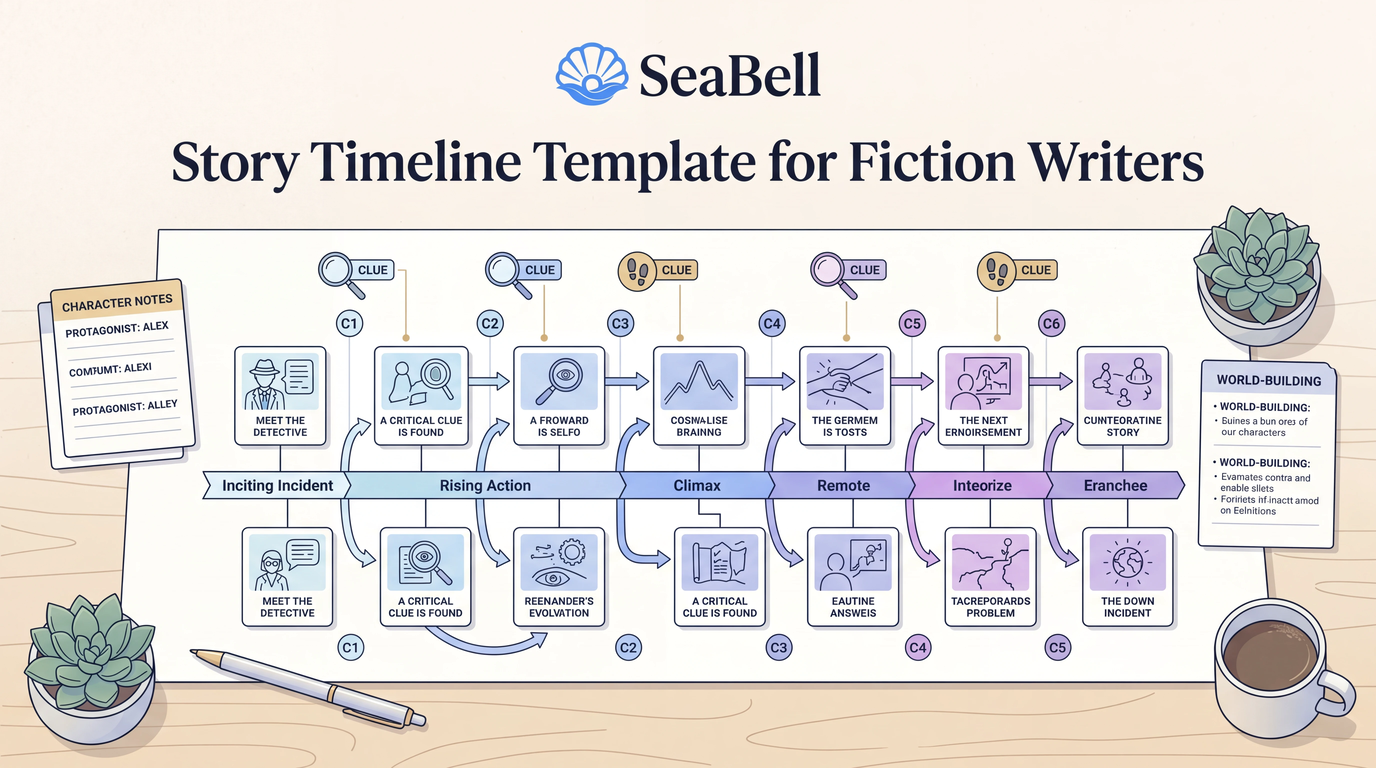
Story Timeline Template for Fiction Writers
Copy a practical story timeline template for fiction writers and learn how to track chronology, reveal order, character knowledge, clues, and revision continuity.
Scene Card Template for Novel Writers | SeaBell
Copy a scene card template for fiction writing, see a filled example, and turn your scene plan into a focused AI drafting brief

Story Bible Template for Novel Writers: AI-Ready Guide
Use this story bible template to organize characters, world rules, timelines, plot threads, and AI drafting notes before your novel gets messy.
Chapter Outline Template for Novel Writers
Use this chapter outline template to plan POV, conflict, character change, continuity notes, and ending hooks before drafting your next novel chapter.