

Scene Card Template for Novel Writers
Most weak scenes do not fail because the writer has no ideas. They fail because the scene is carrying too many jobs at once: banter, backstory, an early clue, a mood shift, and a character who enters without wanting anything concrete.
A scene can look busy and still have no pressure. The characters talk, the prose moves, maybe a clue appears somewhere in the middle, but the page never turns into a real dramatic unit. A scene card stops that before the draft begins. It does not outline the whole novel. It tells you what this one scene needs to accomplish before you write it.
Below, you will get a copy-paste scene card template, a filled example, and a practical way to turn the card into an AI drafting brief without handing the scene's judgment over to the tool. Use it before drafting when you need focus, or during revision when a chapter feels busy but strangely flat.
🧩 What Is a Scene Card?
A scene card is a compact planning note for one scene. It can live on an index card, in a spreadsheet, in a notes app, or inside your writing workspace. The format matters less than the discipline behind it: one card, one scene, one clear dramatic job.
For novel writers, a useful scene card usually tracks the point-of-view character, where and when the scene happens, what the character wants, what pushes back, what changes by the end, and what the scene must not reveal yet. That last field matters. Scenes often weaken when they explain too much too soon, especially in fantasy, mystery, romance, serial fiction, and AI-assisted drafting where continuity can drift if the brief is vague.
The card should give the scene a spine, not lock down every beat. If a note does not name pressure, a turn, or a consequence, it is probably a summary rather than a working card. Keep the card small enough to glance at while writing. If it starts to feel like homework, cut it back to the fields that protect the draft.
📋 Copy-Paste Scene Card Template
Copy this scene card template into your writing notes and fill it in before you draft. Leave any field blank if it does not help this scene. You are not trying to complete a perfect worksheet. You are making the next scene draftable.
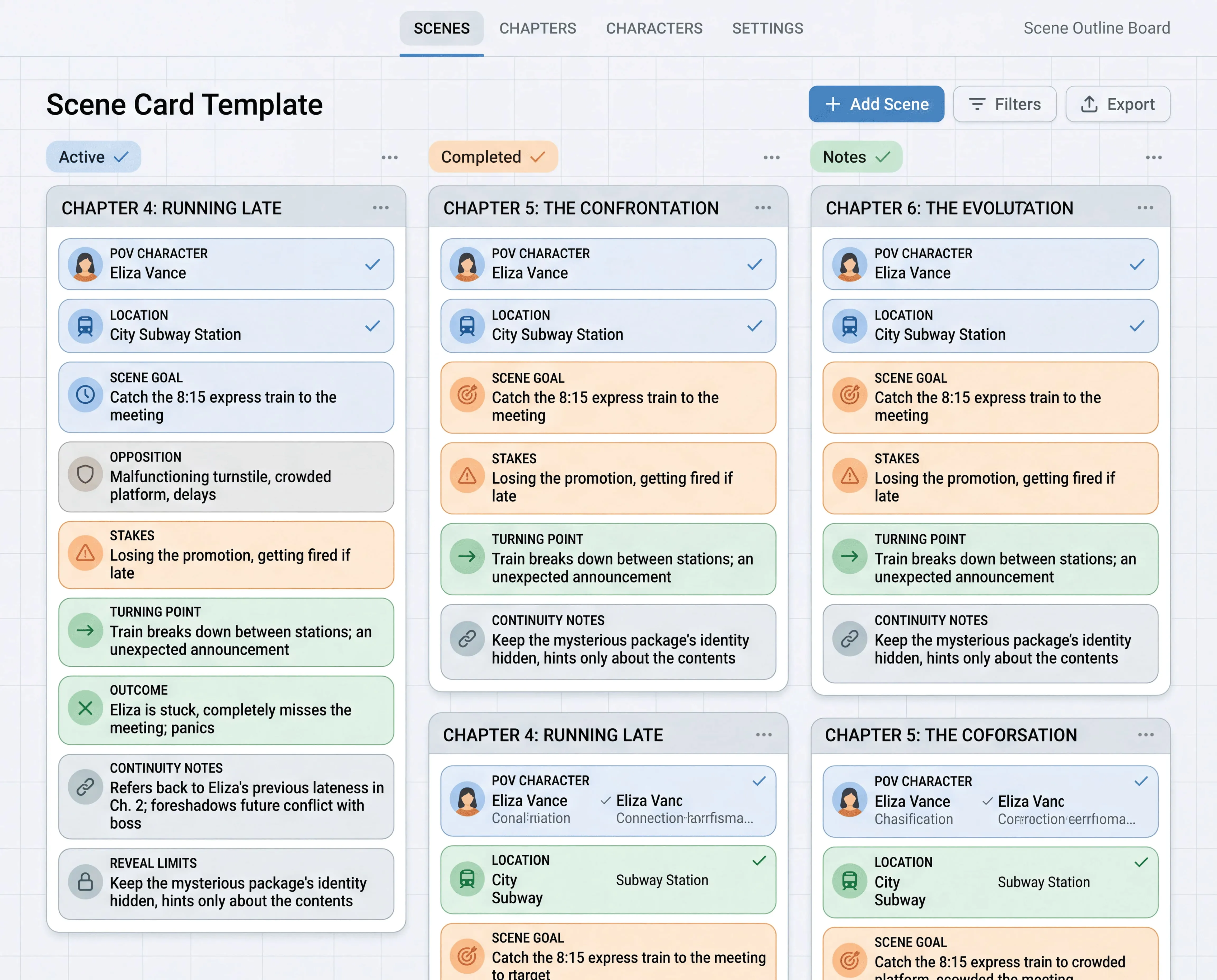
Scene number / chapter:
Working title:
POV character:
Location and time:

Scene goal:
What does the POV character actively want right now, in this scene?

Opposition or conflict:
Who or what resists that goal?

Stakes:
What becomes worse if the character fails, delays, or chooses badly?

Emotional starting point:
What is the POV character carrying into the scene?

Turning point or decision:
What moment changes the direction of the scene?

Outcome:
What happens by the end?

What changes after this scene:
What is different in the plot, relationship, clue trail, power balance, or emotional state?

Continuity notes:
What facts, injuries, promises, objects, timelines, or previous events must stay consistent?

Reveal limits:
What must this scene hint at, hide, or avoid explaining yet?

Drafting note for AI or future-you:
What should the draft emphasize in tone, pacing, dialogue, style, or restraint?
Quick Scene Checklist
If you are short on time, fill these four fields and draft:
- Scene goal
- Opposition
- Turning point
- What changes
Stakes, continuity notes, and reveal limits come next because they connect the scene to the rest of the book. They protect what failure costs, what the draft must obey, and what the scene should withhold for later. If those facts start repeating across many chapters, move the larger continuity layer into a story bible template instead of overloading every scene card.
If your genre needs it, add one optional field. A fantasy scene may need "magic rule used but not explained." A romance scene may need "boundary or confession withheld." A mystery scene may need "clue planted, false interpretation, later payoff." This is close to how external scene-planning resources such as Plotiar's scene planning template treat goal, conflict, stakes, and outcome as practical drafting fields. Add specialty fields only when they protect the draft; do not turn every card into a giant worksheet.
✍️ Filled Scene Card Example
Here is the difference between a vague setup and a scene card that gives the writer something to draft.
Weak setup: Mara confronts Prince Cael in the palace garden. They argue about the treaty. She tries to convince him to wait. He refuses at first but eventually agrees to think about it.
This version has names, a location, and a result. It still does not give the scene enough pressure. We do not know what Mara risks, what Cael misunderstands, what must stay hidden, or why the next scene changes.
Stronger scene card:
Scene number / chapter: Chapter 8, Scene 2
Working title: The Treaty in the Rain
POV character: Mara, junior envoy and secret heir to the border clan
Location and time: Palace garden arcade, midnight, during a storm

Scene goal:
Mara wants Prince Cael to delay signing the treaty until she can confirm whether the border villages were deliberately left undefended.

Opposition or conflict:
Cael believes delay will restart the war. He also thinks Mara is protecting her clan out of loyalty, not evidence.

Stakes:
If the treaty is signed tonight, the villages lose legal protection. If Mara reveals her identity, she may save them but destroy her position at court.

Emotional starting point:
Mara is exhausted, angry, and trying to sound diplomatic. Cael is controlled but wounded because he thinks she distrusts him.

Turning point or decision:
Cael admits one military report is missing. Mara decides not to reveal her identity yet and instead offers him the coded map as proof.

Outcome:
Cael agrees to delay the signing until dawn, but only if Mara brings him the original report.

What changes after this scene:
Their alliance becomes possible, but the prince now knows Mara has access to information no envoy should have.

Continuity notes:
Mara's left hand is bandaged from Chapter 7. Cael does not know she can read border ciphers. The queen's spy is watching the arcade from the east balcony.

Reveal limits:
Do not reveal that Mara is the missing heir. Hint that the spy recognizes her clan ring but do not explain why.

Drafting note for AI or future-you:
Keep the dialogue restrained. The scene should feel intimate but politically dangerous. No confession, no full backstory, no exposition dump about the war.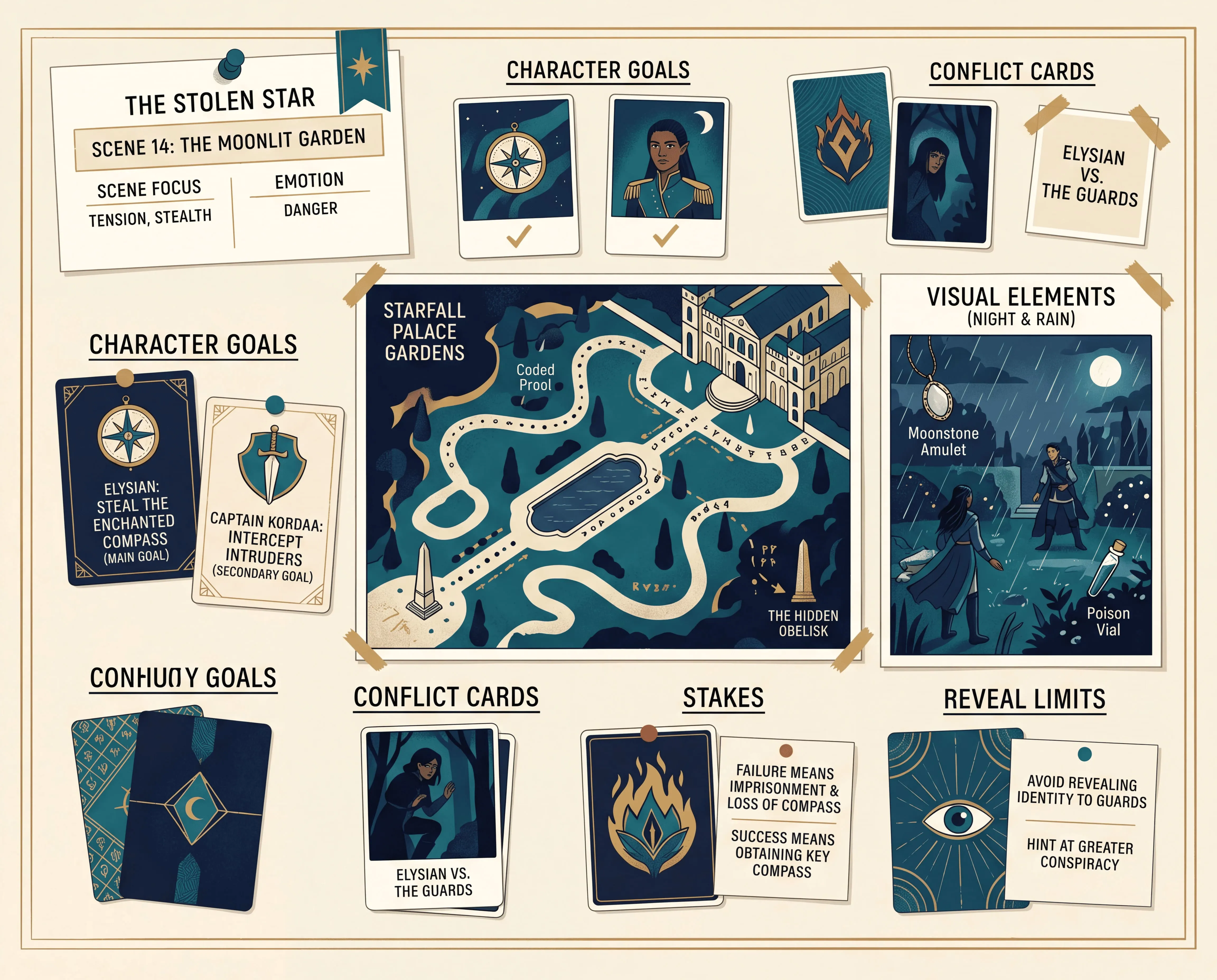
The stronger version does not make the scene longer. It makes the scene harder to fake. Mara's goal creates action. Cael's resistance gives the dialogue pressure. The reveal limit keeps the hidden-heir plot from spilling out too early. The continuity notes keep the bandaged hand, coded map, spy, and cipher knowledge from drifting between chapters. The outcome gives the next scene a new condition: Mara must find the original report by dawn.
🧭 Scene Card vs. Scene Outline, Scene List, and Chapter Outline
These terms often get mixed together. The difference matters because each tool solves a different writing problem.
| Tool | Scope | Main job |
|---|---|---|
| Scene card | One scene | Defines the scene's dramatic job: POV, goal, opposition, turn, outcome, continuity, and reveal limits. |
| Scene outline | One scene | Plans the internal beat order: entrance, exchange, discovery, interruption, decision, and exit. |
| Scene list | Several scenes or chapters | Checks pacing, repetition, subplot gaps, and scene order. |
| Chapter outline | One chapter | Sets the chapter's overall dramatic shift and decides which scene cards sit underneath it. |
If a scene keeps wandering, start with a scene card. If the card is clear but the moment still feels shapeless, expand it into a scene outline. If several scenes repeat the same emotional beat, move up to the scene list. When the problem is no longer one scene but the whole chapter turn, move up again to a chapter outline template.
🚦 How to Use a Scene Planning Template Before Drafting
Start with the next two or three scenes, not the entire book. Scene cards work best when they lower the friction of your next writing session. If you spend three days building cards for every chapter before you know how the early scenes feel, the template has turned into procrastination with better formatting.
Fill in the four pressure fields first: goal, opposition, stakes, and turning point. Without them, the scene may still contain beautiful description or funny dialogue, but it will not move with purpose. Then add continuity notes and reveal limits. Those fields connect the scene to the larger book without forcing you to solve the whole plot at once.
Before you draft, ask one simple question: "What must be different when this scene ends?" If the answer is only "the characters talked," the card is not ready. Under the conversation, something should shift: trust, leverage, knowledge, danger, desire, suspicion, access, or commitment.
After drafting, update the card only if the scene's job materially changed. Do not polish the card for its own sake. Treat it as a working hypothesis: useful before the draft, adjustable after the scene proves what it really wants to do.
🔁 How to Use Scene Cards During Revision
Scene cards can be even sharper after the first draft. In revision, reverse-engineer a card from the scene that already exists. Write down what the POV character appears to want, what resists them, what changes, and what information the scene gives away.
This exposes weak scenes quickly. If you cannot identify the goal, the scene may be passive. If you cannot name the opposition, it may be only information delivery. If the outcome is identical to the starting point, the scene may need a turn or may belong inside another scene.
When several reverse-engineered cards repeat the same outcome, move up to the scene list. The chapter may be circling the same emotional beat, delaying the same reveal, or staging the same conversation in different rooms.
A revision pass with scene cards also helps with continuity. Track when a clue appears, when a promise is made, and when the reader learns a secret. You are not trying to make the card elegant. You are checking whether the scene still earns its place.
⚠️ Common Scene Card Mistakes
Writing a summary instead of a playable scene. "Mara and Cael discuss the treaty" is a summary. "Mara tries to delay the treaty without revealing why she has forbidden evidence" is playable.
Listing events without a character goal. A scene can contain several events, but the reader follows pressure through a character's want. Give the POV character something specific to pursue.If that want is still too abstract to produce a difficult choice, build the underlying character motivation before you fill in the scene card.
Tracking so many fields that the card becomes another chore. If your card has thirty boxes, you will stop using it. Keep the template lean. Add specialty fields only when your genre needs them, such as "clue planted," "romantic boundary," or "magic rule used."
Forgetting the reveal limit until it is too late. Reveal limits are not only for mysteries. Romance often depends on what a character refuses to say. Fantasy often depends on what the world has not explained yet. A card should protect those delays.
Letting every scene resolve too cleanly. A scene can have an outcome without solving the problem. In many novels, the best ending gives the character a partial win with a new complication attached.
A card is working when it makes the scene harder to fake. If the draft can ignore the card and still produce the same pleasant conversation, the card is not specific enough yet.
🤖 How to Turn a Scene Card Into an AI Drafting Brief
The most common AI drafting problem is not a bad prompt. It is missing context. The model does not know the relationship state, what the scene should only hint at, or what the POV character is hiding. So it guesses, and the draft sounds fluent while the heroine confesses too early, the wrong clue gets planted, or the tension resolves in the wrong direction.
A filled card works better because the writer has already made the story decisions the model should not be guessing.
Turn the card into a short context pack using a simple labeled format. Using the Mara and Cael card, it looks like this:
AI drafting brief from the scene card:
POV: Mara, close third-person. She is exhausted and angry but trying to sound diplomatic.
Scene goal: Mara needs Cael to delay the treaty until dawn without revealing she is the missing heir.
Relationship state: Cael thinks Mara distrusts him and may be protecting her clan for personal reasons, not because she has evidence.
Hidden information: Do not reveal Mara's identity. Hint that the queen's spy notices her clan ring.
Continuity limits: Mara's left hand is bandaged. Cael does not know she can read border ciphers. The coded map is the only proof she is willing to show.
Style note: restrained dialogue, political danger, intimate tension, rain and torchlight in the arcade. No confession and no war-history exposition.
Draft task: write one scene around the argument and the coded map. End with Cael agreeing to delay only if Mara brings the original report.
Do not: resolve the romance, expose Mara's identity, explain the full history of the border war, or invent a new clue that solves the treaty problem.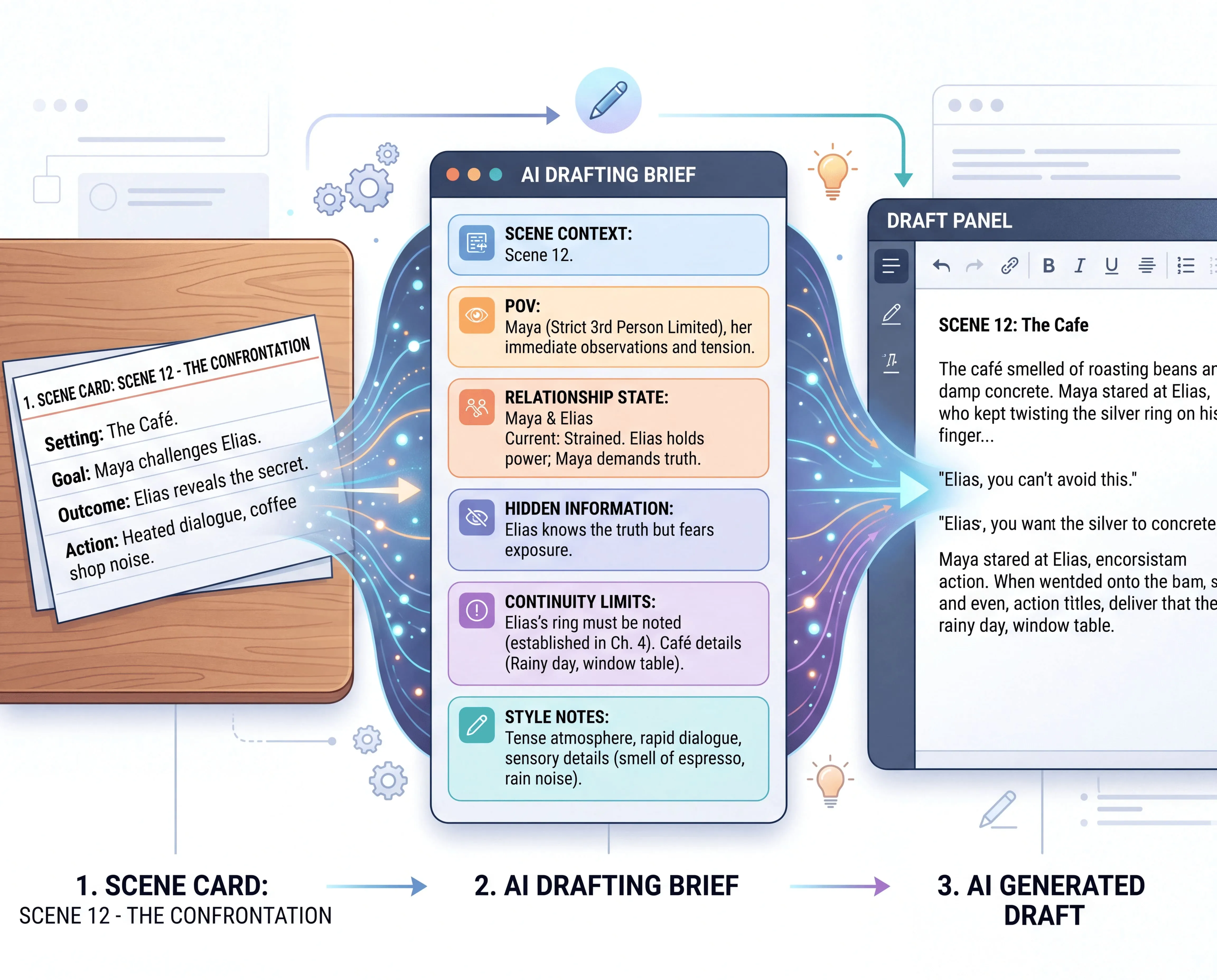
That brief will not produce a finished scene by itself. It reduces the number of things the draft can get wrong by guessing. Do not ask the tool to invent missing continuity, decide the reveal, or fix a plot hole you have not solved. The writer still chooses the final shape.
🌊 Where SeaBell Fits Into Scene Planning
The card is finished. Now you are staring at a blank draft window, trying to remember which version of the scene brief you wrote, where the character note lives, and whether the continuity limit was in the doc or the spreadsheet.
Keeping that context visible while drafting is harder than it sounds. Copying the same goal, relationship state, hidden information, continuity limit, and style note into a blank prompt again and again gets messy once the book has a story bible, recurring character notes, and chapter-level pressure to track.
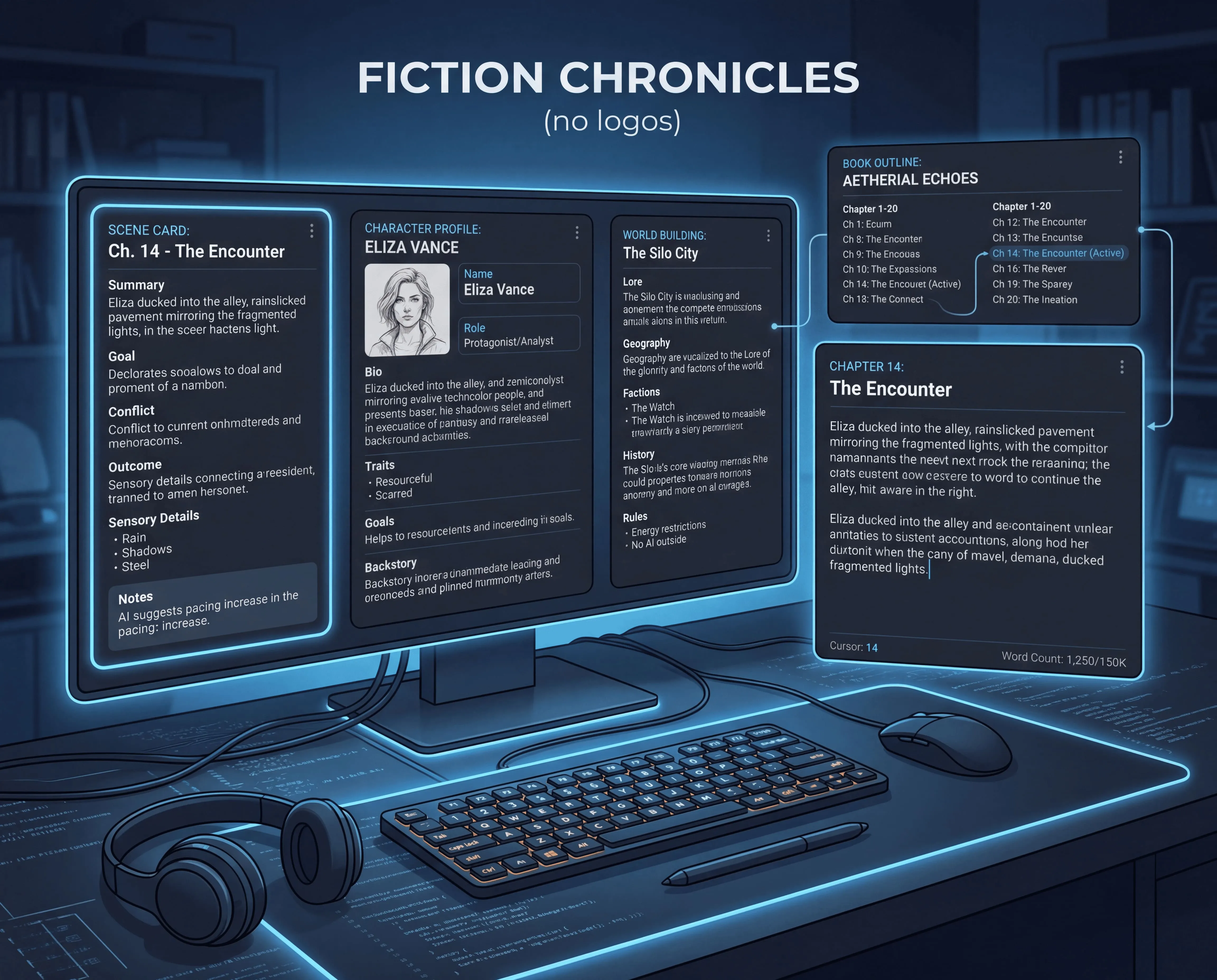
SeaBell can help at that handoff, not by deciding what the scene is about, but by keeping the brief close to the draft. Use the scene card as the opening context for a drafting session, then keep the relevant character notes, story context, and continuity limits nearby while you test the scene. If the scene depends on voice, wounds, habits, or relationship state, SeaBell's character cards can hold that recurring character layer outside the one-scene brief. The writer still chooses the version that belongs in the book.
If your project is still small, a simple document may be enough. For a long novel, serial arc, or AI-assisted draft with recurring context, SeaBell can help keep the scene card beside the larger story bible, character notes, and chapter plan. If you are writing fast-paced serial fiction, the same pressure also shows up in light novel writing style, where scene rhythm and chapter hooks have to stay easy to track. That way, the constraints you built into the scene card stay visible when the book gets large enough to forget them.
❓ FAQ
What is a scene card in writing?
A scene card is a short planning note for one scene. It usually captures the POV character, location, goal, conflict, stakes, turning point, outcome, continuity notes, and reveal limits.
What should be included in a scene card template?
Include only the fields that help you draft or revise the scene. For most fiction writers, the core fields are scene number, POV, location/time, goal, opposition, stakes, emotional starting point, turning point, outcome, what changes, continuity notes, reveal limits, and a drafting note.
Is a scene card the same as a scene outline?
No. A scene card is usually shorter and more focused on the scene's dramatic job. A scene outline may include the internal beats of the scene in more detail. You can turn a scene card into a scene outline if the scene needs more planning.
How many scene cards do I need for a novel?
You need one card for each scene you want to control at scene level, but you do not have to card the entire novel in advance. Many writers do best by planning the next few scenes, drafting them, then adjusting the larger scene list as the story changes.
Can discovery writers use scene cards?
Yes. Discovery writers can use scene cards lightly before drafting or reverse-engineer them during revision. The card does not have to predict the whole story. It can simply clarify what the current scene ended up doing.
Can I use a scene card with AI writing tools?
Yes, and it is usually better than starting with a broad prompt. Turn the card into an AI context pack with POV, goal, relationship state, hidden information, style note, continuity limits, and a narrow draft task. Do not ask the tool to invent missing continuity or decide the reveal for you. Revise the output against your scene card. If the draft invents a continuity detail you did not put in the card, remove it. If it resolves a tension you marked as "not yet," revise that. The card is the authority, not the draft.
🏁 Start With the Next Scene, Not the Whole Novel
A good scene card is not paperwork. It is a pressure test for the next page: this scene has a point, a pressure, a turn, and a consequence. Pick the next scene, fill the four pressure fields, and add only the continuity and reveal notes the draft truly needs. When the story grows beyond scattered notes, bring the scene card, character context, and chapter brief into SeaBell so the drafting context stays beside the page.