

How to Write a Mystery Book: Fair Clues and Reveals | SeaBell
How to Write a Mystery Novel With Fair Clues and a Satisfying Reveal
If you are learning how to write a mystery novel, start by making two sequences work at once: what actually happened, and what the reader is allowed to learn before the answer arrives. Even a strong premise disappoints when the answer depends on a clue the reader had no fair chance to use.
The work is to control information, not to force a fixed sequence of beats. You need a hidden truth, characters whose actions make sense away from the page, evidence that can be misread without being invented, and an investigation that changes the case. This guide uses one original mini-case—the disappearance of a museum archive folio before an ethics review—to show how those parts fit together.
🧭 Start With the Truth Your Characters Are Trying to Hide
Before you plan the investigation, write a plain-language version of the answer. It does not have to be elegant. It does have to tell you what happened, who caused it, why they acted, how they did it, when it happened, and what they are doing now to avoid the consequence.
A mystery does not need a murder to create this problem. A vanished document, a stolen object, a betrayal, a missing record, or a concealed identity can all create a gap between the truth and what the characters believe.
In the running example, a donor folio disappears from the Harrow Museum archive just before an ethics review. The folio contains an early transfer note that complicates the ownership history of a map due to go on public display. Months earlier, Amaya, the acquisitions curator, approved the exhibition file without noticing that note. During a routine condition check shortly before the review, she finds it, recognizes what her oversight could expose, and moves the folio into an assigned outbound conservation crate. She completes the numbered condition record, initials it, and notes the crate's legacy code before taking the record out of its normal filing route.
Amaya hides the paper record behind a superseded checklist instead of destroying it, which would create an obvious gap, or putting it in the crate, which would tie it directly to the folio if anyone opened the crate. She leaves the blue transfer slip in place because she expects staff to keep treating its legacy code as a stale routing trace until the scheduled reconciliation. She also knows that ordinary batch reconciliation is scheduled for the closeout after the ethics review, and she gambles that no one will confirm the missing record in time. That is the hidden truth. It gives her a motive, a method, and a reason to keep acting while Tessa, a junior archivist, investigates.
At Harrow, the museum's own records follow a fixed route: the condition-check schedule records when a folio enters conservation; a numbered paper condition record waits in the conservation inbox for entry in the intake log; and a separate crate ledger links each outbound crate to its batch and record number. A blue transfer slip is a routine routing form that stays with a batch when a crate is issued. Its legacy identifier no longer appears in the live intake system, so Tessa can tell that the code is obsolete without yet knowing which former system used it. Ordinary batch reconciliation happens at the scheduled closeout, but a reported missing item can trigger an earlier exception once the evidence identifies a specific record number.
Each sealed donor correspondence box has a museum-owned inventory sleeve on its exterior. The sleeve holds an inventory duplicate that lists the compartment as correspondence and identifies the linked transfer folder, but reveals nothing about the private letters inside. A separate public-index copy provides the same neutral cross-reference for ordinary users. Before Amaya's condition check, a museum log recorded the box's tamper-seal number and the date it was applied. Under the documented missing-item procedure, Tessa can ask a collections manager to inspect the external sleeve and compare the current seal with that pre-disappearance record. The manager cannot open the sealed correspondence compartment or read its letters. The donor-controlled transfer folder and the correspondence still require Leila's separate permission.
You can begin in either of two ways:
- Solution-first: Decide the central truth before drafting, then work backward to place evidence, false interpretations, and pressure points.
- Discovery-first: Draft toward an unresolved question and let the culprit, motive, or method emerge through scenes.
Neither approach is more legitimate. The difference is revision cost. A solution-first writer can still discover better scenes; a discovery-first writer can still produce a fair mystery. But once you decide that Amaya is responsible, that choice becomes canon: a fact you have committed to and must keep consistent on the page. Changing it later means rechecking her earlier behavior, every clue tied to the missing folio, the plausibility of other suspects, and the final explanation. The more firmly a fact supports the case, the more expensive it is to replace.
A useful starting tool is a compact Truth-to-Reveal Map. It is not an outline template. It is a way to see whether the invisible story and the visible investigation can meet honestly. Complete the hidden truth, cover-up or obstruction, character tracks, and payoff once for the whole case. Then repeat the evidence-and-route, first-interpretation, true-meaning, reveal-timing, and investigation-change fields for each decisive clue.
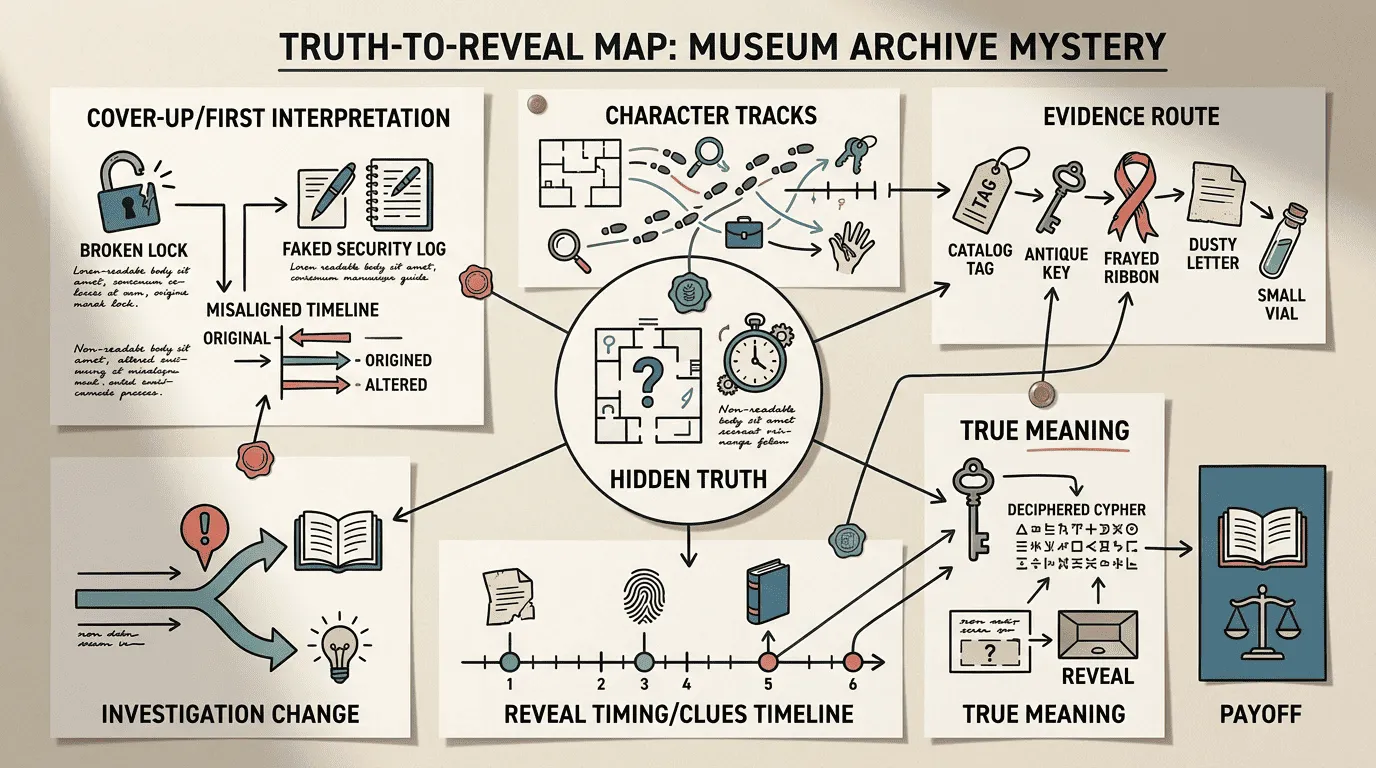
| Map field | Completed Harrow Museum entry |
|---|---|
| Hidden truth | Amaya finds the transfer note during a condition check, hides the folio in an outbound conservation crate, and removes the numbered condition record before it is logged. She hides the record behind a superseded checklist, leaves the blue transfer slip because she expects staff to treat its legacy code as stale, and gambles that scheduled reconciliation will not happen before the ethics review. |
| Cover-up or obstruction | The blue transfer slip remains with the conservation inbox batch, while the completed condition record is removed before it reaches reconciliation. Daniel's time-stamped after-hours access to the conservation loading bay and Leila's restricted access to the donor-controlled transfer folder create separate, plausible obstacles. |
| Character tracks | Amaya protects the exhibition; Tessa follows an incomplete intake trail; Daniel conceals an after-hours favor for Leila; and Leila removes the public-index copy while protecting private family letters. |
| Evidence and route | Tessa finds the blue slip in an inbox batch she can inspect. A collections manager checks the museum-owned exterior sleeve and confirms that the current, unbroken tamper seal matches the number logged before Amaya's condition check. That establishes that the correspondence compartment was not opened between its documented pre-disappearance sealing and the manager's check, ruling out the theory that Daniel hid the folio inside it. The inventory duplicate in the sleeve directs Tessa to Leila's donor-controlled transfer folder. Leila grants a supervised review of that folder only. It identifies the legacy code as a former conservation crate code, so Tessa checks the crate ledger. Its entry is the first record to tie the legacy code to Amaya's crate, its batch, and the condition-record number. With that specific number now identified and absent from the intake log, the reported missing item triggers the earlier exception. Tessa reopens the matching batch and checks the superseded checklist, behind which she recovers the record. |
| First interpretation | Daniel's time-stamped access to the conservation loading bay just after the condition check, his evasiveness, and the missing folio make it reasonable to suspect that he used the trolley to hide it inside Leila's sealed correspondence box. The blue slip first looks like an obsolete storage trace. |
| True meaning | Daniel moved a sealed correspondence box. Leila removed the public-index copy, while the inventory duplicate remained in the exterior sleeve. The transfer folder, ledger, and recovered record instead connect Amaya's condition check to the concealed folio. |
| Reveal timing | The reader sees Daniel's access log, the blue slip, and the missing public-index copy when Tessa does. The manager later finds the inventory duplicate in the exterior sleeve, but neither the reader nor Tessa yet knows what system the legacy code belongs to. The reader sees the recovered record before the final accusation; Tessa recognizes it as the missing record, but needs to compare its date and code with the crate-ledger entry to understand what it proves about Amaya. |
| Investigation change | The sleeve-and-seal check rules out the theory that Daniel hid the folio inside the correspondence box and gives Tessa a documented reason to request a narrow review from Leila. The code, ledger, and recovered record then make Amaya the leading theory. |
| Payoff | The folio is recovered from Amaya's identified outbound crate, the exhibition is delayed pending the ethics review, Amaya must face a public correction, and Tessa's trust in the institution changes. |
Use the map before you explain the case to the reader. In Harrow, the cover-up is not simply that Amaya hides a folio: she moves it, leaves a blue transfer slip whose legacy code she expects staff to dismiss as stale until reconciliation, removes the numbered condition record before it is logged, and hides it where the incomplete intake trail can still lead back to it. Her gamble depends on the ordinary reconciliation happening after the ethics review. The record carries her initials and the same code, so the later comparison gives Tessa something concrete to test. If you can only describe the case in the investigator's final explanation, the cause-and-effect chain probably needs another pass.
🧠 Track What the Culprit, Investigator, and Suspects Do
Suspects cannot exist only to be questioned on schedule. Each person needs a present goal, a private concern, a reason they might lie, and some activity that continues while the investigator looks elsewhere. The central loss also needs weight: the folio matters because it affects a public exhibit, a donor family, and the staff members who trusted the archive record—not merely because the plot needs an object to vanish.
Here is a compact version of the case track:
Amaya, acquisitions curator
What they want now: Keep the exhibition open and avoid public correction
What they know: The folio exposes her earlier oversight
What they do off-page: Moves the folio into an outbound crate, removes the completed condition record before it is entered in the intake log, and leaves the blue transfer slip because she expects staff to keep treating it as a stale routing trace until the scheduled reconciliation
What Tessa sees: She is tense about the review and had access to the exhibition and condition-check records
What the reader first assumes: Her oversight may be embarrassing, but she is not yet a likely culprit
What later evidence changes: The legacy crate code, the recovered record carrying her initials, and the crate ledger connect her access to the concealment
Daniel, facilities manager
What they want now: Conceal an unauthorized after-hours storage favor
What they know: He knows his after-hours swipe at the conservation loading bay came shortly after Amaya's condition check, that he used a museum trolley to move Leila's sealed correspondence box, and that the access log will expose that favor
What they do off-page: Uses his restricted after-hours access to move Leila's sealed correspondence box through the conservation loading bay without disturbing its exterior sleeve or the tamper seal recorded before Amaya's condition check
What Tessa sees: Tessa sees a time-stamped access log placing him at the loading bay after the condition check and hears his evasive account of moving a box
What the reader first assumes: He used his restricted after-hours access and the conservation trolley to hide the folio inside Leila's sealed correspondence box
What later evidence changes: A collections manager confirms that the current, unbroken tamper seal matches the number recorded before Amaya's condition check and checks the museum-owned exterior sleeve. That establishes that the correspondence compartment was not opened between the documented pre-disappearance sealing and the manager's check, ruling out the box theory. The inventory duplicate identifies Leila's transfer folder; Daniel's access explains his presence but not the match between the condition record and the crate code
Leila, donor’s granddaughter
What they want now: Keep private family letters from becoming public
What they know: Her relative's private correspondence includes an embarrassing dispute. She removes the public-index copy, but knows that the inventory duplicate remains in the museum-owned exterior sleeve and identifies the transfer folder she controls
What they do off-page: Removes the public-index copy and asks Daniel to move the sealed correspondence box after closing
What Tessa sees: Tessa sees her resistance, the missing public-index copy, and her control over the transfer folder
What the reader first assumes: She is trying to suppress the transfer history and may know where the folio went
What later evidence changes: The public-index copy cross-references the correspondence box and transfer folder; it does not concern the folio. The inventory duplicate remains in the exterior sleeve and points to the transfer folder. Leila permits a supervised review of that folder to distinguish Daniel's favor from the disappearance without opening the letters
Tessa, junior archivist
What they want now: Protect the archive’s integrity and keep her job
What they know: The institution-owned schedule shows that the folio entered conservation for a condition check, and its intake trail is incomplete, but she does not yet know which condition-record number belongs to it
What they do off-page: Uses the missing-item procedure to inspect institutional records and, with the collections manager, the exterior sleeve and tamper seal; she interviews staff and requests permission for the donor-controlled transfer folder
What Tessa sees: She sees an unexplained gap in the intake trail, Daniel's access log, the missing public-index copy, and separate limits on institutional and donor-controlled materials
What the reader first assumes: She can test the institutional record trail if she can distinguish Daniel's box move from the disappearance of the folio
What later evidence changes: Each access decision changes which records and witnesses she can test
Daniel is a red herring because the early evidence supports a specific wrong theory: that he used the trolley to hide the folio inside the sealed correspondence box. A time-stamped access log places him at the conservation loading bay shortly after Amaya's condition check, and he lies about using a museum trolley after closing. Under the documented missing-item procedure, Tessa can ask the collections manager to inspect the museum-owned exterior sleeve and compare the current tamper seal with the number recorded before Amaya's condition check. The manager does not open the correspondence compartment or read the letters. The same numbered seal is still unbroken, so the record establishes that the compartment was not opened between its pre-disappearance sealing and the inspection. That rules out the box theory, while the inventory duplicate directs Tessa to the donor-controlled transfer folder. Daniel's lie now has a grounded explanation, but it still leaves the missing condition record unexplained.
A suspect who stops acting once an interview ends usually announces the author’s hand. You can see the problem when the investigator receives three pieces of information, but no one has made a fresh choice, protected a secret, or created a new obstacle in the time between them. Give every major character something to pursue that is not simply “look guilty.”
When a suspect’s desire is still vague, pause here rather than adding another twist. A deeper character motivation framework can help you separate a temporary goal from the fear, pressure, and personal cost behind it. For this case, Leila’s private goal matters because it makes her remove the public-index copy, resist Tessa’s request, and later permit only a narrow review; that behavior changes the route to the records. The mystery only needs enough of the framework to explain why each character acts as they do.
🔎 Turn Facts Into Clues Readers Can Use
A fair clue is a real fact in the story. The reader can encounter it through a believable route, and it still fits the hidden truth after the reveal. A clue that needs to sustain uncertainty should also support a reasonable first interpretation that later evidence complicates. The author does not need to make the answer obvious. The author does need to avoid changing the rules after the reader has started solving.
In the Harrow Museum case, Tessa finds a blue transfer slip while tracing the folio's last condition-check batch in the conservation inbox. It carries a legacy code that no longer appears in the live intake system. At first, that tells Tessa only that the code is old or out of place. The slip is a routine routing form that normally stays with the batch to track its crate assignment, so its presence has a mundane explanation. Amaya counts on that. Daniel's recent use of a trolley makes the theory of a box-hidden folio plausible, too. The reader sees the slip when Tessa does, but neither yet knows what former system the code belongs to. Only after Leila's transfer-folder review identifies it as a former conservation crate code can Tessa consult the ledger, identify the missing record number, and use the retained checklist to test what the code means. That later comparison shows that the code marks Amaya's concealed transfer, not Daniel's after-hours move.
| Version | What makes it weak or strong |
|---|---|
| Weak clue | A distinctive key appears in a drawer solely because the author needs a clue, with no ordinary reason for it to be there. |
| Stronger clue | A visible routing form has a normal job, such as tracking the crate assigned to a batch, while its legacy code also fits the concealment once the reader knows what to look for. |
A red herring is not a random lie. It is a real fact that makes a wrong theory plausible for a while. Daniel’s restricted access is a red herring because it genuinely needs explaining. His box movement gives Tessa a reason to inspect the missing public-index copy and the exterior sleeve, which point her to the inventory duplicate outside the sealed correspondence compartment. A fake clue exists only to point away from the answer and then disappears from the story’s logic. A withheld decisive fact is different again: if the reader could not possibly know it before the reveal, it cannot do the heavy lifting of a fair solution.
Decorative clues often fail in a recognizable way: they arrive with unusual emphasis, prompt no ordinary reaction from the people who should notice them, and vanish until the final chapter needs them. Before keeping one, ask what it changes on the day it appears—not only what it will mean later.
🕰️ Separate the Real Timeline From the Discovery Timeline
The real sequence of events is not the same as the order in which Tessa finds out about them. In the Harrow Museum case, Amaya approves the exhibition file months earlier without noticing the transfer note. During a later condition check, she finds it, moves the folio into an outbound conservation crate, removes the completed condition record before it is logged, and relies on scheduled reconciliation happening after the ethics review. Tessa encounters the relevant evidence in another order: she first traces the folio to its condition check and finds the blue transfer slip; Daniel's access log then makes it plausible that he used the trolley to hide the folio in Leila's correspondence box; the missing public-index copy raises a question about Leila's materials, and the manager's exterior-only box check finds the inventory duplicate; Leila's limited transfer-folder review explains the legacy code; and the crate ledger first ties that code to Amaya's crate, its batch, and a specific missing record number, triggering the missing-item exception that leads Tessa to the recovered condition record. The reader sees each item when Tessa does, even though the full pattern is not clear until the final comparison.
For a case like Harrow, start by tracking two timelines:
- The real timeline: what happened before and during the case.
- The discovery timeline: when the investigator and reader encounter evidence.
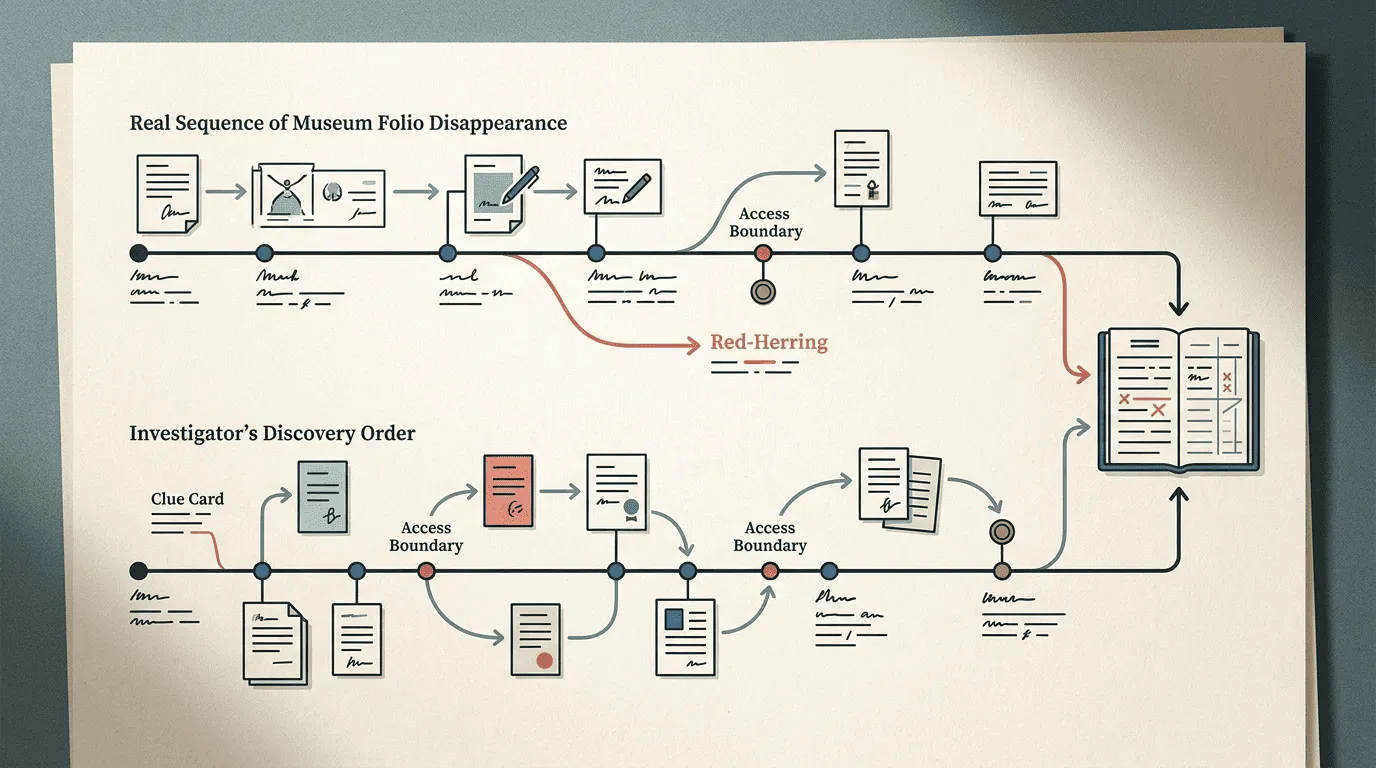
A third track is often useful in a longer novel: what the culprit and other characters are doing while the investigation advances. This is where inactive suspects become visible and where a cover-up continues through off-page actions while the investigator is working elsewhere.
For every discovery, answer five questions:
- Who can reach this evidence?
- Why would they look there now?
- What do they think it means at first?
- What does it make them do next?
- Does the reader know something the investigator does not, or vice versa?
The blue transfer slip becomes a fair clue because every step after it has a trigger. The two cards have distinct physical paths: Leila removes the public-index copy, which Tessa sees is missing, while the inventory duplicate remains in the museum-owned sleeve on the outside of the sealed correspondence box. Under the documented missing-item procedure, the collections manager inspects only that exterior sleeve and confirms that the current, unbroken tamper seal matches the number recorded before Amaya's condition check. The manager does not open the correspondence compartment or read the letters. That establishes only that the compartment was not opened between its documented pre-disappearance sealing and the inspection, ruling out the theory that Daniel hid the folio inside it. The inventory duplicate identifies Leila's donor-controlled transfer folder.
Tessa asks Leila for a supervised review of that folder alone, explaining that it can test whether Daniel's box move is connected to the missing folio without exposing the private letters. Leila accepts the narrow request because it keeps the inquiry away from the correspondence while answering that limited question. She authorizes the transfer folder, not the letters, so Tessa still has to work within a real limit.
The transfer folder identifies the blue slip's legacy code as a former conservation crate code. Tessa then checks the crate ledger, the first record that connects that code to Amaya's outbound crate, its batch, and the condition-record number assigned to it. That number is absent from the intake log. Only once Tessa has identified that specific number can the reported missing item trigger the earlier exception. She reopens the matching inbox batch and checks the superseded checklist retained there. Behind it she finds the completed condition record, bearing Amaya's initials and the same crate code, but never entered in the log. The reader sees the recovered record before the final accusation. Tessa recognizes it as the missing record, but only when she compares its date and code with the ledger entry does she see that it documents Amaya's hidden transfer rather than Daniel's after-hours move.
When the case begins to spread across chapters, use a story timeline template to track the full chronology, character knowledge, clue order, and continuity. Keep this article’s map smaller: it tests whether information arrives fairly without taking over your book-wide planning.
🎯 Make Every Investigation Beat Change the Case
An investigation scene needs more than a location and a question. It should alter the investigator's working theory, available options, risk, access to evidence, or relationship with another character. Otherwise, interviews become a row of scenes that all produce the same result: someone acts suspiciously, and the investigator walks away with another name on a list.
Use this test before drafting or revising a scene:
- Before: What does the investigator currently believe?
- During: What fact, obstacle, or pressure appears?
- After: What can the investigator no longer safely assume?
For example, Tessa first believes Daniel hid the folio in Leila's correspondence box because he had access and lied about being in the archive. Her interview establishes that he moved the sealed box after hours. The manager's exterior-only check confirms that the current, unbroken tamper seal matches the number recorded before Amaya's condition check and that the museum-owned sleeve identifies the linked transfer folder. The check rules out that specific hiding place; it does not establish what happened to the folio. Daniel's lie becomes a real but separate secret. The inventory duplicate gives Tessa a defined reason to request Leila's transfer folder. Leila permits that narrow review because it can clarify Daniel's favor without exposing the letters. The access changes the case: the box theory falls away, Leila becomes a constrained source, and the legacy code can now lead Tessa to the crate ledger.
A common cause of a flat investigation is that its interviews never change the investigator's theory. If the investigator enters a room believing Daniel is guilty and leaves believing exactly the same thing, the scene needs a sharper obstacle, contradiction, or choice. Even a setback can work if it closes a route and forces a different approach.
This is also where investigation pressure belongs. Deadlines, damaged trust, professional risk, or withheld access can make each discovery matter without turning the mystery into a generic pacing exercise. Use a focused resource on writing tension in fiction when a scene needs more friction, while keeping this method centered on how each discovery changes the case.
💡 Make the Reveal Surprising Without Making It Arbitrary
A satisfying reveal lets the reader look backward and see that the answer was possible. They may not have predicted it. They should not feel that the author smuggled in the decisive fact after the game was over.
For the museum case, Tessa realizes that Daniel's access log explains a real but separate secret, not a way to hide the folio in the correspondence box. The blue transfer slip, crate ledger, and unlogged condition record point to Amaya's concealment. The ledger identifies Amaya's outbound crate, and the folio is recovered from it. The reader has already seen the slip, Daniel's access, the missing public-index copy, the inventory duplicate, the transfer-folder entry, the ledger entry, and the recovered record before the final accusation. Amaya expected staff to treat the legacy code as stale and the missing record to wait for scheduled reconciliation; the missing-item exception defeats that gamble. Tessa recognizes the recovered sheet as the missing record when she finds it, but its date and crate code only identify Amaya's hidden transfer when she compares them with the ledger. The final scene connects those facts rather than adding a new piece of evidence. Amaya's motive also has to explain her behavior: she is not "the culprit" in the abstract; she is a curator who made a damaging judgment call and chose concealment over public correction.
Run a short reveal audit:
| Reveal question | Pass condition |
|---|---|
| What did the reader already see? | The final answer does not depend on a brand-new decisive fact. |
| What was misread? | The early interpretation was reasonable at the time. |
| What did the investigator overlook? | The oversight has a character, pressure, or access reason. |
| What does the responsible character gain? | The character gains time, preserves a concrete benefit, or avoids a defined loss; the story shows why that outcome matters now. Here, Amaya buys time before the ethics review by postponing a public correction and keeping the exhibition on track. |
| What remains unresolved? | Any open thread is deliberate, not an accidentally dropped question. |
Late culprit changes often break in the quietest places: a casual alibi becomes impossible, an early clue no longer has a true meaning, or a suspect’s off-page behavior now exists only to fill a gap. When you change the solution, do not patch the reveal scene alone. Re-audit the whole map from the hidden truth outward.
The answer should also leave a consequence. After the truth comes out and the folio is recovered from the identified crate, the exhibition is delayed pending the ethics review, Amaya has to face the professional cost of her choice, and Tessa’s trust in the institution changes. Justice, grief, relief, or a damaged relationship can make the ending feel complete without insisting that every mystery must end with the same moral outcome.
📝 Choose a Drafting Workflow That Matches Your Tolerance for Revision
Choose solution-first when fairness and causal control are your main risks. You establish the truth, follow each character’s actions, then place evidence and plausible misreadings around that structure. The advantage is that you can test the clue chain early. The cost is that a new, better idea may require you to reopen a lot of connected material.
Choose discovery-first when you need to explore voice, relationships, or the shape of the central question before the answer feels alive. The advantage is surprise for the writer. The cost is that, once the answer is binding—that is, once you have chosen the culprit, motive, and method as facts the later chapters must keep consistent—you must do a deliberate second pass. Lock the culprit, motive, method, character knowledge, and decisive evidence; then check whether earlier scenes prepare the reader for that version of the case.
The useful checkpoint is the moment a discovery becomes a promise to the reader. A mystery can tolerate uncertainty in the drafting process. It cannot tolerate a final explanation that has no roots in the draft. At that checkpoint, write down the case canon: the locked culprit, motive, method, and established evidence, alongside each character’s current knowledge and goals. Later chapters must honor the case canon. A character’s knowledge or goals may change only through a visible or credibly established causal event. If you change the culprit, motive, or method, return to the earlier clue-and-action audit instead of treating the change as something the story can explain after the fact.
Once your case logic is stable, scale it to the book by turning each meaningful theory change into a chapter decision: what the viewpoint character learns, what evidence the reader sees, which option closes, and what the new cost or question is. Carry the locked facts and each character’s current knowledge into the next chapter so the investigation does not reset between scenes. Use a novel outline template to organize the case around subplots and turning points, and a chapter outline template to place discoveries by point of view, conflict, character change, and chapter hooks. The case logic you have already tested still determines whether the mystery is fair.
🤖 How AI-Assisted Writers Can Keep a Mystery Coherent
AI can be useful for testing scene variations, drafting an interview from two different assumptions, or turning your case notes into a scene-level checklist. When the essential facts are scattered across old conversations, loose documents, and half-updated character notes, the writer has a harder time checking each scene against the established facts, character knowledge, and clue logic.
Before you draft a chapter with an AI assistant, prepare a compact case context:
- the current hidden truth and any facts you have locked;
- each major character’s knowledge and present goal;
- evidence already shown on the page;
- what the reader is currently likely to believe;
- open questions and discoveries that are still allowed;
- facts the next chapter must not contradict.
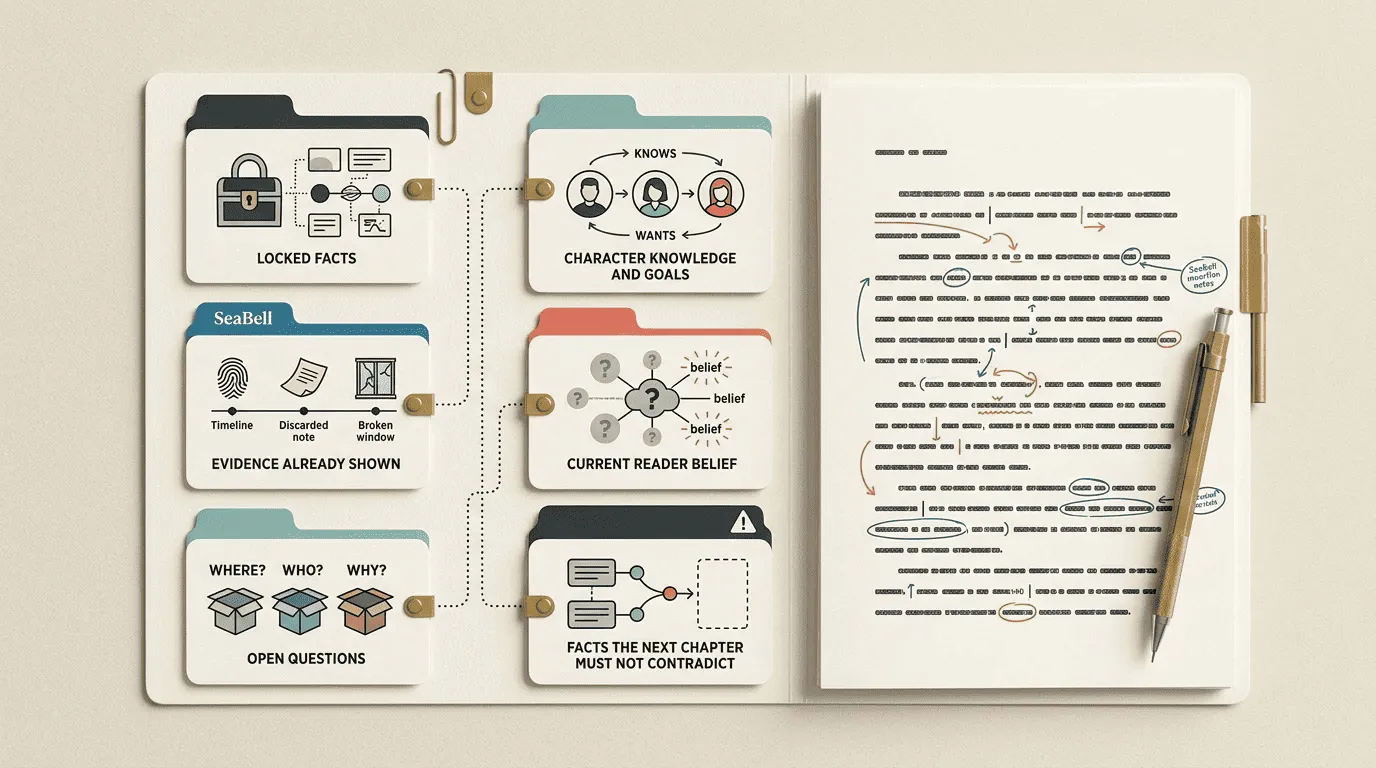
When that context is missing, an AI assistant may produce a new clue too conveniently, shift a motive halfway through, or make a suspect act as though they know something they have not learned. Treat those outputs as prompts to inspect the map, not as proof that the case works.
Once you have that compact case brief, SeaBell’s long-form workspace can keep the working truth, character knowledge, clue state, and chapter context close to the draft as you write. After you finish a Truth-to-Reveal Map, bring its locked facts and the next chapter’s knowledge state into that workspace before drafting. SeaBell does not decide what the evidence means or whether the reveal earns the reader’s trust; the writer still has to make and test those judgments.
✅ Run a Final Mystery Audit Before Revising the Whole Book
Before a major revision, read the case as if you were trying to solve it with only the information the reader receives. Then check the following:
- The hidden truth is written in plain language.
- Every major suspect has a reason to act, a private objective, and an off-page life.
- The responsible character remains active while the investigation proceeds.
- Every decisive clue has a believable route of discovery.
- Red herrings are real possibilities, not random distractions.
- The reader can reason backward from the reveal using facts already in the story.
- Each investigation scene changes a theory, option, risk, access point, or relationship.
- The final explanation covers motive, method, opportunity, and relevant behavior.
- The ending resolves the central unknown and its most important emotional consequence.
- Any change to the solution has triggered a review of earlier clues and character tracks.
Start with one case, not the whole manuscript. Complete the Truth-to-Reveal Map for a contained problem in your own novel, then convert the stable logic into a book-level plan and chapter context. A mystery becomes manageable when you can point to what is true, what the reader has seen, and what changed when each new fact arrived.
❓ Frequently Asked Questions
Do I need to know the ending before writing a mystery novel?
Knowing the core truth early makes clue fairness and causal control easier, but it is not mandatory. Discovery-first drafting can work if you record the solution once it becomes binding and then revise earlier evidence, character actions, and reveal timing to match it. The choice of drafting method matters less than the facts you commit to: whichever route you take, you must honor them.
What are the main elements of a mystery story?
A practical mystery needs a central unknown, someone with a reason to pursue it, people or forces that complicate the answer, evidence the reader can interpret, and a reveal that explains what happened. That is a working set of functions, not a universal five-part formula.
How do you make mystery clues fair?
Put the fact in the story, give it a believable discovery route, let it support a plausible first reading, and make the later interpretation fit the same fact. Do not introduce the decisive information only when the solution is announced.
Does a mystery novel need a murder?
No. A disappearance, theft, betrayal, missing record, secret identity, or unexplained event can create the same truth-versus-knowledge problem. Murder is one form of mystery, not the definition.
How many suspects should a mystery novel have?
There is no universal number. Use enough plausible alternatives to sustain uncertainty, but give every important suspect an independent motive, action, and reason to be investigated rather than adding names only to crowd the solution.
Can AI help write a mystery novel?
AI can help draft scenes, organize a case brief, and test variations, but the writer must lock the facts, track what the reader knows, and verify that the reveal was earned. It is a drafting aid, not a substitute for causal logic or revision.
Related Posts
Story Timeline Template for Fiction Writers
Copy a practical story timeline template for fiction writers and learn how to track chronology, reveal order, character knowledge, clues, and revision continuity.
Character Motivation for Writers: A 5-Part Framework | SeaBell
Learn how to build character motivation with a five-part framework for want, need, fear, wound, and pressure that creates difficult choices on the page.
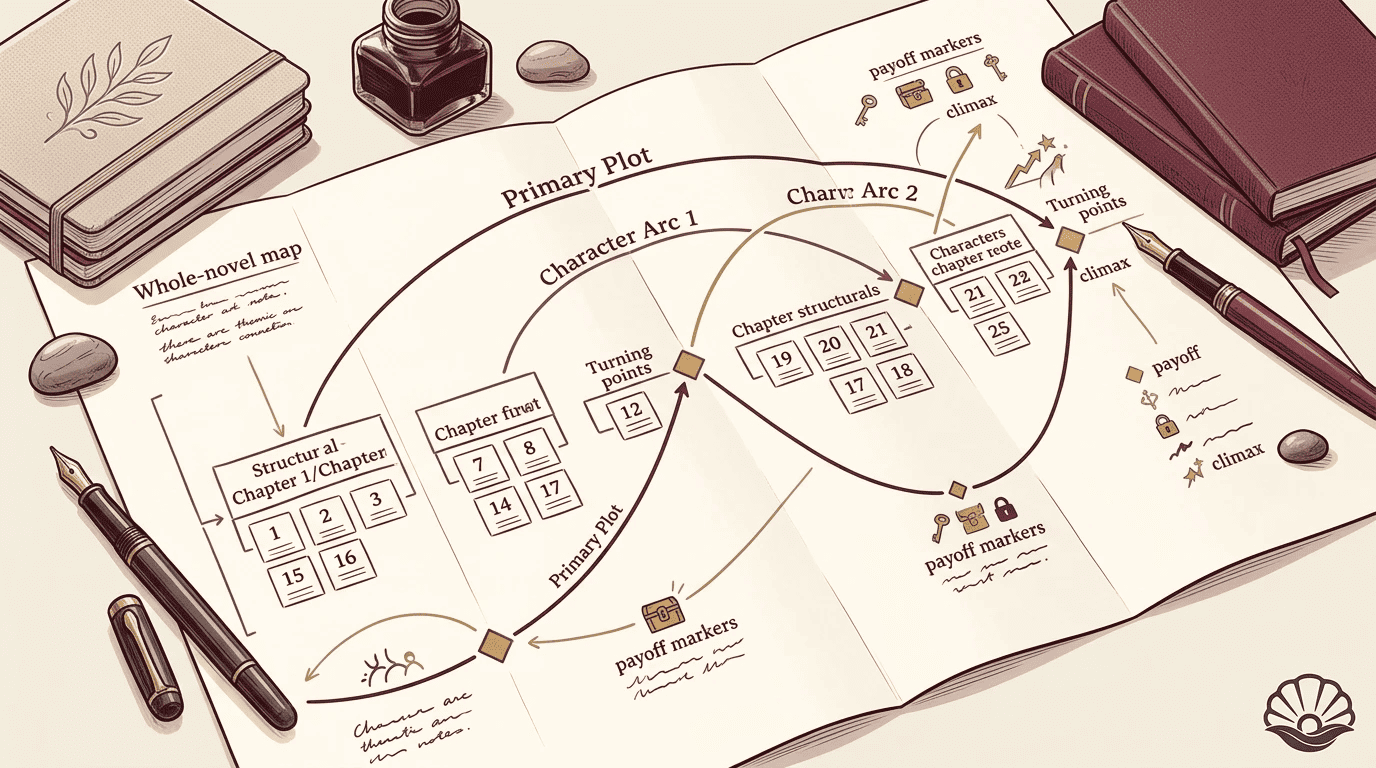
Novel Outline Template for Fiction Writers| SeaBell
Copy a practical novel outline template for premise, acts, turning points, character arcs, subplots, and the handoff into chapter planning.
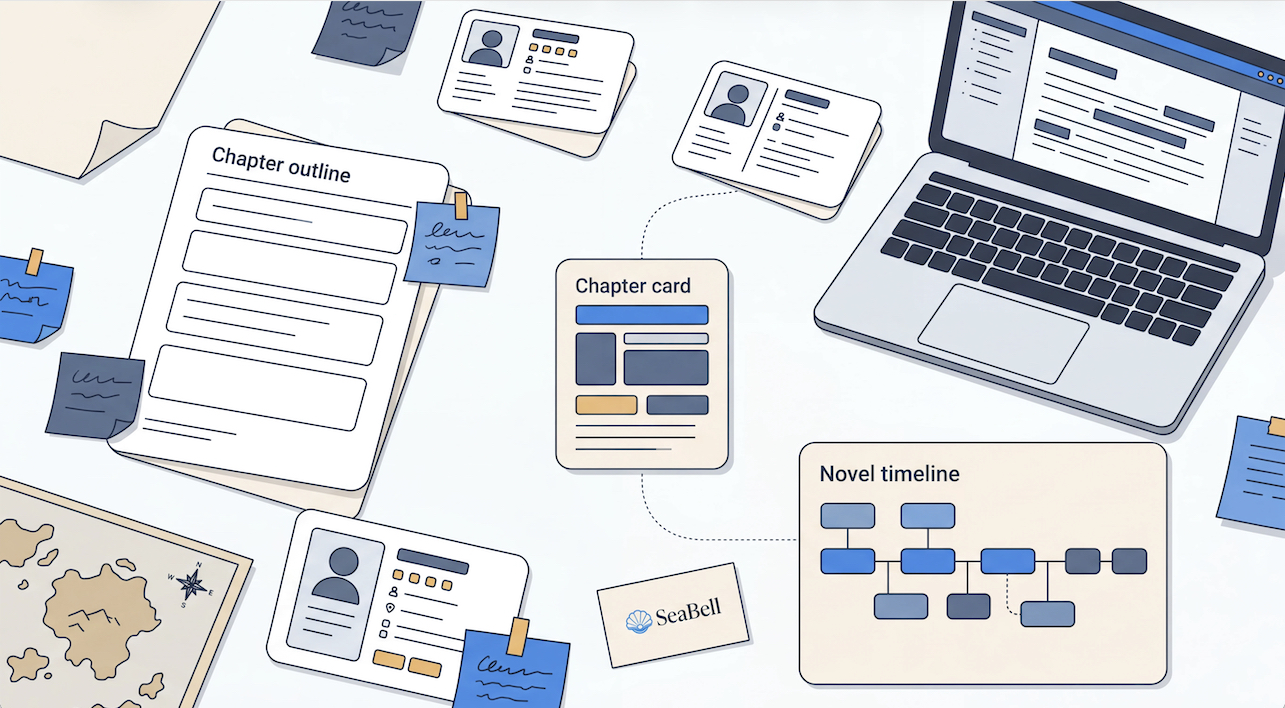
Chapter Outline Template for Novel Writers
Use this chapter outline template to plan POV, conflict, character change, continuity notes, and ending hooks before drafting your next novel chapter.