

Character Motivation for Writers: A 5-Part Framework | SeaBell
Character motivation is the force that turns a threatened desire into a choice with a cost. It is not just what a character wants; it is why that want becomes urgent, what they are afraid of losing, and what they do when the safe option disappears.
A character can have a detailed backstory, a tragic wound, and a beautiful profile page and still feel passive on the page. The symptom is usually easy to spot: the character explains feelings, remembers pain, or states a goal, but the scene still has to push them from the outside because they never make a costly move of their own.
If you are still diagnosing who your character is, start with broader character development questions. This guide is narrower. It is for the moment when you already know enough about the character, but their choices still feel like they are being carried by the plot.
🧭 What is character motivation in fiction?
In fiction, character motivation is the reason a character acts when doing nothing would be safer. It connects an inner drive to an outward decision: what the character pursues, what they avoid, and what price they are willing to pay.
A cautious character may avoid risk in general, but motivation explains why this particular risk finally matters. A goal gives the visible target: win the appointment, hide the letter, reach the city before dawn. Motivation explains what the character believes will happen if they fail, and why that belief changes the next choice.
Backstory is different again. Backstory can explain where the wound came from, but it is not useful until it changes present behavior. A betrayal in chapter one hundred of the character’s history does not create story movement by itself. It becomes motivation when the character now refuses to ask for help, burns a bridge too early, or lies because dependence feels more dangerous than guilt.
Most flat motivation is not too simple; it is too static. The writer knows the character wants something, but the story never makes that want expensive enough to reveal what the character protects.
🧩 The five parts of a usable character motivation
A usable motivation is not five labels filled in on a profile. Each part has to change what the character can plausibly do in a scene. If a part does not affect a visible choice, it may still be useful background, but it is not yet active motivation.
| Part | What it does in the story | Common failure |
|---|---|---|
| Want | Gives the character a concrete result to pursue. | The want is abstract, such as “freedom” or “respect,” with no visible object or deadline. |
| Need | Points toward the change that would stop the character from repeating the same old strategy. | The need is a moral lesson, not a behavioral shift. |
| Fear | Defines the cost the character believes failure will bring. | Fear is written as an adjective, such as “insecure,” instead of a strategy the reader can see. |
| Wound | Explains why the old strategy once made sense. | The wound becomes lore or trauma decoration instead of a rule the character still obeys. |
| Pressure | Removes the safe delay and forces a choice now. | The pressure changes the plot situation but does not make the character’s usual defense more expensive. |
Here is the chain in its simplest form:
Want is threatened → fear activates → the wound supplies an old defense → pressure removes the easy exit → the character chooses between the defense and the need.
The most useful version of a wound is not a diagnostic label. It is a private rule. “Therefore I must never owe anyone.” “Therefore I must always know first.” “Therefore I must leave before I can be left.” Once the wound becomes a rule, the writer can put pressure on it.
When a protagonist has a strong backstory but weak choices, the wound often explains emotion but not tactics. The character may feel abandoned, betrayed, or ashamed, yet under stress repeat no recognizable move: they do not hide information, test loyalty, refuse help, attack first, or leave early. A wound becomes playable when it produces a repeatable defense.
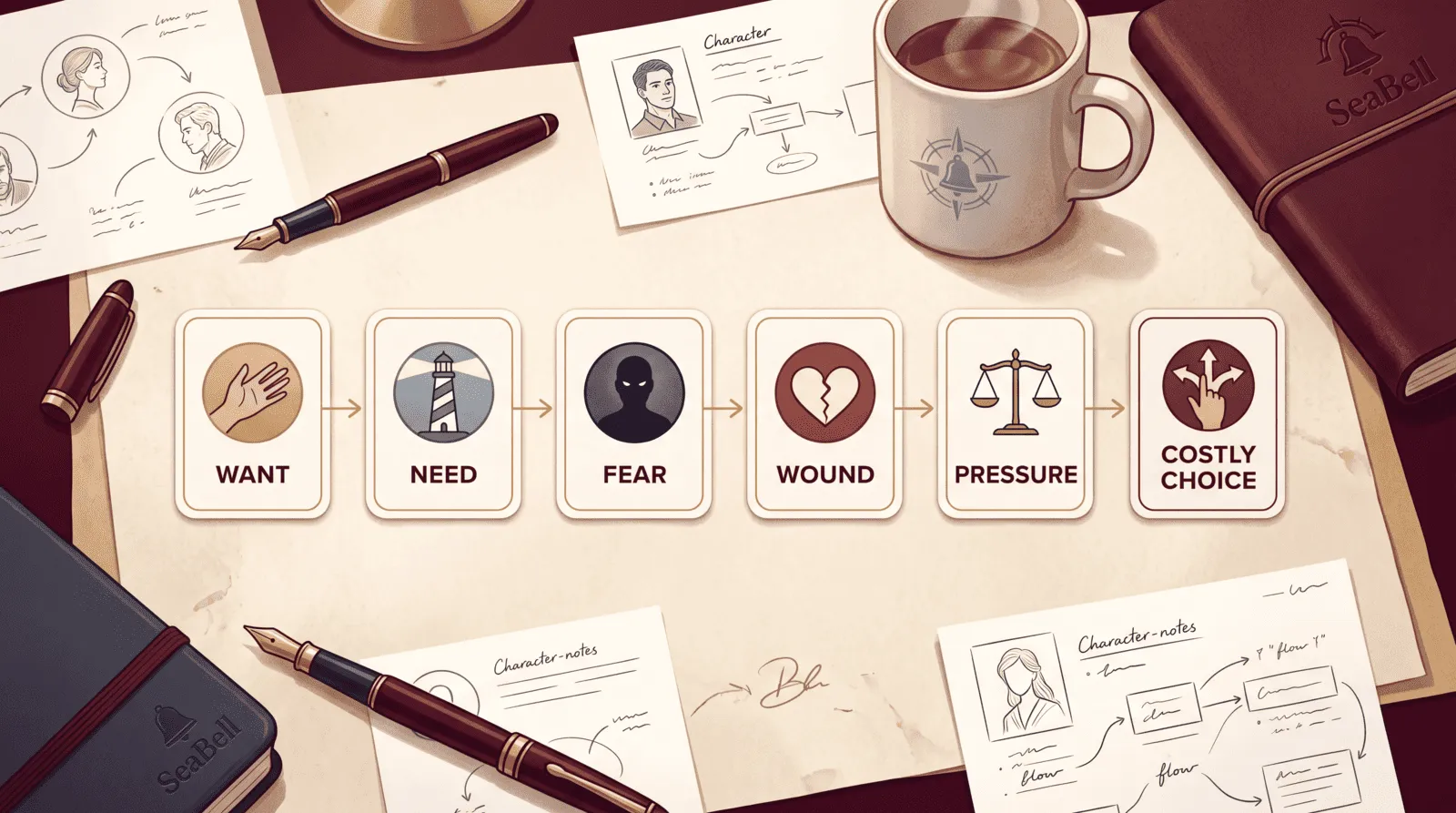
⚙️ Turn the five parts into a motivation engine
Let’s use one compact fiction setup.
An archivist wants a public appointment that would help clear her family’s debt. The post would make her visible, legitimate, and safe from the creditors circling her mother’s estate. What she needs is not simply “confidence.” She needs to accept that trust can be chosen carefully instead of avoided completely.
Before the crisis, her fear already has a shape. She keeps duplicate keys, copies records before anyone asks, answers offers of help with a polite delay, and never lets another clerk know which document matters most. Years ago, a mentor used her request for protection to force her into falsifying a minor record. She survived by deciding that asking for help always creates a debt. Her old defense is control: if no one holds part of the truth, no one can use it against her.
Now add pressure. On the night before the appointment hearing, she discovers that the only record proving her family’s claim has been altered. A witness can expose the forgery, but the witness is also the one person who knows about her mentor’s old crime. If she asks for help, she risks becoming dependent again. If she forges a correction herself, she may win the appointment by becoming exactly the kind of official she despises.
The labels “she wants security” and “she has trust issues” are not yet motivation on the page. The engine becomes active when every plausible choice costs her something.
The pressure matters because it does not merely create a plot problem. It attacks the character’s preferred survival strategy. She cannot solve this cleanly by staying private, delaying, or controlling every variable.
In this example, if the archivist could still protect the appointment by staying private and controlling the record alone, the pressure would not be strong enough yet.
📌 Character motivation examples that create plot
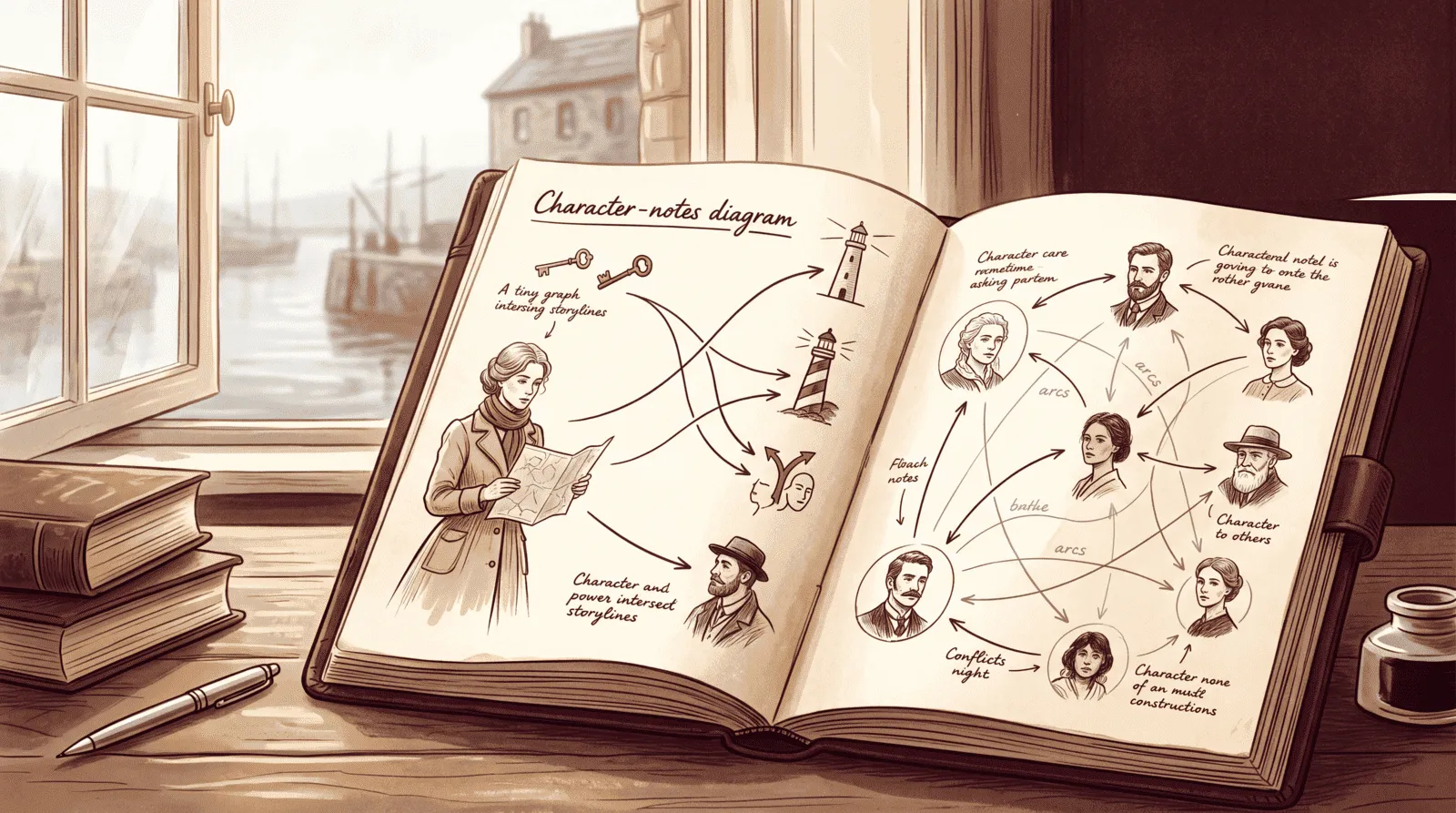
The same pressure point can push the plot in three directions.
First, the safe old defense. The archivist forges the correction herself and avoids the witness. This protects her from dependence, but it gives an enemy real evidence against her. The next scene is no longer just a hearing; it is a trap where anyone who notices the different handwriting can own her future. She has moved the plot forward by doubling down on the rule that hurt her.
Second, the costly escalation. She threatens the witness before he can expose her. This is more active than the first option, but it still comes from fear. The witness now has a reason to fight back, bargain harder, or turn a private secret into a public weapon. Her self-image also cracks: she wanted the appointment to become a just custodian of records, yet she is using power the way her mentor did.
Third, the choice that moves toward the need. She tells the witness enough truth to ask for his testimony, while keeping one boundary: if he tries to use the old crime as leverage, she will disclose her role in the earlier falsification and withdraw from the appointment. This choice is not clean or soft. It may cost her the post, and it gives another person real influence over the next scene. But it moves her from total control toward selective trust.
That is how character motivation affects plot: one pressure point changes which doors open, which relationships become dangerous, and which version of the character becomes harder to deny. A motivation example earns its place when it changes what can happen next.
🤝 When another character becomes the pressure
A relationship becomes story pressure when another person’s goal, secret, power, or need makes the protagonist’s preferred strategy more expensive.
In the archivist example, the witness is not important because he is “a love interest,” “an opponent,” or “a morally gray ally.” He matters because he can force the protagonist to confront the exact rule she has lived by: never owe anyone. If he were merely helpful, the scene would soften. If he were merely hostile, the choice would become simple. His power comes from being useful and dangerous at the same time.
He also makes her usual tactics fail. If she keeps the secret, the damaged record stands. If she controls the document alone, he can still contradict her. If she avoids him, the hearing happens without the only testimony that can save her claim. The relationship is pressure because his presence turns secrecy, control, and avoidance into costs rather than solutions.
If the relationship pressure needs to carry across chapters, track the power shift, secret, recent change, and unresolved consequence in a character relationship chart template. The motivation work stays here; the chart is useful when that pressure becomes a continuing relationship state.
🎬 Carry the motive into the next scene
Once the motivation engine is clear, do not carry all five parts into every scene as exposition. Carry the next decision.
For the archivist, the next scene brief might be:
She enters the hearing room planning to submit the corrected record without naming the witness. When the examiner asks who verified it, she must choose between protecting herself with another lie or naming the witness and giving him power over the outcome.
The active pressure is the examiner’s question. The choice is between control and selective trust: she can keep the record clean-looking by lying again, or she can make the witness visible and lose full control of the outcome.
The want, fear, wound, and need are present without a paragraph of interior analysis; they have become a choice the scene can test.
For execution, the motivation engine can hand off to a scene card template: the engine tells you what kind of choice must hurt, and the scene card helps you place that choice inside a specific dramatic turn.
📚 Keep an active motivation usable across a long draft
In a short story or one-off scene, you may be able to keep the whole motivation chain in your head. In a long novel, serial draft, or AI-assisted writing workflow, the danger is different: the motivation exists somewhere in your notes, but it is not close enough to influence chapter-level choices.
You do not need every piece of backstory beside the draft. You need the active parts:
- current want;
- fear as observable behavior;
- old defense supplied by the wound;
- present pressure;
- arc state: whether the character is repeating the defense, testing the need, or paying for a new choice.
Motivation drift can be quiet: chapter eight says the character is learning to trust, but chapter twelve has them hide evidence because the writer reused an older character state rather than choosing a relapse.
Once you know which desire, fear, and pressure are active in the current chapter, the useful next step is keeping that small context close to the draft. SeaBell’s AI character card for novel writing can hold the recurring motivation and arc state, while the next scene still needs a writer-chosen decision. SeaBell does not generate motivation, guarantee continuity, or replace revision; it keeps the writer’s chosen direction beside the draft.
⚠️ Common character motivation mistakes
An abstract want is the first warning sign. “She wants freedom” may be true, but a scene needs a target that can be blocked: a ship ticket, public appointment, locked room, destroyed contract, or name cleared before sunrise.
Another common mistake is treating the wound as exposition. A wound should not sit in the story like a sad fact. It should produce behavior the reader can notice before the character explains it. If the character was betrayed, look for the tactic now: hiding evidence, testing loyalty, refusing gifts, leaving first, keeping receipts, or choosing loneliness over obligation.
Pressure with no cost is only noise. A deadline, villain, argument, or missing object is not enough unless it makes the character’s usual strategy fail. Check whether the protagonist can still avoid the scene, lie without consequence, or get the want without confronting fear. If so, the motivation engine has not engaged.
Giving the character the need too early can flatten the arc. If the archivist learns to trust in the first act and never pays for it, the need becomes a slogan. Let the old defense work sometimes. Let the new choice cost something. Growth feels earned when the reader understands why the character resisted it.
The fifth mistake is making every relationship trigger the same reaction. If every person makes the protagonist guarded, every scene starts to prove the same point. One relationship might tempt control. Another might tempt honesty. Another might expose how the old defense hurts someone innocent. Motivation becomes richer when different pressures reveal different edges of the same wound.
❓ FAQ
What is character motivation?
Character motivation is the reason a character acts when a desire is threatened and the choice has a cost. In fiction, it connects what the character wants, what they fear, what old defense they rely on, and what pressure forces them to act now.
What is the difference between a character goal and a motivation?
A character goal is the visible result the character is trying to reach. Motivation is the deeper force that makes that goal urgent and explains what the character will risk, hide, sacrifice, or betray to pursue it. The goal says where the character is going; the motivation explains why failure feels dangerous.
How does character motivation affect plot?
Character motivation affects plot by changing the choices a character makes under pressure. Two characters can face the same obstacle and produce different consequences because one hides, another attacks, and another risks an alliance. The plot moves when the choice changes what is possible next.
What are examples of character motivation?
Examples of character motivation include an archivist seeking public legitimacy because debt threatens her family, then hiding evidence because dependence once became leverage. A smuggler might want to clear her brother’s debt but refuse a partner’s help because a shared plan once ended in betrayal; when the border closes, she must choose between trusting the partner and abandoning the rescue. In each case, a specific want meets a fear-driven behavior and a pressure point that forces a choice.
How do I write a character motivation without making a long backstory?
Write the rule the backstory created, not the whole backstory. Instead of explaining five pages of betrayal, name the present behavior: “She never asks for help because help once became leverage.” Then put that rule under pressure in the next scene.