
Writing Tension in Fiction: Lessons from The Bear | SeaBell
What The Bear Teaches Fiction Writers About Scene Pressure
FX's The Bear has reached its fifth and final season, which premiered on June 25, 2026. For fiction writers, the useful lesson is not that tense scenes need yelling. It is that ordinary work becomes dramatic when every task carries emotional, professional, and relational pressure.
A kitchen rush is just movement until the audience understands what the movement could cost: money, reputation, trust, pride, family repair, or the one chance a character may not get again. That is the craft question behind writing tension: what pressure is the scene supposed to carry, and is that pressure actually present on the page?
🧭 Tension Is Pressure With Direction
Tension is not action. A scene can have rapid movement and zero tension. A fistfight in a novel is not automatically tense if the reader does not understand what is at stake for the person throwing the punch.
Tension is not danger, either. Characters can face physical threat and remain emotionally flat if the reader does not know what the character stands to lose.
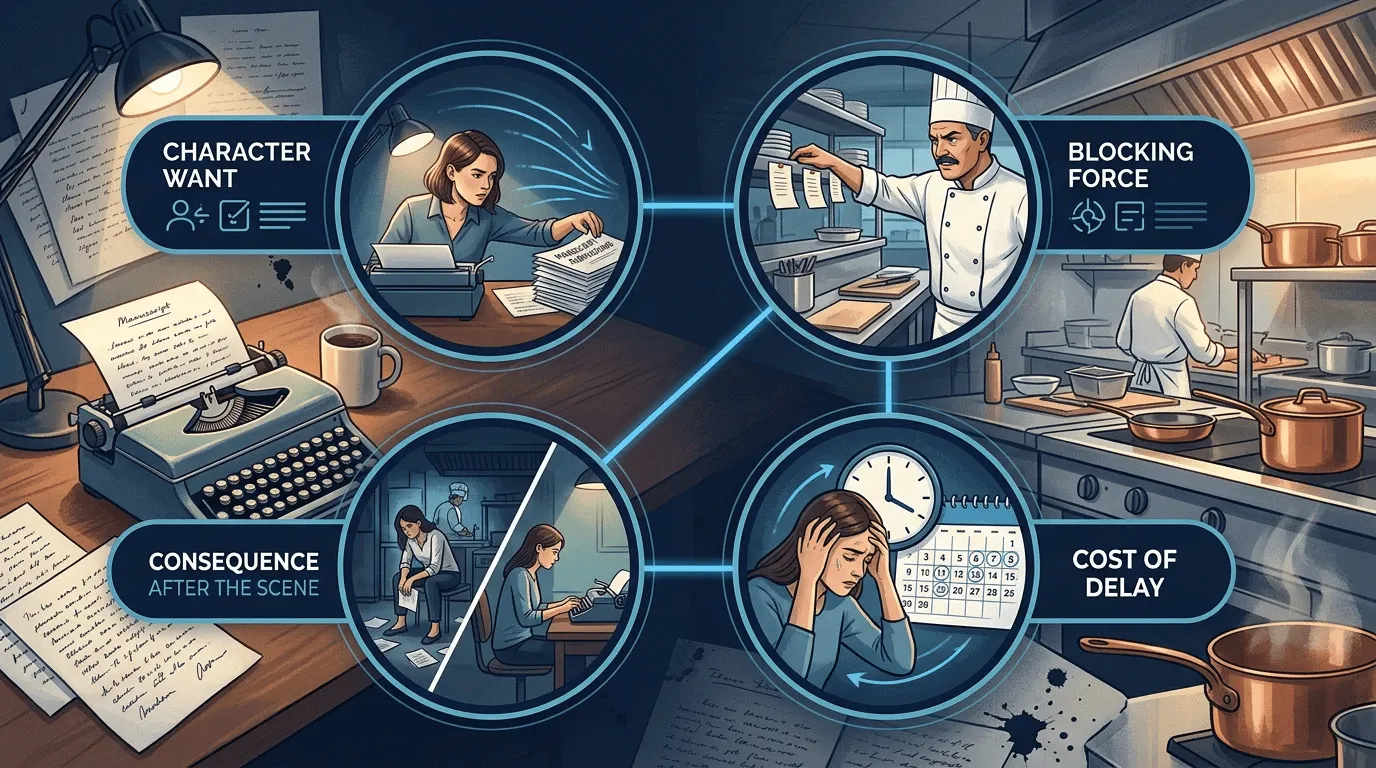
Tension is the gap between what a character wants and what the scene makes difficult. It appears when the reader understands what could change, worsen, be exposed, or be lost before the scene resolves.
This is why The Bear works. A restaurant service is not inherently dramatic. You have seen people cook and serve food. But when a kitchen becomes the place where grief, debt, pride, and exhaustion all have to keep moving at the same time, the task is no longer just a task. It is carrying weight. The rush does not need loud music to feel urgent—it needs the audience to know that if this service fails, something outside the kitchen breaks.
A quiet scene can be deeply tense if the reader knows which apology will not be made, which question cannot be answered, or which door is about to close.
🔥 The Bear Works Because Stress Is Layered, Not Random
Here is the writing lesson The Bear keeps demonstrating: stress is not enough. Adding conflict is easy. Adding noise is easier. But a scene where everyone is upset for unrelated reasons reads as chaos, not tension.
The Bear is loud, but the useful writing lesson is not volume. It is compression. Different pressures are forced into the same small space, and nobody gets to step outside the scene until something changes.
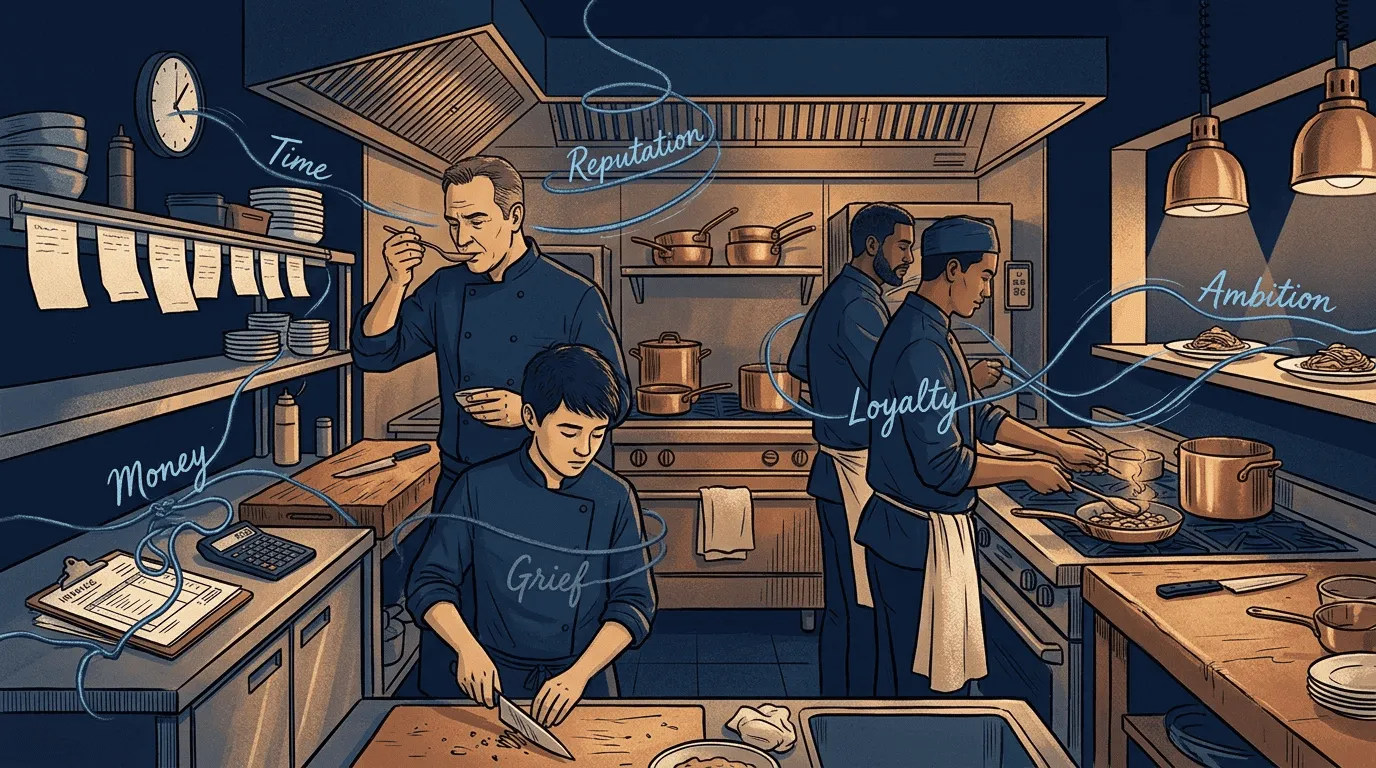
In a kitchen, you might have:
- A head chef who needs this service to go perfectly because the restaurant's reputation—and their ability to keep the doors open—is on the line.
- A sous chef who has been waiting for a real chance to prove they can lead, and who is terrified of wasting it.
- A family member who does not want to be here but cannot leave without resolving something unspoken.
- A line cook who is carrying personal grief that has nothing to do with the food and everything to do with why they took this job in the first place.
None of these pressures are the same. They do not cancel each other out. They stack. When the ticket printer fires, every person in that room is trying to protect a different outcome, and the outcomes are incompatible.
That is where the tension lives. Not in the speed, but in the collision.
🎯 Give Characters Opposing Goals, Not Just Opposing Personalities
A common failure in fiction: two characters argue, the dialogue sounds lively, and yet nothing changes. The reader finishes the page unsure what was actually at stake.
This often happens when conflict is built on personality rather than goals. "She is controlling and he is stubborn" is not a scene. It is a description.
Tension strengthens when two characters need incompatible outcomes, and both outcomes are concrete. The reader should understand what each person is protecting and why those protections cannot both succeed.
Think about a restaurant scene where one character needs speed, another needs precision, a third needs control, and a fourth needs recognition. The conflict is not "they are all stressed." The conflict is that each person's solution threatens someone else's need. One character's win is another character's problem.
The same pattern works outside a kitchen. In a romance scene, one character may need honesty while the other needs safety; in a fantasy court, a public apology may save a treaty but expose a family secret. The setting changes, but the pressure works the same way: one necessary outcome damages another.
This is why opposing goals create more useful tension than clashing personalities. When you know what each character is fighting for, you know what they will sacrifice, what they will not say, and what they are willing to risk. Personality explains why someone snaps. Goal conflict explains why the scene cannot be solved cleanly.
📌 Add Stakes That Survive After the Scene Ends
A scene can have opposing goals and still feel flat if the outcome does not matter beyond the page.
This is the consequence problem. If a character fails or succeeds, and the next scene proceeds as if nothing changed, readers sense the disconnect. The story starts to feel hollow because the pressure leaves no mark.
Tension deepens when stakes outlive the scene. The final season of The Bear makes that especially clear: money is running out, a sale is possible, a storm is closing in, one last service has to work, and the kitchen is still chasing a Michelin star. These pressures are not background color—they are all pointing at the same service, which means every failed plate, every argument between staff, every moment of hesitation carries weight beyond the kitchen.
When you put multiple high-stakes pressures around the same task, the task stops being just a task. It becomes the place where money, reputation, ambition, and family damage all press on the same service.
Stakes can be professional, financial, emotional, relational, or moral. The key is that something gets worse—or better—after the scene, and that shift matters for what comes next.
When you are drafting a scene, ask: what is different after this scene ends? If the answer is "not much," the tension is not landing yet. The scene might be earning its page count without earning its emotional weight.
For writers tracking how consequences carry into the next chapter, a chapter outline template can help map which pressures survive and what they affect.
⏳ Use Time Pressure Without Making the Scene Feel Mechanical
Deadlines are one of the most reliable tension tools. When a character has to decide now, before they have enough information, before they have time to think it through—decision under compression is almost always tense.
But time pressure is easy to misuse. A countdown clock is not inherently dramatic. If the time limit merely means "faster, please," the scene feels mechanical. Readers do not care about a clock; they care about what the clock makes impossible.
Good time pressure removes a good option. When a deadline forces a choice between two things the character cares about, the tension becomes personal. Time pressure can also be emotional rather than logistical. "Say it now or lose the chance" is a time limit that has nothing to do with clocks.
In a kitchen, service windows create constant time pressure. But the craft lesson is not "add a deadline." The lesson is: time pressure compresses choices. If the compression makes every option painful, the tension works.
💬 Let Dialogue Carry Subtext
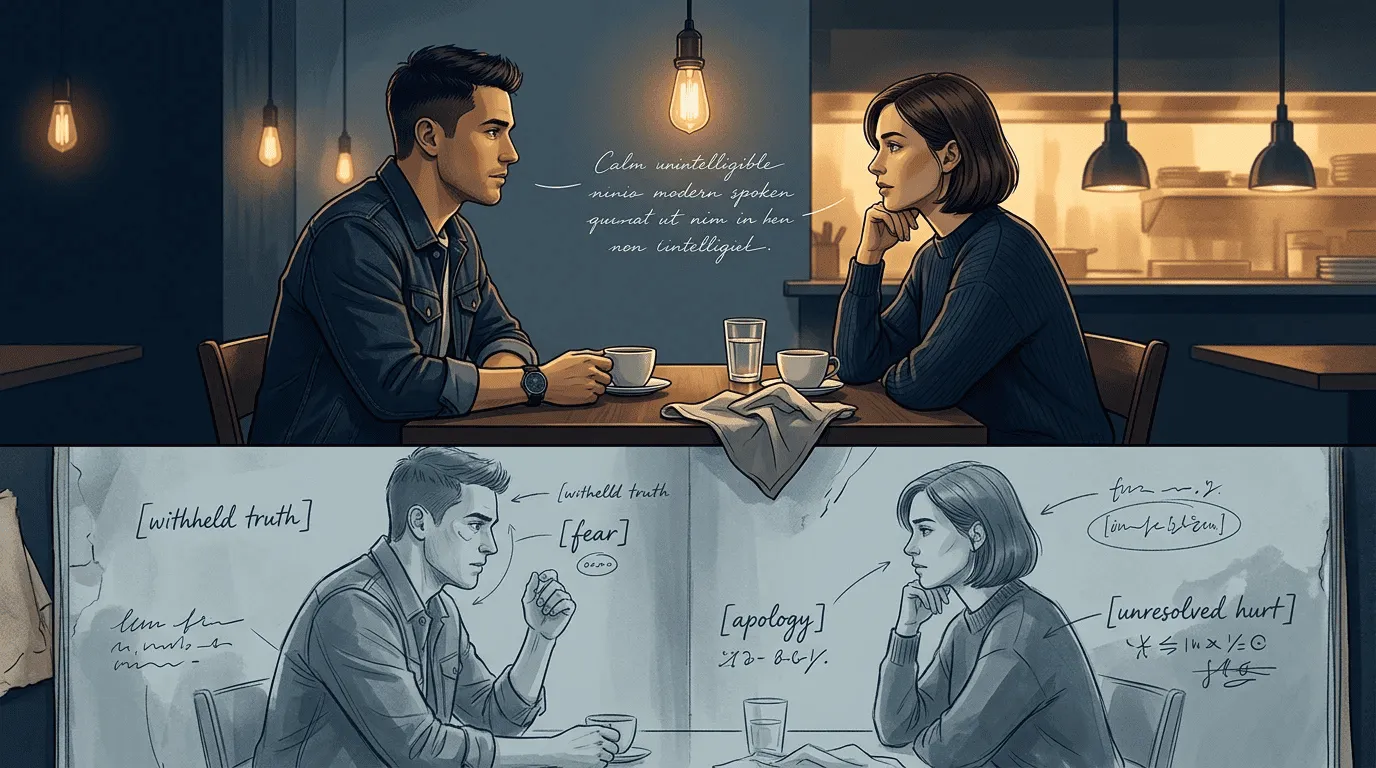
One of the fastest ways to kill tension in dialogue is to let characters say exactly what they mean. Directness is not bad, but when every line states the emotional truth plainly, the scene loses its pressure.
Tense dialogue often says one thing while protecting another. Characters speak around the wound before they can name it. The thing they are actually communicating is often what they cannot safely say.
A character says "We are fine on time" when they mean "If this service fails, I am finished." A family member criticizes a recipe but is really criticizing years of abandonment—the food is just the safe surface of a conversation that has no safe depth. A colleague deflects with professionalism when the real issue is hurt and resentment that has been accumulating for months.
This is subtext. The tension in dialogue is not what is said—it is what the line is deflecting from, protecting, or dancing around. When you notice which lines of dialogue could be stated more directly, those are often where the tension lives. The moment a character names the wound directly, the tension often releases—which is fine if that release is earned, and terrible if it happens too soon.
AI-assisted drafts often go soft here. A prompt for "tense dialogue" may produce clipped lines and raised voices, but still avoid the one thing the characters are protecting. The fix is not to ask for more anger. It is to name what each speaker cannot safely say.
🧩 Keep One Thing Unresolved
Tension has a lifespan. When a scene resolves completely, the reader's attention relaxes. Some scenes should release pressure and let the reader breathe. But if every scene resolves completely, the story starts to feel episodic. Each chapter becomes a contained unit that does not connect to the next in terms of emotional weight.
Good tension across a longer piece depends on partial resolution. A scene can solve the immediate task—service ends, the argument pauses, the decision gets made—but leave an emotional debt unpaid. The immediate problem is handled. The relationship problem is not.
This is where serial fiction especially has to be careful. If a chapter ends with every conflict addressed and every relationship in a clear place, the next chapter has to rebuild pressure from the ground up. But if the chapter solves the plot problem while leaving a relationship wound open, the next chapter starts with the pressure already built.
In The Bear, this is everywhere. A service ends. The food goes out. The kitchen gets its breath—but the conversation that was waiting underneath does not happen. The repair does not come. The tension carries forward into the next episode, the next service, the next confrontation that seems like it is about food but is actually about the thing that was never said.
When you are mapping relationship pressure that cannot resolve yet, a character relationship chart template can help track what is owed between characters without resolving it on the page.
🔍 How to Build Tension in a Scene: Ask What Pressure Is Missing
If you have a scene that feels like it should work but does not—if events are happening, characters are talking, nothing is wrong with the sentences, and yet the page feels flat—the diagnosis usually comes down to pressure.
A common pattern: a scene has three arguments in a row and still feels flat. The issue is rarely that the conflict is too small. It is that every argument has the same outcome—nobody loses access, status, trust, time, or leverage. The scene happens without anything actually changing. That is the stall readers feel. Use the questions below to find where the pressure is missing.
Before you revise, ask these questions:
- What does the POV character want right now? Be specific. Not "she wants to be happy," but "she needs him to admit he was wrong before she can move forward."
- Who or what blocks it? The blocker is not automatically another character. It can be circumstance, time, information, their own hesitation, or an external event.
- What gets worse if they delay? If the answer is "nothing," the scene lacks urgency. Delay has to cost something.
- What truth is being withheld? This may be factual information, but it may also be fear, shame, desire, resentment, or an apology the character cannot safely make.
- What relationship cannot safely resolve yet? A relationship where everything is either fine or completely broken is not carrying tension. The tension is in the middle—the place where they care but cannot close the distance.
- What will be different after the scene? If nothing changes, the scene might be earning its length without earning its place in the story.
- Which line of dialogue is carrying subtext? Find the line where the character is saying one thing and protecting another.
🛠️ Turn Tension Into Drafting Context
Once you have identified the source of tension for a scene, the next challenge is keeping it alive while you draft. Tension sources tend to scatter. The character goal is in one place in your notes. The relationship state is somewhere else. The chapter consequence is somewhere else again. When you sit down to write, you are rebuilding the pressure from scratch each session.
The craft decision is already made. The problem is the workflow: how do you keep those decisions close to the draft so the next session does not start from zero?
SeaBell fits the handoff after the craft decision is made. The tension still has to come from the writer: the goal, the block, the withheld truth, the relationship state, and the consequence. The workflow problem is simpler but easy to lose: keeping those choices beside the draft so the next scene does not start from a blank prompt.
A scene card template is the next step when the diagnosis is clear but the draft still needs a narrow brief: what pressure the scene carries, what cannot resolve yet, and what must change before the scene ends.
❓ FAQ
What is writing tension?
Writing tension is the pressure a scene carries before it resolves. It appears when the reader understands what could change, worsen, be exposed, or be lost before the scene ends.
How do you build tension in a scene?
Give the POV character a specific want, block it with a specific force, and make delay cost something. Then make sure the scene changes the next scene, even if the immediate problem only partially resolves.
What is the difference between tension and conflict?
Conflict is the opposition. Tension is the pressure created while that opposition remains unresolved. Two characters can argue with no tension if the reader does not know what either person stands to lose.
How can dialogue create tension?
Dialogue creates tension when characters speak around what they cannot safely say. The surface line may be about timing, work, food, or politeness, while the real pressure comes from hurt, fear, desire, guilt, or withheld information.
How do you keep tension from becoming melodrama?
Make the stakes concrete instead of inflated. Do not just announce that everything matters; show what the character will lose, who will notice, what choice disappears, or which relationship cannot return to neutral.