

How to Write a Dystopian Novel That Feels Lived In | SeaBell
How to Write a Dystopian Novel That Feels Lived In
A dystopian premise can sound enormous and still feel hollow. You have the surveillance state, the propaganda slogans, the ministry with a sinister name. You have fifty pages of notes on how the regime rose. And still the draft reads like a stack of labels: the government is evil, the citizens are afraid, the hero is special.
When writers ask how to write a dystopian novel, that gap is what makes the work harder than expected. The concept is rarely the problem; the trouble is that the world never shows up in what people do.
A lived-in dystopia operates at the level of an ordinary Tuesday. It appears in an intake form or a queue, in a timetable or a sentence a teenager repeats at dinner without thinking. The rules are not explained first. They are obeyed first.
This guide moves from society-level design down to scene-level writing, using one example throughout: a city that promises free medical care but ranks patients by a public "social usefulness" score. The protagonist, Sorrel, is a clerk in the clinic that maintains the score, and her brother's treatment depends on the system. You will build the argument, the compliant system, the dependent protagonist, and the consequences that escalate from there.
Start With the Argument Behind the Dystopia
Before you design a single law, decide which fear you are extending. Dystopian fiction starts from a pressure people already recognize: being watched, being ranked, being priced out of care, being quietly sorted into categories. The genre pushes that pressure one step past what society currently admits.
Write down the question your novel is testing; leave the theme you want to announce for later. "Authoritarianism is bad" is not a question. "Would a sister accept a ranking system that saves her brother?" is. A question can be tested by scenes, while a slogan can only be repeated.
"Surveillance state" is a label any writer can rent. An argument is a claim, like this one: a society will accept almost any cruelty delivered as care.
One strong argument is worth more than five disconnected issues. Every extra issue (media control, environmental collapse, class war, algorithmic bias) splits the reader's attention and gives your rules no center. Pick the pressure that reaches your protagonist's life, and let the other problems exist only where they touch it.
One boundary keeps this clean. The approach here organizes the novel around a system of control rather than the collapse itself. The two can overlap in one book. But a ruined landscape with no governing order is a different kind of story, and for this kind of story, dystopia is about what the rules require and what complying costs.
Try this exercise before moving on:
This society promises ____. To deliver that promise, it requires ____. The cost is paid by ____.
In our running example: the city promises free medical care for everyone. To deliver that promise, it requires treatment priority to follow a public social usefulness score. The cost is paid by the patients whose records the score is built on.
If you cannot fill those three blanks yet, keep digging. Every section below depends on them.
🏙️ Design a System People Could Actually Comply With
Most dystopia drafts go wrong at this step. Writers design oppression; readers need the terms people live under. A regime everyone rejects on sight is a cartoon; the believable version is a set of compromises people can defend in public, and do, every day.
These six fields make a system feel real:
- Public promise: What benefit does the system claim to provide? Free, reliable medical care for every resident, with no billing and no way to buy a better place in line.
- Daily rule: What must ordinary people do? Keep your score current: log work hours, clinic visits, dependents, and community service at the local office or through the home terminal.
- Visible reward: Why does compliance feel reasonable? A score of 70 or above opens same-week appointments, private recovery rooms, and priority for specialists. Compliance is visible, immediate, and shared with neighbors.
- Unacknowledged cost: Who pays for the stability? Low-score patients are scheduled last. When the queue tightens, the appointments that slip belong to patients with no one at the desk watching for them.
- Enforcement mechanism: What happens when someone refuses? Missed logging drops the score, and a dropped score delays care, housing renewal, and school placement. Nothing is announced as punishment. The same-week calendar simply stops opening.
- Social participation: How do ordinary people help the system continue? Clerks apply the rule because it is their job. Families nag each other about logging hours. Neighbors compare scores in the queue. The system runs on ordinary people doing ordinary things.
If only the secret police keep the world running, the story is closer to a villain plot than to a society. Sorrel maintains the patient scores herself. She is not a guard; she is a clerk with a keyboard.
A quick test for each rule you invent: can a character defend it in one sentence, without irony? "The score keeps the queue fair. Everyone can see where they stand." If no one in the story could say that with a straight face, treat the rule as too naked to generate compliance; it will read as a prop.
A worldbuilding template for fiction writers gives those six fields one home as the project grows, next to your factions, locations, and canon notes. The point is to keep a usable record while the rest of the world stays unfinished.
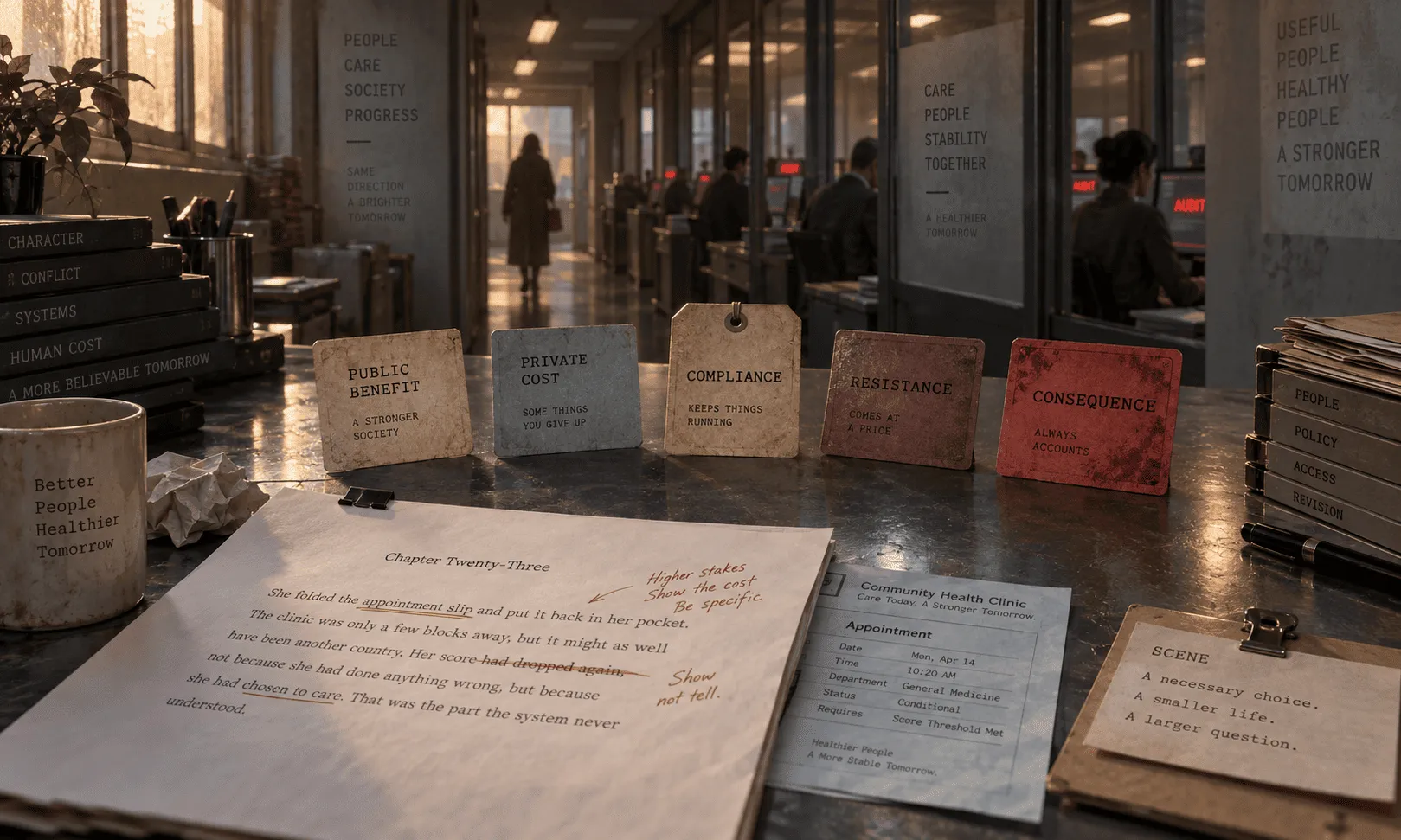
🛠️ Show the System Through Ordinary Routines
Bring the system down to street level. The details that carry the most weight are the ones readers already recognize from their own lives:
- A clinic intake form.
- A school timetable.
- A workplace ranking board.
- A ration queue.
- A housing renewal notice.
- A public announcement.
- A family conversation where someone repeats the official language without noticing.
The rule should arrive through an action, an object, an interruption, or a choice, before it ever receives a full explanation.
As pure exposition, it reads like this:
The city's Health Priority Act had reformed medical triage by tying treatment order to social usefulness. Citizens complied because the system was efficient and the penalties for fraud were severe.
Nothing happens in that paragraph; the reader is told about the world instead of standing inside it.
Now the same information, staged as a routine:
At the intake desk, Sorrel types her brother's ID and watches the score field load: 61. The appointment calendar only opens same-week slots for patients at 70 or above. She tabs to the override field, hesitates, and closes it. Her supervisor walks past and glances at the screen without breaking stride.
The rule arrives as an object (the score field), an action (the override she does not use), and an interruption (the supervisor). The reader understands the mechanism before anyone explains the law. Explanation can come later, or never in full.
The staged version leaves behind a number that can move, a threshold that can be crossed, and a person whose treatment rides on both.
Give the Protagonist Something to Lose Inside the System
An instant rebel is hard to put under pressure. If your protagonist hates the regime on page one and holds nothing inside it, the system can only threaten someone who never accepted it, and a threat to a person with no stake reads as noise. The one exception is a determined outsider, and even then the system has to be able to demand something of that outsider.
The protagonist here benefits from the system, depends on it, or helps operate it. Compliance was rational for them. That is what makes resistance expensive. The hero also has to care about something that exists independently of the system, while the system controls the means of getting it. Sorrel's brother would need treatment no matter who ran the clinic; what the score controls is when he receives it.
Four kinds of dependency work well:
- Material dependency: her brother's treatment schedule is tied to her employment at the clinic. She is the one who keeps his file correct; if she loses the job, errors in his file go uncorrected, his score slips, and he loses his priority.
- Relationship dependency: a coworker who covers her shifts; a sibling who believes the system is keeping him alive. Resisting means lying to both.
- Identity or status: she is the one who fixes records. People trust her because she is good at the system's own game. Nine years in, her own record is still clean.
- A promise or professional duty: she promised her mother she would keep her brother in treatment. The duty points in the same direction as compliance.
A protagonist does not need all four; one is enough to start. Decide the first rule they break. Keep it small: correcting one mis-scored record is plenty, and the break still has to cost them something.
These dependencies are where motivation and change begin. If you want to dig into what the character wants, needs, fears, and what wounded them, a character motivation framework covers it, and tracking how those wants change across the story's turns is its own character arc problem. Keep those broader tools in the background here. This article needs exactly one thing from them: the protagonist must have something inside the system worth losing.
Turn Rules Into Scenes and Plot Pressure
A rule that never enters a scene is a note in a document. Force every major rule through a scene card before you draft the chapter:
FieldRule
QuestionWhat does the system require here?
FieldSurface task
QuestionWhat is the character trying to do?
FieldPrivate need
QuestionWhat do they actually need from this situation?
FieldCompliance cost
QuestionWhat do they risk by following the rule?
FieldResistance cost
QuestionWhat do they risk by refusing?
FieldWitness
QuestionWho can reward, expose, or misunderstand them?
FieldNew consequence
QuestionWhat becomes impossible after the scene?
The record-correction scene card, filled in:
Her brother's treatment priority had been restored through the ordinary logging she did for him, and that restored slot pushed another patient's surgery date back. The queue is public and neighbors compare scores in it, so her family watched her brother move up. It shows scores and positions, not other patients' surgery dates. The displaced patient is mis-scored: her documents support a higher score than the system shows. The rule requires every score change to be logged with a reason code. Sorrel's surface task is fixing the data entry error, and her private need is keeping her brother's appointment from slipping again.
The two obvious paths both cost her. Following the rule means logging the correction with a reason code: the decision that pushes her brother back down the queue would carry her name and an official reason. Refusing means the mis-scored patient waits months for treatment she already qualifies for, while the patient's daughter watches from the counter.
Sorrel takes the third path. She fixes the record without a reason code, leaving blank the one field the rule requires. She will not leave the mis-scored patient waiting, and she cannot bring herself to write down the decision that costs her brother his slot. The blank does not hide what she did; the log still records her edit. It only keeps her reasons off the record, so she never has to face what she traded.
The patient moves up the queue and her brother's appointment slips again. Once she helps this patient, the private need is lost; what she gives up in return is the protection of a logged decision. The witness is the same supervisor, walking past on her usual round and glancing at the screen.
The new consequence follows from the missing code. With no reason on the record, the change sits in the log as an unexplained edit, traceable to her but carrying no justification she can point to if anyone asks. When her family files a complaint about her brother's new date, not knowing the change came from her desk, every score change Sorrel has made this month goes under review. Her nine-year clean record is suddenly part of what is at stake, and she can no longer quietly fix anything.
The last field is what earns the scene's place in the book. A scene should change an available option. If nothing becomes harder, more dangerous, or more revealing after the scene, it has described the dystopia without using it. Cut it or rebuild it around a decision.
Reveal the World Without an Exposition Dump
Many writers who draft a dystopia eventually write the paragraph that explains the regime's founding. Start by deleting it. History earns its place only when it changes what the viewpoint character understands about the pressure they are in.
Four channels carry world information without stopping the story:
- Dialogue that assumes shared knowledge. "Don't joke like that in here. The intake mics keep transcripts." Two people who already know the rule never explain it to each other, and the reader leans in to catch up.
- Objects that carry institutional rules. The score field on the intake form. The override button that is always logged. The notice on the housing office wall listing which services a score of 50 still qualifies for.
- Routines that reveal what people fear. A clerk who checks the queue twice before speaking. A father who logs his daughter's study hours like a ritual. Fear is legible in habits long before it appears in narration.
- Contradictions between public language and private consequence. The banner over the clinic entrance reads "Care for every citizen." In the same building, the 61-score patient waits while the 70-score patient walks in.
Run the anti-infodump test on any paragraph that explains the world:
- Can this be shown through a character trying to complete a task?
- Does the information change a choice in the current scene?
- Is the reader learning more than the viewpoint character has a reason to notice?
Treat the test as a diagnostic, not a gate: a paragraph is usually in good shape when the first two answers are yes and the third is no. If you are answering the third question with a yes, trim the paragraph back to what the viewpoint character would notice; the rest can wait in your notes. The practical limit on information is the viewpoint itself: Sorrel knows the day-to-day mechanics of the score rather than the ministry's founding documents, and the reader should know no more than she does.
Build Escalation Around Consequences, Not Bigger Villains
When a middle draft stalls, the instinct is to add a crueler minister and a larger chase. That adds volume without adding pressure.
Map escalation as consequences, in this order:
- The character notices a rule. (The 70-point threshold on the calendar screen.)
- The rule causes a small inconvenience. (Her brother's appointment gets pushed by one week.)
- The character benefits from following it. (She logs her brother's rehabilitation hours and dependents until his score clears the threshold, and the appointment returns.)
- A personal relationship is damaged by it. (Her brother learns that his restored slot pushed another patient's surgery date back, and stops talking to her about his care.)
- The character violates it. (The record-correction scene above: she fixes the mis-scored record of the patient her brother displaced without a reason code, and her brother's appointment slips again.)
- The system adapts or retaliates. (Audit flags appear on every terminal in the department; the override procedure changes; a colleague is questioned.)
- The character must choose which loss to accept. (Her brother's priority, the patient's treatment, or her own record of having stayed clean for nine years.)
Each step is bigger in cost, not in spectacle. By step seven the character is choosing between losses, and the reader understands every term of the choice because they have seen steps one through six. The general mechanics of pressure inside a single scene, like opposing goals, stakes, time limits, and subtext, belong to the broader problem of how tension works in fiction.
🧩 Decide What the Ending Says About the System
Hopeful, ambiguous, and bleak endings can all work in dystopian fiction. None of them can afford an outcome that dodges the story's argument. The question from the first section has to be answered here, and answers cost something.
Ask these five questions of your ending:
- Does the system survive?
- Does the protagonist survive as the same person?
- Who pays for the apparent victory?
- What new rule or responsibility remains?
- Does the ending expose, reform, escape, or reproduce the system?
A hopeful ending might reform one procedure (score changes and their reason codes become visible to the patients they affect, so a mis-score can be appealed) while Sorrel loses her job and her brother's care is delayed for months. A bleak ending might have her cross the line she held at the desk, the one between breaking a rule and lying about it: undo the correction, pass it off as a mis-entry when the audit comes, and watch every appointment go back where it was, the mis-scored patient back to waiting, her clean record staked on the department taking the paperwork at face value. Either way the ending settles the question the novel is testing, and neither version is free.
If the protagonist walks away clean, or the system collapses because one document was published, re-check the whole chain. The ending should feel like the consequence of the rules you built rather than a verdict delivered on top of them.
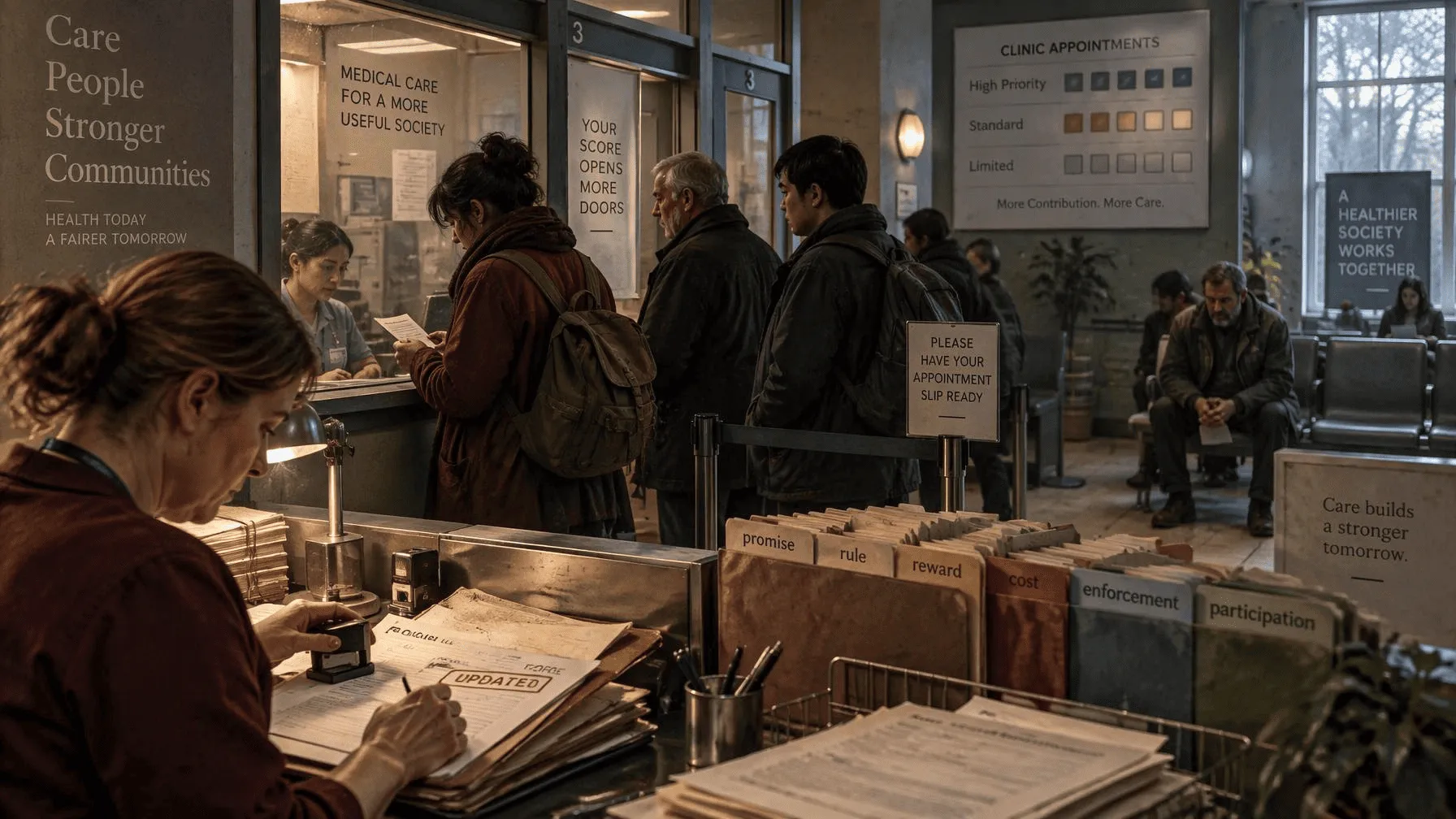
📝 Dystopian Novel Revision Checklist
Advice on how to write dystopian fiction often stops at the premise level: the evil government, the ruined city, the chosen hero. This checklist starts later, when a full draft exists and has to be checked against the rules it actually runs on.
- The system has a public benefit and a private cost.
- People have specific reasons to comply.
- The protagonist depends on something inside the system.
- Rules appear in daily behavior, not only explanations.
- Each major scene changes an option or relationship.
- The antagonist is not the only source of pressure.
- The world is shown through a limited viewpoint.
- The climax forces a meaningful loss or commitment.
- The ending makes a clear argument through consequences.
An unchecked item means one of two things: the rule behind it was never really designed, or it never entered a scene. Fix the world in the first case, and the scenes in the second. A dystopian novel that feels lived in makes its rules cost something scene after scene, whatever the regime is called.
🌊 Keeping the System Visible as the Novel Grows
Once the rules, character dependency, and consequences are written down, the next challenge is keeping them visible while the novel grows. A story bible can hold the governing rules and social costs, while character cards and chapter notes keep each scene tied to the current pressure. SeaBell supports that handoff from planning notes to long-form chapter drafting.
❓ Frequently Asked Questions
What are the key elements of a dystopian novel?
The key elements map onto this guide's sections: an argument the novel is testing, a system built from the six fields above, a protagonist with something inside it to lose, pressure generated by the rules themselves, escalation staged as consequences, and an ending that argues through them. An element is real when a scene would change or collapse without it; if nothing moves, it is still a genre label.
How do you make a dystopian world feel believable?
Start from a recognizable fear or institution, give the system a benefit people would choose, and show its rules operating through ordinary routines: forms, queues, timetables, family talk. What usually goes wrong is a world where nobody behaves like a beneficiary: everyone complains, nobody complies, and the system survives only because the outline says so. The city really does deliver free care, and the believability comes from watching the score field load while Sorrel decides what to type.
How do you avoid dystopian worldbuilding clichés?
Begin with the specific character and the argument; the trope inventory comes last. Then change the institution, incentive, daily routine, or relationship that makes the system matter to this protagonist. A medical score maintained by the protagonist's own keyboard is harder to confuse with the usual thought-police agency. A trope turns into cliché when it stops touching this protagonist's day.
Does a dystopian novel need a rebellion?
No. The central movement can be open resistance, quiet refusal, adaptation, complicity, reform, escape, or a decision to protect one person at a cost. Sorrel's story runs on a single unauthorized record correction rather than an uprising. A quick way to decide: remove the uprising and ask whether the protagonist still faces a choice that costs her something inside the system. If she does, the story can work without an uprising.
Can a dystopian novel have a hopeful ending?
Yes, as long as the ending still acknowledges what the system changed and what the protagonist had to give up. Hope that arrives without a loss reads as an escape hatch. The hopeful version still takes Sorrel's job and months of her brother's care: the procedure improves, and Sorrel is the one who pays for it.
Related Posts

How to Beat Writer's Block When Writing Fiction
Learn how fiction writers can break through writer's block by restocking creative inputs—ideas, plot moves, voice—with SeaBell's chapter-first workflow, references, and revision tools.
Worldbuilding Template for Fiction Writers | SeaBell
Use this worldbuilding template to organize rules, locations, factions, magic systems, and canon notes for consistent fiction drafting.