

Worldbuilding Template for Fiction Writers
A useful worldbuilding template earns its place the first time your draft catches itself in a lie.
Once a fictional world has regions, factions, old wars, magic rules, customs, naming patterns, and travel limits, small slips become harder to catch. A city shifts position. A forbidden power appears with no cost. An AI writing tool gives the same royal office a new title because the canon term was never recorded clearly.
Below is a copyable worldbuilding template built for fiction drafting, not for collecting lore that never reaches the page. It works for fantasy, sci-fi, dystopian fiction, paranormal romance, alternate history, and any story where the setting has rules the draft needs to remember. If you also need one place to track plot, cast, and chapter-level continuity, pair it with a story bible template instead of asking one worldbuilding document to hold the whole novel.
🧭 What Is a Worldbuilding Template?
A worldbuilding template is a structured reference for the rules, locations, history, cultures, power systems, terminology, and continuity facts that shape your story world.
Worldbuilding questions help you brainstorm. A worldbuilding checklist helps you spot gaps. A template stores the decisions you need to track: confirmed canon, optional ideas, retired material, and facts that must not change later. For a broader question-led comparison, Kindlepreneur's worldbuilding template guide is a useful external reference, but this article keeps the focus on a drafting-ready system.
Readers may forgive a missing map. They will notice if a desert capital suddenly has open rivers, or if a magic system loses its cost the moment the plot needs an easy rescue.
🛠️ How to Use This Worldbuilding Template Without Overbuilding
Worldbuilding can turn into a second project that delays the novel. Start with details that put pressure on characters: laws, resources, borders, powers, taboos, factions, travel limits, and consequences.
Fill the overview and hard rules first. Add locations, factions, cultures, and systems when they enter the plot. Mark notes as Canon, Maybe, or Retired as you go, and update the template when a chapter creates a new fact.
Keep entries short. "Public magic is illegal inside the capital after the Glassfire Riots" is more useful than three pages of magical history with no present consequence. If a detail cannot shape the next stretch of story, leave it blank for now.
📋 Copy/Paste AI-Ready Worldbuilding Template
Copy the headings and fields below into Google Docs, a notebook, your story bible, or a writing workspace. Fill the fields that affect your current story first. Use the questions only when you get stuck. For AI-assisted drafting, label important notes as Canon, Maybe, or Retired. Only Canon notes and scene-relevant details should enter drafting context.
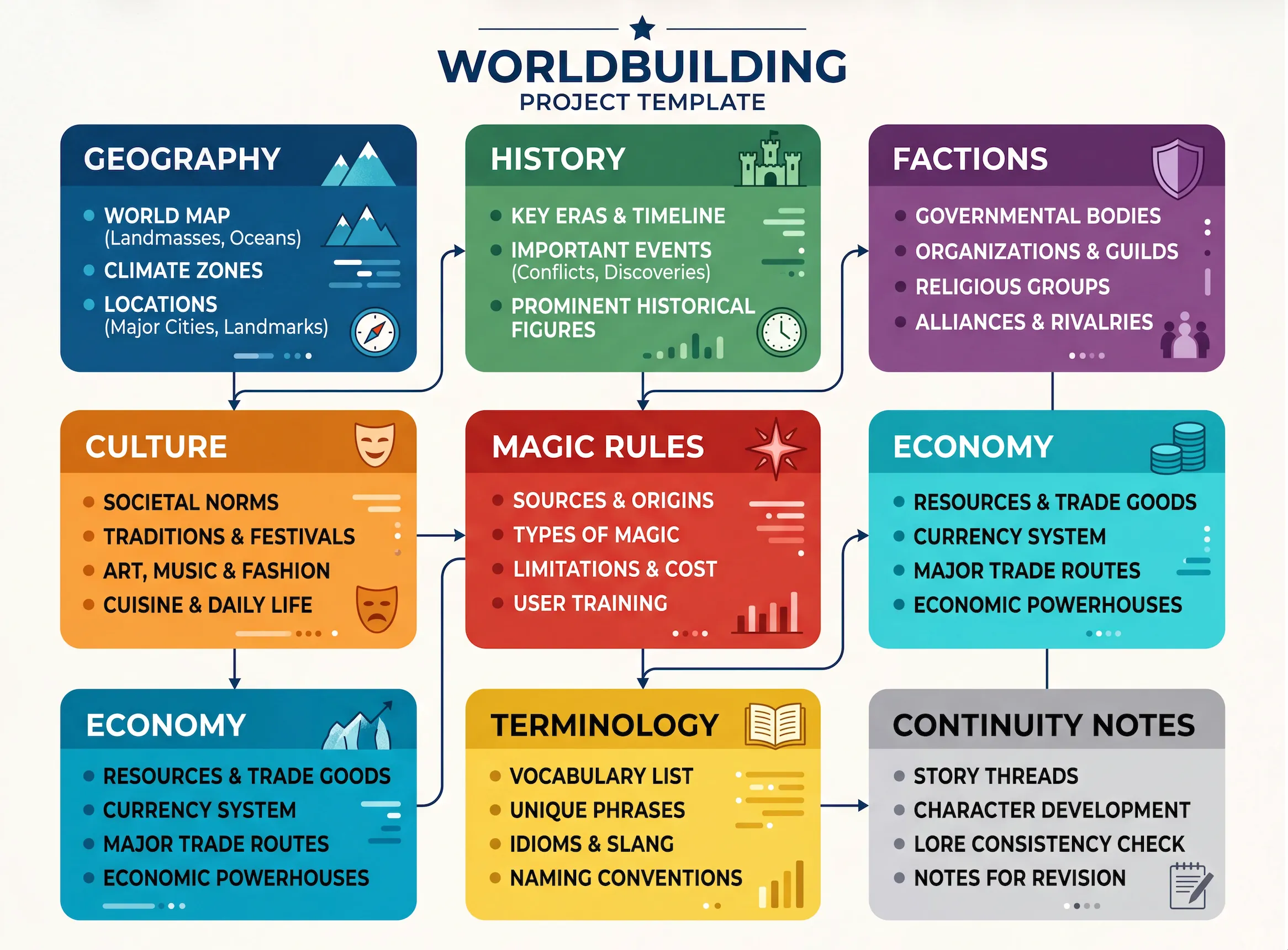
1. World Overview
Start here so the rest of the template has a center. You are not looking for a slogan; you are naming the pressure the reader should feel when the story opens.
Template fields:
- World name:
- Genre or subgenre:
- Time period or era:
- Core atmosphere:
- One-sentence world premise:
- Central tension of the world:
- What makes this world different from ours?
Questions:
- What should the reader feel when they first enter this world?
- What pressure shapes daily life for ordinary people?
- Which part of the world creates immediate trouble for the protagonist?
For AI context, this becomes your stable world summary. Keep it short enough to reuse before important scene drafts.
2. Geography and Key Locations
Geography controls travel, danger, communication, resources, and isolation. Start with places that actually appear on the page.
Template fields:
- Recurring locations:
- Major regions or borders:
- Important cities, towns, or settlements:
- Climate and terrain:
- Travel constraints:
- Location-specific rules:
Questions:
- Which locations will matter more than once?
- What does each location allow, prevent, or make expensive?
- What becomes impossible because of distance, weather, borders, or terrain?
Example field: Travel constraint: crossing the salt flats takes three days and requires a licensed guide.
For scenes, every major location should change what characters can do, hide, buy, fear, or flee.
3. History and Timeline
History matters when the past still changes what people fear, believe, hide, or fight over. Skip ancient timelines unless the present plot still carries their consequences.
Template fields:
- Founding events:
- Wars, disasters, revolutions, or migrations:
- Myths versus recorded history:
- Timeline of events relevant to the plot:
- Historical facts that must stay consistent:
Questions:
- What past event still shapes the present?
- Who remembers history differently?
- Which dates, inheritances, wars, or disasters must not move later?
For AI context, timeline locks are the dates or event orders the draft must not rearrange.
4. Political Power and Factions
Power decides who can act, who needs permission, and who gets punished.
Template fields:
- Ruling system:
- Major factions:
- Power hierarchy:
- Laws and punishments:
- Conflicting interests:
- Public image versus private agenda:
For each major faction, add a compact faction card. When those power groups start shaping character behavior across chapters, SeaBell's novel character card system can keep the person-world relationship separate from general lore notes.
- What they want:
- What they fear:
- What they control:
- What they will not do:
- What lie they tell about themselves:
Questions:
- Who benefits from the current system?
- Who wants to change it?
- What could the protagonist gain or lose by crossing this group?
For scenes, a faction note should tell you what pressure enters the room when that group appears.
5. Culture, Beliefs, and Daily Life
Culture becomes useful when it changes behavior on the page. Prioritize customs a character can violate, exploit, obey, or misunderstand.
Template fields:
- Social values:
- Customs and rituals:
- Visible daily-life details that affect scenes:
- Education and class structure:
- Religion or belief systems:
- Taboos:
- Signs of status:
Questions:
- What behavior is normal here but strange somewhere else?
- Which mistake would expose an outsider?
- Which rule can a character break at a cost?
For scenes, a cultural note is strongest when a character can misread it, weaponize it, or pay a price for breaking it.
6. Magic, Technology, or Special Rules
Treat limits as part of the system, not as an afterthought. A power with no cost often removes the conflict it was meant to create.
Template fields:
- System name:
- Who can use it:
- What it can do:
- What it cannot do:
- Limits and costs:
- Training or access requirements:
- Forbidden uses:
- Failure conditions:
- Known loopholes:
Questions:
- Which problem can this system never solve?
- What is the price of using it?
- How do these rules prevent easy plot solutions?
Weak rule: Healing magic exists.
Better rule: Healing magic can close wounds, but it cannot restore memory, reverse poison, or save someone after the heart has stopped.
For AI context, the "cannot do" line protects long-form continuity.
7. Economy and Resources
Resources create stakes. Scarcity, trade, debt, class, and labor can make a fictional world feel lived-in without padding it with random detail.
Template fields:
- Main resources:
- Scarce goods:
- Trade routes:
- Currency or exchange system, if buying or debt matters:
- Black markets:
- Who controls the most important resource:
Questions:
- What does everyone need but not everyone can access?
- Who profits from scarcity?
- What would people risk breaking the law to obtain?
Example field: Scarce good: winter coal. The temple owns the legal mines, so poor districts burn black-market river peat that makes children sick.
For scenes, this kind of resource note gives a character a reason to bargain, steal, lie, migrate, join a faction, or betray someone before the chapter even begins.
For AI context, resource rules stop the draft from solving scarcity with a convenient shipment, sudden wealth, or unexplained access.
8. Language, Names, and Terminology
Naming drift is easy to miss in a long draft.
Template fields:
- Naming conventions:
- Titles and ranks:
- Place-name patterns:
- Invented terms and definitions:
- Terms to use consistently:
- Terms to avoid:
- Alternate spellings that are not allowed:
Questions:
- Do names follow cultural, regional, or class patterns?
- Which invented terms need short definitions?
- Which titles, spells, cities, guilds, or ranks have one approved form?
For AI context, if a title has one canon name, state it directly. Do not let AI invent synonyms for official ranks, places, spells, or factions.
9. Creatures, Species, and Non-Human Groups
Add beings that affect the story, not every creature that might exist somewhere offstage.
Template fields:
- Species or group name:
- Story function: obstacle, ally, political group, ecosystem pressure, mystery, or viewpoint culture:
- Physical traits:
- Abilities and limits:
- Social role:
- Relationship with humans or other groups:
- Scene-relevant traits:
Questions:
- What does this group want?
- What would make this group feel generic instead of specific?
- Which trait changes actual scenes?
- Which boundary should the writer or AI not cross when portraying them?
Scene example: if river spirits cannot cross iron bridges, a chase scene changes the moment the protagonist reaches the old trade road. That trait belongs in the template because it affects the scene, not because it is decorative lore.
10. Story-Relevant Continuity Notes
This section is the control panel for your world. Keep it visible while you draft.
Template fields:
- Facts that must not change:
- Rules the writer or AI often forgets:
- Location constraints:
- Character-world relationships:
- Timeline locks:
- New canon added after recent chapters:
- Do-not-contradict list:
Maintenance routine:
- After a chapter changes a law, location, relationship, timeline, or rule, update Canon.
- Keep unapproved ideas in Maybe.
- Move rejected or replaced ideas to Retired.
Examples of do-not-contradict notes:
- Magic cannot resurrect the dead.
- The northern gate is sealed after chapter 5.
- The royal family uses silver titles, not gold titles.
- Desert cities do not have open rivers.
- The protagonist has never visited the capital before chapter 9.
🌍 Worldbuilding Template Example
Here is a short filled example for a fantasy city-state. Each entry gives the writer scene pressure, not just background.
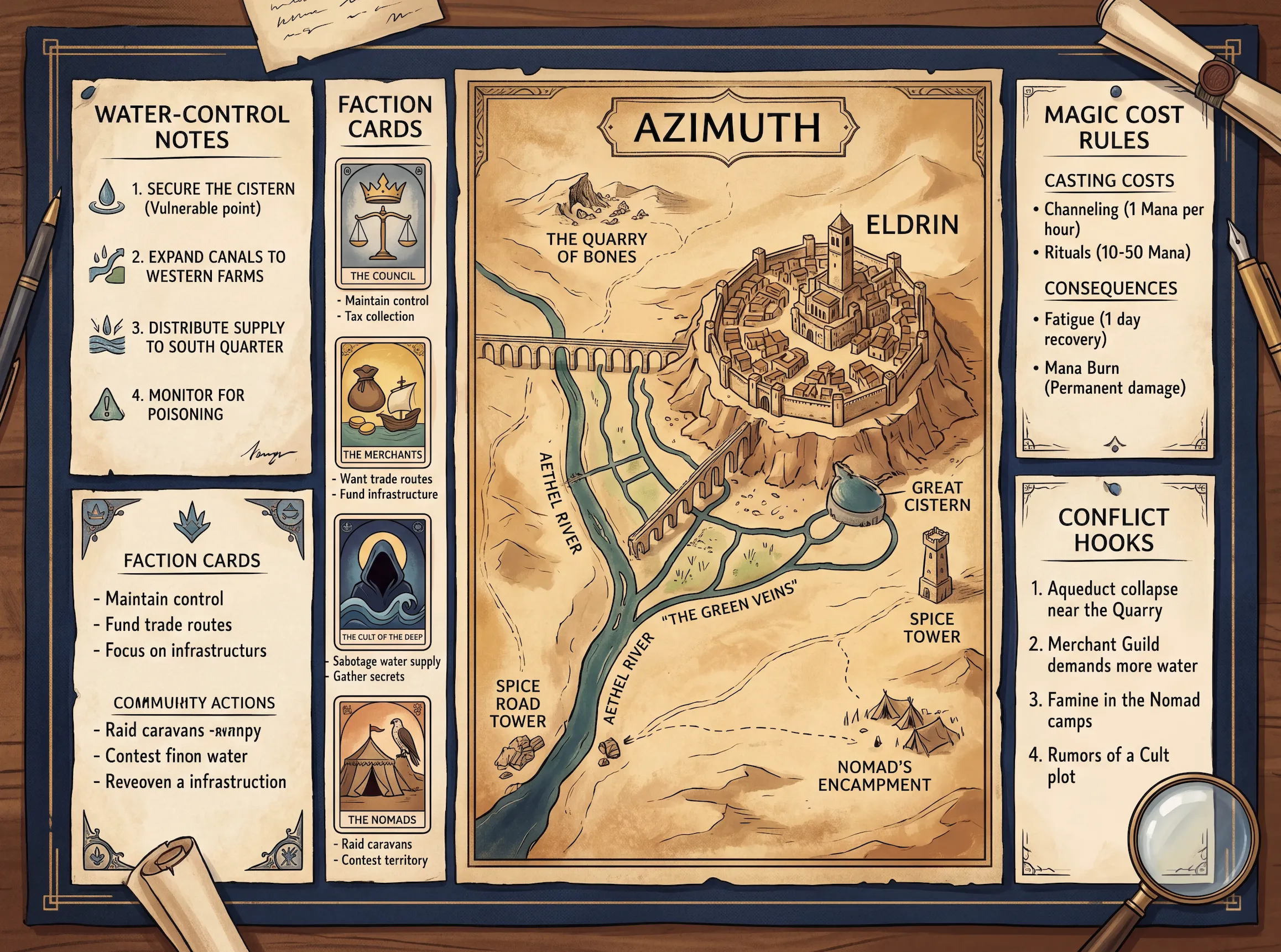
World overview:
- World name: Veyr
- Genre: Political fantasy with elemental magic
- Core atmosphere: Dry, crowded, suspicious, ritual-heavy
- One-sentence premise: A desert city-state survives by controlling the only legal wells in the region.
- Central tension: Water access is both a public necessity and a political weapon.
Key location:
- The Glass Market is built around sealed water towers.
- Public fountains only open during tax ceremonies.
- Underground cisterns are illegal unless registered with the Well Council.
Power structure:
- The Well Council controls water licenses.
- Street guilds smuggle rainstone charms to poor districts.
- Priests claim droughts are punishments for civic disobedience.
Magic rule:
- Rain-calling exists, but it drains heat from the caster's body.
- Public rain magic is punishable by exile.
- Rain magic cannot create water indoors.
Conflict hook:
- The protagonist's sister is caught with an unlicensed cistern map.
- A council heir secretly hires the protagonist to find a stolen rainstone cache before the festival.
Continuity note:
- No open rivers exist inside the city.
- Rain magic always has a physical cost.
- The Well Council never admits that rainstone charms work.
Why this example works: the world rules create pressure that can turn into scenes, reversals, and plot choices. If you are still shaping that causal chain, SeaBell's plot generator is the better place to turn these constraints into story movement.
- Scarcity touches money, law, class, religion, and survival.
- The magic limit blocks an easy solution.
- The power structure gives several groups motives.
- The continuity notes protect future chapters from contradictions.
A compact AI context packet might read: Veyr is a desert city-state where the Well Council controls legal wells. Public rain magic is illegal and drains body heat. The protagonist must buy medicine without revealing her family's unlicensed cistern map. Do not add open rivers inside the city.
🤖 How to Turn Your Worldbuilding Template Into AI Writing Context
The most common AI drafting problem is usually not a bad prompt. It is messy context: three versions of the same faction name, a timeline updated in one note but not another, and a magic rule that disappeared after chapter four.
Before drafting a chapter, build a small context packet instead of pasting the full template. This is where a chapter outline template helps: the worldbuilding document stores the rules, while the chapter outline decides which rules matter in the next scene.
- Stable canon block: world premise, hard rules, timeline locks, and facts that must not change.
- Scene block: current location, active faction, resource pressure, cultural rule, or travel constraint.
- Character-world block: how the protagonist is affected by the setting right now.
- Terminology block: approved names, titles, spellings, and terms the AI must preserve.
- Do-not-contradict block: the short list of rules the draft must not break.
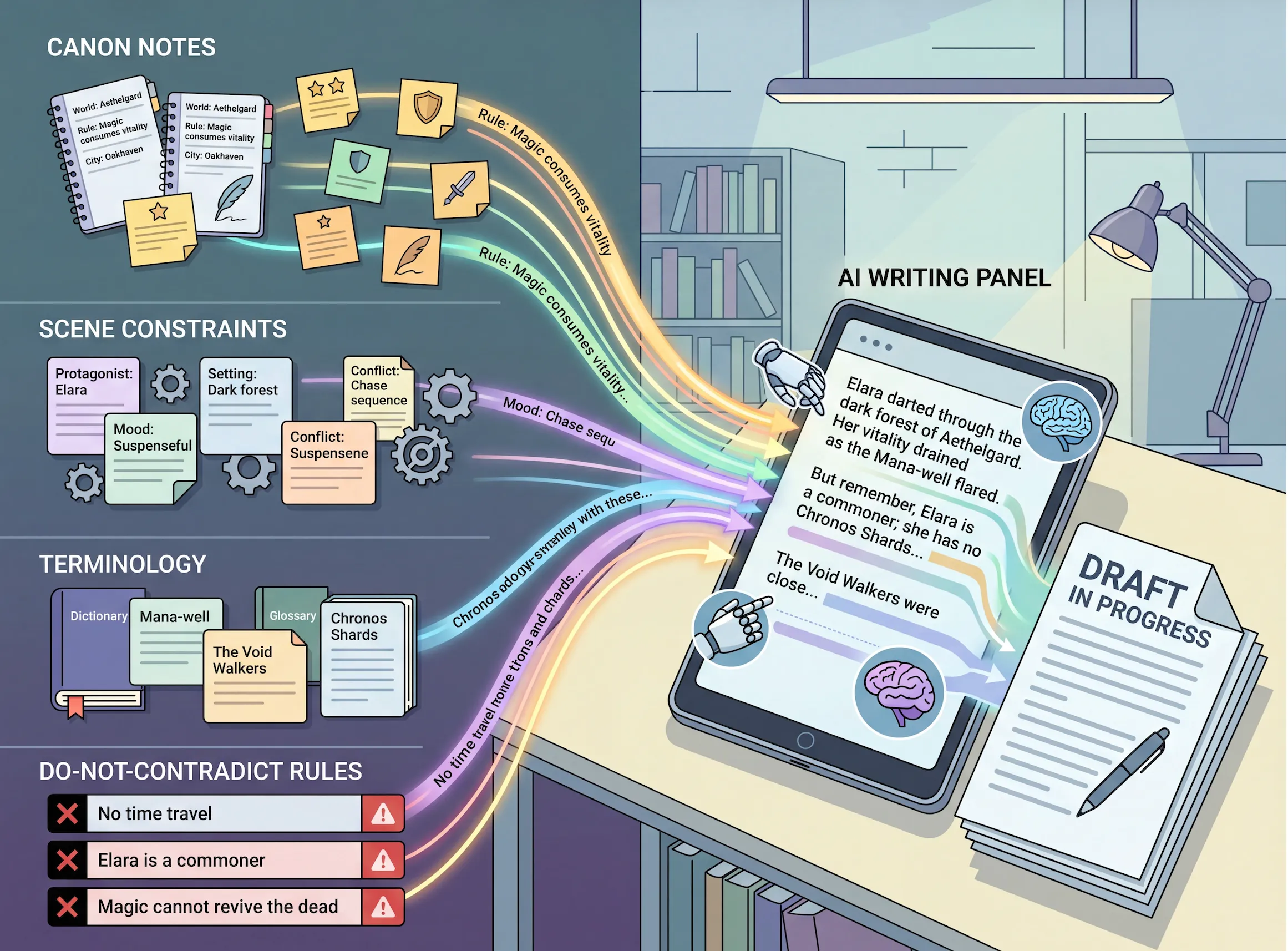
After drafting, run a quick update loop:
- Add accepted new world facts to Canon.
- Move rejected ideas to Retired so they do not return later.
- Keep unused possibilities in Maybe, away from drafting context.
Keep Canon Facts Separate From Brainstorming Notes
Canon is confirmed story truth. Brainstorming is possibility. Retired is material you no longer want the draft to use.
Keep those categories apart. If an AI tool sees three possible origins for the same empire in one note, it may treat all three as available.
Create a Do-Not-Contradict List
A do-not-contradict list is a small set of hard rules that protects the story from accidental drift.
Good entries are specific:
- The city has no open rivers.
- Only licensed healers can use bone-mending magic.
- The prince does not know his mother's real name until chapter 18.
- Guild titles use metals, not colors.
Place this list near the top of important AI context. It gives firm boundaries without forcing you to paste the full template every time.
Use Worldbuilding Notes as Scene Constraints
Weak instruction:
> Write a scene in a fantasy marketplace.
Stronger instruction:
> Draft a marketplace scene in Veyr. Use the city's water scarcity, guild tax system, and rule that public rain magic is illegal. The protagonist is trying to buy medicine without revealing her family's unlicensed cistern map. Do not contradict the rule that rain magic drains body heat.
The second version gives the scene pressure and names the rule the AI must not forget.
For long fiction, world rules, character notes, plot direction, and chapter constraints need to stay near the draft without being rebuilt every time. In SeaBell, the context packet can sit beside the chapter, so the same canon block stays available from scene to scene without repeated explanations.
⚠️ Common Worldbuilding Template Mistakes
Watch for these problems before they harden into the draft:
- Answering every possible question before writing, then creating beautiful lore that never affects the story. Start with the next scene's needs. If a detail has no consequence yet, move it to Maybe.
- Forgetting limits and costs for magic or technology. Put the "cannot do" rule beside the ability, not in a separate note you will forget to check.
- Mixing canon details with optional ideas. Label notes as Canon, Maybe, or Retired before they enter drafting context.
- Letting AI invent new world facts without approval. Treat new details as suggestions until you accept them and update the template.
- Using too many invented terms without a terminology list. Keep approved spellings, short definitions, and forbidden variants together.
- Treating the template as finished. A living worldbuilding template changes when chapters create new laws, locations, relationships, or constraints.
✅ Worldbuilding Checklist Before and After Drafting
Use this worldbuilding checklist before a chapter, outline, or AI-assisted drafting session:
- [ ] Can you describe the world in one sentence?
- [ ] Do you know which locations appear in the next scene or chapter?
- [ ] Are the world's rules and limits clear?
- [ ] Do factions or power groups have conflicting goals?
- [ ] Does the world create real pressure for the protagonist?
- [ ] Have you separated confirmed canon from optional ideas?
- [ ] Have you removed brainstorming notes from AI context unless you want new ideas?
- [ ] Do you have a do-not-contradict list for facts that must not change?
After drafting, do one quick maintenance pass:
- [ ] Did you add accepted new world facts back into Canon?
❓ FAQ
What should be included in a worldbuilding template?
Include the world overview, key locations, history, factions, culture, magic or technology rules, resources, terminology, non-human groups if relevant, and continuity notes. Prioritize fields that affect scenes or prevent contradictions.
How long should a worldbuilding template be?
Long enough to support the story, short enough that you will actually use it. For an early draft, one page covering the premise, core rules, major location, and central conflict may be enough. Expand only the recurring locations, factions, systems, and timeline facts the story keeps using.
What is the difference between a worldbuilding template and a worldbuilding checklist?
A checklist asks whether you have covered an area. A template stores the answer so you can reuse it later. For drafting, the template usually matters more because it becomes a working reference.
Do I need a worldbuilding template for non-fantasy fiction?
Yes, if the setting has recurring rules the reader needs to understand. Sci-fi, dystopian fiction, paranormal romance, alternate history, historical fantasy, and some contemporary series can all benefit from one.
How can I use a worldbuilding template with AI writing tools?
Turn the template into a small context packet: stable canon, scene-specific details, terminology, do-not-contradict notes, and an update step after drafting. Do not paste Maybe or Retired ideas unless you want brainstorming.
What are the most important worldbuilding questions for fiction writers?
Start with questions that create usable pressure: Who holds power? What resource is scarce? What can magic or technology not do? What rule can a character break? Which facts must stay consistent?
How do I avoid overbuilding my fictional world?
Build from the next scene outward. If a note cannot shape a choice, limit an action, reveal a belief, create conflict, or prevent a contradiction, it can wait.
🏁 Conclusion
A worldbuilding template is not a test of how many details you can invent. It is a working document that helps the story stay coherent as it grows.
Before the next chapter, pull only the world rules that affect that scene. Keep canon separate from maybes. Update the template when the draft creates a new fact. If your story uses AI across many chapters, SeaBell can help keep world rules, character context, and chapter direction close to the draft, so you do not have to re-explain the same canon every time.
Start with the section that affects your next scene. The rest can wait until the story needs it.