

Character Arc Template for Fiction Writers | SeaBell
Character Arc Template: Plan Change Through Choices
Most character profiles stop at the door of the story. They tell you that the protagonist is guarded, grew up above a bakery, takes coffee black. None of that tells you what she does in chapter twenty-six, when the habit that has kept her safe for years stops working.
A character arc records where a person starts, what their choices cost them, and what they finally do that they could not have done at the opening. This article gives you a copyable character arc template you can fill in as you plan. Below the template, a running example follows one character through five story turns so you can see how the fields connect.
![Three character arc paths shown as simple line diagrams on a notebook page: a rising line for the positive arc, a falling line for the negative arc, and a steady line tested by downward spikes for the flat arc.]](https://image.cdn2.seaart.me/static/upload/20260917/d8bbe1b9-0988-4017-8a82-72a5bf88c19e.webp)
✍️ What a character arc tracks
A character arc is the relationship between an internal starting position and later behavior. The starting position can be a belief, a coping strategy, a fear, a boundary or a priority. The arc becomes real when the character faces situations that make relying on the old position costly and responds with choices that create visible consequences.
A character can change in many ways: they can revise a belief about other people, abandon a priority that once defined them, or deepen a commitment they already held. They cannot change just because the outline says so. The arc needs a chain of decisions and costs, and evidence that the change happened.
Three common outcomes are worth naming, though none of them is a formula you have to follow:
- Positive arc. A limiting belief becomes expensive enough that the character acts against it, and the new behavior sticks.
- Negative arc. The character protects the old belief until it causes deeper damage. The ending shows what that protection cost.
- Flat arc. The character holds a central value throughout, and the story tests whether they can act on it when the cost is high.
Which one you are writing usually becomes clear only after you know what the character's choices cost.
📋 Copy-and-fill character arc template
Copy the table below. Leave fields blank when you do not yet know the answer. Blank fields mark where the story has not been decided yet.
| Field | Prompt |
|---|---|
| Starting state | What does the character believe about themselves, other people or the world? |
| Visible want | What are they trying to obtain or avoid? |
| Internal need | What truth must they accept, or what capacity must they develop? |
| Protective strategy | What habit, belief or behavior helps them cope at the beginning? |
| Pressure point | What makes that strategy stop working? |
| First costly choice | What do they do when the old strategy creates a problem? |
| Consequence | What becomes harder, more exposed or impossible after that choice? |
| Midpoint realization | What do they now understand differently? |
| Repeated test | What situation asks them to act on the new understanding? |
| Crisis choice | What must they give up or risk to act consistently with the arc? |
| Ending evidence | What action proves the change, refusal or conscious commitment? |
| Carry-forward state | What remains unresolved for the next book, subplot or relationship? |
For a plain-text version you can paste into any editor:
CHARACTER NAME:

STARTING STATE:
VISIBLE WANT:
INTERNAL NEED:
PROTECTIVE STRATEGY:
PRESSURE POINT:
FIRST COSTLY CHOICE:
CONSEQUENCE:
MIDPOINT REALIZATION:
REPEATED TEST:
CRISIS CHOICE:
ENDING EVIDENCE:
CARRY-FORWARD STATE:
You do not need to give every field its own scene. A first costly choice and its consequence often happen in the same scene; record both, but do not force them into separate beats. If you prefer to draft first and diagnose later, fill the template after a complete draft as a revision tool: the fields that remain empty will show you where the arc was never earned.
A note on naming: "Midpoint" and "Crisis" are positions in the arc, not mandatory beats. A story can reach its crisis in chapter six or in chapter twenty, depending on length.
Here are the first five fields filled for the running example: Ines, a meticulous archive assistant who believes that control prevents harm. The remaining seven fields unfold through the story turns below.
| Field | Ines |
|---|---|
| Starting state | Things get lost when other people handle them. If I check it myself, nothing is lost. |
| Visible want | To get the digitization project through with no errors attached to her name. |
| Internal need | To accept that accuracy is a property of a system, not of her attention, and that being indispensable is not the same as being useful. |
| Protective strategy | Re-checks every record personally; silently redoes other people's work after hours. |
| Pressure point | 40,000 items, two partner departments and only one pair of eyes. There are not enough hours in the week for her to check every scan personally. |
How to fill the starting state
The starting state is the belief or strategy the character relies on when the story begins. Ask three questions:
- What does the character do when they feel threatened?
- What do they believe keeps them safe?
- What do they refuse to admit?
Those three questions give you the starting state. The next three fields come at it from different angles: what the character wants, what they need, and how they cope. A character who wants a promotion may need to accept that her value is not measured by how much of the work passed through her own hands. Until then, she copes by controlling every detail of it. Each field creates different pressure later.
The starting state must produce behavior. "She is guarded" is a label. "She is an ICU nurse who re-reads every chart at shift change because someone once missed a medication change at handoff and a patient went back to the OR" gives you something to test. She will not admit that the unit would run fine without her. That refusal is where the story applies pressure.
📋 Build the arc from choices, not labels
An arc becomes real when the character makes a decision while the old strategy still feels safer, and the decision creates a consequence that changes what happens next. Deciding in your outline that a character becomes brave at the midpoint does not do this.
For each story turn, record three things:
| Story turn | Pressure | Choice | Cost / evidence |
|---|---|---|---|
| Opening | Existing strategy still works | Character uses it successfully | Short-term reward reinforces the strategy |
| First break | Strategy harms someone or fails | Character doubles down or makes a partial change | New consequence narrows options |
| Midpoint | Character sees the real pattern | Character acts against old belief once | Progress creates a new risk |
| Crisis / ending | Old strategy offers safety at a cost | Character chooses what they now value | Final action proves the arc |
Here is this structure applied to Ines. The four rows above are the minimum shape; the example below expands the middle into two turns — a Midpoint and a Repeated test — giving five, because the backsliding in that stretch is what makes the crisis choice cost something. The First break row covers the First costly choice and its Consequence; the Midpoint row covers the Midpoint realization; the Repeated test row maps to the Repeated test field; the Crisis row covers the Crisis choice and Ending evidence.
| Story turn | Pressure | Choice | Cost / evidence |
|---|---|---|---|
| Opening | A misfiled deed of gift surfaced during last year's audit, and the department spent six weeks reconstructing the provenance. Ines now checks every filing cabinet twice before leaving. | When a volunteer mislabels a box, she stays late to redo the work without telling anyone. | The work is correct. Her belief that only she can do it properly is reinforced. |
| First break | A new digitization project requires sharing access with two other departments. Her personal checking becomes a bottleneck. After a department head complains, her manager mandates delegation. | She insists on reviewing every scan for as long as she can. When delegation is mandated, she agrees publicly and re-checks the delegated batches at night. | The project loses a week. She is now lying about the process. The compliance is on paper; the reversal is in private. |
| Midpoint | A record she double-checked herself is misfiled; a volunteer finds it three days before a researcher needs it. For the first time Ines cannot explain it away: the record has passed through her own hands twice. | She tells the team about the error and suggests a peer-review step for all digitized records. | The record surfaces in time because someone else is looking. Within a month the shared log is where people check first, and researchers stop coming to her desk for answers they can find themselves. |
| Repeated test | Peer review adds two days to every batch, and the partner departments are asking why their material is still queued. | She sends some through. Others she completes alone at night. | The shared log has gaps: batches she completed alone list no reviewer. A volunteer asks why. |
| Crisis / ending | The funding review needs an inventory in nine days. Doing it alone would feel safer; at this scale it would also mean gaps she cannot see. | She runs it through peer review and presents the results, corrections included. | The review passes. Two of the corrections carry volunteers' names. The board now talks about the archive as a team effort. Nobody stays late anymore, and the junior archivists begin answering routine reference questions without defaulting to her. |
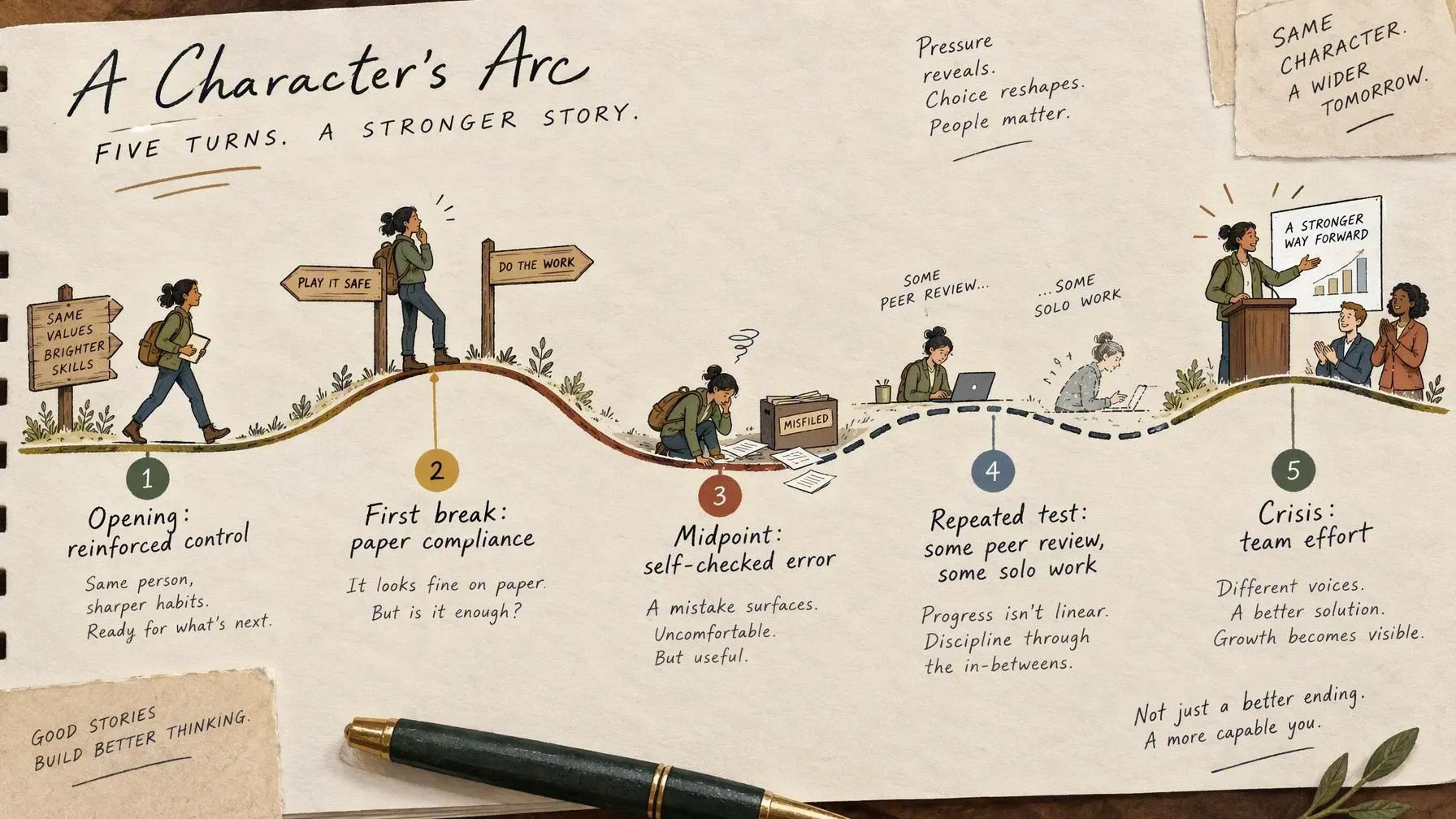
The opening deserves a closer look. Ines's strategy began with a failure: the misfiled deed, the six-week reconstruction. The audit taught her to check twice. It could just as easily have taught her to build a second pair of eyes into the process. The arc is the distance between those two lessons.
Ines's carry-forward state: the archive no longer depends solely on her. She has gained a functioning team but lost the quiet security of being irreplaceable. That tension carries into whatever she manages next.
Positive, negative and flat arcs in the template
The structure stays the same. What differs is what the character does with the pressure.
Positive arc. The character revises a limiting belief through costly action. Ines moves from "only I can prevent errors" to "errors are caught before they reach a researcher when the process is shared." The midpoint realization is genuine, and the crisis choice proves it.
Negative arc. The character protects the old belief until it causes deeper damage. Imagine the same starting state and the same mandate to delegate; the divergence is in how she absorbs it. At the midpoint, Ines hides the misfiled record and blames the volunteer. By the crisis, she is running the inventory alone, burning out, and the funding review finds gaps she cannot explain. The template still fills the same way. The ending shows what the protection cost.
Flat arc. This one needs a different Ines. Suppose she believes from page one that the public record must be trustworthy, and says so in meetings. The story does not ask her to revise that belief. It tests whether she will act on it when a colleague's error leaves a misleading record in the catalog and reporting it would cost that colleague their contract renewal. A flat arc can end in failure. What it cannot do is go untested.
For a flat arc, the pressure point does not have to show a protective strategy failing. It can be the first moment an existing value collides with a cost the character has never had to pay.
The same template works for all three, but the prompts need small adjustments. In a negative arc, the midpoint realization records the understanding the character refuses; the repeated test becomes the moment where the old strategy starts to produce harm the character cannot ignore. In a flat arc, the midpoint is not a new understanding but a concrete cost that makes the existing value expensive; the repeated test is the recurring pressure to abandon it.
One thing applies to all three: a character can be destroyed and still hold exactly the belief they started with. What makes an ending an arc is that the character's last decision was not available to them in chapter one. In a positive arc, they lacked the capacity; in a negative arc, they had not yet crossed that line. In a flat arc, the value was already there; what was not there was the price.
Use behavior as evidence
After each major arc turn, check whether the change is visible in action.
What did the character do that they could not have done at the beginning? This is the most important question. If Ines's behavior at the crisis point looks identical to her behavior at the opening, the arc has not happened, regardless of what the outline says. Ines is doing something at the crisis that she could not have done at the beginning: presenting the inventory publicly, including the volunteers' corrections. That difference makes the arc real.
What old behavior still surfaces under stress? This question catches the common pattern of paper compliance: the character agrees to change, then reverses the change in private. Ines re-checking delegated batches at night shows you exactly what the old strategy looks like when it survives inside a new agreement. If no old behavior reappears, the change may be too easy.
Do other characters treat the protagonist differently by the end? If the people around the protagonist act exactly as they did in chapter one, the reader may not believe the change. The researchers who used to come to Ines's desk now check the shared log first. Nobody remarks on it. The traffic around her desk simply changes.
What did the change cost them? By the last chapter the junior archivists answer reference questions without checking with Ines. That is the same fact as her success, read from the other side.
Does the change live only inside the character's head? If you remove the internal narration and the reader cannot tell anything changed, the arc exists in the outline but not in the draft.
🧩 Move the arc into chapters and scenes
Once you know what the character believes, what they choose and what it costs, you can turn each arc point into a chapter or scene. Pick one turn from the arc. Give it a scene job: what must happen, what the character wants in the moment and what changes by the end. Record the character's current state before you draft. Ines's first break becomes one scene: she wants to keep personal review in place; the turn comes when her manager mandates delegation; the continuity note is that she plans to re-check the batches at night anyway.
The Scene Card Template gives you fields for scene-level conflict and continuity notes. The Chapter Outline Template does the same at the chapter level, so you can see where each arc turn lands in the sequence.
🧩 Extending the arc beyond the protagonist
Filled in for one character, the template becomes an arc card. It works for anyone whose internal position shapes the outcome. If you are writing multiple points of view, fill one arc card per POV character. Mark each character's crisis choice on the same chapter-number timeline. If two crises land on the same chapter, check that each still has room to matter. One useful way to design an antagonist is to give them a related fear and a different protective strategy. Both characters may fear losing control, for example, but one copes by controlling the work and the other by controlling the people.
🧩 Keep the arc visible while drafting
Once the arc is drafted, the AI Character Card gives the character's current state a fixed shape: peer review adopted, old habit still surfacing under deadline pressure. SeaBell lets you keep that card beside the chapter you are drafting, so your drafting assistant works from the Ines of chapter nineteen rather than the one from chapter three. You still decide whether the change feels earned.
FAQ
Does every character need an arc?
No. Secondary characters, functional roles and comedic figures can serve the story without a tracked arc. The template is most useful for viewpoint characters, antagonists whose opposition matters to the protagonist, and any character whose internal position shapes the outcome of the plot.
Can a character arc be subtle?
Yes. Subtle arcs often involve shifts in priority, boundary or self-understanding rather than dramatic reversals. The key is behavior evidence. If the character acts differently by the end, the arc is real. If their behavior is identical, the outline is naming a trait, not tracking a shift.
Is a flat character arc the same as no development?
No. A flat arc holds a value constant and tests what it costs to act on it. The Ines example above shows this: she believes the public record must be trustworthy, and when a colleague's error threatens that, she must choose between the value and the relationship. If she hides the error, she fails the test — but the value itself has not changed.
How is a character arc different from character motivation?
Motivation is the engine at the start: what the character wants, needs, fears and how they cope. The arc is the chain of choices that unfolds when that engine meets resistance. Motivation fills the first few fields of the template. The arc fills the rest.
Can a character change back after the midpoint?
Yes. Backsliding and partial change are common in fiction and realistic in life. The template can record a midpoint realization followed by a crisis choice that retreats from it. What matters is that the retreat is a decision with costs, not an accidental reset.
How do I use a character arc template for a series?
Treat each book as one arc with its own starting state, pressure points and ending evidence. The carry-forward field at the end of the template is designed for this: it records what remains unresolved, what the character now knows, and what new tension exists at the boundary between books. Each installment needs a chain of choices that resolves its own central pressure.
Related Posts
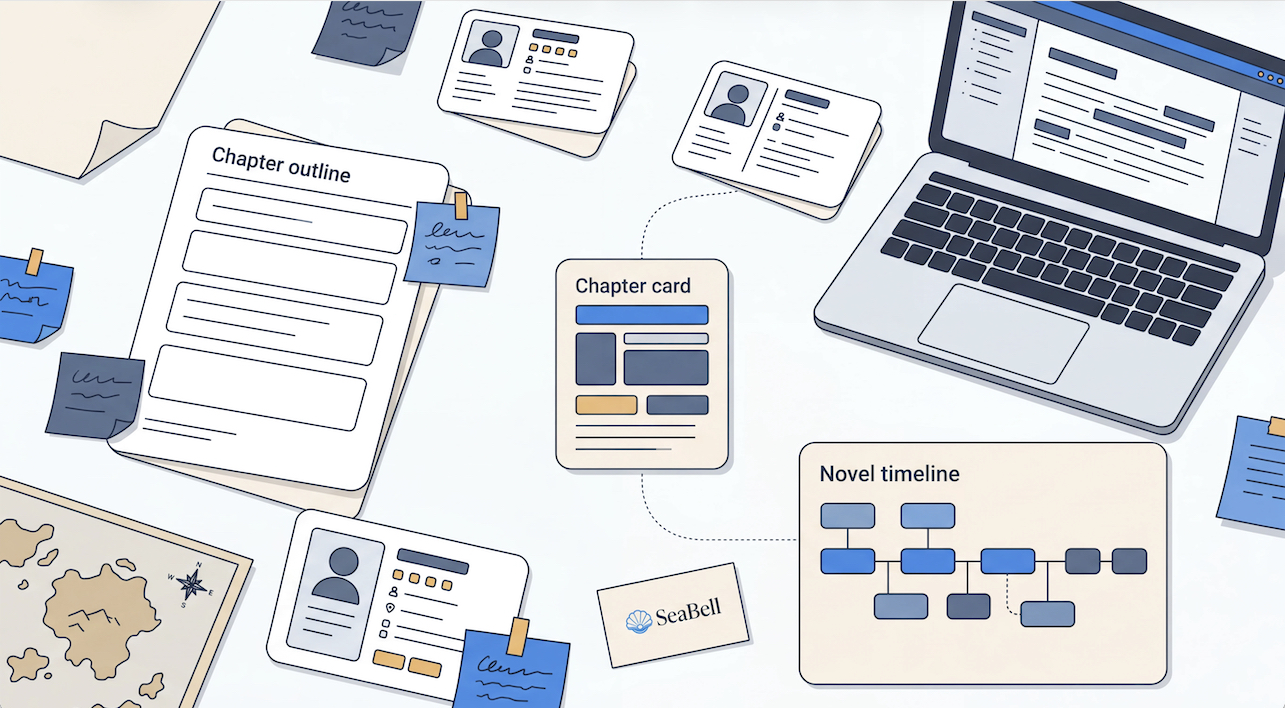
Chapter Outline Template for Novel Writers
Use this chapter outline template to plan POV, conflict, character change, continuity notes, and ending hooks before drafting your next novel chapter.
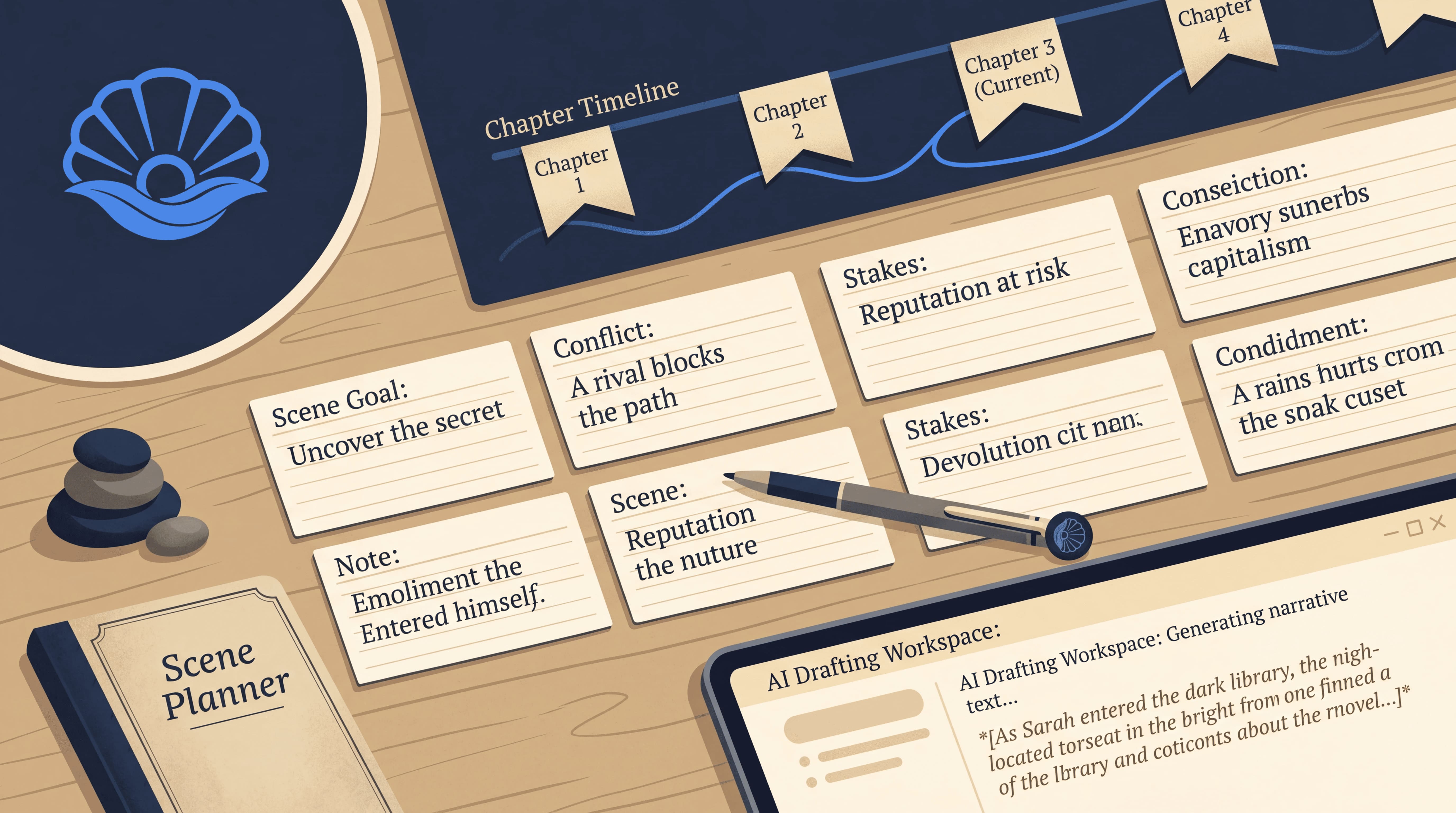
Scene Card Template for Novel Writers | SeaBell
Copy a scene card template for fiction writing, see a filled example, and turn your scene plan into a focused AI drafting brief