

Character Development Questions for Fiction Writers | SeaBell
A character questionnaire can tell you your hero’s favorite food, childhood nickname, and favorite weather. Those details may become useful later. But when you are trying to draft the next scene, the sharper question is usually this: what does this character want badly enough to make the story move?
Character development questions work best as a stage-based diagnostic: premise, motivation, arc, relationships, scene pressure, and revision. Start with the stage that matches the problem in front of you, and stop when an answer changes the next draft decision.
✅ Quick Answer: What Makes a Good Character Development Question?
The best questions for character development reveal something that can affect a choice, conflict, relationship, scene, or revision decision.
A weak question adds information the story never uses. A stronger question changes what the writer can write next.
For example:
- Weak: What is the character’s favorite drink?
- Stronger: What drink would they accept from an enemy because refusing would reveal too much?
- Weak: What are they afraid of?
- Stronger: What fear makes them choose the safer lie instead of the useful truth?
- Weak: Who is their best friend?
- Stronger: Who can make them betray their own stated goal?
You do not need to answer every question for every character. A protagonist needs enough depth to carry premise, motivation, arc, relationships, and scene behavior. A side character may only need the one or two answers that complicate the protagonist’s choices. If an answer will never affect a decision, conflict, relationship, or scene, save it for later.
🧭 How to Use These Questions Without Turning Them Into Homework
The fastest way to ruin a useful character exercise is to treat it like a form to be completed before drafting. Fiction rarely works that neatly. Some answers only become visible after the character has made a mess on the page.
Start with the problem you are trying to solve, not with the first question on the page:
| If you are... | Start with... | Stop when you know... |
|---|---|---|
| Choosing the right character for a premise | Premise questions | Why this character makes the story harder to solve, harder to avoid, or more expensive to survive. |
| Planning plot cause and effect | Motivation and arc questions | Which choices create consequences. |
| Writing a relationship that feels decorative | Relationship pressure | How the bond makes a decision harder. |
| Fixing a scene with no energy | Scene pressure | What the character wants specifically right now. |
| Revising a flat draft | Revision questions | Where the character becomes passive, inconsistent, or too easy. |
Answer in short, usable language. “She wants safety” is too broad to guide a scene. “She wants to hide her forbidden magic long enough to save her brother” gives you action, secrecy, risk, and a deadline.
I have seen writers lose momentum because they try to make every character note sound polished before drafting. The useful note is often rougher: what the character wants, what they are hiding, and what would force them to choose badly.
Mark answers as stable, changing, unknown, or scene-specific. Stable answers belong in long-term character context. Changing answers belong near the arc. Unknown answers can wait.
Do not let AI fill every answer into a smooth biography before you test it. A polished bio can still be useless if none of the answers creates pressure.
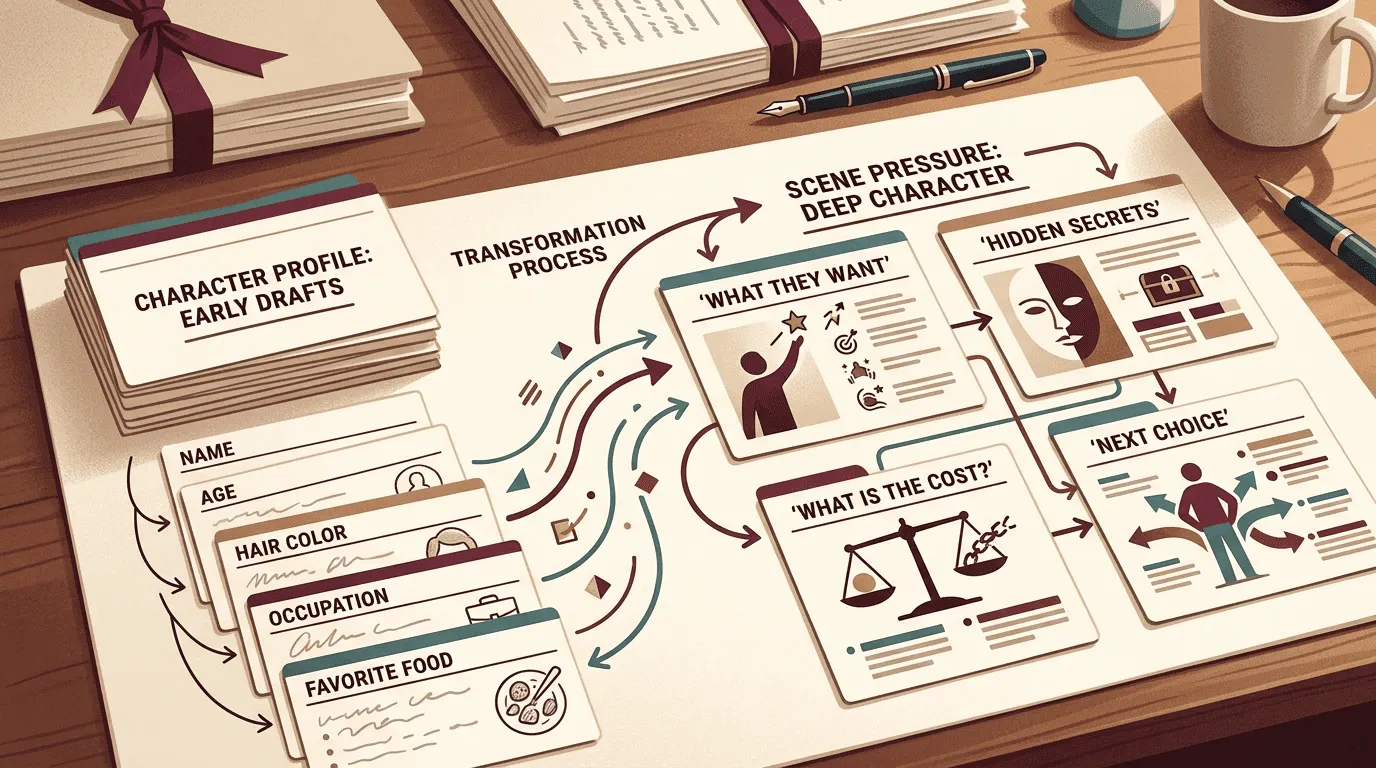
🎯 Premise Questions: Does This Character Belong in This Story?
If the premise would survive a protagonist swap, the character is not carrying enough story weight. Premise questions test whether this story becomes sharper because this person is inside it.
Ask:
- What can this character do, fear, or misunderstand that makes the premise sharper?
- If this character were removed, what would break in the story?
- What decision could only this character make?
- What does the genre promise through this character?
- What does the opening situation force them to reveal?
- Why is this story happening to them now, not a year earlier?
- What part of the premise attacks their comfort zone?
- What secret, skill, wound, debt, or loyalty pulls them into the plot?
- What false version of themselves are they trying to protect?
- What kind of trouble follows them into scenes?
The most useful premise answer connects the outside problem to an inside pressure. A reluctant heir becomes more interesting when refusing the throne would protect their freedom but endanger the one person they still trust.
A useful warning sign: the premise would work almost the same with any protagonist. If swapping in a soldier, scholar, thief, or prince would barely change the emotional cost, the character is not tied tightly enough to the story.
If those premise answers start turning into act turns, major reversals, or whole-book cause and effect, move that larger planning work into a novel outline template instead of expanding this question list until it becomes an outline.
🔥 Motivation Questions: What Do They Want, Need, Fear, and Protect?
Motivation does not need to become a full psychological essay. For drafting, the first test is simpler: does the motive change a choice?
A character who “wants respect” can still stand still for ten chapters. A character who wants respect from the court badly enough to expose a rival’s secret, even though doing so will harm the rebellion he claims to support, already has a scene problem.
Ask:
- What does the character want at the start of the story?
- What would they say they want if asked directly?
- What do they actually need, even if they would reject it?
- What are they afraid will happen if they fail?
- What are they protecting: a person, status, secret, belief, freedom, or identity?
- What lie makes their current behavior feel justified?
- What would make them change tactics?
- What desire becomes more dangerous under pressure?
- What would they sacrifice, and what would they refuse to sacrifice?
- When do they choose the wrong goal because it feels safer?
For a deeper character motivation framework, use the five-part model of want, need, fear, wound, and pressure. At this stage, the useful answer is the one that tells you what the character chooses when the easy answer and the honest answer split.
🔄 Arc Questions: What Pressure Can Change Them?
An arc is a pattern of pressure that makes the old way of surviving stop working.
Ask:
- What belief does the character start with?
- Why has that belief helped them survive until now?
- What does the plot keep asking them to admit?
- What choice would prove they are changing?
- What choice would prove they are refusing to change?
- What relationship or failure exposes the old belief?
- What does the midpoint teach them that the opening could not?
- What does the climax ask them to give up?
- What part of them should remain recognizable at the end?
- What cost makes the change feel earned?
One of the easiest arc mistakes is treating the starting belief as simply “wrong.” Often, the belief used to protect the character. The healer who refuses forbidden magic may not be cowardly; maybe using it once saved a patient and condemned someone else. The arc becomes stronger when the old belief has a reason to exist.
Use arc questions to identify pressure, not to build a complete arc template. You only need the next meaningful test: what will the story ask the character to do that their old self would avoid?
🤝 Relationship Questions: Who Makes Their Choices Harder?
A label is not pressure. “Mentor,” “rival,” and “love interest” only matter when the bond makes a choice harder.
Ask:
- Who sees the character most clearly?
- Who believes the character’s false self?
- Whose approval does the character want too badly?
- Who benefits if the character never changes?
- Who gets hurt when the character chooses the old pattern?
- What secret would change this relationship?
- What debt, promise, attraction, rivalry, or guilt keeps them connected?
- Where does love, loyalty, or duty conflict with the character’s goal?
- What topic can they not discuss honestly yet?
- What relationship should not be resolved too early?
A relationship often becomes useful the moment both characters want something different from the same conversation. Weak answer: “The rival is jealous.” Draftable answer: “The rival needs the protagonist to fail publicly because their own family contract depends on the vacant court position.” Now the apology scene becomes a trap, not a conversation.
That is the difference between a relationship note and a relationship engine. The bond does not just describe how two people feel about each other; it changes what they can safely say, hide, ask for, or refuse.
When that pressure needs to stay visible across alliances, secrets, rivalry, or romance tension, move it into a character relationship chart template so the relationship can change on the page instead of sitting in a loose note.
🎬 Scene Pressure Questions: What Does This Character Want Right Now?
Planning questions only matter if they eventually change scenes. Scene pressure brings character development down to the page.
Ask before or during a scene:
- What does the character want in this scene?
- What do they want but cannot say directly?
- What do they think will happen if they lose?
- What tactic do they try first?
- What tactic do they switch to when the first one fails?
- What emotion are they hiding under the surface action?
- What flaw or fear makes the scene harder?
- What new information changes their choice?
- What decision changes the relationship, plot, or self-image?
- What should carry into the next scene?
Flat scenes often come from a missing immediate want. The character may have a long-term goal, but in the current scene they are only present, reacting, or explaining. Give them something smaller and sharper: get the key, avoid the question, win the apology, hide the wound.
On the page, fear is a tactic problem: the character dodges, bargains, performs, attacks, or hides. A flaw is not visible because the draft names it; it is visible because it makes the character choose the wrong move.
If the answer is scene-specific, put it where it can shape the draft: scene goal, pressure, turn, reveal limit, and revision note. A scene card template is a better home for that than a long character bio.
🔍 Revision Questions: Why Does the Character Still Feel Flat?
Revision is where character development becomes less about knowing more and more about seeing what the draft is failing to show.
Use these when the story exists but the character still feels passive, inconsistent, or too easy:
- Does the character make decisions that cause plot events, or do events simply happen to them?
- Can the reader infer motivation from action, not only explanation?
- Does the character behave consistently without becoming predictable?
- Does every major change have pressure, cost, and consequence?
- Does the character’s flaw create problems rather than decorative self-description?
- Do relationships change because of choices made on the page?
- Does the draft repeat the same emotional beat too often?
- Is the character’s internal conflict visible in scene behavior?
- Are important answers stored somewhere the writer can see while drafting?
- Which scene would become stronger if the character wanted something more specific?
In revision, the useful test is behavioral evidence. Look for the delayed confession, bad bargain, sharper line of dialogue, refusal, changed relationship, or consequence in the next chapter. If none of those marks exist, the note may still be true, but the scene has not carried it yet.
A good “Hard Mode” test is to remove the character’s internal explanation from one scene. Can the reader still tell what they want, fear, or misunderstand from what they do? If not, the draft has not forced the idea into behavior yet.
A harder version: choose one scene where the character sounds consistent but changes nothing. Ask which action, omission, or lie would make the scene impossible to skip.
📝 Example: Turning Questions Into a Draftable Character Note
Here is a compact romantic fantasy example: an apprentice healer can use forbidden magic, but using it openly could exile her family. Her younger brother is sick, and a rival apprentice wants to expose her to win a permanent position.
What do they want?
- Weak answer: To be safe.
- Draftable answer: To keep her forbidden magic hidden long enough to heal her brother before the court inspection.
What do they fear?
- Weak answer: Getting caught.
- Draftable answer: Being praised as a gifted healer in public, because the same miracle that saves a patient could expose the magic that would exile her family.
Who makes it harder?
- Weak answer: Her rival.
- Draftable answer: The rival demands a public demonstration of skill, hoping to prove she is either a fraud or a threat.
What is the scene pressure?
- Weak answer: She needs information.
- Draftable answer: She must steal a court remedy recipe from the magician’s study while pretending she came to apologize.
The weak answers stay abstract: safety, fear, rivalry, and missing information. The draftable answers turn those abstractions into secrets, deadlines, tactics, and consequences.
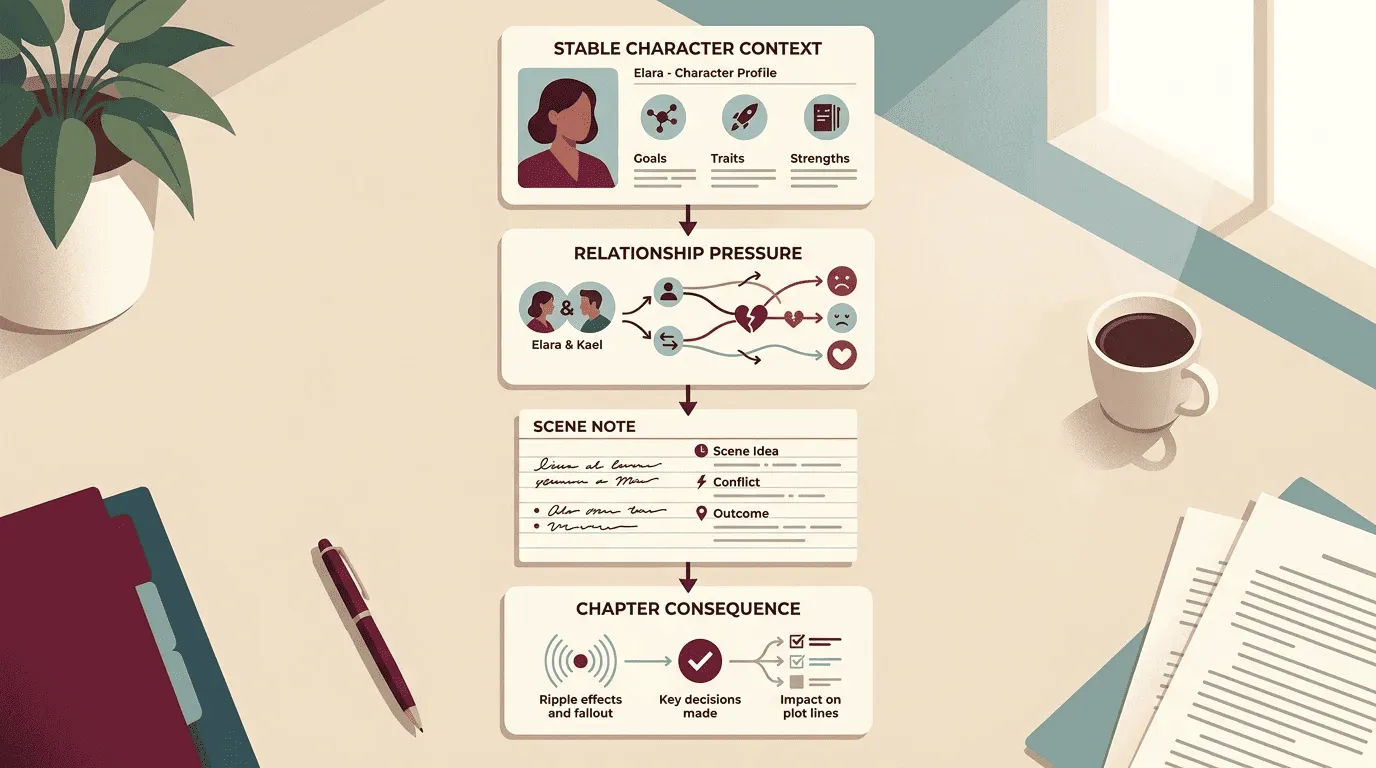
🛠️ How to Turn Character Answers Into a Writing Workflow
Once you know which answers matter, stop adding trivia. Put each answer where it can help you draft.
Use the romantic-fantasy example as a handoff:
- Stable answer → character context: forbidden magic, brother’s illness, family exile risk, and the false identity she must protect.
- Relationship answer → relationship state: the rival needs public proof and can turn an apology into an exposure trap.
- Scene answer → scene note: she must steal the remedy recipe while pretending she came to apologize.
- Chapter consequence → drafting note: if her public miracle saves someone, it should also increase suspicion in the next chapter. A chapter outline template can hold that consequence beside the next chapter’s POV, conflict, and continuity notes.
A static questionnaire often breaks down at this exact point. The writer answers good questions, but the answers stay in a separate document. Three chapters later, the useful answers are no longer close to the scene being written. The problem is not memory alone; it is placement. A scene note works best when it sits beside the scene, not buried under twenty polished character facts.
SeaBell fits best at this late workflow stage, after the writer has chosen the answers that actually matter. Stable answers can become reusable context, including an AI character card for novel writing. Relationship pressure, scene notes, and chapter consequences need to live next to the chapter being drafted, not scattered across a worksheet.
That does not replace the writer’s judgment. It gives chosen answers a more useful place to live while chapters are being drafted, tested, and revised.
❓ FAQ
Are character development questions the same as a character questionnaire?
They overlap, but they are not the same thing. A character questionnaire often collects facts: appearance, background, habits, preferences, and history. Character development questions test story function: what the character wants, what they fear, who pressures them, and what choice changes the scene.
A questionnaire can be useful after the core pressure is clear. If you are stuck on the next scene, start with development questions first.
How many character development questions should I answer?
Answer enough to make the character usable in the story stage you are working on. For a protagonist, that usually means premise role, motivation, arc pressure, key relationships, and scene behavior. For a side character, answer only what affects conflict or plot function.
If you are answering questions for an hour and still cannot write the next scene, stop collecting facts. Choose the three answers that most affect the character’s next choice.
Do I need a character profile template too?
Maybe, but not first if your real problem is story pressure. A profile can store stable facts once you know what matters. It is less helpful when the character has traits but no desire, relationships but no conflict, or backstory but no scene behavior.
Use development questions to find the pressure. These are the questions to develop a character before drafting; a profile or card can store the answers you need to reuse later.
Can AI answer character development questions?
AI can brainstorm options, generate contrasts, and help summarize your chosen notes. It should not make the final story judgment for you.
The risk is accepting the smoothest answer instead of the one that creates the hardest choice. A polished bio may sound complete while giving the character nothing costly to do. If you use AI, ask for multiple possible answers, then choose the version that creates pressure, cost, or a consequence you can put on the page.
Should I make a PDF of character development questions?
A PDF is fine for collecting the questions, especially if you want a quick reference. But the important answers should not stay there. Move the few answers that affect choices, relationships, and scene pressure into the workspace where you plan, draft, or revise.
What questions help fix a flat character?
Start with four questions:
- What does the character want in this scene?
- What are they afraid will happen if they fail?
- What false belief or protective habit shapes their choice?
- What decision changes the situation by the end of the scene?
If those answers are vague, the character will probably stay flat no matter how much biography you add. Make the want specific, give the fear a cost, and force the choice to change something on the page.
Related Posts
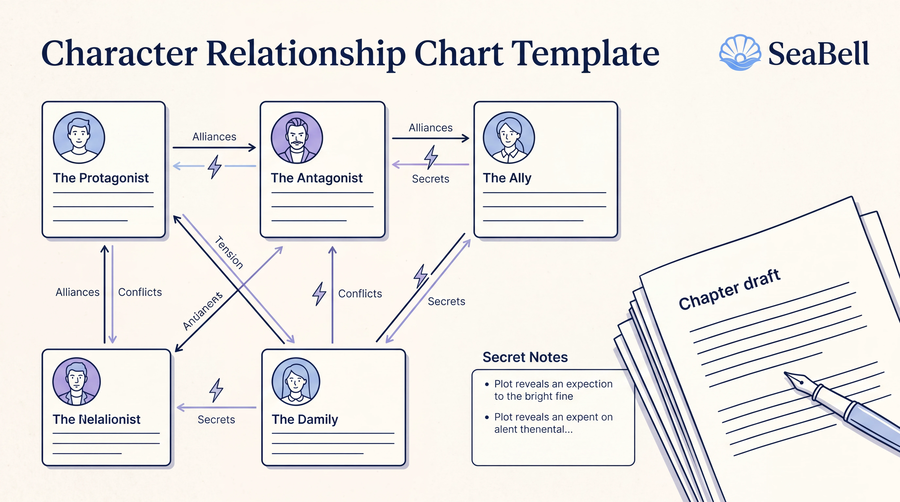
Character Relationship Chart Template for Fiction Writers
Use this character relationship chart template to track alliances, secrets, conflict, romance, family ties, and relationship changes across your fiction draft.
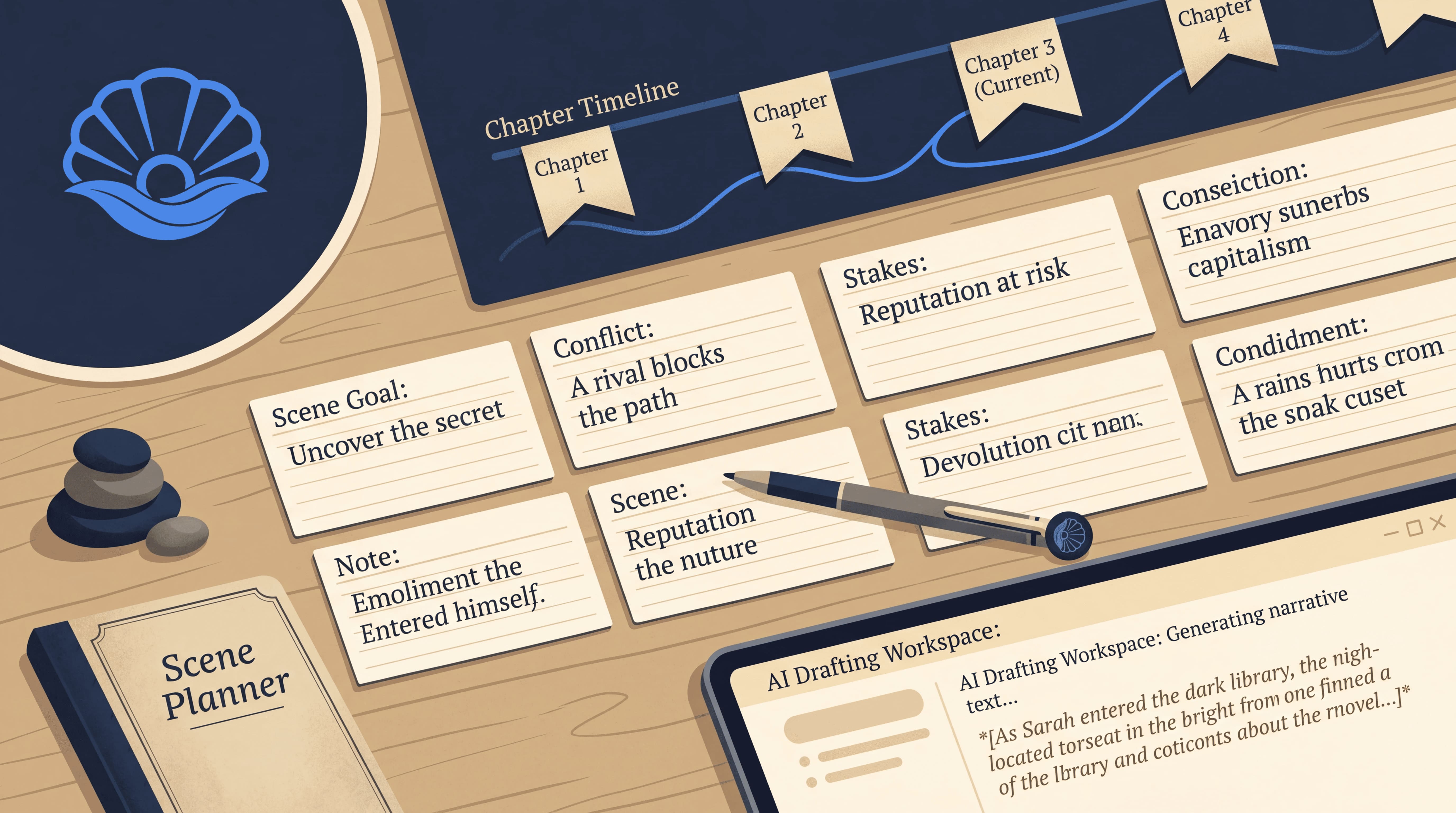
Scene Card Template for Novel Writers | SeaBell
Copy a scene card template for fiction writing, see a filled example, and turn your scene plan into a focused AI drafting brief
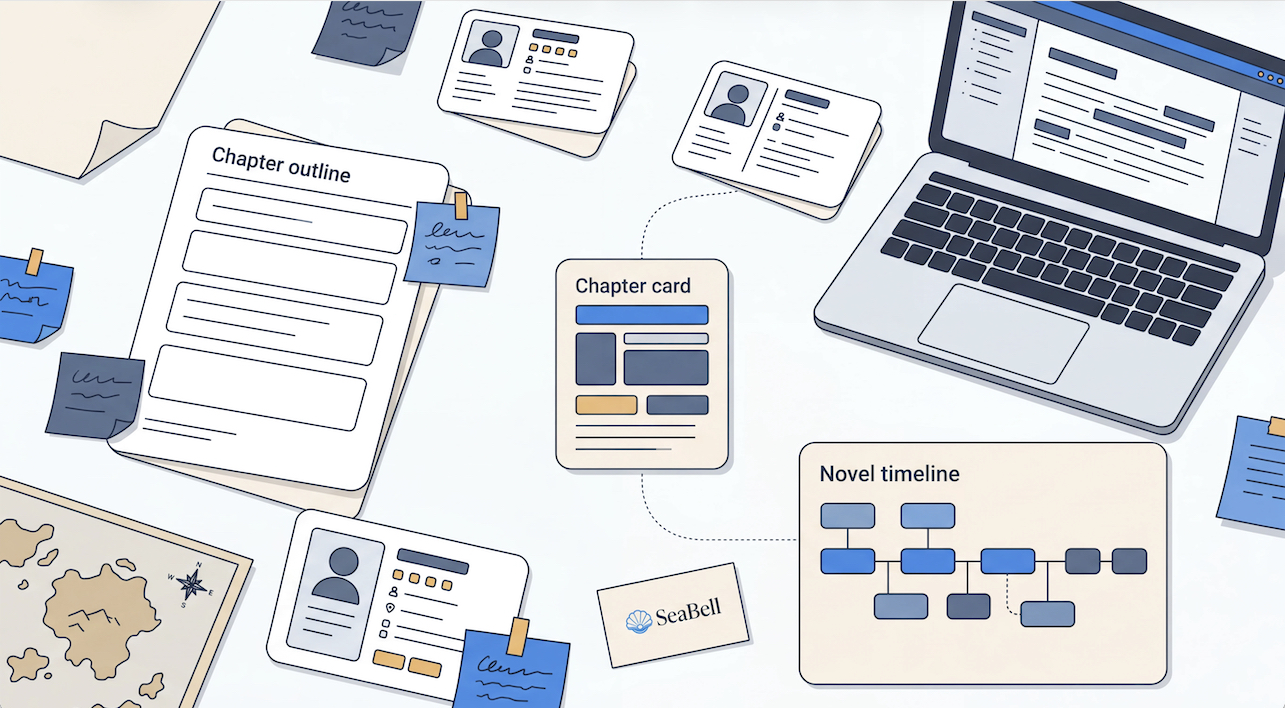
Chapter Outline Template for Novel Writers
Use this chapter outline template to plan POV, conflict, character change, continuity notes, and ending hooks before drafting your next novel chapter.
AI Character Card for Novel Writing | SeaBell
Chapter 12 and your characters are already slipping. Learn how an AI character card keeps voice, arc, and relationships consistent through a long novel draft.