

Character Relationship Chart Template for Fiction Writers
You usually do not reach for a character relationship chart when the story feels easy. You reach for one after Chapter 17 makes you mutter, "Wait. Didn't these two hate each other?"
A rival gets forgiven in Chapter 6, then treated like a stranger in Chapter 14. The slow burn jumps into confession because the scene got warm for three pages. A suspect knows too much, or not enough. An AI pass turns a dangerous alliance into polite banter because the prompt named the characters but forgot the damage between them.
That is not a character moment. It is a relationship tracking failure.
The chart is built for that failure. Not a cast directory, a pretty character relationship map, or a static family tree. A relationship state sheet: what the public sees, what the characters know, what they hide, who has leverage, what changed last time, and what the next scene must not clean up too soon.
Use the template below when your cast starts lying, forgiving, flirting, protecting, betraying, or misreading each other in ways the plot depends on.
🧩 Copy-Paste Character Relationship Chart Template
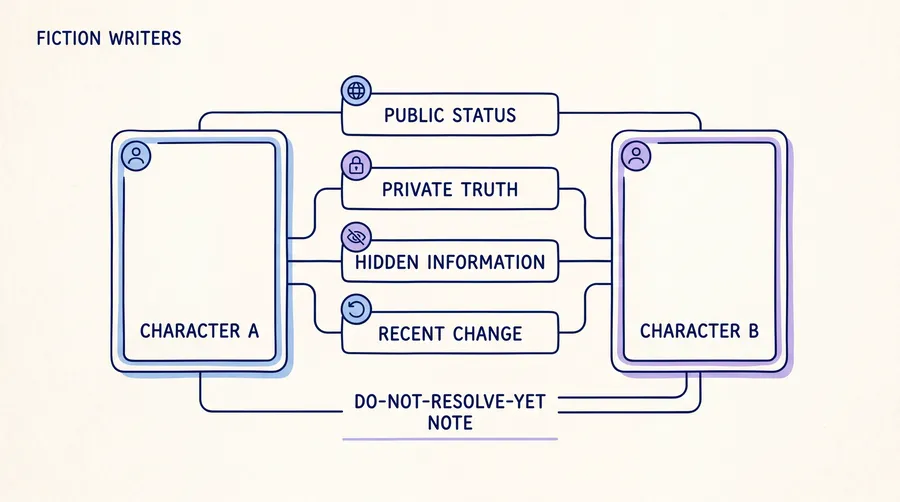
Start with one active pair. If a field does not affect the next few scenes, leave it blank for now. A useful row is better than a perfect row that becomes homework.
Character A:
Character B:
Relationship type:
Public status:
Private truth:
Power balance:
Shared history:
Current tension:
Hidden information:
Recent change:
Next-scene consequence:
Source chapter/scene:
Do-not-resolve-yet note:
🔎 What a Character Relationship Chart Actually Tracks
A character relationship chart does not ask, "Are these two connected?" A character map template or character relationship diagram already answers that. The better question is narrower: what can these two safely do to each other in the next scene?
The relationships that wreck a draft are rarely the ones you forget entirely. They are the ones you remember in the wrong state. You remember that Rook protects Elian. You forget that she just saw him destroy a message about her brother's murder, so the next scene comes out charming, calm, and completely wrong.
"Rook protects Elian" is a label. "Rook protects Elian in public while hiding a clue about her brother's murder" is a scene engine. It changes where they stand, how much eye contact they risk, which questions they dodge, and why a quiet line can feel more threatening than an argument.
The relationship state test: Before: "Rook and Elian are allies." After: "Rook protects Elian in public, but she saw him destroy a message about her brother's murder." If the row does not change dialogue, blocking, reveal timing, or the final beat, it is not a relationship state yet.
✍️ How to Fill the Fields Without Turning Them Into Paperwork
The field names matter less than the pressure they preserve. Do not write a biography in each box. Write the piece of relationship context the next scene would lose without it.
| Field | What to write |
|---|---|
| Character A / Character B | The pair whose interaction can change the scene, not every pair who happens to know each other. |
| Relationship type | The surface label: ally, rival, sibling, mentor, ex, fake friend, political hostage, secret lover. |
| Public status | The mask. What the court, team, family, town, or reader is allowed to see. |
| Private truth | The leverage underneath the mask: attraction, guilt, resentment, fear, debt, suspicion, or need. |
| Power balance | Who has control right now: rank, money, evidence, access, affection, guilt, protection, or physical force. |
| Shared history | The old rescue, betrayal, promise, humiliation, contract, childhood debt, or wound that still changes the room. |
| Current tension | The pressure visible on the page right now. Not "complicated." Name the complication. |
| Hidden information | The lie, clue, unconfessed attraction, hidden crime, false assumption, or withheld fact affecting the bond. |
| Recent change | The last event that shifted the relationship: apology, rescue, public insult, clue reveal, almost-confession, betrayal. |
| Next-scene consequence | What the next scene must do because this row exists: avoid, misread, lie, protect, provoke, test, confess, or refuse. |
| Source chapter/scene | Where the current state was established, so revision does not become guesswork. |
| Do-not-resolve-yet note | The secret, attraction, resentment, power imbalance, or misunderstanding the story still needs alive. |
⏳ The Field That Saves the Most Scenes: Do-Not-Resolve-Yet
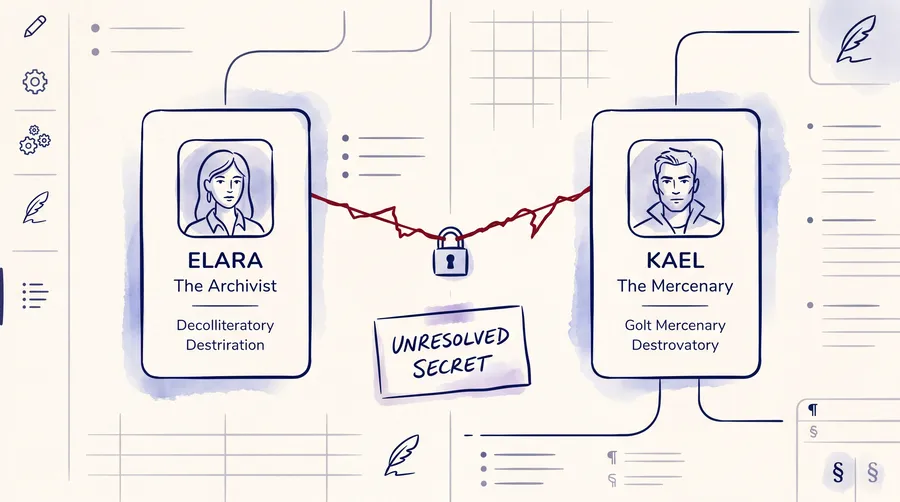
If you only keep one extra field, keep this one. Think of it as the brake pedal.
The do-not-resolve-yet note stops the draft from being too kind. It tells you what must stay broken, hidden, awkward, unconfessed, politically dangerous, or emotionally unfinished at the end of the scene.
Most writers are more addicted to resolution than they think. The apology feels satisfying. The confession feels earned because the scene is warm. The honest talk looks mature on the page. And just like that, the tension you needed for three more chapters is gone.
I distrust dialogue most when it becomes neat right after a betrayal. Real people stall. Fictional people can stall with shape: a formal address where a nickname used to be, a hand pulled back, an answer that dodges the real question, a joke that lands too hard. This note keeps the knife in the wound until the story is ready to pull it out.
Weak note: "They are tense."Better note: "Do not let Elian confront Rook about the destroyed message yet. Make her test him through a tactical choice, not an accusation."
That second note gives the next scene a job. The first one only gives it a mood.
📌 Filled Character Relationship Chart Example
Here is one row from a fantasy court story where romance, politics, and a murder clue all press on the same relationship.
| Field | Example entry |
|---|---|
| Character A | Princess Elian |
| Character B | Captain Rook |
| Relationship type | Public guard assignment; private slow-burn attraction; political alliance under strain. |
| Public status | Rook is sworn to protect Elian during the succession hearings. |
| Private truth | Elian trusts Rook more than her council, but suspects he hid evidence about her brother's death. |
| Power balance | Elian outranks him. Rook controls access to the witness list. |
| Shared history | He saved her during the border rebellion. She later used him as a political shield without warning him. |
| Current tension | They need each other, and both know that need is becoming dangerous. |
| Hidden information | Rook knows the court physician met the rival duke before the murder. |
| Recent change | Elian saw Rook destroy a message instead of delivering it. |
| Next-scene consequence | Their next private conversation starts guarded, not intimate. Trust gets tested through a tactical choice. |
| Source chapter/scene | Chapter 8, archive corridor scene. |
| Do-not-resolve-yet note | Do not let Rook explain the destroyed message until after the public accusation in Chapter 11. |
This row stops Elian and Rook from falling into easy trust just because the scene has chemistry. They can want each other's trust. They can even protect each other. But the destroyed message, the murder clue, and the public performance are still in the room. The row reminds you not to sweeten the scene until the story has paid for it.
🎭 Scenario Examples You Can Steal
Good rows are not decorative. They tell you what the next scene has to do with the relationship.
Fantasy Court Alliance
| Public status | Lord A swears unbreakable loyalty to King B during the coronation vote. |
| Private truth | King B ordered the murder of Lord A's father. Lord A needs the crown secure before he can strike. |
| Next-scene consequence | The public scene sounds ceremonial. The private scene sounds like a threat wrapped in etiquette. |
Romance Slow Burn
| Recent change | Nia and Tomas almost confessed after the storm rescue. |
| Do-not-resolve-yet | They cannot sleep together tonight. The story still needs the fear that touch would make things too honest. |
| Next-scene consequence | Use formal address, careful distance, one failed almost-apology, and one moment where touch would solve too much. |
Mystery Clue Network
| Hidden information | Elian knows Rook destroyed evidence tied to her brother's death. |
| Current tension | Rook suspects she knows, but cannot prove it. |
| Next-scene consequence | He lies to her face. She almost believes him. The reader sees the cost of both choices. |
Team or Found Family Bond
| Public status | The team still treats Jae as the loyal medic. |
| Private truth | Two members know Jae sold a route map to protect his sister. |
| Next-scene consequence | A rescue scene carries gratitude and suspicion at the same time. Nobody gets to hug it out yet. |
🗂️ Character Relationship Chart vs. Character Map vs. Character Card
These tools overlap, but mixing them creates a muddy reference file. A map shows the room. A card explains the person. A chart keeps the pressure between two people current.
| Tool | Question it answers | Use it when |
|---|---|---|
| Character map template | Who is connected? | You need factions, families, allies, rivals, and cast clusters at a glance. |
| Character relationship chart template | What is true between these two right now? | You need trust, secrets, romantic tension, betrayals, leverage, and continuity across chapters. |
| Character card | Who is this person alone? | You need voice, wounds, goals, motivation, habits, fears, and recurring behavior. |
An AI character card for novel writing might say Rook avoids confession because loyalty has cost him before. The relationship chart says how that wound behaves around Elian after Chapter 8. Those are different jobs.
🧭 Relationship Types Worth Tracking in Fiction
You do not need every coffee purchase, hallway nod, or background cousin. A chart with every low-stakes connection will die by Chapter 3. Track the relationships that change decisions, secrets, conflict, emotional payoff, or repeated scene behavior.
- Romantic tension: attraction, denial, boundaries, jealousy, misunderstandings, trust tests, and the almost-confession. If they almost kissed after the storm rescue, the next scene cannot treat them like casual friends.
- Political alliance: bargains, leverage, betrayal risk, and the private cost of public loyalty. Two characters can vote together while one keeps a blackmail letter in reserve.
- Mentor and student: withheld truth, control, pride, dependency, and the moment the student stops asking permission.
- Rivals or enemies: ideology, insult, competition, grudging respect, and temporary cooperation that neither person wants to admit they need.
- Mystery clue connection: who knew the victim, who lies about proximity, who misreads a bond, and who hides the truth from the wrong person.
- Found family or team bonds: trust earned through action, damaged by secrets, and tested under pressure. A rescue does not erase the lie that made the rescue necessary.
The power balance check: If the chart says Character A is isolated, broke, exposed, or disgraced, do not let them behave like they still control the room. If Character B holds the evidence, access, money, or affection, the scene needs to feel that imbalance.
📝 How to Use the Chart Before Drafting
Before drafting, do not reread the whole chart. Pull the rows that can damage the scene if you forget them.
- Flag active relationships only. For a dinner scene, pull the host, the guest who is lying, the sibling who suspects the lie, and the romantic lead who misreads the silence.
- Check the last source scene. Did someone apologize, betray, rescue, humiliate, learn a secret, or make a promise?
- Write the do-not-resolve note first. That one line usually shapes the scene faster than a page of mood words.
- Turn the row into behavior. What must they hide? What almost slips out? What lie do they have to sell?
If the row says, "She owes him an apology but needs his vote," the dialogue needs calculation. If the hidden information says, "He knows she forged the letter," his politeness should carry an edge. The chart has not done its job until the scene has to behave differently.
🔧 How to Use the Chart During Revision
Revision is where a character relationship tracker earns its keep. Relationship drift often hides in the scene after a big change. A betrayal lands well, then the next chapter treats it like weather. A rescue creates intimacy, then the pair goes back to neutral banter.
- Audit the do-not-resolve notes. Did Chapter 5 accidentally solve a secret meant to explode in Chapter 12?
- Trace the information chain. Does Character C know what A told B in Scene 3, or did the draft skip how C found out?
- Validate the power balance. If Character A loses their title in Chapter 2, Character B's blackmail in Chapter 10 needs a new source of leverage.
- Choose change or pressure. A tense relationship can stay tense, but the scene needs to add something: a new lie, a failed apology, a public humiliation, or a rescue with a cost.
Common drift looks like forgiveness followed by suspicion with no new trigger, rivals acting like strangers after a vulnerable scene, a slow burn resolving too early, or a suspect forgetting a fact the plot already gave them.
🤖 How to Turn a Relationship Chart Into an AI Drafting Brief
The weakest AI dialogue is often not ugly. It is pleasant. Everyone says the correct thing, nobody risks anything, and the scene politely avoids the one wound that should shape every line.
Do not ask AI to guess the subtext. Give it the relationship state.
Weak prompt: "Write a tense scene where Elian and Rook talk in the archive."Better prompt: "Elian needs Rook's help, suspects he destroyed evidence tied to her brother's murder, and must not learn why until Chapter 11. Rook suspects she knows. Keep the dialogue restrained. Build the scene around a tactical choice, not a confession."
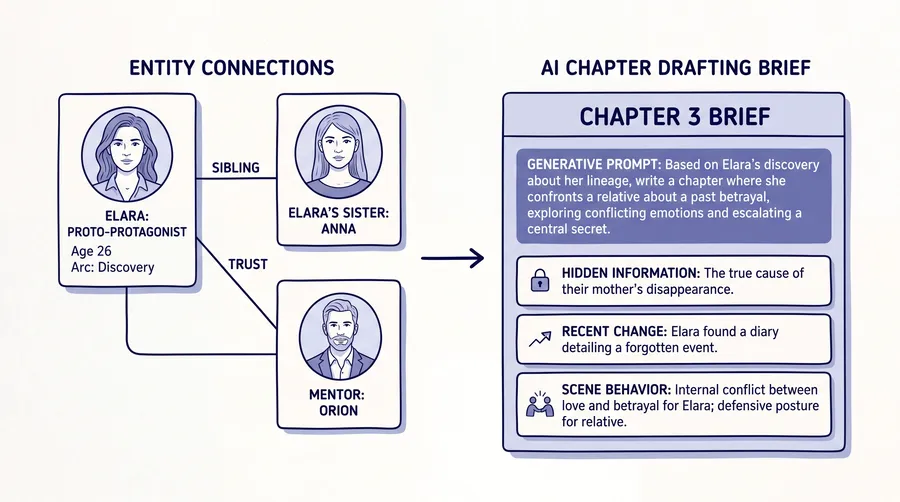
Scene relationship brief:
- Relationship state now: Elian and Rook are publicly protector/protected, privately attracted, and politically uneven.
- What changed last time: Elian saw Rook destroy a message tied to her brother's murder.
- Hidden information: Rook knows the court physician met the rival duke.
- What must not resolve: Do not reveal why Rook destroyed the message yet.
- Scene behavior: Keep dialogue restrained. Let tension come from withheld information, tactical cooperation, and a trust test rather than open confession.
When you give an AI drafting tool this level of context, you are not asking it to invent the relationship for you. You are refusing to let the scene start from neutral.
If you write with SeaBell's AI novel writing agent, keep the active relationship row beside the chapter brief and character notes. That small context pack is usually enough to stop the scene from starting at neutral. The real work still happens before drafting: deciding what the relationship cannot resolve yet.
⚠️ Common Character Relationship Chart Mistakes
- Only tracking labels. "Best friends," "siblings," and "enemies" are not enough unless the row also says what changed and what follows from it.
- Resolving tension too soon. If the argument, secret, attraction, or power imbalance still gives the story energy, protect it in the do-not-resolve-yet note.
- Tracking every pair in the cast. A chart with fifty low-stakes relationships becomes noise. Track the bonds that affect scenes.
- Ignoring public versus private status. Court allies may privately hate each other. Exes may act civil while one still holds leverage.
- Letting the chart go stale. Update it after betrayals, confessions, lies, rescues, public humiliations, clue reveals, failed apologies, and power shifts.
- Using the chart as a family tree. Family connections matter, but the working question is what the bond does to the draft.
- Expecting AI to remember unstated context. If the relationship state matters, put it in the brief.
✅ Final Check Before You Draft
Before you start the next chapter, pick the relationship row with the most pressure and ask four questions:
- What changed the last time these two shared a scene?
- What does one person know that the other does not?
- Who has power right now, and what kind?
- What would ruin the story if it got resolved too early?
If the row answers those questions, you have more than a chart. You have a small piece of story memory sitting beside the draft.
❓ Writers Ask
Do I need to track every single interaction?
No. A character who buys your protagonist coffee does not need a row unless the coffee is poisoned, the buyer is secretly family, or the protagonist reads the gesture as a betrayal. Track the interactions that change something.
What should a character relationship chart include?
Start with the two characters, relationship type, public status, private truth, power balance, hidden information, recent change, next-scene consequence, source scene, and a do-not-resolve-yet note. Cut fields when they stop helping the draft.
Is a character relationship chart the same as a character map?
Not quite. A character map or character relationship diagram shows the cast network. A chart tracks the state of a specific bond, especially what changed and how that change affects upcoming scenes.
How is a relationship chart different from a character card?
A character card describes one person. A relationship chart describes the pressure between two people. The card tells you Rook avoids confession. The chart tells you why Elian cannot trust that silence in Chapter 9.
How often should I update the chart?
Update the row after a relationship changes on the page: a betrayal, confession, rescue, lie, clue reveal, public insult, failed apology, or power shift. You do not need to update it after every line of dialogue.
Can I use this with AI writing tools?
Yes. Generate or update the chart before you prompt. If you do not know what Character A feels, hides, or needs from Character B when you hit generate, the AI will often default to neutral pleasantries. This is where a broader AI novel writing workflow can help keep relationship state attached to the draft. Without that state, the output is not fiction. It is customer service.