

Romantasy Tropes: 15 Fantasy Romance Tropes Explained | SeaBell
Romantasy tropes are fantasy romance patterns in which elements like magic, law, species, power, prophecy, or political danger change what the couple can choose and what the relationship costs. The familiar labels are easy to name: fated mates, enemies-to-lovers, magical bonds, forbidden love, political marriage, quests, trials, shadowy protectors, hidden power, and found family. The craft problem starts when those labels could be moved into a contemporary romance with almost nothing changing.
A trope is a promise, not a plot. “Fated mates” promises pressure before trust. “Enemies-to-lovers” promises a real shift from opposition to respect. “Forced proximity” promises that the characters cannot simply leave, but it still has to matter after the door opens or the quest ends. A one-bed scene in an inn is familiar romance machinery; a one-bed scene during an oath hearing, where one character feels every strategic lie as pain, is a different kind of chapter problem.
This romantasy tropes list opens with a quick-reference matrix, then moves into the writing tests that keep familiar patterns from becoming a bundle of popular tags. Use it as a craft check: if removing the magic leaves the same relationship scenes intact, the fantasy system is not doing enough work.
🧭 What makes a trope specifically romantasy?
A general romance trope becomes a romantasy trope when the fantasy world changes the relationship’s options, risks, or consequences. The difference is not just dragons in the background or a court title attached to a love interest. The fantasy element has to change what a character can safely say, refuse, hide, promise, or sacrifice.
In genre romance, readers usually expect a central love story and a happy-ever-after or happy-for-now ending. In romantic fantasy, the fantasy plot may carry more weight, and market language is not always consistent, as Indie Author Magazine's genre discussion also notes. For a working writer, the useful distinction is simpler: ask whether the romance could happen the same way in a contemporary setting. If the answer is yes, the trope may still be romantic, but it is not yet doing distinct romantasy work.
That is where the Remove-the-Magic Test helps:
If you remove the magic, species difference, oath, curse, prophecy, kingdom law, or supernatural cost, do the same scenes still make sense?
If the couple still meets, fights, flirts, separates, reunites, and chooses each other in exactly the same way, the fantasy layer is scenery. If a single world rule changes what one character can reveal, what the other can safely believe, or what both of them risk by choosing love, then the trope has become romantasy-specific.
This page focuses on that fantasy-pressure layer. For general relationship patterns, use these broader romance trope mechanics; this article stays with the narrower question of how world rules reshape romance choice, agency, power, and cost.
Decorative lore can look impressive in planning and disappear when a scene begins. Use a worldbuilding template to define the rule, then check the next scene. If the court hierarchy, magic system, or monster law never forces a choice between costly actions, the fantasy pressure is still on paper rather than in the story.
A trope is not automatically good or bad. The useful question is why it works here and what makes it fail.
🗂️ Romantasy tropes quick-reference table
| Trope | Reader Promise | Fantasy Mechanism | Common Failure |
|---|---|---|---|
| Fated mates | Intense pull before safety or trust | Bond, mark, prophecy, or soul recognition that creates pressure before choice | Treating destiny as consent, trust, or compatibility |
| Magical tether or shared powers | Forced intimacy with real consequences | Linked pain, borrowed magic, curse radius, life debt, or power echo | The bond creates closeness but never creates a choice |
| Reincarnated or repeatedly separated lovers | Love under time, memory, and loss | Rebirth cycle, broken curse, interrupted timeline, or partial memory that changes present trust | Past-life feeling replaces present-life relationship work |
| Enemies across factions or species | Attraction under real opposition | War law, species boundary, prior harm, forbidden alliance, or inherited duty | “Enemies” are only sarcastic flirtation |
| Political marriage or magical treaty | Private desire inside public obligation | Treaty terms, succession law, oath magic, hostage peace, or heir rules that make affection politically useful or dangerous | The marriage is arranged but never politically costly |
| Forbidden love under law, oath, caste, or divine rule | Love that threatens identity, duty, or survival | Enforced taboo, divine punishment, caste magic, oath penalty, or inheritance rule | Rule-breaking has no meaningful consequence |
| Immortal/human or lifespan-gap romance | Love across time, authority, and unequal knowledge | Immortality, aging rules, ancient office, memory burden, or power that can outwait ordinary consent | Age becomes aesthetic rather than a power problem |
| Reluctant quest companions | Trust built through danger and competence | Artifact route, rescue obligation, border crossing, or shared enemy that exposes values through survival decisions | The quest could be replaced with a road trip unchanged |
| Fantasy forced proximity | No easy exit, but not random confinement | Warding spell, curse radius, dangerous territory, ritual pairing, or complementary magic that makes separation costly | The proximity ends and nothing in the relationship changes |
| Training partners or paired magic | Skill, vulnerability, and attraction under pressure | Combat discipline, unstable magic, paired casting, mentor taboo, or power that fails without trust | Training becomes instant mastery or sensual montage only |
| Trials, competitions, and war-bound alliances | Desire tested by public stakes | Arena law, divine trial, succession contest, wartime pact, or public ranking that turns private loyalty into evidence | The couple ignores the larger stakes once romance begins |
| Shadow daddy or morally-grey protector | Danger, devotion, and moral tension | Dark magic, violent office, underworld power, blood debt, or command authority with visible limits | A costume of shadows with no values, limits, or cost |
| Hidden-power heroine / Chosen One | Discovery, competence, and identity shift | Latent magic, bloodline, prophecy, sealed ability, failed training, or power that attracts political use | Instant unmatched power with no training cost or failure |
| Monster or nonhuman love interest | Desire across real otherness | Species biology, hunger, territory, transformation, promise-law, lifespan, or courtship rules | Nonhuman traits become only aesthetic packaging |
| Found family around the central couple | Love that joins a wider emotional system | Crew bond, rebel cell, court circle, pack law, coven duty, or quest party that keeps the couple accountable | The couple erases every other relationship after pairing |
🔗 Bonds, fate, and magical compulsion
Fated mates
The fated-mates trope promises intensity before certainty: recognition, a shared mark, or a pull neither character can ignore. That magic can create pressure, but it cannot stand in for consent, attraction, trust, compatibility, apology, or repair.
Treat destiny as an interruption, not a verdict. One character may welcome certainty after danger while the other experiences it as captivity. Ask what the bond forces them to confront, and what they must still choose without magical proof.
Magical tether, shared powers, or curse-bound lovers
A magical tether matters when it changes behavior: linked pain, misfiring spells, borrowed power, or a curse radius makes cooperation unavoidable. Shared access is not automatic intimacy. The tether becomes sharper when access turns into leverage: sensing fear removes privacy, drawing magic can look like exploitation, and painful separation makes staying together different from choosing each other.
If the bond only reports emotion, it is exposition. “He felt her fear” gives information. “He lied to the council so she could keep the secret he had every reason to use” forces a choice.
Reincarnated or repeatedly separated lovers
Reincarnated lovers bring a curse, prophecy, or repeated meeting into the present, but the characters still have to build a relationship that matters in this lifetime. Past-life feeling cannot replace current friction, curiosity, fear, desire, and choice.
Partial memory creates more tension than certainty: one remembers betrayal while the other remembers sacrifice. Give the present self a chance to refuse the old story. She may remember dying for him and decline to repeat it; he may remember worship and have to accept distrust. Ask what this lifetime can change that the last one could not.
⚖️ Power, politics, and forbidden relationships
Enemies-to-lovers across real factions or species
Enemies-to-lovers needs incompatible duties, prior harm, bad information, a moral difference, or a survival reason not to trust. In romantasy, a world system such as rival kingdoms, species law, or rebel and royal bloodlines must create consequences beyond the couple's feelings.
Name the earned turn: the costly evidence that changes contempt into respect, not the first spark of attraction. One saves the other and loses rank, surrenders a military advantage by telling the truth, or protects a prisoner and becomes a traitor.
Political marriage or magical treaty
Political marriage works when a border treaty, succession rule, divine bargain, or oath binds public duty to private desire. Ordinary choices become political: who inherits, whose court speaks for the couple, and who gains leverage when affection becomes visible?
Give each spouse a separate stake, then make tenderness carry a public cost. A warning may save one spouse while weakening the treaty; a public touch may calm a court while exposing real attachment. For conflicts shaped by factions and leverage, track power, secrets, and changing relationship states rather than reducing the marriage to shared rooms.
Forbidden love under law, oath, caste, or divine rule
Forbidden love needs more than disapproval. Define whether the bond is illegal, sacrilegious, biologically dangerous, oath-breaking, or a threat to succession or magical inheritance. Explain why the rule exists even if the story condemns it; a caste law may preserve a magical monopoly, while a royal oath may control inherited power.
Then run an enforcement check: who notices, who punishes, and what cannot be undone? If breaking the rule produces only disapproving looks, the label is doing more work than the world.
Immortal/human or large-lifespan-gap romance
Immortality changes authority, memory, grief, and power, not just age. Wealth, knowledge, political leverage, or magical control can make the human partner's agency feel ornamental unless the story addresses life stage and unequal experience.
Give the human a decision the immortal cannot override, solve, or outwait: refusing a bargain, keeping a political loyalty, or leaving with allies. If every problem bends around immortal power, protection has replaced reciprocity.
🗺️ Quests, training, and survival pressure
Reluctant quest companions
Quest companions build attraction through observed competence: keeping watch, crossing a hostile border, or choosing who carries a dangerous artifact. The fantasy route should expose private values through a condition such as an object that reacts to lies, or a homeland one character must falsely claim as home.
If the quest could become a business trip without changing the romance beats, the world is not carrying enough weight.
Forced proximity created by a real fantasy constraint
Forced proximity works when leaving is desirable but materially impossible: a ward traps them, a curse punishes distance, or complementary magic makes separation dangerous. The constraint must change what they know, owe, or risk.
Ask what closeness reveals that distance hid: a failed spell, a lie told in sleep, a reactive wound, or a duty one character cannot perform while watched.
Training partners or paired magic
Training makes competence, embarrassment, restraint, and trust visible. In paired magic, control may depend on another person's timing, honesty, or emotional state. Avoid instant mastery; let power fail, bruise, and expose bad assumptions.
Make the lesson reveal a relationship problem. She cannot cast because she suppresses anger he needs her to use. He cannot guide her because his instructions assume a court education she never had. If failure changes the next attempt, training is carrying plot rather than filling space.
Trials, competitions, and war-bound alliances
Trials and war-bound alliances give romance a public stage where affection can look like weakness, betrayal, or leverage. If a contest determines succession or an alliance depends on trust, private desire should alter the outcome.
Ask what choosing the other person would cost in front of witnesses.
🧩 Character archetypes readers recognize and quickly tire of
Shadow daddy or morally-grey protector
The shadow-powered protector promises danger with devotion, but “morally grey” cannot mean only violent and conveniently tender. Define what he values, where he stops, what he did that cannot be undone, and who besides villains has reason to fear him.
Shadows, knives, wings, and scars are texture, not moral history. Make protection create a debt, lost alliance, public fear, or a choice the heroine resents because it narrows her power.
Hidden-power heroine / Chosen One
Hidden power offers recognition, but the reveal should change how the heroine understands her body, family, past, or political value. Instant supremacy turns competence into decoration.
Give power a learning curve and price: magic may answer only to truth, save strangers while endangering someone she loves, or expose a bloodline that makes her useful and unsafe. Let one failure persist into trust, strategy, or the next public decision.
Monster or nonhuman love interest
Otherness in a love interest should change more than appearance. The fantasy mechanism can shift how the couple communicates, courts, eats, measures time, holds territory, or structures family. A dragon may reject human property rules, a fae lover may treat promises as physical law, or a vampire may experience hunger as daily ethics.
Make the rule alter behavior, not merely appearance. A lover who cannot lie without pain or measures devotion through territory forces the couple to build trust through different signals.
Found family around the central couple
Found family keeps the central couple from erasing every other bond. A rebel cell, court circle, pack, coven, or quest party notices patterns, demands sacrifices, and holds the romance accountable.
Use the Separate-Lives Test: after the couple forms, can each character still name a goal, loyalty, friendship, fear, and consequence outside the relationship?
🧱 How to combine romantasy tropes without writing a checklist
Many weak drafts stack tropes as marketing tags without showing how one changes the next chapter. Shared vocabulary becomes limiting when it hardens into repeated character and plot patterns.
Use the Causal Trope Stack instead:
- One relationship engine.
- One fantasy-pressure engine.
- One reveal or reversal.
Each layer should cause the next: fantasy pressure makes the relationship engine harder, and the reveal changes what the characters think that pressure means.
Bad bundle:
Enemies to lovers + fated mates + shadow daddy + hidden-power heroine + one bed.
Better story logic:
A treaty interpreter can hear broken oaths as physical pain. She is magically paired with the exiled commander whose testimony could end the war, but exposing his truth would invalidate the treaty that protects her younger brother. Their bond forces proximity; it does not create trust.
Here is the stack:
- Relationship engine: enemies to reluctant allies.
- Fantasy pressure: oath-hearing bond.
- Reveal: the treaty protects one family by sacrificing another.
- Scene consequence: every strategic lie hurts one character and exposes the other’s motive.
Before:
The heroine and commander argue, discover they are bonded, share a room because the court requires it, and slowly fall for each other while uncovering a conspiracy.
After:
The heroine feels pain whenever the commander hides information during treaty hearings. At first, she thinks the pain proves he is dangerous. Then she realizes he is lying to protect witnesses the treaty would execute. If she exposes him, her brother remains safe but the witnesses die. If she protects him, the treaty that saved her family collapses. Attraction does not erase the political problem; it makes every truthful moment more expensive.
That is the difference between trope presence and trope causality. The same labels are still there, but now each one changes the next scene.
When a stack feels crowded, find the layer that never changes a decision: a bond that only intensifies attraction or a power reveal that leaves the treaty's cost unchanged. Cut or rebuild it before adding another trope.
✅ Five tests before you draft the next chapter
1. Remove-the-Magic Test
Remove the magic, law, species difference, court structure, oath, curse, prophecy, or supernatural cost. If the romance scenes still work unchanged, revise the fantasy mechanism.
A good romantasy scene should contain at least one choice that exists because of the world. The character cannot confess because a truth spell would expose a rebellion. They cannot touch because their magic burns through skin. They cannot run away because a treaty will punish the village they leave behind.
2. Agency Test
A fantasy bond can create pressure. It cannot create consent, trust, compatibility, attraction, forgiveness, or repair.
Ask what each character can refuse. If one character has no meaningful way to say no, delay, question, negotiate, or redefine the bond, the story may be using destiny to bypass agency. You can keep magical compulsion in the plot, but the narrative has to know it is compulsion.
A useful warning sign is a scene where the bond answers every objection before the character can. If the magic says they belong together, the chapter still needs a human-scale choice: a boundary, a refusal, a renegotiated term, or a repair the bond cannot perform.
3. Earned-Turn Test
For enemies-to-lovers, rivals-to-lovers, protector dynamics, and forbidden relationships, name the concrete turn.
What did one character do that forced the other to revise a belief? What did it cost? What proof remains after the scene ends?
Attraction is not the turn. The turn is evidence. By the end of the scene, there should be a visible receipt: a lost rank, a broken order, a protected witness, a public lie corrected, or a private assumption the character can no longer keep.
4. Separate-Lives Test
After the couple becomes important to each other, each character should still have a life beyond the couple.
List one goal, one loyalty, one friendship or social bond, one fear, and one consequence for each person. If one character’s entire role becomes loving, protecting, healing, or being chosen by the other, the romance is flattening identity instead of deepening it.
Check the chapter outline after the first kiss, bond, or confession. If every scene now begins with the couple’s feelings and no scene begins with a duty, friend, rival, oath, faction, craft, or private goal, the story is quietly erasing separate lives.
5. Causal Trope Stack
Write your trope stack as cause and effect, not a tag list.
Try this sentence:
Because [fantasy pressure], the [relationship engine] becomes harder when [reveal or reversal] forces [scene consequence].
If the sentence does not work, the stack may be decorative. If it does work, you have the beginning of a chapter problem rather than a list of labels.
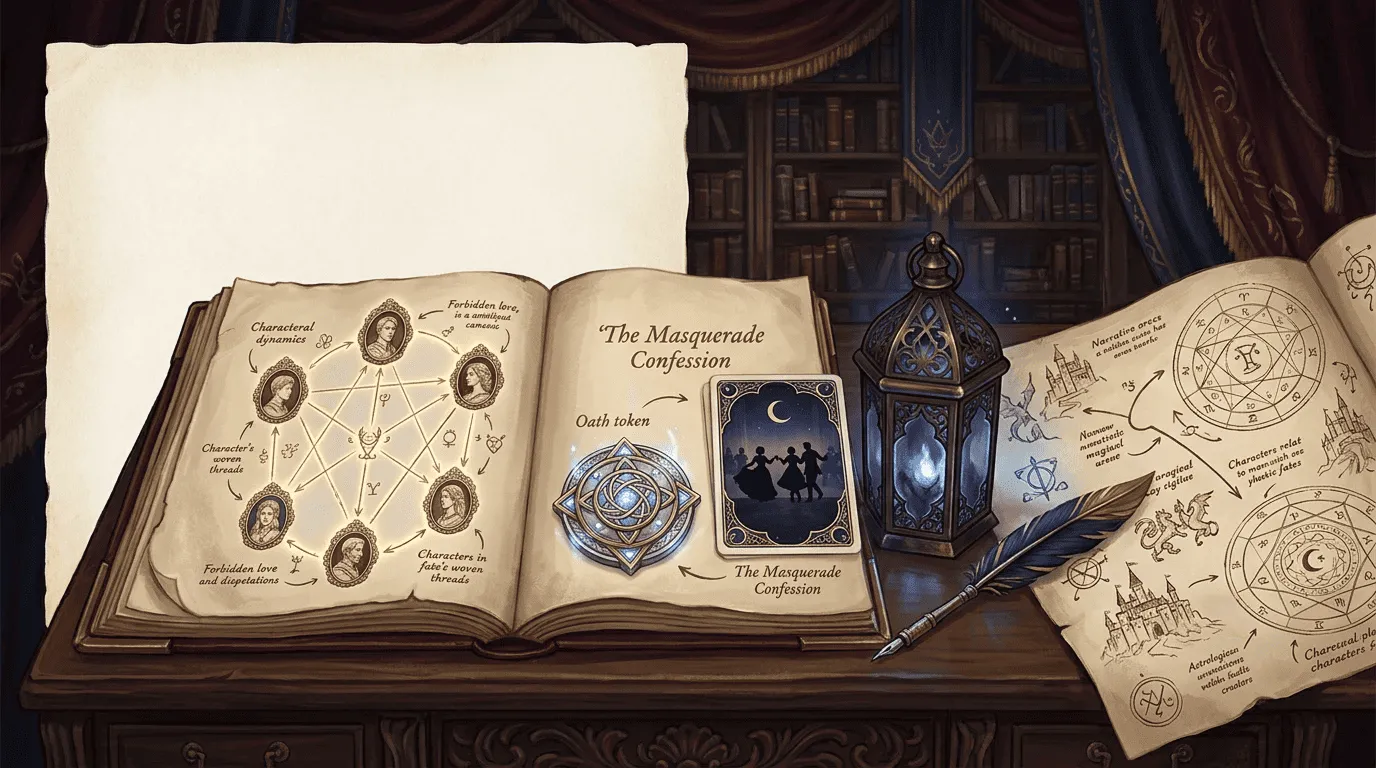
✍️ Move the trope from notes into a drafting workflow
A useful romantasy planning note is not “fated mates + enemies + trial.” It is a decision the next chapter can test.
Before drafting, capture four things:
- World rule: What magic, law, oath, species trait, political system, or divine rule controls the relationship?
- Relationship state: What do they want, hide, owe, fear, misread, or refuse to admit?
- Scene pressure: What choice becomes harder in the next scene?
- Continuity: What bond cost, injury, promise, faction duty, secret, or reveal must carry into later chapters?
This is where a dedicated drafting workspace can help, especially in a long or serial story. Once bonds, treaties, species rules, and relationship states change across chapters, writers can retain a fact yet lose the emotional reason it matters.
To prepare the next chapter, note the rule creating the pressure, the relationship boundary it tests, and the scene where the cost must land. You can keep bond rules and continuity decisions in one story bible, then turn the trope pressure into a scene card for the next concrete choice.
SeaBell fits this late handoff because it keeps world rules, character context, and relationship pressure beside the draft instead of in scattered notes. When the planning is ready to become chapters, move the planning brief into long-form chapter drafting. The tool does not decide whether a trope is earned for you; it keeps the decisions you already made close enough to carry forward.
💬 FAQ
What are the most common romantasy tropes?
Common romantasy tropes include fated mates, enemies-to-lovers, magical bonds, forbidden love, political marriage, forced proximity, quests, trials, shadowy protectors, hidden-power heroines, monster love interests, and found family. In a working draft, each trope should do something specific: a bond pressures agency, a treaty turns desire public, and a quest makes trust visible through action.
What makes a trope a romantasy trope rather than a general romance trope?
A trope becomes specifically romantasy when fantasy rules change the relationship’s choices, risks, or consequences. Strip those rules out as a test: if the characters can make the same decisions at the same cost, the fantasy layer is decorating a general romance pattern rather than driving it.
Is fated mates the same as insta-love?
No. Fated mates can create instant pressure, recognition, or attraction, but it should not replace trust, consent, compatibility, or repair. Insta-love treats the relationship as emotionally complete too quickly; the fated-mates trope works better when destiny creates a problem the characters must still choose through.
How do you write enemies-to-lovers when the characters are real enemies?
Give them concrete opposition first: incompatible duties, prior harm, a real information gap, or a world rule that makes trust dangerous. Then define the earned turn. One character must produce costly evidence that forces the other to revise a belief, and that evidence should still matter after the scene ends.
Does romantasy need a happily ever after?
It depends on how the book positions itself. Genre romance often promises a happy-ever-after or happy-for-now. Romantic fantasy and fantasy romance are used inconsistently across the market, and some stories give the fantasy plot more control over the ending. For reader trust, make the emotional contract clear in the book’s framing and do not market a tragedy as if it were a guaranteed romance payoff.
How many tropes should a romantasy novel use?
There is no useful fixed number of tropes. A small causal stack is usually stronger than a large bundle of labels. Start with one relationship engine, one fantasy-pressure engine, and one reveal or reversal. Add another trope only if it changes what the characters can choose, what they risk, or what the next scene must prove.
Related Posts
Romance Tropes List for Writers: 25 Story Engines | SeaBell
A practical romance tropes list for writers, with common trope meanings, relationship pressure, scene examples, and ways to turn familiar setups into draftable story conflict. - Suggested slug: romance-tropes-list-for-writers
Worldbuilding Template for Fiction Writers | SeaBell
Use this worldbuilding template to organize rules, locations, factions, magic systems, and canon notes for consistent fiction drafting.
Character Relationship Chart Template for Fiction Writers
Use this character relationship chart template to track alliances, secrets, conflict, romance, family ties, and relationship changes across your fiction draft.