

How to Write an Unreliable Narrator: Scene Guide | SeaBell
How to Write an Unreliable Narrator: A Scene-Level Guide
You want readers to doubt a narrator's account without wondering whether the author has lost track. That tension lives in the sentence: which facts stay fixed, where the account bends, and what lets a reader see the bend. A flat contradiction with no cue can look like a continuity error. An explanation that names the trick has the opposite problem: it leaves readers nothing to infer.
This guide works at the level of a single scene. You will keep its actions, dialogue, and stated setup fixed, change only the narrator's account of them, and test whether a reader can reach another evidence-backed conclusion without relying on an omniscient correction or a final twist.
🧭 What makes a narrator unreliable?
An unreliable narrator is one whose account the story has given readers reason to doubt, because a gap opens between what happened and how the narrator presents it. It shows up in three places:
- Reporting. What the narrator states as fact: wrong, incomplete, or quietly adjusted.
- Interpretation. What they conclude from what they see. The facts are right; the reading is bent.
- Judgment. How they value people and events. Everyone else is weak or ungrateful; the narrator is the only reasonable person in the room.
You are not picking one of these three; you are choosing which one leads.
Not every gap is a case of designed unreliability: a narrator you dislike, a young or limited narrator, and one who lies to another character on purpose are not automatically unreliable. Lying to a person in the story is a plot action; distorting the reader's picture is a narrative method. "I don't like this narrator" and "this narrator's account does not hold up" are different claims, and this guide is about the second.
📝 Choose what the narrator cannot admit
Before you write a distorted sentence, decide the telling situation: who is narrating, to whom, and on what occasion. A narrator explaining themselves to a friend bends the story differently from one writing a private account, and the occasion tells you what the narrator stands to lose by being honest.
Then pin down three things:
- The protected self-image. What the narrator needs to believe about themselves. Kind. Supportive. The competent one.
- What they notice. A self-protective narrator still takes in the awkward details; what matters is which ones they catch and how fast they reframe them.
- What they cannot bear to conclude. The one inference their self-image will not allow, however much evidence piles up.
Ordinary self-deception is enough; you do not need malice, illness, or a diagnosis. In the scene below, the narrator needs to see themselves as a supportive older sibling. That need decides what they notice, what they explain away, and what they cannot say. The self-justifying version below runs on that ordinary self-deception.
For a fuller model of the drives behind this self-protection, our guide to character motivation covers want, need, fear, and wound. Get the scene method first; the motivation model is the scaffolding behind it.

⏱️ Choose when readers should notice
Timing is a promise to the reader.
- Early suspicion. The reader can doubt the account inside the scene and watch the narrator work. The baseline below gives readers more information than a finished novel usually would; in a story, this setup promises a second reading, not certain dramatic irony. It still promises tension with a clear source, and the intimacy of watching someone fool themselves.
- Accumulating suspicion. The reader assembles the truth across several scenes. It promises the pleasure of noticing; every installment must add visible evidence, or suspicion stalls.
- Delayed reversal. The reader learns at the end and re-reads. It promises a second, different reading at the highest fairness cost, since everything the reveal depends on must already be on the page.
No timing works for every story, but the order of operations is constant: evidence before deduction. Before you require a conclusion, it must already be reachable.
✍️ Write one scene three ways
Here is the scene, rendered three ways. On Tuesday night at home, a narrator believes they are supporting their younger sister's writing ahead of her school reading on Saturday. The microphone is set up beside the shared laptop for practicing Saturday's reading. Without asking, the narrator deletes six pages of her story and rewrites the ending. When the sister comes in and looks at the screen, she says, "You could have asked me first." She stands by the door. She does not approach the microphone.
Read the scene on three layers: layer 1 holds its fixed facts (actions, dialogue, and stated setup), layer 2 holds what the narrator reports, leaves out, or concludes, and layer 3 holds another inference a reader can support from the same scene. The distortion types above say where an account bends; the layers let you compare a line or an omission with the fact beneath it.
Layer 1 never moves; four of its facts do the heaviest work and must survive every version: the six deleted pages, the rewritten ending, her line of dialogue, and her position relative to the door and the microphone. Only the narrator's account of it changes.
The observable version
Tuesday night at home, the narrator opened the sister's story on the shared laptop, with the microphone set up on the table beside it for practicing Saturday's reading. Without asking, the narrator selected six pages, deleted them, and typed a new ending. When the sister came in and looked at the screen, she said, "You could have asked me first." She stood by the door. She did not walk over to the microphone on the table.
This baseline records actions and dialogue; the microphone's purpose is part of the stated setup, not an emotion assigned to the sister. It leaves her motive open. Sentence by sentence: the first fixes the time, the home setting, and the microphone set up to practice Saturday's reading; the second records the six deleted pages and the new ending, all done without asking; the third keeps her line exactly as spoken; the fourth and fifth record her position by the door and her distance from the microphone.
The self-justifying version
This first-person version is the narrator explaining the evening to a friend afterwards, wanting the account to show them helping. The over-explicit version below runs in the same situation.
So Tuesday night I sat down with my sister's story and, honestly, the ending fell apart, so I cut six pages and wrote her a real ending. When she came in, she gave me the "you could have asked me first" line and hung back by the door instead of coming over. She was clearly nervous about Saturday, she couldn't even go near the microphone, so she needed me to take the ending off her hands.
The table tracks the three sentences and one omission. Each row isolates a cue, but a reader's alternative may draw on other fixed facts in the same scene:
| Sentence or omission | Fixed scene fact (layer 1) | Narrator's account (layer 2) | Reader's alternative (layer 3) |
|---|---|---|---|
| "the ending fell apart, so I cut six pages and wrote her a real ending" | six pages deleted; ending rewritten | her draft was broken; the replacement is the real one | the scene does not establish that the draft was broken; "real" is the narrator's verdict |
| "she gave me the line and hung back by the door" | her sentence; her position at the door | her objection is a performance and she is being difficult | her line challenges the narrator's verdict; her position may show withdrawal rather than difficulty |
| "clearly nervous... needed me to take the ending off her hands" | distance from the microphone | she is nervous and needs the narrator's help | keeping away may mean she is refusing the takeover rather than asking for more help |
| Omitted: "without asking" | no request preceded the deletion and rewrite | the narrator never admits in their own voice that they edited without asking | her "You could have asked me first" brings the omission back into view |
The bolded words are where observation converts into self-serving judgment: "real" grades her work, "gave me" turns her objection into a performance, "hung back" turns her position into an attitude, and "clearly nervous" and "needed me to take the ending off her hands" turn one visible fact, her distance from the microphone, into an emotion and then into a requirement.
The self-justification mostly bends interpretation and judgment, but it also makes a reporting move: the narrator never admits in their own voice that they changed the draft without asking. A silence by itself does not prove distortion. Here the narrator quotes the sister's protest, reduces it to "a line," and calls her withdrawal nerves. Those moves push the failure to ask out of focus while leaving readers a way to recover it. The table's last row compares the fixed fact, the missing admission, and the quoted line that exposes it. Her protest is also the dialogue signal discussed below.
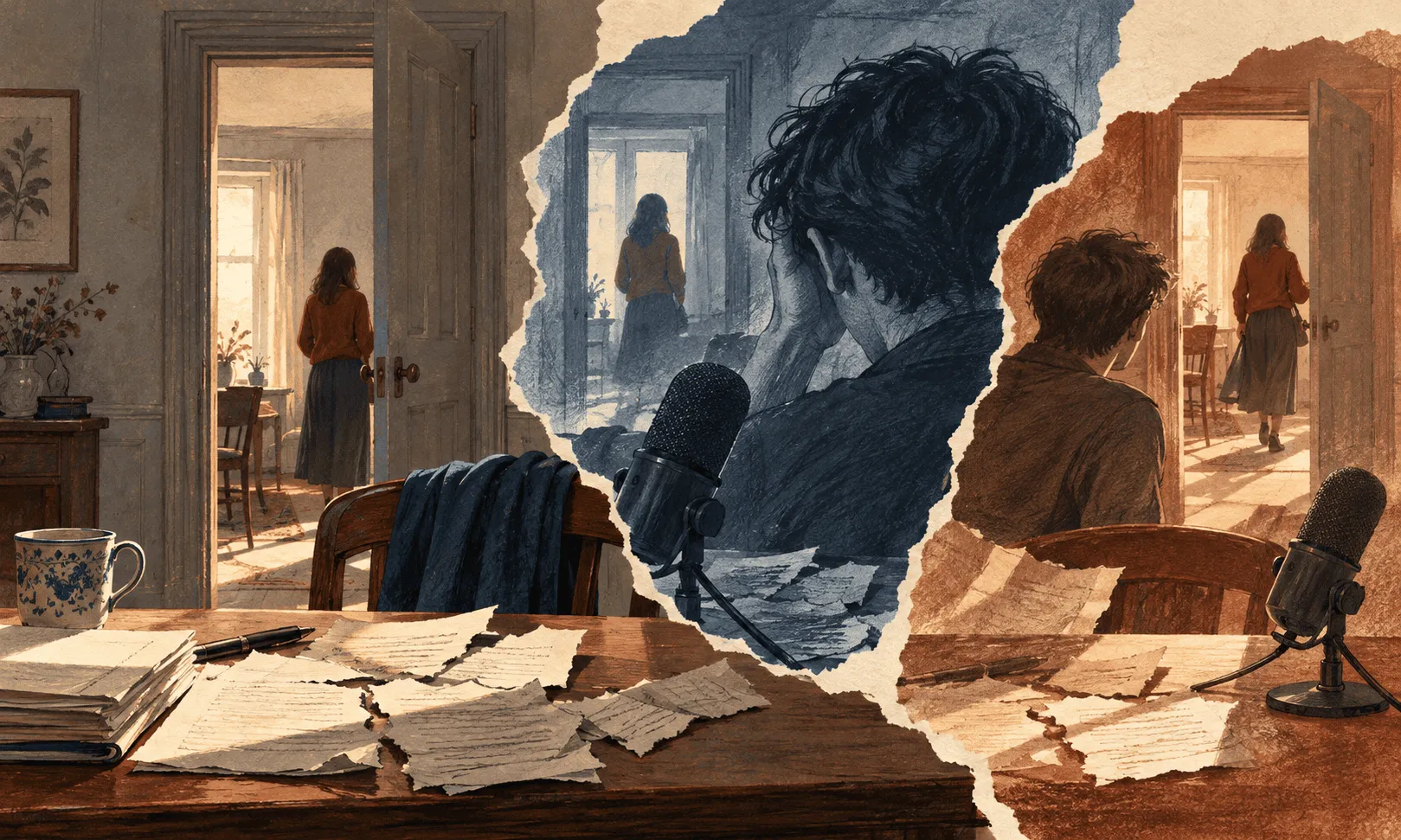
The line that gives readers another inference
The cue is a combination, not one phrase: the rewrite done without asking, her protest against it, and the narrator recasting that protest as nerves. The clearest excerpt is "She was clearly nervous about Saturday, she couldn't even go near the microphone". The observable half (her distance from the microphone) and the narrator's inference (nervous, therefore in need of guidance) sit in one sentence, and the inference runs ahead of the evidence. A reader can hold the facts and reject the interpretation: her protest targets the unasked rewrite, and keeping away from the microphone may mean she is refusing the takeover rather than asking for more help. Her earlier line, "You could have asked me first," is the visible anchor; nobody has to correct the narrator.
The over-explicit version
In the same telling situation, a version that says too much reads like this:
I deleted six pages of my sister's story because I could not stand her being better than me, and I rewrote the ending to prove I could. When she said, "You could have asked me first" and stood by the door, keeping her distance from the microphone, that just proved it: I was taking over her work.
Sentence by sentence, the first names jealousy outright. This version introduces that motive for contrast; nothing in the fixed scene supports it. The second spells out the takeover that the sister's words and actions already let the reader infer.
This version fails in two separate ways. It announces the judgment the reader was meant to reach, leaving no gap to cross. Even a confession grounded in the scene's facts would do that: "I knew I hadn't asked. I told myself I was helping, but I was taking over her work." That confession closes the gap without inventing jealousy. The jealousy sentence also assigns a motive the fixed facts cannot support.
Reader exercise
Compare the self-justifying version with the observable baseline, then run this pass:
- Underline the scene's fixed facts; mark any the narrator leaves out or only reveals indirectly.
- Circle the narrator's judgment words.
- Write a competing interpretation of the same facts.
- Point to the visible evidence for it.
- Name the self-image being protected.
- Name one fixed fact the narrator reports accurately, such as the six-page cut, and keep it fixed when you revise.
- Revise one line and test again.
Different readers will weigh the same evidence differently; you are not engineering identical responses, only making sure a second reading exists and is defended by what is on the page.
🔍 Signal the gap from a single POV
You do not need a second viewpoint to certify the truth. Inside one narrator's head, four things can challenge their account:
- Reactions. Even through the narrator's telling, another character's behavior can resist the offered explanation. The sister stays by the door and away from the microphone; those actions give readers something to weigh against the claim that she "needed me to take the ending off her hands."
- Dialogue. Lines that do not fit the narrator's frame stay on the page uncorrected. "You could have asked me first" tells readers the edit was unasked for, even though the narrator never admits it.
- Material consequences. Six pages are gone, a fact the narrator keeps accounting for, and the accounting is where the gap grows.
- Repeatable behavior. Patterns do not lie well: if the narrator "helps" this way next chapter and gets the same withdrawal, the alternative inference strengthens on its own.
Long-form writers often assume no one will spot an unreliable narrator without a second POV or a confession. Usually the missing piece is not a witness account but a consequence the narrator must explain away, repeated until it becomes a pattern.
⚠️ Diagnose unfairness and confusion
The over-explicit version said too much. Two other problems can make the device feel broken: unfair withholding and an unanchored contradiction.
Unfair withholding versus motivated narration
Ask four questions:
- Does the telling situation give the narrator a reason to bend the account? Explaining the evening to a friend while needing to seem supportive gives the narrator a reason to bend it. "She is nervous and needs me" is the bend, not the reason. A narrator with nothing to protect who simply withholds facts can read as a trick.
- When a known fact is evaded, denied, or told selectively, does the text let the reader see the gap? Look for the wording, the pressure, or the reaction that explains why this fact gets bent. Motivated withholding with visible clues is unreliable narration. What reads as cheating is the author skipping a fact the viewpoint plainly covers just to protect the answer, with nothing on the page to justify the skip.
- Is the vital evidence on the page? A reader who goes back for the clue should find it; if the reveal depends on a fact that was never visible, the ending has no receipts.
- Can the reader form a plausible alternative without solving the whole plot? They need not identify the twist; they need a second reading that survives contact with the evidence.
If your story turns on a detective-style reveal where clue architecture spans the whole book, our guide to writing a mystery novel covers that map; the scene-level test above is the unit that map is built from.
Intentional contradiction versus continuity error
A hard contradiction reads as characterization only when it is anchored. In the sister scene, the self-justifying "I cut six pages" and the baseline's record of six deleted pages describe the same edit. They are different frames across versions, not incompatible claims inside one narrator's account.
For a real contradiction, keep both claims in one telling. Suppose a friend asks whether the narrator deleted any pages. They answer, "I didn't delete any pages." Later, while defending how much they helped, they say, "I deleted six pages so she'd have a real ending." Both claims cannot be true of the same Tuesday edit. The friend's question presses on the narrator's helper self-image, and they still quote the sister's protest, "You could have asked me first." Those cues make the denial legible as self-protection; without them it may look like a continuity error. Two checks for such a case:
- Find the contradiction. Circle two statements that genuinely cannot both be true. Redescriptions of one event — cut versus deleted, rescue versus takeover — are frames, not contradictions, and stay out of this test.
- Find the pressure on the page. Point to the visible wording, pressure, or reaction that explains why the narrator denies or bends that fact here, and note which event facts still stand. If your draft gives the reader no such clue, revise the text so the clue is visible where the reader needs to judge.
Treat the verdict as a risk judgment, not a promise. When genuinely contradictory statements keep bending toward the same protected self-story, readers are more likely to read the contradiction as characterization; a shift in the narrator's motive or understanding later in the story needs its own setup. Contradictions that anchor nothing are more likely to read as errors. Readers can still take a bend for an author mistake, so grounding is safer when it appears before the contradiction lands.
🛠️ Run a blind-reader pass and carry the pattern forward
Before you trust your cue, give a reader who doesn't know your plan only the version your story would present, not the observable baseline, annotations, or answer. Then ask three questions:
- What happened in this scene?
- What does the narrator think happened?
- Which visible line supports the difference between the two?
If the reader cannot answer the third question, revise the cue, not the reader. The distinction lives in the text or it does not live at all.
Then carry the pattern forward with a small note kept beside your next chapter draft:
- Protected belief: what the narrator must keep believing.
- Recurring cue: the kind of line that keeps showing the gap.
- Challenge: what other characters or events press on the belief.
- Response: how the narrator explains the pressure away.
- Earned change: whether and how the account cracks.
For a longer work, this note is also where reveal order lives: what surfaces in chapter three versus chapter eleven. Our story timeline template tracks who knows what and when, the cross-chapter version of the same problem.

❓ FAQ
Can third-person narration be unreliable?
Yes, depending on narrative distance and whose perceptions the prose represents; close third person inside one character's perceptions carries the same reporting, interpretation, and judgment distortions as first person. But not all limited third person is unreliable: withholding what the viewpoint character happens not to notice is ordinary limitation, not designed distortion.
Does the narrator have to lie?
No. Selective attention and self-deception can be enough. In the self-justifying version, the narrator does not falsify the physical actions they report: six pages are cut, an ending is rewritten, the sister protests and stays by the door. The narrator never admits in their own voice that they acted without asking; instead, they dismiss her protest as "a line" and read her distance from the microphone as nerves. That combination, not the missing admission alone, gives readers reason to doubt the account.
How soon should readers suspect it?
Timing should follow the reader experience you want, not a rule of thumb. Early suspicion lets doubt form in the first scene; delayed reversal asks for patience. In every case, give evidence before you require a deduction: if the reader must guess before any visible line supports the guess, the scene is asking for trust it has not earned.
One habit worth keeping: carry the five-line note above (protected belief, recurring cue, challenge, response, earned change) beside the next chapter draft. SeaBell is built to keep story context close to chapter drafting, where notes like this belong. It cannot run the interpretation test for you: deciding what a reader can infer from a line is the writer's judgment, not a one-click twist or a prompt.
Related Posts
Character Motivation for Writers: A 5-Part Framework | SeaBell
Learn how to build character motivation with a five-part framework for want, need, fear, wound, and pressure that creates difficult choices on the page.
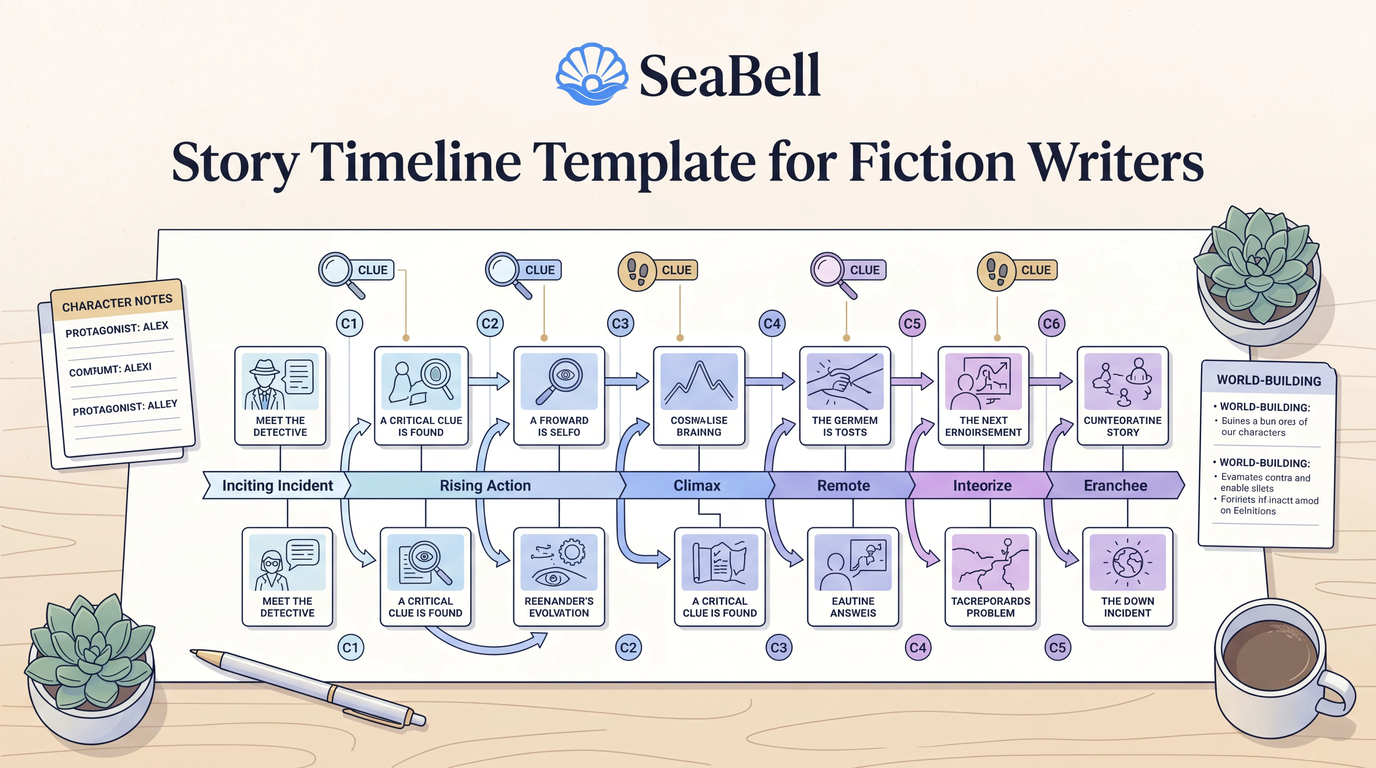
Story Timeline Template for Fiction Writers
Copy a practical story timeline template for fiction writers and learn how to track chronology, reveal order, character knowledge, clues, and revision continuity.
How to Write a Mystery Book: Fair Clues and Reveals | SeaBell
Learn how to write a mystery novel by building the hidden truth first, tracking clues and suspect motives, and revealing the answer without confusing readers.Learn how to write a mystery novel by building the hidden truth first, tracking clues and suspect motives, and revealing the answer without confusing readers.