

How to Write a Thriller Novel: Threat, Counter-Move, Payoff | SeaBell
How to Write a Thriller Novel: Threat, Counter-Move, Payoff
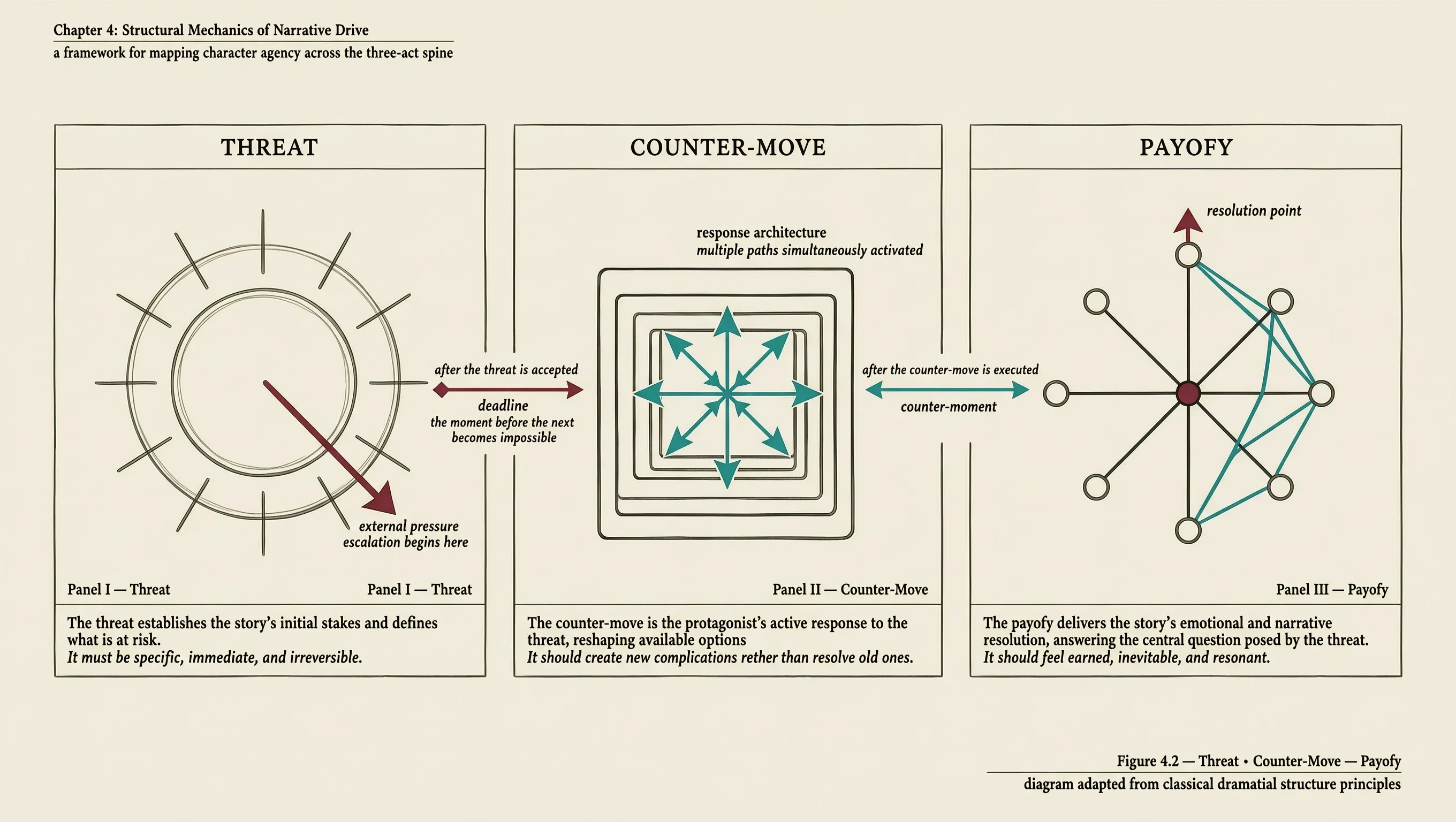
Start with two sides whose moves keep closing off each other’s options. Decide what the threat will do next, why the protagonist cannot ignore it, and how each attempt changes the other side’s options.
In Frederick Forsyth’s The Day of the Jackal, readers spend substantial time following the assassin’s preparations—his papers, his route, his rifle—while the police work from scant clues. The novel does contain a mystery—the assassin’s real identity, which the police never fully establish—but much of its suspense comes from whether they can close the gap in time.
Consider an invented example. A community-radio producer learns that her lead reporter, who was investigating missing money from a housing fund, is being held by the station owner. The owner wants her on tape endorsing a fake retraction before an independent partner station airs the investigation at 8:00 a.m. If she refuses, he will take the reporter across state lines as a hostage. The owner, who still administers the fund’s accounts, has scheduled a 9:00 a.m. wire transfer that will move the money beyond the trustees’ reach. She knows the transfer time because the reporter’s investigation file includes the fund’s bank records, which also trace part of the missing money to the owner’s purchase of a storage warehouse.
The Threat
Ask what the opposition will do while the protagonist is deciding. Give the villain a rational endgame and a timeline that serves that purpose.
The owner does not need the story killed forever. He needs it held until the 9:00 a.m. transfer clears. If the producer does not comply, the reporter becomes his insurance policy on the road.
The producer commissioned the investigation and promised her reporter she would stand behind it. Her immediate responsibility is to keep the reporter safe without lending her name to a lie. Personal stakes do not require a secret family connection. A professional duty or a past promise can make withdrawal cost more than she is willing to pay.
The Protagonist’s Leverage
Competence creates options
Because the partner editor trusts the producer’s judgment, the owner specifically needs her voice on the recording. The producer knows the station’s protocols and has earned the editor’s trust. She also knows that the owner has access to the shared studio calendar. Those facts give her options, but they do not solve the core problem instantly.
Try removing the protagonist’s occupation from your outline. If the sequence still works unchanged, the job is decoration. Here, her knowledge of the station and the editor’s trust determine what she can risk.
Believable involvement
The producer immediately contacts the police, forwards his demand to the partner editor, and sends the investigation file to the housing-fund trustees. The editor agrees that a coerced recording will not count as a valid retraction, and the trustees begin an emergency hold on the 9:00 a.m. transfer. The owner does not know that either safeguard is in place. He still believes a recording can delay the broadcast and protect the transfer, which is why he keeps negotiating. The police let her keep talking for a simple reason: he will take her call, and he will not take theirs.
The Counter-Move
The information gap
The owner wants to meet at the station at 7:30 a.m. and record the statement on his own device. He wants the file clean, with no call-quality artifacts or background he cannot explain. He also wants her inside a room he controls, where he can take her phone and prevent another call.
When she first calls the police, she gives them the investigation file her reporter compiled during the housing-fund investigation. It confirms that he owns the warehouse and includes an initial layout of its offices, exits, and loading dock, along with an archived real-estate listing photo of the back office. Officers place an unmarked unit outside the station. They have grounds to detain the owner, but moving before they confirm the reporter’s location could destroy their best chance of finding her.
The producer arranges for a station engineer to open the studio at 7:00 a.m. and stay until after 8:00 a.m. She is not trying to force the owner to move; she wants another employee in the building if he appears. She knows he may see the booking and accepts that risk to avoid an empty building. The booking says nothing about the police.
The owner arrives at the station early to prepare his recording device, leaving the reporter restrained inside the locked back office of the warehouse. At 6:45 a.m., he checks the shared studio calendar and sees the engineer’s booking. Rather than accept a witness, he abandons the station. He gives up the studio’s controlled environment in exchange for a place where he can isolate the producer.
At 6:50 a.m., he sends the producer the warehouse address and orders her to arrive by 7:30. She forwards the message to police, who direct her to a secure staging point several blocks away. He then leaves for the warehouse, and the unmarked unit follows his car, confirming that he is heading to that address. Her precaution has denied him the empty studio he expected, but it has also cost her the venue she had prepared for.
Identify how each side acquired the information it acts on. The owner changes venue because he can see the studio calendar. The police can act quickly because they follow the owner to the warehouse and because the investigation file gives them a preliminary layout of the building.
The Chain of Scenes
List what happens without intervention, what the protagonist tries, and what follows. A strong reversal changes the situation, not merely a character’s mood. It makes something possible, impossible, or more costly. When the owner shifts the venue to the warehouse, the address change alters both the meeting plan and the rescue possibilities.
Weak: She learns he has lied before, and trusts him less. Strong: He moves the meeting, and her plan for the station is worthless.
Test a twist by asking what becomes possible, impossible, or newly expensive because of it.
Threat’s next move: Owner demands a recorded retraction before 8:00 a.m. to secure a 9:00 a.m. wire transfer.
Protagonist’s intervention: Producer alerts police, forwards the owner’s demand to the partner editor, and sends the investigation file to the trustees.
Result: The editor agrees not to treat a coerced recording as a valid retraction; the trustees place an emergency hold on the transfer; and the police use the producer as their only effective line to the owner.
New constraint or opportunity: Owner still believes the recording will work.
Next decision: Avoid meeting him alone by putting another employee in the building.
Threat’s next move: Owner schedules a 7:30 a.m. recording session at the station.
Protagonist’s intervention: Producer arranges for the engineer to open the studio at 7:00 a.m. and stay until after 8:00 a.m.
Result: Owner sees the booking and shifts the meeting to his private warehouse.
New constraint or opportunity: Police follow his car from the station, and the investigation file gives them a preliminary layout of the warehouse.
Next decision: Confirm the reporter’s exact location without revealing the police presence.
Threat’s next move: Owner demands she enter the warehouse to record the audio.
Protagonist’s intervention: She refuses to enter and demands proof of life first.
Result: He opens a video call; she matches the loading-dock window to an archived listing photo of the back office.
New constraint or opportunity: Police now know the reporter’s precise location and have a preliminary route to the back office, but the owner remains in the room with the restrained reporter.
Next decision: Keep him talking while the police entry team moves in.
The Clock and the Quiet Scenes
A deadline earns its place when waiting changes the options. The example starts with two clocks, and the producer’s first move quietly stops one of them: the trustees hold the transfer before dawn. The owner does not know. What remains is the 8:00 a.m. broadcast, his threat to move the reporter, and the fact that every minute of negotiation depends on his believing the recording still matters.
The reader knows who holds the reporter. Suspense comes from the 8:00 a.m. broadcast and the threat that the owner may move the reporter. Give travel and necessary preparation space in the timeline. The warehouse is a twenty-minute drive across town. The 6:50 departure leaves time for the owner to arrive, for police to confirm the location, and for the entry team to take position by 7:25. Keep the people and places consistent with the clock you chose.
Quiet scenes can change the board. Before sunrise, the producer convinces the engineer to take the early shift and stay at the studio until after 8:00 a.m. He agrees to come in but refuses to take part in any confrontation or rescue attempt. The negotiation secures a witness on the calendar, but the owner’s response removes that witness from the meeting she had prepared for. A quiet scene still counts if its outcome forces the next move—even if the next move throws the original advantage away.
The Payoff
Paying off earlier choices
By 7:25 a.m., police are in position outside the warehouse. The producer waits at a secure staging point several blocks away, close enough for the owner to believe she can still enter the warehouse.
At 7:30 a.m., she tells him she has reached the area but will not approach without proof that the reporter is alive. He opens a video call, believing proof of life will remove her last excuse for staying outside. He keeps the frame tight on the reporter, but a narrow loading-dock window remains visible over her shoulder.
The producer recognizes the window from the listing photo of the back office. On a second phone, out of frame, she sends the back-office location to the police entry team. She asks the owner to dictate the retraction line by line, pretending she needs to make it sound credible. While his attention remains on the wording, officers breach the back office at 7:35 a.m., pull the reporter clear, and take the owner into custody.
What remains unresolved
The immediate coercion ends, and the reporter is safe. The transfer is on hold, and the owner is in custody. One decision remains, and it is the one he spent all night trying to buy: whether to ask the partner editor to delay the 8:00 a.m. airing until the kidnapping can be verified and incorporated into the report. A story about a kidnapped reporter is no longer the story she commissioned. Resolving the threat does not resolve the job.
A Six-Question Revision Check
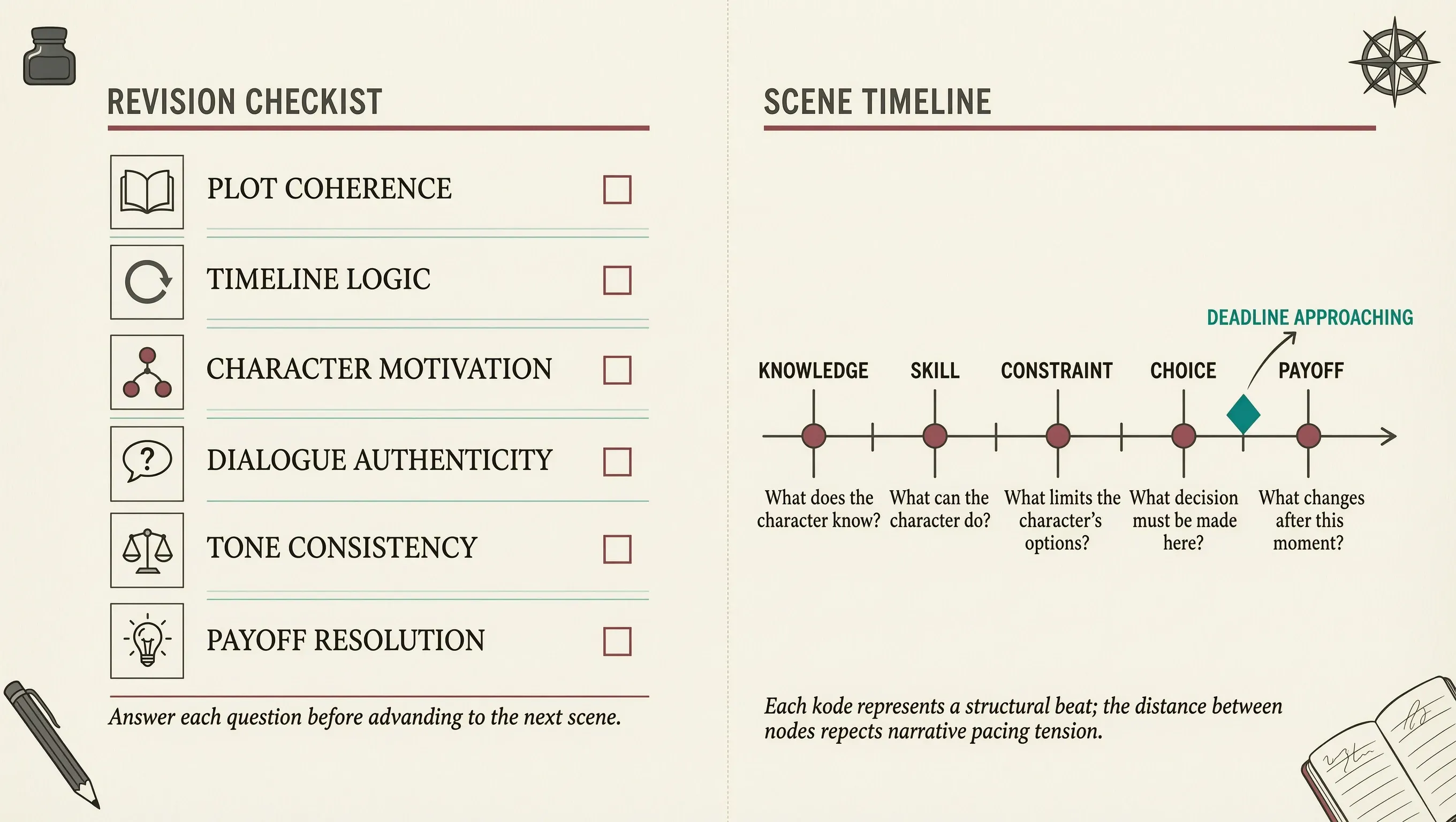
Before you draft or revise a major sequence, ask:
- What will the antagonist do if the protagonist does nothing?
- What does each side know, withhold, and wrongly believe?
- What useful skill gives the protagonist an option, and what can that skill not solve?
- What changes in the situation—physically, informationally, or institutionally—after each intervention?
- What new constraint or opportunity does that change create?
- Which earlier skill, relationship, clue, or limitation makes the final move possible?
Keep the current situation beside the draft:
- Threat: The owner will flee across state lines with the reporter if he does not get the recording.
- Goal: Get proof of life and keep him on the line without giving him the recording.
- Knowledge: Police are outside. The owner thinks the recording still matters.
- Time: Thirty minutes remain before the 8:00 a.m. broadcast.
- Next decision: Keep him talking while the police entry team moves in.
A note on tools: keep this context block wherever you actually write—a notebook, the top of the chapter file, or a drafting app like SeaBell, which can pin it beside the chapter along with the relevant character notes. The tool does not matter. Checking the finished scene against the block does.
FAQs About Writing a Thriller Novel
What Makes a Novel a Thriller Rather Than a Mystery? A thriller usually emphasizes an unfolding danger and efforts to counter it. A mystery emphasizes discovering a hidden truth. A hybrid can do both, but revealing the culprit may leave the thriller’s immediate danger unresolved.
Can You Write a Thriller Without Knowing the Ending? Yes. Start with a threat and a meaningful response, then discover what follows. You will still need to revise earlier scenes so the climax depends on information, abilities, and choices the reader has already encountered.
Does Every Thriller Need a Ticking Clock? No. A literal countdown is optional. An opportunity can close, an opponent can gain control, or help can become harder to reach. Establish what waiting costs instead of adding an arbitrary deadline.
Related Posts

Story Timeline Template for Fiction Writers
Copy a practical story timeline template for fiction writers and learn how to track chronology, reveal order, character knowledge, clues, and revision continuity.
Scene Card Template for Novel Writers | SeaBell
Copy a scene card template for fiction writing, see a filled example, and turn your scene plan into a focused AI drafting brief

Chapter Outline Template for Novel Writers
Use this chapter outline template to plan POV, conflict, character change, continuity notes, and ending hooks before drafting your next novel chapter.