

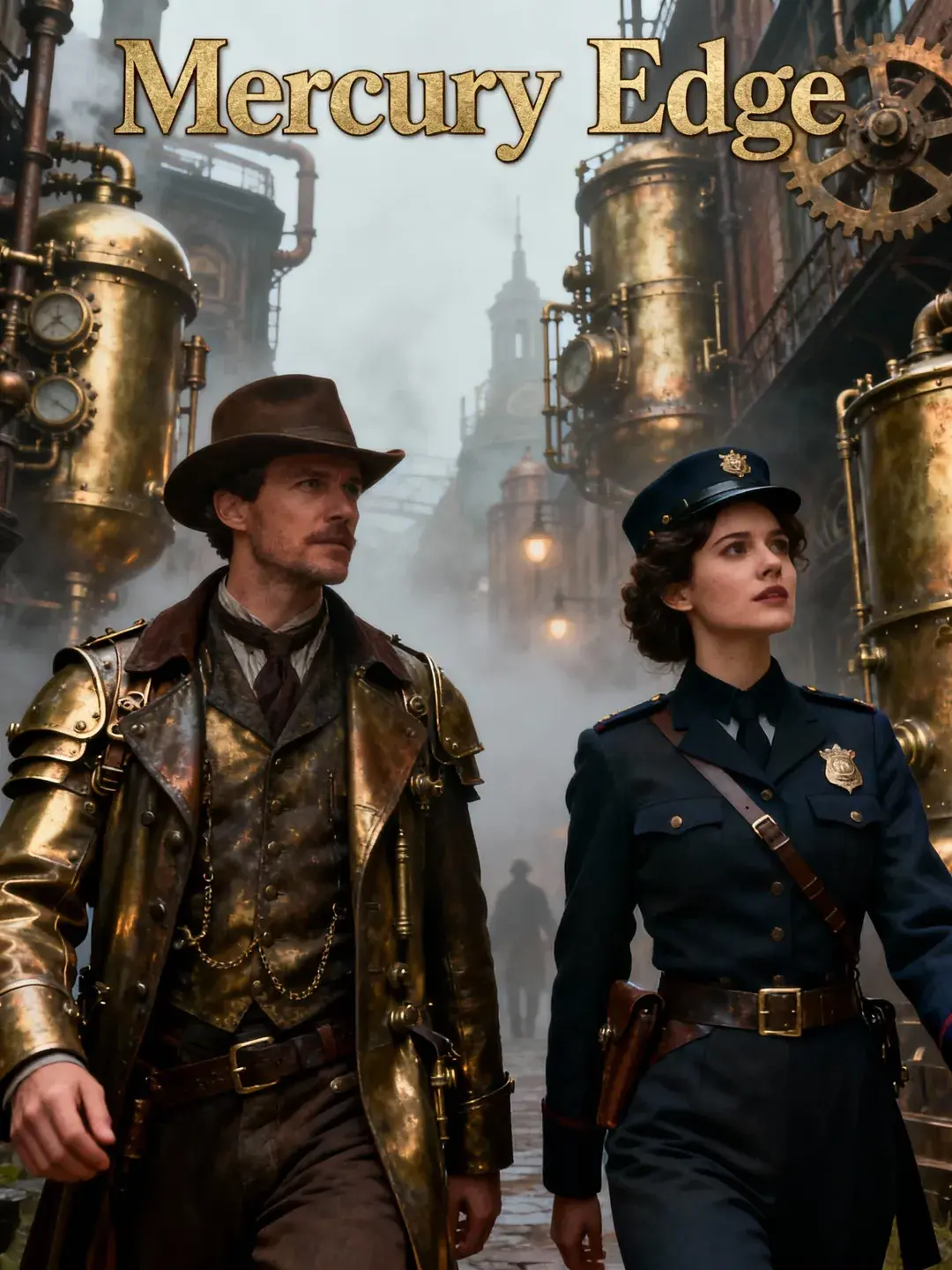
Mercury Edge
Sinopsis
A steampunk detective
Capítulo1
The city of Aetherbridge never woke; it was kept awake.
Grey felt the truth of it in the iron catwalk that hummed beneath his boots at five-forty that morning. Fog rolled off the sky-docks above him and drifted down like dirty cotton, carrying the smell of hot tallow and steam. Somewhere high overhead a turbine hissed, then coughed into a steady roar. The sound echoed along the copper gutters and came back changed—duller, older, tired.
Grey set his lantern on the railing. The glass was cracked; the flame inside leaned with the wind, thin but stubborn. He kept his gloved hands on the rail and looked across the canyon of roofs. Chimneys bristled like bayonets. A dirigible, fat and silver, nosed through the haze, its propellers chopping the air. The noise covered the city the way a lullaby covers a child—something meant to soothe that only reminded you how sharp the world could be.
He had come up here to breathe before the day’s paper-work chained him to the desk. Instead he counted heartbeats: one, two, three… until the numbers felt solid enough to lean on. The fog tasted of iron and salt. He had not slept; sleep was a luxury for people who still believed morning carried hope.
Boots clanged on the spiral stair below him. The rhythm was wrong for a factory man—too light, too urgent. Grey did not turn. He listened: four steps, pause, four more. A woman’s breath, shallow. Leather soles, not steel. Constabulary issue.
“Inspector Grey?” The voice arrived before the speaker, bright with effort.
He lifted the lantern. “You climbed fast, Constable.”
Lila Ashcroft emerged into the glow, cheeks red from the climb, dark hair unpinned and whipping. She clutched a folded warrant in her fist as if it might fly away. “Sir, the Commissioner sends orders. You’re wanted on Founders’ Lane. Immediate.”
Grey took the paper. Wax seal, still warm. He cracked it with his thumb. The ink inside was fresh enough to smear. “Artificer found dead,” he read aloud. “Cause uncertain. High-profile. Keep discretion.” He folded the sheet once and tucked it into the inner pocket of his greatcoat. “Discretion,” he muttered. “That means the press is already there.”
Ashcroft straightened. “I came straight up the maintenance ladders, sir. No trams, no reporters following.”
“You climbed two hundred feet to spare me journalists?”
“And to learn how you work.” She said it plainly, no blush, no boast.
Grey studied her for the first time since she transferred from Rivergate. Coat too new, gloves unscarred. She still believed answers could be earned by sweat. He envied the illusion. “Then keep close and stay quiet,” he said. “The city talks loud enough without us adding noise.”
He started down. She followed. The stairwell was a screw of iron inside a chimney of brick. Condensation dripped from old rivets and tapped their collars. Halfway, the air warmed; by the time they reached street level it stank of coal smoke and yeast. The fog here was thinner, stirred by early carts and the clatter of shutters going up.
They crossed the mid-tier market. Butchers shouted prices; a boy wound copper coils around a spool, humming. Grey walked fast, coat flapping. Ashcroft kept pace, eyes darting. She had never seen the under-levels at dawn; the city showed her its teeth—black grates, steam valves, rats fat on refuse. She did not flinch. Grey noted it the way a carpenter notes sound timber.
At the lip of Founders’ Lane the cobbles turned smooth, laid a century earlier for the first guild parades. Bronze plaques marked each doorway: names of men who had built the sky-docks, the gear-halls, the very pumps that kept the Thames from drowning the cellars. The lane was quiet now, guarded by constables in slickers. They lifted the rope when they saw Grey’s badge.
The workshop doors stood open. Brass fittings, green with verdigris. Above them a sign still gleamed: “Meridian Precision, Master I. Vale.” Inside, electric lamps hissed, throwing white arcs across benches of files and gauges. The dead man lay beyond the last bench, pinned upright to the iron frame of a hydraulic press. His arms spread as if welcoming an embrace. A blade of silvery metal transfixed his chest and vanished into the machine behind. The metal smoked in the lamplight, dripping quicksilver that hardened before it hit the floor.
Ashcroft swallowed. “Is that… mercury?”
“Frozen,” Grey said. “Cooled fast enough to hold an edge. Clever.” He stepped closer. The constables around the body shifted, uncertain. Grey removed his hat, laid it on a stool. “Who found him?”
A sergeant pointed to a boy in oil-stained overalls. “Apprentice Arnie. Came for the early shift, found the doors ajar.”
Grey crouched to the boy’s height. “What time?”
“Six bells, sir. Maybe ten past.” The lad’s voice cracked. “I called for master, saw… this.”
“Did you touch anything?”
“Only the door. I ran for the watch-house.”
Grey nodded. “Good. Wait outside.” He stood. “Sergeant, clear everyone but the photographer. Constable Ashcroft stays.”
The room thinned. The lamps buzzed. Grey moved clockwise: first the workbench—tools aligned, no sign of struggle; then the floor—no scuffs, no dragged feet; lastly the windows, latched from within, glass unbroken. He returned to the press. The victim’s eyes were open, pupils wide, reflecting the overhead lamp like wet stones. Mouth relaxed, almost amused. No bruises on the wrists. Shoes polished, no scrapes.
Ashcroft whispered, “No fight. He let the killer close.”
Grey lifted the dead man’s right hand. Under the nails: black grit, like forge scale. “He gripped something hot. Maybe the press lever.” He glanced up. The control arm hung midway, neither up nor down. “Help me.”
Together they hauled the lever to neutral. Gears clanked; the ram eased backward an inch. The mercury blade quivered, shedding more droplets that chimed on the iron like tiny bells. The body sagged but stayed upright, held by the frozen spike.
Ashcroft’s breath clouded. “Why freeze mercury? A show?”
“A signature,” Grey said. “Our artificer built machines for the Royal Mint. He knew metals. So does the killer.” He looked at the walls: framed certificates, a portrait of the Queen in youth, a calendar stuck at yesterday. “Time of death close to midnight. Doors locked inside, windows sealed. One blade, one thrust. Neat.”
“Suicide?” she asked, doubt already in her tone.
Grey tapped the blade. It rang, high and brittle. “Try to forge this alone. You’d need furnaces, coolant pumps, a die cast. Not the work of a grieving man at midnight.” He wiped his fingers on a rag. “We’re hunting a craftsman who wanted us to admire his handiwork.”
Outside, a reporter’s shout rose above the murmur. Ashcroft tensed. Grey placed the rag on the bench, slow and deliberate. “Steady. First we learn, then we speak.”
He circled the press again, eyes on the gears. Somewhere in the tangle of pistons a single brass cog carried a nick shaped like a crescent moon. He noted it, said nothing. The ram’s chain dripped oil in perfect intervals—tap… tap… tap—marking time the way his heartbeats had on the catwalk.
Ashcroft watched him. “What next?”
Grey grasped the lever. With a soft grunt he reset the machine. The cog with the crescent rolled one full turn and clicked into place, sounding louder than the lamps, louder than the fog outside. The note hung in the air like a promise or a warning; even the constable at the door paused.
Grey let go. “Next we ask the metal who touched it last,” he said. “And we listen while it remembers.”
The lantern hissed. The mercury blade began to sweat, shedding mirrored tears that shattered when they landed, scattering the lamplight into a thousand restless stars.
Últimos capítulos
Chapter 12
The Ledger of Mercury
The ledger room lay beneath the re
Chapter 10
The Ledger of Smoke (Part II)
1
The dead ma
The streetlamps were still on when they hit the cobbles, thin bulbs humming like cornered flies.
Chapter 9. The Ledger of Smoke
The inquiry hall had once been a customs wa