

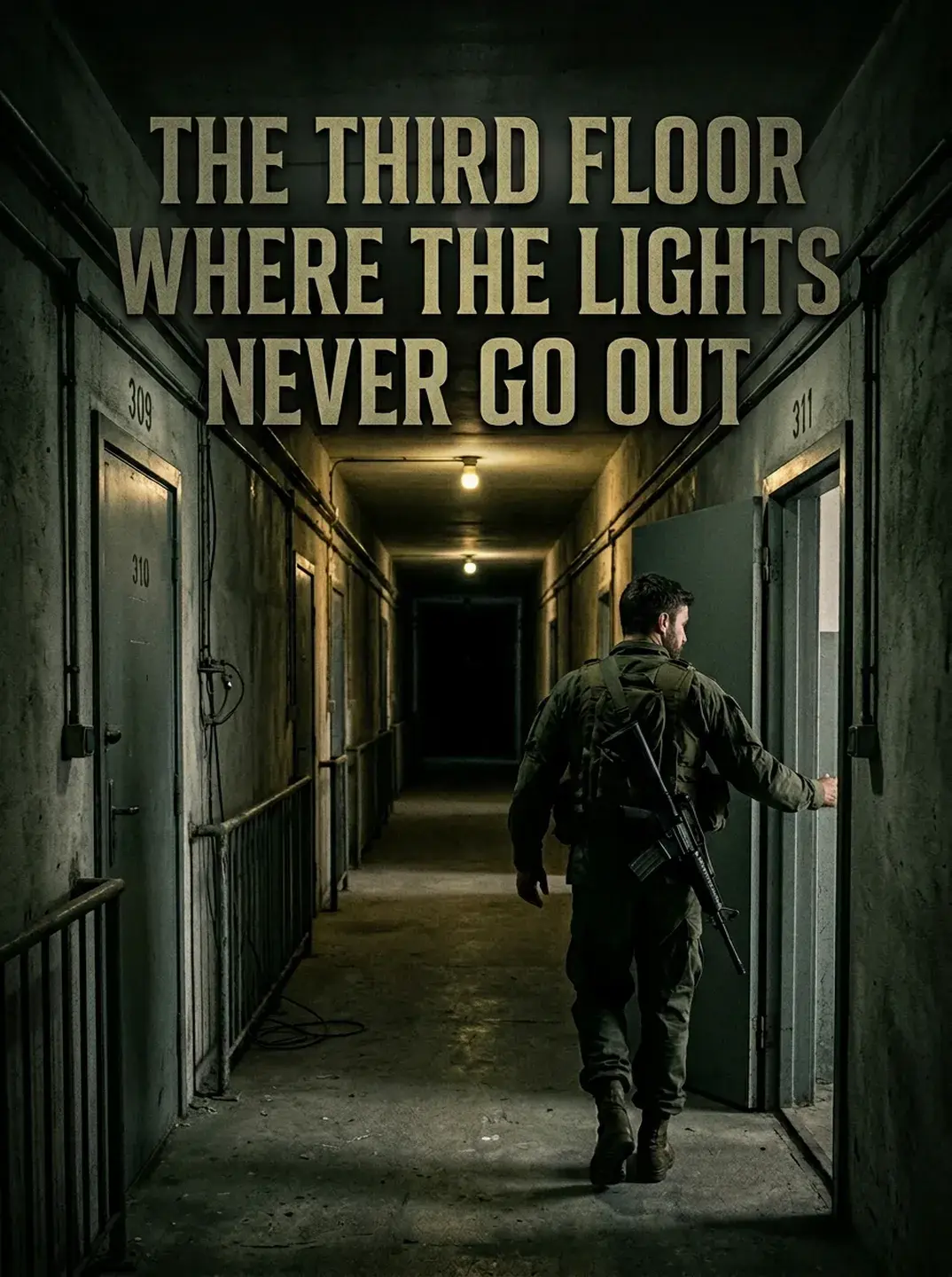
The Third Floor Where the Lights Never Go Out
Synopsis
A man enters a military training camp that seems ordinary—until it isn’t. The hallway stretches too far, the air feels heavy, and strange rules govern the night:
Do not answer if your name is called a second time. Do not look into the mirror at the end of the hall. Do not count people after dark.
At first, they seem like harmless ghost stories. But those who break them disappear—and even their memory fades. As training erodes individuality, fear takes shape, yet instead of breaking them, it binds them together.
In time, he understands: the truth of the stories doesn’t matter. They are a safeguard—something that keeps people from losing each other.
Even after leaving, he follows them. He no longer believes in ghosts. But he knows:
Some rules exist simply to keep you alive.
Chapter1
The transport bus didn’t roar; it hummed with a low-frequency vibration that seemed to settle in the marrow of my bones long before we reached the gates. Through the window, the world was being bled of its color. The vibrant greens of the provincial countryside through which we had traveled were steadily replaced by a monotonous, washed-out grey. It was as if we were passing through a filter that stripped away the unnecessary, leaving only the structural skeleton of the world.
When the gates of the training center finally appeared, they did not creak with the expected rust of a military outpost. Instead, they slid open with a silent, oiled precision that felt predatory—a throat opening to swallow a meal.
The silence hit me first. I had expected the cacophony of drill sergeants screaming, the frantic clatter of gear, and the desperate energy of several hundred young men suddenly stripped of their autonomy. But the parade ground was a vacuum. Low-slung grey barracks huddled against the earth like ancient, brooding beasts, and the sun-bleached dirt of the square felt unnaturally flat. There were figures in the distance, moving in rigid, synchronized lines, but they moved with a mechanical grace that produced no sound.
The air was the second thing. It wasn’t just humid; it was *weighted*. It felt thick, carrying a cloying dampness that tasted of pulverized stone and the sour, metallic tang of unwashed fatigue jackets. It pressed against my skin, a physical layer that seemed designed to mold us into the very dirt we stood upon. As I stepped off the bus, the sheer gravity of the place made my knees buckle slightly. I wasn’t the only one; I saw legs tremble and shoulders hunch. We were being condensed.
The enlistment ceremony was a blur of preordained procedures. We were no longer individuals; we were a mass of clay being sorted. Names were called, documents were stamped with a finality that sounded like a coffin lid closing, and we were funneled into companies. I found myself in the Third Company, standing in a jagged line on the parched earth, facing a man who seemed to have been carved out of the same grey concrete as the barracks.
He was the Company Commander, a Master Sergeant whose face was a map of deep-set creases and sun-hardened skin. He didn’t use a megaphone. He didn’t need to. His voice was a low, resonant rasp that bypassed the ears and vibrated directly in the chest cavity. He didn't scream; he stated facts.
"Look at the man to your left," he began, his eyes—opaque and hard as obsidian—sweeping over us. "Now look to your right. By the end of this cycle, you will not remember their names. You will remember only their position in the rank."
He paused, a silence so heavy it felt as if the oxygen was being sucked out of the square.
"From this moment, logic is a luxury you can no longer afford," he continued. His hands were clasped behind his back, his posture so rigid it looked painful. "You will follow instructions without the 'why.' You will execute movements without the 'how.' Most importantly: if you see something that defies your understanding, if you hear a sound that has no source, or if the walls where you sleep seem to hold a shape they did not hold an hour prior—you will not investigate. You will not verify. You will look forward, you will maintain your posture, and you will wait for the next command. A soldier is a vessel of discipline first; the mind is merely the passenger."
At the time, I felt a flicker of the old civilian cynicism. I told myself this was the "theater of the military"—a calculated psychological gambit designed to break our spirits and rebuild them in the service of efficiency. It was a classic trope: confuse the recruit, isolate them, and make the authority figure the only source of truth. I gripped the strap of my temporary bag, my knuckles whitening, and told myself it was all a game.
But the "game" began to leak into reality by the third night.
The barracks were a masterclass in architectural monotony, yet they were fundamentally "wrong." The hallway outside our quarters was lined with flickering fluorescent lights that hummed in a discordant, uneven rhythm. At night, that hum became a voice—not one that spoke words, but one that projected a feeling of intense, vibrating anxiety.
I remember walking toward the supply depot during a late-afternoon detail. The sun was a pale, sickly disc behind a veil of grey clouds, and the dampness in the air had intensified until the barracks themselves seemed to be sweating. Droplets of moisture bubbled out of the concrete pores of the walls, thick and viscous.
I stopped for a moment, my heart hammering against my ribs. I looked at the end of the hallway. It seemed... further away than it had been when I started walking. The perspective was warped, as if the floorboards were stretching like pulled taffy under the flickering light. The lines of the walls didn't meet at a natural vanishing point; they curved inward, creating a funnel that felt as though it were trying to draw me into a space that didn't exist on the blueprints.
A sudden, intrusive thought pulsed through my mind, rhythmic and insistent like a second heartbeat: *Do not lose your grip on anything here.*
I tightened my hold on my bag until the plastic handles bit into my palms, the pain a necessary anchor. I realized then that the Master Sergeant’s address hadn't been a threat or a psychological tactic. It had been a warning—a set of operating instructions for a reality that was fraying at the edges.
The "reasons" he told us not to seek were the jagged, lethal edges of the training center itself. To "verify" the hallway's length or to "investigate" the sweating walls was to acknowledge the breach, and to acknowledge the breach was to be pulled into it.
I turned my head back, looking for the gates, for the bus, for any sign of the world I had left behind. But the bus was gone, its tire tracks already swallowed by the grey dust of the parade ground. There were only the barracks, the silent, moving figures of the other companies, and the heavy, damp air that waited for the slightest slip of my grip. I adjusted my posture, fixed my eyes on the nape of the recruit in front of me, and waited for the next command to tell me I still existed.
Latest Chapters
The neon signs of the city outside were a blurred smear of neon pink and clinical white against
The atmosphere in the barracks did not break; it settled. The sharp, jagged edge of terror that
The logic Min-ho offered was a clean blade, meant to excise the rot of superstition from our min
The departure of the boy from Room 302—whisked away in the dead of night like a stain being scru