

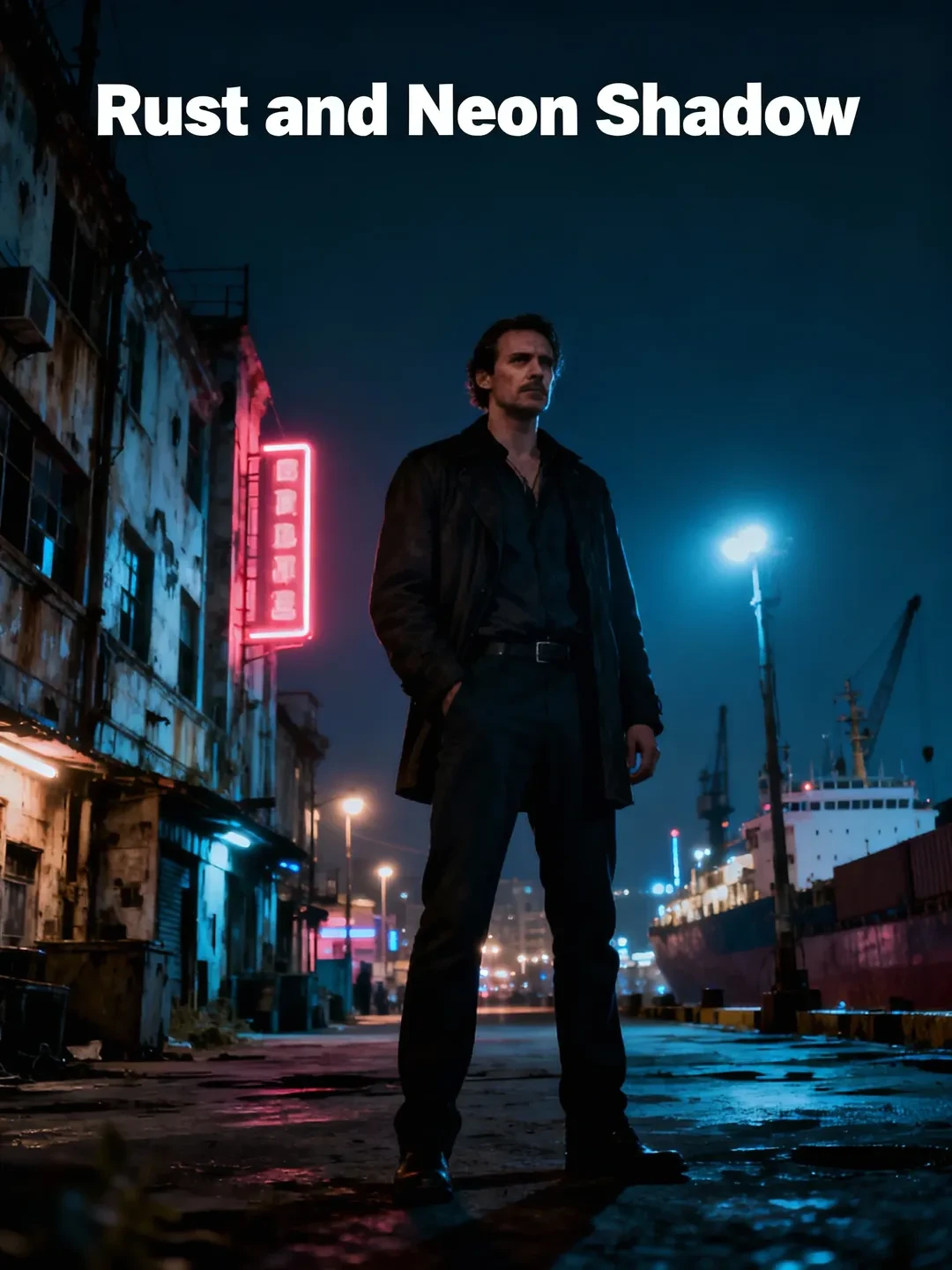
Rust and Neon Shadow
Synopsis
In an unnamed port city, the start of port redevelopment and the reorganization of logistics routes shakes the tacit agreements that have long held the mafia families together. The protagonist, a low-ranking operational functionary, is ordered to “clean up” a single disrupted route—but the more he resolves, the more he uncovers signs of deeper fractures and quiet purges. The boss culls his people through suspicion rather than trust, while the second-in-command silently tightens internal control and tests the protagonist. Taking no side, the protagonist subtly redirects the flow of information, steering the boss and a rival family into a direct collision, and leaves behind a cold conclusion: power is not seized—it is what remains.
Chapter1
The 04:17 air over the Port of Aethel tasted of salt and diesel exhaust. It was a thin, wet cold that settled deep in the fabric of Leo’s coat, a permanent dampness that the city’s concrete lungs exhaled before dawn. Below the elevated causeway, the terminal was a sprawling circuit board of sodium lamps and shadow, a city block of organized rust and motion. Headlights from his nondescript sedan cut two cones of white through the gloom, illuminating swirling particles of mist. He killed the engine. The silence that followed was immediately consumed by the port’s low hum: the distant groan of a ship’s hull, the rhythmic hydraulic sigh of a crane, the faint, high-pitched beep of a reversing vehicle.
He sat for a moment, a ritual of stillness. The car’s interior was sterile, smelling of nothing. He checked the time on his watch: 04:19. He popped the glove compartment, the click of the latch unnaturally loud. Inside, alongside the vehicle registration and a tire-pressure gauge, was a small, black leather-bound notebook. He took it out. The leather was worn smooth at the corners. He did not open it. He placed it in the inside pocket of his coat, the slight weight a familiar pressure against his ribs. Lock the car. Double-check the handle. The chirp of the alarm was an unwelcome intrusion, a sound too personal for this place.
His boots crunched on loose gravel as he walked toward the chain-link fence of the yard’s administrative outpost. A single light burned over the door of the prefabricated shed. Inside, the night-shift foreman, a man named Kowalski, was hunched over a desk, the skin around his eyes bruised with fatigue. The air was thick with the smell of stale coffee and wet wool.
“Leo,” Kowalski grunted, not looking up from a stack of manifests. He gestured with a pen toward a clipboard on the counter. “All yours. Shift change in ten.”
“Any issues overnight?” Leo asked. His voice was quiet, even.
“Generator on Reefer Block C is acting up. Kicks out every two hours. Maintenance knows. Other than that, just the usual.” Kowalski initialed a final form with a flourish of exhaustion. “They’re all yours.”
Leo took the clipboard. Bill of Lading, Container Manifest, Inbound/Outbound Tally Sheet. He scanned the columns, his finger tracing the lines of container numbers and seal codes. His eyes moved with practiced efficiency. Everything was a number, a code, a weight, a destination. He made a small, precise tick mark with his own pen next to three specific container IDs. He didn’t need to consult his notebook for those. He already knew them.
The wail of a siren signaled the shift change. It was a sound that cleaved the night. The low thrum of activity in the yard seemed to pause, holding its breath. Then, a new energy. Doors to the locker room banged open. The outgoing shift shuffled past the shed, faces pale and grimy under the lights, heads down, not speaking. The incoming crew moved with more purpose, carrying lunch boxes and thermoses, their talk a low murmur of shared complaint and anticipation. The system was flushing itself out, replacing tired components with fresh ones.
Leo stepped outside, into the path of the new arrivals. The air had grown colder, the drizzle thickening into a persistent, miserable rain that slicked the asphalt and beaded on the shoulders of his coat. He found Gallo standing by the towering form of a straddle carrier, its engine idling with a deep, guttural tremor. Gallo was broad, solid, a man who seemed to have been formed from the same dense materials as the machinery around him.
“Leo,” Gallo said. His voice was gravel. He wiped rain from his face with the back of a gloved hand.
“Gallo.” Leo held up the clipboard. “Manifest looks clean. We’re focusing on the HLXU containers first. North quadrant, rows seven through nine.”
“Got it. Heard from the night guys crane three is running slow. Hydraulics are whining.”
“I’ll keep an eye on it,” Leo said. “Let’s get the first one moved to Bay 12 for inspection.”
Gallo nodded, turning to shout an order to a nearby driver. The name was lost in a sudden roar as the straddle carrier’s engine revved. The machine, a bright yellow behemoth on eight wheels, began to move, its immense frame rolling over a row of containers like a grazing animal.
Leo retreated to the covered walkway that ran alongside the loading bay. From here, he had a clear view of the entire operation. The yard was a ballet of organized chaos. Forklifts, small and nimble, darted between stacks, their reverse alarms a constant chorus. The straddle carrier positioned itself over a container, the grappler descending with a metallic shriek to lock onto the corners. The box, weighing tons, was lifted effortlessly, water streaming from its corrugated sides.
He pulled out the black notebook and a small, silver pen. He opened it to a fresh page. The pages were not lined, but gridded. He began to write, his script a tight, blocky cipher of letters and numbers. Time of arrival. Weather conditions. Shift foreman name. Manifest number. He noted Gallo’s report about crane three. A procedure. A record of every variable. The organization did not like surprises. Leo’s job was to eliminate them.
A crackle came from the radio on his hip. “Yardmaster to Leo.”
He lifted the radio to his mouth. “Leo here.”
“Got a call from Port Authority. They’re flagging a weight discrepancy on the bill of lading for the *Odessa Star*. Says your manifest is five tons over what they have logged at weigh-in.”
Leo’s eyes didn’t leave the container now being lowered onto a waiting flatbed truck. “Which container?”
“Doesn’t say. Just a bulk flag on the whole shipment.”
“Copy that. I’ll look into it.” He lowered the radio. A misfile. A data entry error. It happened. He made a note in his book. *PA. Odessa Star. 5-ton delta.* He would have to pull the individual weight stubs for every container from the ship’s master file and cross-reference them manually. It would add an hour to his morning. He felt no annoyance, only the cool, calm certainty of a new task being added to the list.
The rain fell harder, drumming against the metal roof of the walkway. The temperature dropped another degree. Crane three, just as Gallo had warned, was noticeably sluggish as it swung a container toward the dockside. It moved in a series of slight jerks, its hydraulic whine pitching higher, a sound of mechanical strain. Leo watched it, his gaze clinical. He timed the swing on his watch. Forty-eight seconds. The other cranes were averaging thirty-five. He made another note.
He started his patrol, walking the perimeter of the active loading zone. The ground vibrated under his feet. He moved with a purpose that discouraged interaction. He was an observer, a ghost in the machine, and the workers, smeared with grease and sweat, gave him a wide berth. He was not one of them. He was something else—management, security, they weren’t sure. They only knew his presence meant the cargo was important.
As he passed a stack of containers, a young worker, no older than twenty, stepped into his path. The kid’s face was flushed, his movements jerky with a mixture of fatigue and frustration.
“Hey,” the worker said, his voice louder than necessary. “Gallo said to double-strap this one, but it ain’t on the special handling list.” He jabbed a thumb toward a standard, rust-streaked container.
Leo stopped. He looked not at the worker’s face, but at the container number stenciled on the side. He cross-referenced it with the manifest on his clipboard. “That is container 7-B-4. It requires standard strapping.”
“Yeah, that’s what I said. But Gallo’s screaming about it. We’re burning time here.”
“Then you should follow your supervisor’s directive,” Leo said, his tone perfectly level, devoid of heat or condescension. “If he wants it double-strapped, double-strap it. Log the time. I will authorize the overtime.”
The worker stared at him, looking for an argument, for a flicker of emotion to latch onto. He found none. Leo’s expression was as flat and functional as the concrete wall behind him. The kid’s shoulders slumped. “Right. Fine.” He turned and walked away, muttering to his partner.
Leo made a note. *7-B-4. Verbal order override. Gallo.* It was a small breakdown in the chain of command. A point of friction. He documented it.
His phone vibrated. A blocked number. He answered. “Yes.”
“Leo,” said the voice. Sal. It was always clipped, impatient. “The Meridian shipment. Is the asset on board?”
“The asset is being loaded,” Leo said, turning his body to shield his mouth from the nearest workers, a reflexive gesture of privacy.
“Any flags?”
“Port Authority flagged a five-ton weight discrepancy on the manifest. I’m handling it. Crane three is running below efficiency.”
There was a pause. “The weight discrepancy. Is it the asset?”
“No. The asset’s weight is documented correctly on my end. This is a clerical error on the bulk cargo.”
“Fine. Just make sure the asset is sealed and settled an hour before sunrise. The buyer’s agent is already at the transfer point. He doesn’t like to wait.” The line went dead.
Leo put the phone away. *Meridian. Buyer’s agent.* New variables. He recorded them in the cipher. The asset. He knew which one it was without looking. He walked toward Bay 12, where the first container Gallo had moved was now isolated under a bank of floodlights.
It was different from the others. It was a refrigerated unit, but it was newer, the white enamel clean, almost glowing in the harsh light. The rust-streaked boxes around it looked ancient by comparison. The cooling unit on its front hummed with a quiet, steady thrum, a different frequency from the groaning generators elsewhere. And the lock on its doors was not the standard bolt seal. It was a heavy, circular steel lock with a keypad. Stenciled on the side, almost too small to see, was a simple black scorpion.
He ran a gloved hand along the seal of the door. It was cold, perfectly seated. He checked the container number against the one in his notebook. HLXU-447-9B. A match. He pulled a small digital thermometer from his pocket and held it against the vent of the cooling unit. -18 degrees Celsius. Exactly as specified. He noted the time and the temperature.
The rest of the loading proceeded. The system found its rhythm again. The slow crane was relegated to lighter loads. The paperwork discrepancy with the Port Authority was traced to two containers of scrap metal whose weights had been transposed—a simple, human error. Leo corrected the form, countersigned it, and had it dispatched by a runner. The problem ceased to exist.
As the sky in the east began to soften from black to a deep, bruised purple, the final container was locked into place on the ship’s deck. The noise in the yard began to subside. The straddle carriers parked in their designated zones. The forklifts went silent. Gallo approached, pulling off his heavy gloves.
“That’s the lot,” he said. He handed Leo the final tally sheet. His signature was a greasy smudge at the bottom.
Leo reviewed the sheet, comparing it against his own notes. Every container was accounted for. He took out his pen and signed his name below Gallo’s. His signature was a series of sharp, precise angles. “Clean run, Gallo.”
“Aside from the kid getting lippy and the crane,” Gallo grumbled.
“It was handled,” Leo said. He handed a copy of the manifest back to Gallo. “File this.”
“See you next time.” Gallo didn’t offer to shake hands. Theirs was not that kind of relationship. He simply turned and merged with the other workers heading for the locker room.
Leo did one last walk of the dock. The rain had stopped. In the growing light, the port looked exhausted, a battlefield after the fact. Pools of oily water reflected the grey sky. He stood by the railing, looking at the massive container ship, its deck a mosaic of colored steel. He could see HLXU-447-9B, a single clean white rectangle among the faded reds, blues, and oranges. The asset. Secure.
He turned and walked back toward the administrative shed, his footsteps echoing in the quiet. He dropped the master clipboard in the overnight slot. The job was done.
The drive back was into the flow of the city’s awakening. The causeway was filling with the first wave of commuters, a river of headlights flowing into the heart of Aethel. Leo’s car was just another anonymous sedan in the stream. He was invisible again. He stopped at a red light, the rising sun glinting off the wet asphalt. He glanced at his watch. 06:28. He opened his glove compartment, placed the black notebook back in its spot next to the tire gauge, and locked it. The light turned green. He accelerated smoothly, merging perfectly with the traffic, just another part of the system moving toward the day.
Latest Chapters
**Epilogue**
The city remembers only what it cannot afford
The Asset did not comprehend the preserved memory as memory because memory presupposed
Nightingale did not think of what she was doing as fabrication at first, because the w
The Asset did not know the name of the man it observed at 13:42 local time, and it did