
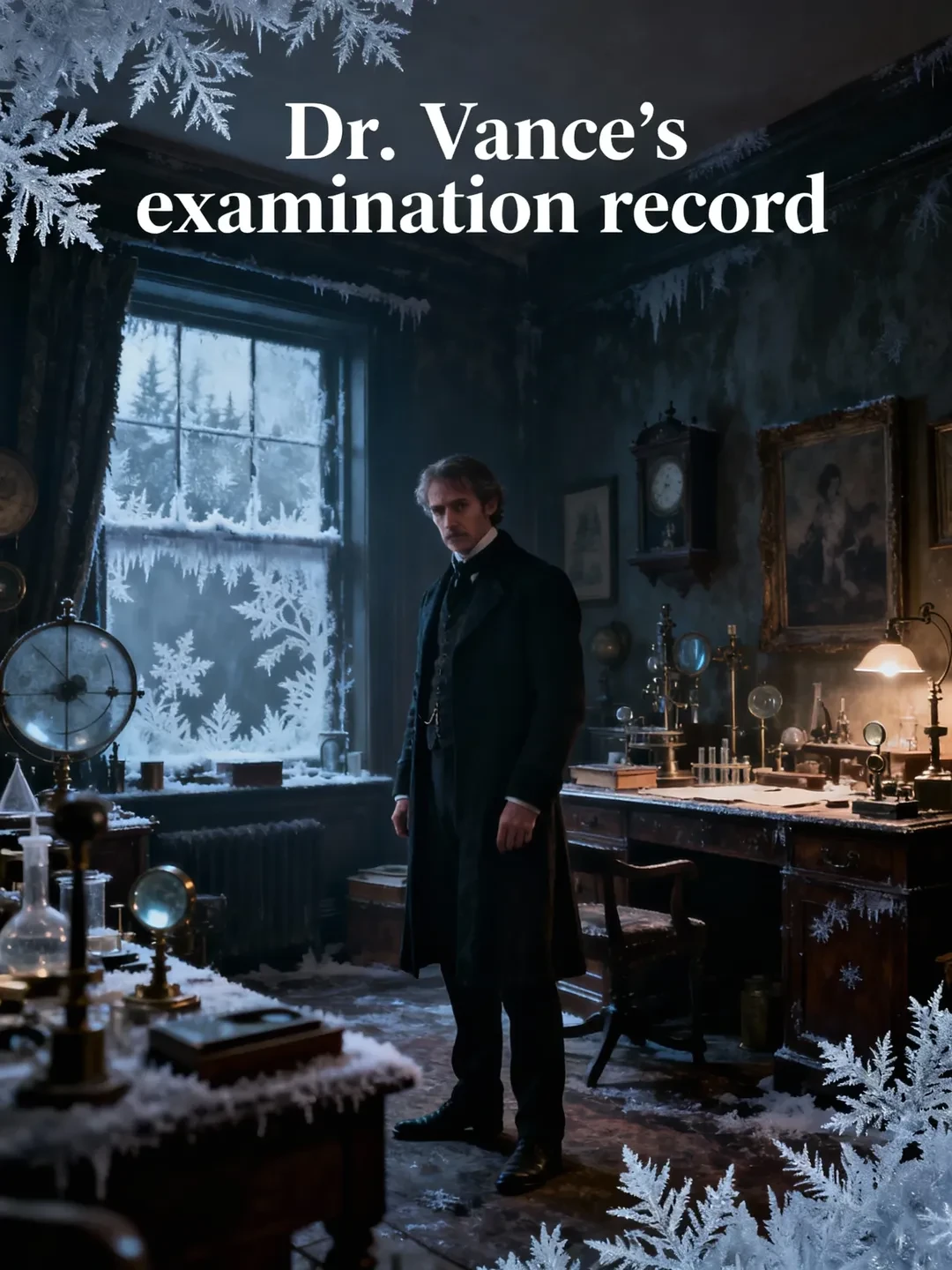
Dr. Vance’s examination record
Synopsis
Ten years ago, after the Great Silence, the world changed at its foundations. Sound fails to travel far and fades away, and though the sun still rises, its light does not reach. London remains a functioning city, yet beneath the surface the very structure of reality is slowly wearing down.
Dr. Elias Vance, a natural philosopher excommunicated as a heretic by the Royal Society, was the first to sense this collapse. He had long traced a common cause behind illness, madness, and sealed-room deaths. It was neither ghost nor criminal— but the residue of reality left by an unperceivable entity: the “Umbral Drift.”
One day, Lady Alistair Harrington, heir and executor of an industrial aristocratic house, seeks out Vance. Her father, Lord Harrington, was found dead in a perfectly sealed study. The police concluded it was a stroke, yet the scene bore inexplicable cold, geometric frost, and traces of “cognitive collapse” beyond human fear.....
Chapter1
Ten years. A decade since the world had gone quiet.
From his vantage in the highest room of the townhouse, Dr. Elias Vance surveyed the result. London, once a roaring heart of Empire, now beat with the weak, febrile pulse of a dying man. The Great Silence had not been a simple blackout. It was a subtraction of essence. Sound did not carry; it stumbled and fell dead within a few yards. The perpetual twilight, a miasma of ochre and grey, was not an absence of sun but the presence of a shroud that pressed upon the city with a physical weight.
Vance’s study was less a room than a bulwark against this new reality. Every surface was a barricade of knowledge: teetering stacks of forgotten grimoires, folios of anatomical drawings, celestial charts rendered obsolete overnight. Brass and copper instruments, of his own strange design, lay in careful arrangements, their polished surfaces reflecting the room's single Argand lamp in warped, miniature prisons of light. He was a tall man, made taller by a gauntness that had carved away all superfluous flesh, leaving only the stark architecture of bone and a restless, consuming intellect. His fingers, stained with ink and the faint, coppery tang of chemical reagents, tapped a frantic, silent rhythm against the cold windowpane.
“Pathology without a pathogen,” he murmured, the words swallowed by the room’s oppressive acoustics. His breath ghosted the glass, momentarily obscuring the view. Below, the gaslights of the square were jaundiced and weak, not so much illuminating the fog as revealing its sickly texture. The fog itself was another symptom. It no longer drifted on the whims of the Thames; it settled, an occupation.
His gaze tracked past the sluggish, almost silent crawl of a hansom cab, upwards, towards the skeletal latticework of the new electrical pylons rising over the rooftops. The official narrative spoke of progress, of conquering the gloom with the harnessed lightning of a new age. Vance knew better. The city was not being wired for light. It was being tuned.
“There,” he breathed. A flicker. To an ordinary eye, it was nothing—a distortion in the air like heat-haze over a brazier. But Vance’s perception, honed by a decade of obsessive observation, recognized the signature. A patch of reality near the steeple of a distant church had grown unstable, its edges shimmering with a faint, oily iridescence. Umbral Drift. The wake left by a predator moving through the aether.
He turned from the window, his movements suddenly precise and economical. He crossed to a heavy, lead-lined chest, the only piece of furniture in the room kept meticulously locked. With a key from a chain around his neck, he opened it. Inside, nestled in worn velvet, lay the Eidolon Scope.
It was a beautiful and terrible thing, a monocular of polished brass and crystal lenses ground to impossible specifications. It was the product of his Aetheric Resonance Theory, the heresy that had seen him cast out from the Royal Society, a madman ranting about frequencies and cognitive dissolution. The device did not magnify light; it filtered reality.
Returning to the window, Vance raised the Scope to his right eye. The cold brass was a familiar shock against his skin. He took a steadying breath, the way a surgeon might before the first incision. The world through the lens dissolved into a screaming wash of static. He adjusted the primary resonator, a knurled brass dial that clicked with the delicate precision of a chronometer. The static resolved, the city re-forming, but it was a sick, translated version of itself. Lines bled. Textures pulsed with a faint, nauseating light. He was looking at the city’s resonant signature, its soul-print.
He found the church steeple again. He tightened the focus. The air around the spire was no longer shimmering; it was curdled. And in the space beside it, hanging in the twilight like a drop of ink in water, was a silhouette.
It had no substance. It was a shape defined by what it was not—a patch of negative space that bent the light around it. Its form was a blasphemy of impossible angles, a shifting, complex geometry that made his teeth ache. It was a cancer in the very fabric of the world. A Chimeric.
Vance felt the familiar pressure build behind his eye, the precursor to a migraine that felt like ground glass being stirred into his thoughts. It was the cost of looking. The cost of knowing. He held the image for a moment longer, burning the impossible shape into his memory, verifying its presence. A patrol. An observation. Or was it feeding? The thought sent a cold spike of dread through him, a feeling that had nothing to do with the night’s chill.
He lowered the Scope, and the world snapped back to its familiar, faded state. The silence of the room rushed in to fill the void, but it was a lie. The thing was still out there. He had seen it. The sickness he diagnosed in the city’s slums, the creeping madness the constabulary dismissed as hysteria, the frozen rictuses of terror on the faces of men found dead in locked rooms—it had a name, and he had just seen its shape.
Vance did not return to the window. He stood in the center of his study, a lone sentinel in a silent, gaslit world, the cool weight of the Eidolon Scope a damning confirmation in his hand. The war was invisible, the enemy incomprehensible, and he was its only soldier.
Latest Chapters
The retinal burn had already faded to a dull, phantom violet, a ghost of an image impressed upon
The hansom cab moved through the city like a vessel navigating the benthic deeps. Sound, the firs
...comfort, Doctor. I am a client seeking an expert.”
The words, delivered with
Ten years. A decade since the world had gone quiet.
From his vantage in the high