

Novelcrafter vs Sudowrite: Story Memory or Drafting?
Both tools can make early drafting easier. The harder question is what happens after the story has chapter history, secrets, relationship shifts, world rules, and revisions that change earlier decisions.
Most AI writing tools look useful in chapter one. Give them a premise, a character, and a mood, and they can usually produce a rough scene. That is not the hard part.
The hard part arrives later, when the romantic lead is not supposed to forgive yet, the fantasy rule has one exception, and chapter eighteen depends on a clue you changed in chapter four. A novel is not just a stack of good paragraphs. Every new chapter has to respect decisions the earlier chapters already made.
That is also where many writers start thinking about switching tools. The first app helped them begin. The next one has to help them keep drafting after the outline, canon, and revisions start piling up.
Short answer: Novelcrafter is usually stronger when the job is maintaining a story bible, canon, and project memory. Sudowrite is usually stronger when the job is drafting, expanding, rewriting, or unsticking a scene. SeaBell belongs in the conversation when your notes and outlines already exist, but turning them into the next chapter still takes too much context rebuilding.
⚡ Quick Verdict: Choose Based on the Part of Writing That Breaks for You
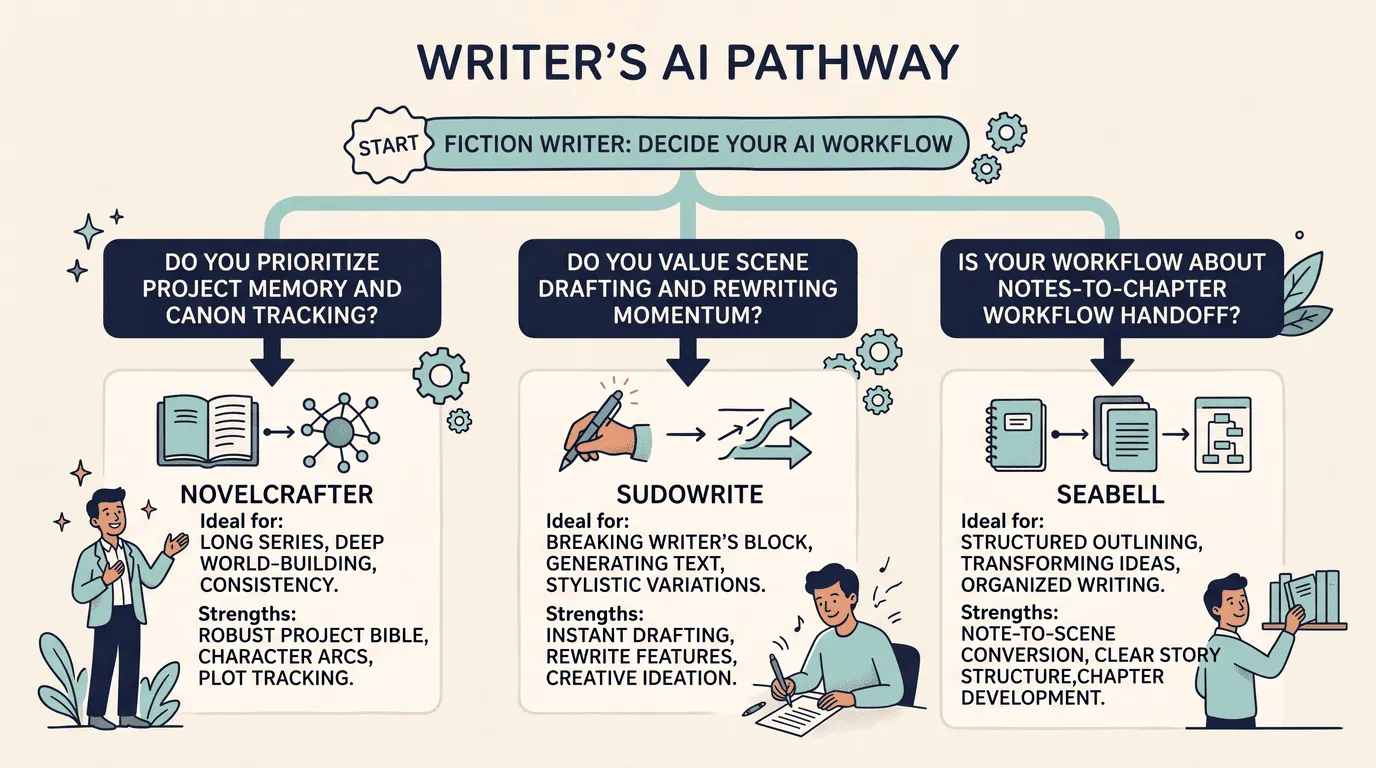
Choose Sudowrite if the page itself is the problem: blank scenes, thin description, stalled dialogue, or a draft that needs momentum quickly.
Choose Novelcrafter if the project is the problem: canon notes, timelines, character states, world rules, chapter history, and a story bible that has to stay updated.
Avoid Novelcrafter if you know you will not keep reference entries updated. Its strength fades if the Codex goes stale.
Avoid Sudowrite if you expect scene generation alone to police a whole novel's continuity.
Consider SeaBell if you already have notes and outlines, but the handoff into chapter-by-chapter drafting keeps costing you time.
That difference matters more than feature count. If you buy the tool for the wrong bottleneck, you do not remove the work; you move it from drafting to note maintenance, or from note maintenance to repeated prompt repair.
🧭 What Novel Writers Actually Need from an AI Writing Tool
A short story can run on mood for longer than a novel can. Long-form fiction starts asking for less glamorous things: current relationship state, timeline order, stable names, firm rules, and a record of what the reader has already been taught to expect.
Use seven practical questions to judge Novelcrafter and Sudowrite:
- How quickly can the writer move from an idea to a usable scene?
- How much structure does the tool ask for before it becomes useful?
- Where does story context live, and how easy is it to update?
- Does the drafting flow protect character voice and relationship state?
- What happens when a rule, clue, or chapter decision changes?
- How much control does the writer have over model choice, output style, and cost?
- Does the tool reduce the writer's mental load, or just move it into another dashboard?
If you already keep a story bible or draft from chapter outlines, you have seen the same problem in a simpler form. Those documents matter most when they change the next drafting decision, not when they merely look organized.
📚 Novelcrafter Review: Where It Feels Strong
Novelcrafter's clearest strength is not line-level prose generation. Its strength is the way it treats a novel as a project with reference history.
The center of that approach is the Novelcrafter Codex, which the company presents as a story bible and worldbuilding system. Its Codex page describes a reference system for characters, locations, lore, objects, subplots, and story details that change over time. For a novelist, that means the tool is built around a structured source of truth.
For the right writer, that is a serious advantage. A romance author can track the trust level between two leads after each scene. A fantasy writer can separate what the kingdom believes about a forbidden spell from what is actually true. A mystery writer can log when a clue appeared and who noticed it.
Those details matter because AI drift often starts small. The first sign may not be a huge plot hole. It may be a line of dialogue that sounds too intimate too soon, a side character using information they should not have, or a magic rule becoming softer because the current scene wants an easy exit. By the time the draft is 50,000 words deep, that small drift can turn into a revision week.
Novelcrafter makes the most sense for writers who are willing to maintain a living reference system, not just upload a one-time story bible and hope the draft behaves. It is a natural first test if you are leaving a looser drafting workflow because the project has become too complex to manage from memory.
⏳ Novelcrafter Review: Where It May Slow You Down
That same reference system can slow writers down when upkeep becomes separate from drafting, especially if they dislike maintaining notes.
Novelcrafter may feel like a second project sitting beside the book. The Codex only stays useful if the information inside it stays current. A character entry that describes the protagonist from chapter one is not enough if chapter nine changed her loyalty, chapter twelve changed her fear, and chapter sixteen gave her a reason to lie.
Maintenance helps when it affects the next scene; it becomes busywork when the writer feeds the system facts no chapter will use. Writers who update only the details their next chapters need will usually get more from Novelcrafter than writers who build a huge archive and then avoid opening it.
The setup cost is especially visible for discovery writers. If your best ideas arrive while drafting, you may not want to define factions, progressions, relationship states, and scene beats before the draft starts moving. Novelcrafter may still work, but it will ask you to turn discoveries into records as the manuscript grows.
In practical terms, Novelcrafter setup can mean creating character entries, places, rules, relationship states, chapter summaries, hidden information, and subplot notes before the system feels fully useful. That work pays off in fantasy, mystery, and series fiction. It may feel heavy if you only want to draft tonight's chapter.
✍️ Sudowrite Review: Where It Feels Strong
Sudowrite's public pages are more immediate. Its public positioning leans toward planning support, first-draft help, brainstorming, description, expansion, rewriting, and feedback. The tool is not only a blank-page helper, but the pitch is easiest to understand from inside a writing session: get a scene started, thicken a beat, test another version, or revise what is already on the page.
Sudowrite is easier to imagine using in the middle of a scene. A paragraph feels flat, so you ask for a sharper sensory angle. A beat feels rushed, so you expand it. A sentence keeps falling flat, so you try variations until one fits the tone and pushes the scene forward.
A practical workflow might look like this: outline the chapter, draft a rough passage, expand the underwritten beat, try a sharper dialogue exchange, then ask for feedback before revising the whole chapter. That is a real use case, not just "inspiration."
If I were a writer with a clear outline but weak daily momentum, Sudowrite would be tempting. The tool seems designed for a common drafting problem: the writer knows what should happen, but cannot turn that plan into usable prose.
The setup is lighter. You can start with the scene itself, use the tool to expand a weak beat, try alternate dialogue, or push toward the next paragraph. The trade is that project memory may still live partly in your outline, notes, or head, especially if you treat the tool as a paragraph engine instead of a full story workspace.
⚠️ Sudowrite Review: Where It May Not Be Enough
Sudowrite can move a scene quickly. The harder question is whether its workflow stays reliable once the manuscript has more canon, revisions, and delayed reveals to protect.
A tool that helps inside a scene still needs a reliable way to respect the rest of the manuscript. The scene may need more than "they are rivals." They almost trusted each other yesterday. One of them lied for a protective reason. Neither is ready to admit attraction, and the reader must not yet learn why the old treaty failed.
Writers should test this level of context carefully. If Sudowrite gives you momentum but you still have to paste and correct the same continuity notes every session, the friction has not disappeared. It has moved into your prompt habits.
Pricing is also part of the decision. The Sudowrite pricing page lists monthly credit allowances, so heavy users should estimate credit use across drafting, expansion, rewriting, and feedback—not just a weekend experiment. A few experimental scenes are one thing; drafting, expanding, and revising thirty chapters is another.
Sudowrite may be the better fit if the draft itself is the main bottleneck. If the bottleneck is canon, chapter memory, or a series-wide reference system, I would test it against that pressure before committing.
🔁 Revision and Cost: The Part Most Comparisons Undersell
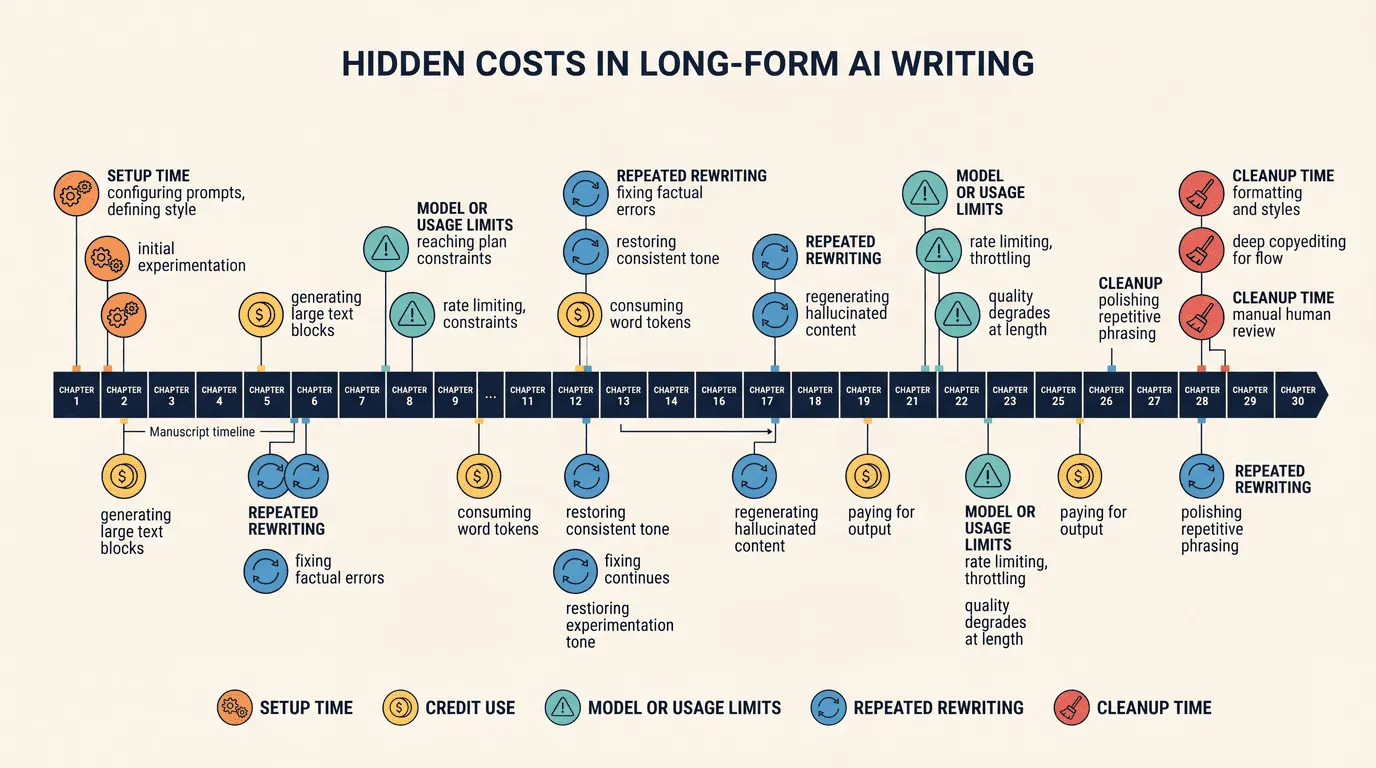
Revision is where the difference becomes clearer: if you change a clue in chapter four, the question is not whether the AI can rewrite chapter eighteen. Most tools can rewrite a scene. The question is whether the workflow helps you remember what changed, which character now knows it, which reveal must stay hidden, and which later chapters need cleanup.
If the revision is mostly prose-level, Sudowrite is better positioned to reshape the page quickly. If the revision changes canon, relationships, rules, or hidden information, Novelcrafter's reference structure matters more, but only if the Codex is current. A stale reference system will not protect continuity any better than forgotten notes.
Cost works the same way: the visible plan price is only part of the workload. Estimate how many times you will draft, expand, rewrite, regenerate, and review chapters across a full manuscript. Sudowrite users should watch credit use across repeated scene work. Novelcrafter users should check the Novelcrafter pricing page against plan limits, available usage options, and the time cost of keeping the Codex current. The cheapest tool on paper may not be the cheapest workflow after thirty chapters.
📊 Novelcrafter vs Sudowrite: Side-by-Side Comparison
| Decision Point | Novelcrafter | Sudowrite |
|---|---|---|
| Best fit | Project-heavy novelists who need a living reference system. | Writers who need scene momentum, description, rewriting, and idea recovery. |
| Learning curve | Higher if you build a detailed Codex. | Lower for writers who want to start inside the page. |
| Story context | Strong Codex and story-reference emphasis. | Positions more around story planning and drafting support, though the workflow reads more drafting-led. |
| Drafting flow | Best with prepared scene context and clear constraints. | Best when shaping prose, expanding beats, or restarting a stuck scene. |
| Revision workflow | Stronger when a change must be checked against canon. | Stronger for pacing, feedback, scene texture, and line-level passes. |
| Setup cost | Higher; the Codex rewards upkeep. | Lower for quick starts; long projects still need outside discipline. |
| Cost and usage control | Check plan limits against a full manuscript workflow. | Estimate credit use across drafting, expansion, and revision. |
| Long-series support | Better when recurring canon and character states drive the series. | Better when the series is organized elsewhere and chapters need momentum. |
| Strongest use case | Maintaining a complex novel through draft and revision. | Moving a scene forward when prose, pacing, or dialogue stalls. |
| Main risk | You spend too much time maintaining the system and not enough time drafting. | You generate momentum but still carry too much continuity work by hand. |
The table is not meant to crown a permanent winner. Treat it as a filter. If your draft keeps losing canon, clues, or character-state decisions, favor the tool that keeps those details visible. If your draft keeps stopping before the scene has usable prose or emotional direction, favor the tool that gets you writing again.
🧪 The Test I Would Use Before Choosing
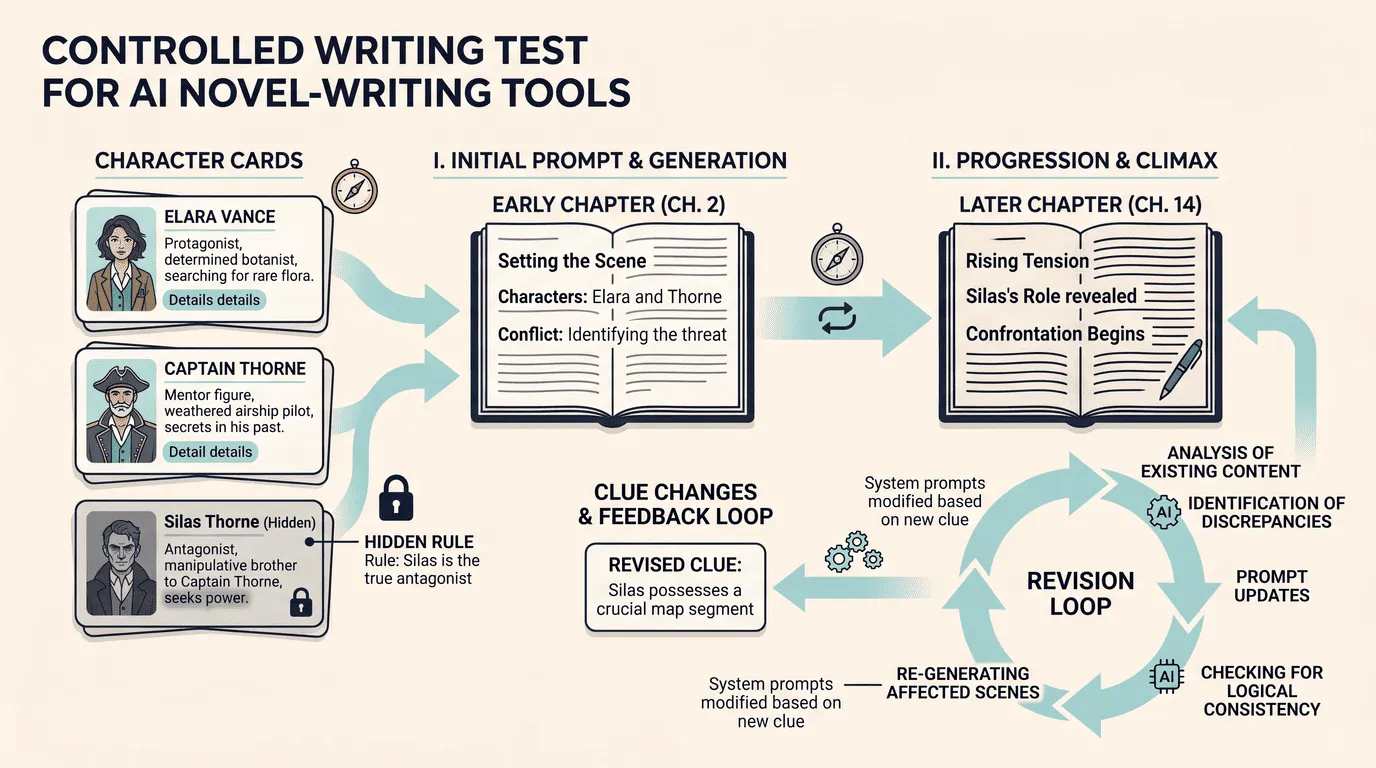
Do not choose from the homepage alone; choose from a controlled writing test.
Build the same small novel setup in both tools: three characters, one central relationship, one hidden rule, one chapter-two reveal, and one later scene where the reveal should matter. Keep the setup modest. The goal is not to impress the tool. The goal is to see how much pressure the workflow can take before you spend more time correcting it than drafting.
Use this test:
- Write a premise with a clear genre promise.
- Create three character notes with current goals, private fears, and relationship tension.
- Add one world rule or mystery clue that should not be fully explained yet.
- Draft an early chapter where the rule is hinted at.
- Ask for a later chapter where the emotional and plot consequences should show up.
- Change one fact from the early chapter, then revise the later scene.
Watch what breaks. Does the tool remember the right tension? Does it reveal the secret too early? Does it flatten the character voice? Does it keep the changed clue clean? Do you spend more time correcting context than writing the next page?
Score the result by cleanup time, character and secret handling, and revision stability. Those results will tell you more than another hour of reading product pages.
The result should point to a practical next step. If the draft stalls before the scene has shape, Sudowrite deserves a closer look. If the scene moves but the canon breaks, test Novelcrafter harder. If both tools make you rebuild the same notes before each chapter, the problem may be the notes-to-draft handoff itself.
That test is more useful than a feature checklist because it shows whether the workflow matches your actual book, not just what the software claims to contain.
🌊 Where SeaBell Fits in This Decision
SeaBell belongs here only if the test reveals a third problem: the planning exists, but each chapter session starts by rebuilding it. A writer may have a story bible, character notes, and a chapter outline, but still lose time moving the right context into the next AI session. SeaBell's AI writing workflow is worth reviewing when you want to bring character context and chapter direction into the drafting session without rebuilding the prompt from scratch each time.
That does not mean the platform makes consistency the software's job. Its value is narrower and more practical: reducing the friction between the notes you already made and the chapter you are trying to draft next. The writer still decides what stays, changes, or gets cut. A good workflow makes those decisions easier to carry from one chapter to the next.
✅ Final Recommendation
If you can only test one tool today, choose based on the failure you already know. Choose Novelcrafter if your novel has enough moving parts that a loose chat workflow keeps losing canon, relationship state, or chapter history. This route is especially strong for planners, worldbuilders, series writers, and anyone who wants a more explicit story reference system.
Choose Sudowrite if you struggle more with the page than the database. If your outline is serviceable but your scenes feel thin, stiff, rushed, or hard to restart after a break, Sudowrite's creative drafting tools may meet the pain more directly.
Consider SeaBell if your real issue is the notes-to-draft handoff. It makes the most sense when you want a repeatable way to move story context and chapter direction into each new drafting session.
If price is the deciding factor, do not choose from the plan page alone. Run one normal week of your writing process through the test above, then estimate setup time, credit use or plan limits, and cleanup time. That will tell you more than the lowest advertised monthly number.
For a broader market scan, read the separate guide to Sudowrite alternatives for fiction writers before comparing the wider field. This article stays narrower on purpose: Sudowrite vs Novelcrafter is a workflow choice, not just a feature count.
If you leave this comparison with one rule, make it this: choose the workflow you will still maintain on a bad writing day. No tool can decide what the book should become, but the right workflow should help you draft the next chapter without losing track of what the last one established.
❓ FAQ
Is Novelcrafter better than Sudowrite?
Novelcrafter is usually better for a full novel with heavy continuity. Its Codex-based workflow is better matched to canon, character state, and long-project control. Sudowrite is still the better pick when the real pain is getting scenes moving, not governing the whole manuscript.
Does Novelcrafter have better memory than Sudowrite?
Novelcrafter is usually stronger for project memory because its Codex is built around story references. That advantage depends on upkeep. If the writer does not update the Codex when characters, rules, or reveals change, that memory advantage fades quickly.
Should romance, fantasy, or mystery writers choose differently?
Genre matters because different stories break in different places. Romance writers who mainly need sharper emotional beats may like Sudowrite's drafting feel. Fantasy and mystery writers with rules, factions, clues, reveals, and delayed information should test Novelcrafter carefully, because those genres punish loose context faster.
What is the main difference between Sudowrite and Novelcrafter?
The shortest answer: Sudowrite is more drafting-led, while Novelcrafter is more structure-led. If you search Sudowrite vs Novelcrafter, the useful question is not which one has more features. Ask whether your manuscript needs more page momentum or more story governance.
Is Novelcrafter a good Sudowrite alternative?
Novelcrafter is a strong Sudowrite alternative when the problem is long-project control. The appeal is less about quick scene energy and more about keeping story references updated as the draft changes. It is not a one-to-one replacement for every Sudowrite habit.
Is Sudowrite better for beginners?
Sudowrite may feel easier for beginners who want to start writing quickly. Novelcrafter may feel heavier at first because it asks the writer to build and maintain more story references before the payoff is obvious.
Which is cheaper for writing a full novel?
The cheaper workflow depends on usage, not only the monthly plan. For Sudowrite, watch credit use across drafting, expansion, rewrites, and feedback. For Novelcrafter, check plan limits, available usage options, and the time cost of keeping references current. A tool that looks cheaper for chapter one may cost more across a full novel after repeated revision passes.
Which tool is better for rewriting a finished draft?
Sudowrite is the better first test for prose-level rewriting, pacing, and scene texture. Novelcrafter is more useful when the rewrite changes canon, relationships, clues, or reveal timing, because those changes need a current reference system.
Can I use SeaBell instead of Novelcrafter or Sudowrite?
SeaBell is not a one-to-one clone of either tool. It fits writers whose notes, outlines, and chapter goals already exist, but who keep losing time moving that context into the next drafting session. Ask whether you need a Codex-heavy planning system, a creative drafting assistant, or a fiction workspace that keeps story context close to chapter creation.
Can either tool replace a human editor?
No. These tools assist with drafting, rewriting, organization, and context checks, but they do not replace editorial judgment. A human still has to decide whether the story works, whether the voice feels right, and whether the final manuscript holds together.
Related Posts
Scene Card Template for Novel Writers | SeaBell
Copy a scene card template for fiction writing, see a filled example, and turn your scene plan into a focused AI drafting brief

Story Bible Template for Novel Writers: AI-Ready Guide
Use this story bible template to organize characters, world rules, timelines, plot threads, and AI drafting notes before your novel gets messy.
Chapter Outline Template for Novel Writers
Use this chapter outline template to plan POV, conflict, character change, continuity notes, and ending hooks before drafting your next novel chapter.