

How to Write Historical Fiction Without Losing the Story | SeaBell
How to Write Historical Fiction Without Losing the Story
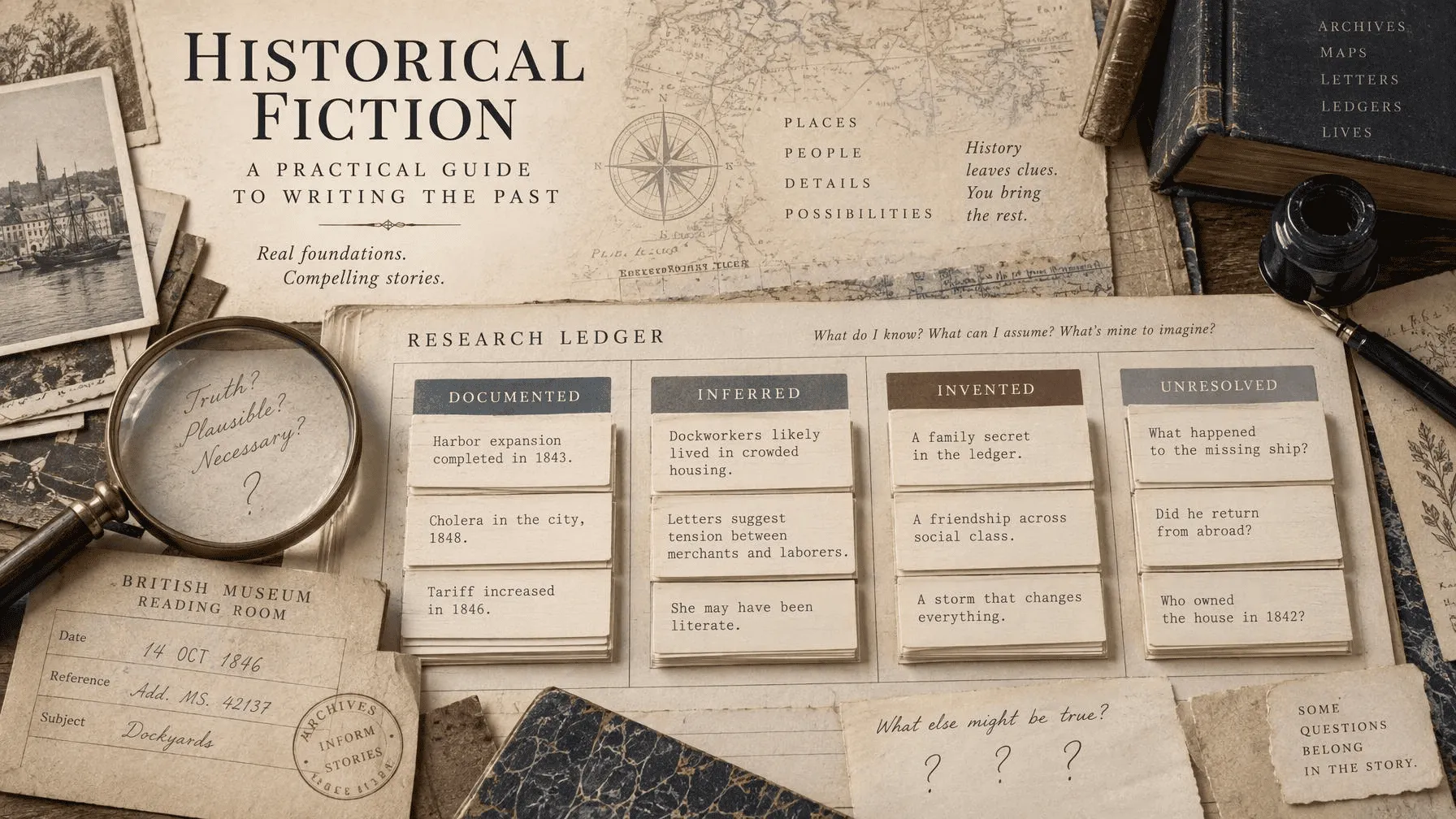
Historical fiction starts with a specific problem in a specific past. Choose a place, a narrow time window, a character with limited access to information, and a decision that matters. Research the facts that could change that decision. Mark each settled detail as documented, inferred, or invented, and flag open questions as unresolved. Draft the scene with those limits in view, then check the historical assumptions holding the plot together. The result is a past that shapes the next choice instead of disappearing into background summary.
Choose a specific past and a character with something at stake
Narrow the setting beyond a period label
“Victorian England” or “ancient Rome” is a shelf label, not a setting. A year alone still leaves out class, occupation, neighborhood, religion, transport, local law, and access to news. A dockworker in Liverpool and a solicitor in London do not inhabit the same version of 1890.
Write a one-sentence constraint before opening another source: On the morning of April 18, 1906, a printer’s apprentice working an overnight shift in San Francisco must choose between obeying his employer’s order to move the paper stock and leaving to check on his sister. The sentence establishes the place, date, role, immediate pressure, and competing obligations. It also tells you what research matters first.
Decide what belongs to history and what belongs to your story
A fictional story can use invented characters and events while staying within documented historical constraints. A novel centered on a real person asks you to handle the record and the gaps with extra care. Alternate history changes a major event and makes that change part of the reader’s contract. These are different jobs. If your plot quietly prevents a well-known event, readers may experience the change as an error rather than a deliberate premise.
Whichever of these forms you choose, the setting still has to put pressure on a character. Let invented characters make unexpected choices, but keep their access to money, work, information, and movement plausible for their position.
🔎 Research what could change the scene first
Which facts can break the scene?
Start with questions whose answers could invalidate an action: Could this person travel there that day? Was the institution open to them? Did the technology exist, and could they afford or reach it? How would a message travel? What legal or physical limit turns the obvious solution into a problem?
Use dated directories and newspapers to find evidence that telephone service was listed or advertised in San Francisco in 1906. That does not establish coverage, access, or post-quake operation. Whether this apprentice could reach a telephone—and whether it still worked after the shaking—remains a separate question to mark as unresolved in your research notes. Even a small object needs careful research when the climax depends on its availability. Research risk follows the fact’s role in the plot, not its size or novelty.
Research paralysis usually starts when every missing detail feels equally urgent. Most are not. Sort them with one question: could a different answer make the scene impossible? A wrong assumption about the route to his sister’s block could. A wrong assumption about the ink brand probably could not. As you draft, bracket unresolved details so a working assumption does not become an unnoticed fact: [check: was this route passable after 5:12 a.m.?]. Brackets let you keep drafting without treating an unchecked detail as settled fact. They should not survive into a final manuscript.
When the research is enough to draft
You can sketch a scene to discover what needs researching. Before treating its main actions as settled and building later chapters on them, check the facts that could make those actions impossible. The example below is an exploratory draft, not a scene that has passed that check.
A discovery writer might find those questions in a rough scene; a planner might find them in an outline. Either can keep writing elsewhere while a crucial fact remains open, as long as later choices do not depend on the unverified answer.
Keep evidence, inference, and invention separate
Where to look first
For practical leads, start with newspapers from the period, city directories, maps, census or workplace records, trade catalogs, and institutional archives. A Sanborn fire insurance map may clarify a building’s footprint, construction, and openings at the time the map was surveyed. A directory may show that a business or service was listed in a particular year. Neither source, by itself, tells you what still stood or operated after a disaster. For printing-specific details, the Library of Congress account of composing text explains how workers selected type from cases and secured it before printing. It covers hand-setting in the 15th–18th centuries; equipment in a 1906 San Francisco shop still needs local evidence. Treat each lead as a place to ask a question, then check who made the record and what it leaves out.
What a source can—and cannot—prove
Whether a source is primary depends on the question. A memoir written decades later is evidence of what its author remembered and chose to report, but exact timings, sequences, and quoted dialogue should be checked against records made closer to the event. A source’s classification does not make it complete or neutral. Ask who made the record, for whom, when, and for what purpose. A newspaper tells you what its editors chose and were able to print; a private letter tells you what one person chose to write. In both cases, notice whose experience never reached the page. For reconstructing what happened that morning, a later scientific explanation is a secondary interpretation.
The USGS account of the 1906 San Francisco earthquake dates it to April 18, 1906, at about 5:12 a.m., and describes the fires that followed. The National Archives (NARA) account of the earthquake and fire records that fires broke out almost immediately after the shaking. Together, the sources fix the sequence; neither says anything about the condition of a fictional shop. The later scientific explanations help you understand the event; they do not belong in the apprentice’s thoughts that morning.
Record uncertainty where you will see it again
Use this table to keep the research for one scene together. Each row pairs what a detail rests on with whether that question is settled or still open.
Detail or questionWhen did the earthquake strike?
Basis and locatorUSGS, “The Great 1906 San Francisco Earthquake”
ResolutionSettled: documented
Character knowledge or accessKnows the shaking has stopped but not the exact clock time
Scene consequenceAnchors the scene’s chronology
Action before finalizingRecord the source in your notes
Detail or questionIs this combination of equipment and overnight staffing plausible for the shop?
Basis and locatorFictional small morning-paper shop; local equipment and labor records still needed
ResolutionOpen: no schedule or equipment source checked
Character knowledge or accessKnows his assigned shift and the equipment in his own workplace
Scene consequenceDetermines whether type cases, an overnight shift, and movable paper can coexist
Action before finalizingCheck comparable shop type, equipment, and labor arrangements
Detail or questionWhy is the employer already at the shop when the scene begins?
Basis and locatorFictional workplace arrangement; local work-practice source still needed
ResolutionOpen: needs a reason and a schedule check
Character knowledge or accessKnows the employer is in the building; does not know why he is there at this hour
Scene consequenceMakes the order possible only if the employer’s presence fits the schedule
Action before finalizingGive him a reason to be there; verify the work arrangement
Detail or questionWhy does the employer insist on moving paper before the apprentice leaves?
Basis and locatorInvented motive: seeing smoke makes him fear losing stock; NARA documents the early fires, not his reaction
ResolutionOpen: historical context checked; local feasibility pending
Character knowledge or accessSees the employer react to smoke and hears the order
Scene consequenceCreates the conflict; moving paper may protect stock while endangering the people who stay
Action before finalizingEstablish his priority in the story; check building condition and stock handling
Detail or questionCould the shop remain standing and accessible long enough for him to move the stock?
Basis and locatorNo building inspection or damage source checked yet
ResolutionOpen: no source checked yet
Character knowledge or accessFeels the damage around him; cannot know the building’s full stability
Scene consequenceDetermines whether handling stock is physically possible, even if staying is dangerous
Action before finalizingCheck the building type and dated damage accounts
Detail or questionCould smoke or fire threaten this shop shortly after the shaking?
Basis and locatorNational Archives records fires erupting almost immediately; exact local location and timing unchecked
ResolutionOpen: no local effect established
Character knowledge or accessSees smoke but cannot know its source or spread
Scene consequenceChanges both the urgency of moving stock and the risk of staying
Action before finalizingCheck the address against a fire-progression map and timeline
Detail or questionCould he send word to his sister after the quake?
Basis and locatorNo telephone or messenger source checked yet
ResolutionOpen: no source checked yet
Character knowledge or accessMay know of a service but may not have access to it
Scene consequenceCould reduce the need to leave immediately
Action before finalizingCheck service and post-quake availability
Detail or questionCould he reach her lodging on foot from the shop?
Basis and locatorNo route source checked yet; addresses still needed
ResolutionOpen: no source checked yet
Character knowledge or accessKnows the usual streets; cannot know which remain passable
Scene consequenceDetermines whether leaving is viable
Action before finalizingCheck the route against a dated map or account
The labels stop a common drift: a research note can turn into invented certainty once it has been copied from one document to another. The Basis and locator cell names the source or premise; the Resolution cell shows whether the row is settled or still open. Record a source title, date, and page or archive reference for documented or inferred claims. An invented premise needs no citation of its own, but the historical conditions it depends on still need to be checked and sourced. An inference requires one or more sources and an explicit line of reasoning.
The overnight shift matters to this scene’s plausibility. Dated notices, union rules, or trade journals could document hours and staffing at comparable local workplaces. An Inferred judgment about a similar arrangement needs an explanation of why the workplaces match in location, size, type of work, and labor arrangements. Comparable records can support the plausibility of the shift and the employer’s presence. They cannot document the schedule of an invented shop or the actions of an invented employer. Those remain story choices; their historical feasibility is still open here.
🧾 Social context and character cost
Once the table shows what is supported or still open, ask what those conditions cost the character. A constraint becomes story pressure when it costs the character something real. It may take away an option, a resource, a relationship, or time. Historical characters need those pressures to come from somewhere specific. Give them particular sources of information, obligations, habits, and fears. A clerk may know an institution’s rules intimately while misunderstanding what happens outside the office. A teenager may reject a family belief and still depend on that family for food and shelter. In a scene, those pressures should narrow an option: the clerk delays a trip because leaving risks his position, or the teenager hides a letter because the family controls the rent.
The past contained disagreement. Do not make every woman, worker, immigrant, believer, or aristocrat share one opinion because a textbook describes a dominant pattern. Give dissent a context and a cost. Ask who taught this character the belief, who benefits from it, what evidence they have encountered, and what they risk by acting against it.
Historical understanding is not moral endorsement. A character can accept a cruel institution, resist it, misunderstand it, or exploit it. The novel’s job is to make that position legible in the character’s circumstances without flattening a whole society into a single voice. Do not use a slur as a shortcut to historical atmosphere; include offensive language when it reveals power, inflicts harm, or changes the scene’s meaning.
Make historical detail serve the scene
Imagine the apprentice still inside the shop when the shaking stops. The sources establish the date, approximate time, and early outbreak of fires. The paragraph below is an exploratory draft for identifying research tasks. Its shop, shift, building condition, and local fire threat remain open; any of them could require the scene to change.
Flat exposition:
On April 18, 1906, a major earthquake struck San Francisco at about 5:12 in the morning. Fires followed the shaking. By daylight, the city’s ordinary work had been interrupted.
The exposition makes a broad claim about “ordinary work” without showing whose work has been interrupted, and it gives the apprentice no next move. The scene draft below gives him a choice and makes its cost visible. The spilled type matters because a compositor’s cases are working tools, not a random box of metal.
Scene draft:
When the shaking stopped, the apprentice was still in the shop. [check: could he plausibly be in the shop at this hour?] Type had spilled from the cases. The dull gray pieces lay face-down and sideways in the plaster. Through the window, smoke seemed to be rising two streets over. [check: source, visibility, and timing of the smoke] His employer came out of the pressroom, glanced through the window, and ordered him to get the paper stock out.“I need to check on my sister.”“The paper first.”Perhaps someone could take a message to her. He had not worked out whom to ask, or whether the route to her lodging remained passable. [check: verify communication and route from the shop to her address] One bundle, he told himself. He would move one bundle, then go. He turned back to the paper. [check: could he remain inside long enough to move it?] He took hold of the nearest bundle and pulled it toward the door.
The NARA account supports a setting in which early fires are a credible concern. The employer’s fear of losing paper is an invented response to that concern; the source does not establish his motive. He sees the smoke and puts stock first. The apprentice tells himself he will move only one bundle, then leave. He has not solved either problem; he has only postponed both. Local fire evidence must still establish the risk of that delay.
Ask what each historical detail does in the scene. Does it alter an option, reveal a pressure or relationship, orient the viewpoint, or make a consequence concrete? If it does none of these jobs, park it in your notes until a later scene gives it a function.
Dialogue reveals power before it reveals period
Dialogue needs a believable register. Forms of address, sentence length, politeness, profession, education, and the relationship between speakers usually carry more period information than scattered archaic vocabulary. A formal letter may preserve a different register from an edited testimony or a transcribed conversation.
If a phrase would sound natural in a modern workplace, ask whether anything in this speaker’s situation would produce it. Archaic diction can make every character sound ceremonial, so use it only when the voice and source support it. A word’s earliest recorded use does not prove that this character would use that sense or register.
For a separate relationship test, suppose the apprentice has told the other speaker where he is going. Compare these two lines.
A coworker’s request: “Can you grab the paper stock? I know you need to check on your sister, but this is urgent.”
An employer’s command: “The paper first. You’ll go when it’s out.”
The second line contains no archaic word. What changes is who claims the authority to decide when the apprentice can leave. The coworker acknowledges the trip and asks for help. The employer makes leaving conditional on finishing the work and offers no justification. Dialogue carries historical information through a relationship only when that relationship’s power, obligations, and social position are historically grounded. Research what authority an employer had over an apprentice, what obligations the apprentice owed, and what refusal might cost him. The power difference may fit the fictional workplace, but the wording is not evidence of 1906 speech. Read the scene aloud. If every voice has the same modern rhythm, rework the power gap and the information gap between the speakers before adding old-fashioned words. Use a few repeatable dialect features rather than spelling every sound; let syntax and what each speaker assumes do more work.
Revise the historical assumptions that hold the plot together
Run three focused passes
In the plot pass, check dates, travel, access, information transmission, material culture, institutions, and character knowledge. In the language pass, check register, meanings, and explanatory phrases. In the trimming pass, cut paragraphs that pause the story to display research.
Track dependencies. If a route is impossible, which meeting disappears? If a character cannot receive the news, which later choice needs a new cause? If you move the date, which technology, law, season, or public event changes with it?
Treat real people as a separate risk
Check real people with particular care. A documented action tells you what someone did, not why. An invented motive stays an invention, even when the act is real. If you compress chronology, combine people, or create a significant departure, an author’s note can disclose the change. It cannot turn an invented motive into documented fact, and it does not remove the risk of attaching unsupported misconduct to a real person.
Check generated details separately
Treat generated details as a review risk alongside chronology, language, and the portrayal of real people. AI tools can suggest questions, sort supplied notes, or help you compare a draft against the constraints you recorded. They can also invent details and citations. Keep the source ledger separate from generated text, and verify every historical claim against an appropriate source before it becomes part of the final manuscript.
Carry the verified context into the next chapter
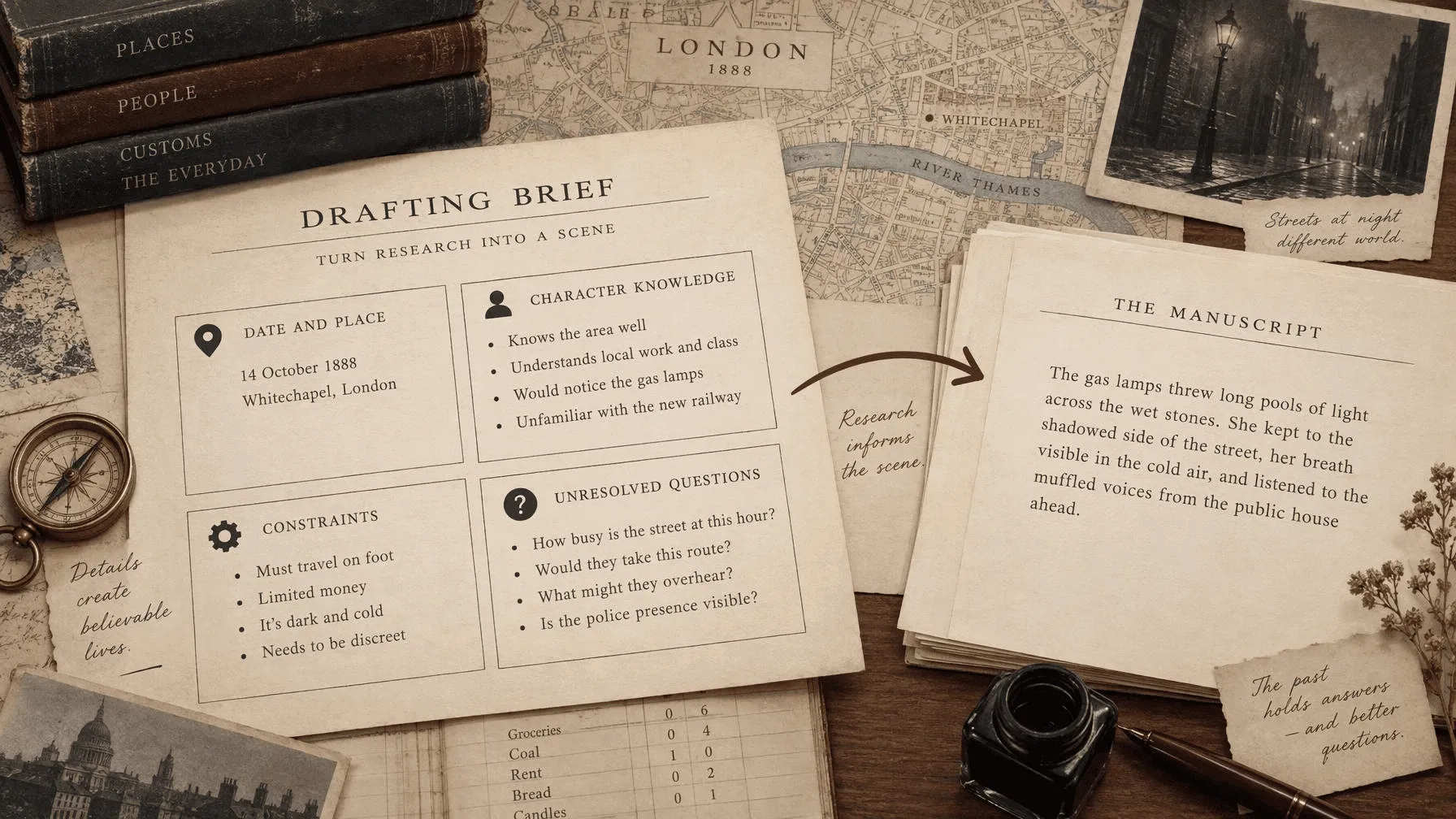
After a scene passes its historical check, carry only the decisions the next chapter needs. A chapter note can include the date and place, what each viewpoint character currently knows, the constraints that affect the next action, accepted inventions, and unresolved questions. These notes give you something to check when the next draft quietly changes a condition.
Carry dates and each character’s current knowledge in a story timeline template, store accepted inventions and setting rules in a story bible template, and put the immediate action, verified constraints, and unresolved next-move questions on a scene card. Leave texture-only questions bracketed in the draft or in your notes.
In SeaBell, you can keep selected scene constraints, character context, and chapter requirements in one drafting brief so those decisions sit next to the draft instead of being reconstructed from memory each session. Classify anything added while drafting in the same way: record locators for documented claims, record the reasoning behind inferences, label inventions, and flag unresolved dependencies.
FAQs about writing historical fiction
Should I translate foreign speech?
Many historical novels render foreign-language dialogue in readable English, then signal language difference through context, formality, or carefully checked untranslated terms. Choose an approach that serves the reader and apply it consistently.
Do I need an author’s note?
Use one when you have compressed chronology, combined people, or made a significant departure that readers may reasonably mistake for fact. Keep it factual and brief; it explains your choices without excusing harm.
How should I handle a historical fact that has several interpretations?
Name the disagreement in your notes and decide which reading your evidence supports. Then decide what the character saw, what they heard as rumor, and what they could not know. Do not turn a disputed explanation into settled dialogue simply because it makes the plot convenient.
Can historical characters speak in modern English?
You can render their dialogue in readable English for today’s audience. Keep the register, power relationship, and assumptions plausible for the setting, and avoid idioms that carry a distinctly modern meaning.
Before the next scene, write the constraint sentence in your own words. List its highest-risk historical questions, classify each settled answer as documented, inferred, or invented, and flag unanswered questions as unresolved. Then draft around the choices those answers permit.
Related Posts
Story Timeline Template for Fiction Writers
Copy a practical story timeline template for fiction writers and learn how to track chronology, reveal order, character knowledge, clues, and revision continuity.
Scene Card Template for Novel Writers | SeaBell
Copy a scene card template for fiction writing, see a filled example, and turn your scene plan into a focused AI drafting brief

Story Bible Template for Novel Writers: AI-Ready Guide
Use this story bible template to organize characters, world rules, timelines, plot threads, and AI drafting notes before your novel gets messy.