

How to Write a Horror Novel That Sustains Fear | SeaBell
A frightening premise can carry a short scene on its own. It rarely carries a whole novel. To write a horror novel that sustains fear, build a system in which a character’s safety, choices, and understanding keep changing under pressure.
That system can involve a monster, but it does not have to. The threat might live in a family, a familiar place, or the protagonist’s own body or memory. Horror often begins when something the character believed was safe, knowable, or survivable no longer is.
This guide follows one running example: at a coastal emergency shelter cut off for several days after an overnight storm, an archivist finds water-damaged call transcripts in the records room. Each sheet appears in the morning, a day before the accident it describes. It names the location and event and sometimes records an exact line someone will say, but gives no cause or solution. Her younger sister is upstairs with the evacuees. The roads are flooded. A sheet stays unchanged even when its predicted accident is prevented, and later sheets still predict more accidents. Two later checks suggest that each successful intervention has erased one memory the sisters share.
🕯️ Start with a specific fear, not a generic scary thing
“An evil presence in a shelter” is an image. It becomes a horror premise when you know what violation gives that image its charge.
In the shelter story, the deepest fear is not simply that the building is haunted. It is that the archivist may lose the ability to recognize, protect, or remember her sister accurately. The wet transcripts turn care into a trap: every attempt to save her sister may damage the relationship she is trying to preserve.
Start by naming the fear beneath the image. Common sources include loss of control, contamination, abandonment, bodily unreliability, isolation, social exposure, grief, or the collapse of a belief about reality. Then make the threat violate an ordinary rule.
Try this sentence:
This character is afraid of _ because losing _ would mean _.
If the answer is only “the monster is scary,” you have not found the story’s pressure point yet.
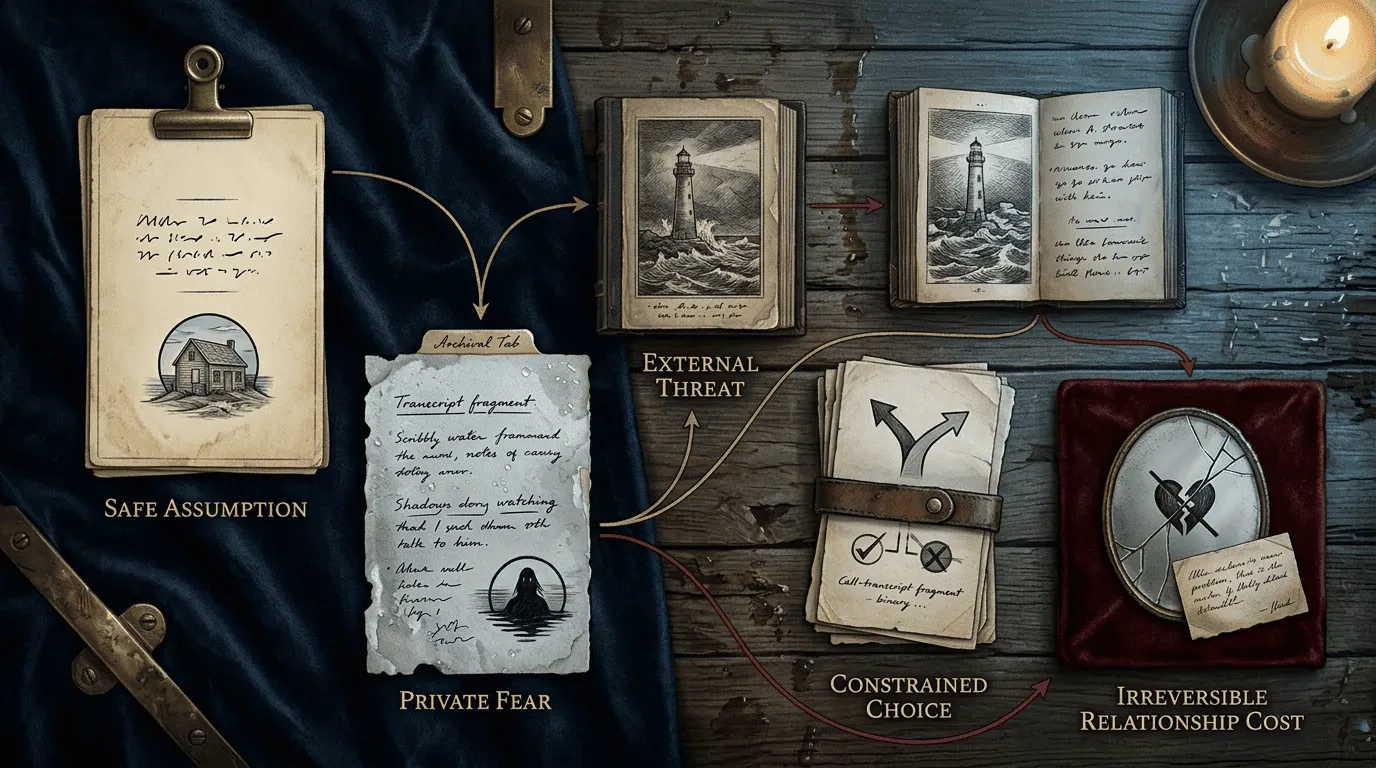
Choose the fear beneath the image
A locked room, a child’s drawing, a voice on a telephone, or an empty road can all be useful horror images. None of them creates a novel by itself. Ask what the image threatens in this particular character’s life.
For example, a phone that rings from an unplugged line could mean many things. For a paramedic who failed to answer a final call from a parent, it may turn guilt into an active force. For a teenager hiding an identity from their family, it may threaten exposure. The supernatural element can stay the same; the emotional consequence should not.
A common weak-draft symptom is a threat that could be dropped into any protagonist’s life without changing much. When that happens, the story often responds by making the threat louder or more graphic. A better fix is to make the threat attack a private assumption the protagonist cannot easily give up.
Make the familiar slightly wrong
Horror often begins before anyone has proof. Give the reader a baseline first: a routine shift, a familiar hallway, a relationship that has settled into its usual friction. Then let one detail refuse to behave.
At the shelter, the archivist reads a phrase in a transcript and later hears her sister repeat the same words, even though her sister has never seen the sheet. The transcript is water-damaged, but the ink on that one line is dry. Neither fact proves a supernatural cause. Together, they give the archivist a detail she can test and make the ordinary world less dependable.
The first disturbance should create a question, a constraint, or a choice. It does not need to deliver the first major scare. Quiet gives the disturbance somewhere to land.
Give the fear a personal consequence
The external threat needs an emotional job. Each time the transcripts predict an accident, the archivist faces more than a puzzle: act and risk losing something shared with her sister, or wait and risk someone being hurt. At this stage, the memory cost is a suspicion, not a rule she can safely assume.
That connection prevents the middle of the novel from becoming a series of incidents. The reader is not only asking, “What will happen next?” They are asking, “What will this cost her if she tries to stop it?”
🎭 Build a protagonist who can act and still has something to lose
Horror does not require a conventionally lovable protagonist. It does require a character whose choices make sense under pressure.
Establish four things early: what the protagonist wants, whom or what they care about, where they are vulnerable, and why they cannot ignore the threat. Once the threat appears, at least two should collide. The archivist wants to get everyone through the storm and keep her sister safe, but her habit of trusting records over people begins to work against that attachment when the transcripts predict events her sister insists will not happen. She stays because the roads are impassable, people are sheltering inside, and her sister is among them; evacuation is not a real option.
Use vulnerability without removing agency
A frightened, overwhelmed, injured, or mistaken character can still make consequential decisions.
Ask instead: what can the protagonist try, and what does trying cost? In the running example, the archivist can compare transcripts, move people, hide information, ask for help, destroy evidence, or refuse to act. Each choice should change the situation.
Stories lose force when every chapter ends with the protagonist watching something awful happen and then returning to the same position. The danger may be external, but the character’s available responses cannot stay static.
Give the character a credible reason to stay
Readers will accept confinement, obsession, duty, love, shame, financial pressure, and practical limits. They are less patient with characters who remain in danger only because the plot needs another chapter.
The “why don’t they leave?” problem usually appears before the writer notices it. A character reaches an obvious exit, ignores it without a cost, and the scene keeps going. Build the reason to stay into the premise instead: flooded roads, an injured person, a child who cannot be abandoned, a promise, a job with real stakes, or knowledge that makes leaving dangerous for someone else.
Credibility does not mean the character always chooses wisely. It means the reader can see the pressure behind the mistake.
Make the danger threaten something specific
Threaten more than a life meter. Horror becomes more personal when the danger bears on a relationship, identity, body, home, belief, future, or moral line.
In the shelter story, memory loss is not merely a penalty. It threatens the archivist’s understanding of why her sister matters to her and whether she can trust the evidence she uses to decide when and where to intervene. That gives the climax an emotional question as well as a survival question.
🏚️ Make the setting enforce the threat
Atmosphere is useful, but setting should do more than provide wet windows and bad lighting. It should change what the characters can do, notice, trust, and escape.
The emergency shelter works because it is crowded, underpowered, and cut off by the storm. A closed stairwell, a dead radio battery, a flooded loading bay, and the need to keep evacuees calm are all story constraints. The building is not just where the horror happens; it helps decide which solutions fail.
Turn safety into a condition that can fail
Choose a place that carries an expectation of safety, then decide how that safety becomes conditional. A home, hospital, school, church, workplace, or shelter can be unsettling because its rules are familiar.
In this example, the shelter initially promises protection from the storm. As the transcripts begin to predict accidents inside the building, that promise reverses. The character cannot simply move from danger to safety because the safe place has become part of the problem.
Use sensory details that change meaning
Pick a small set of sensory anchors and let their significance shift. The smell of mildew, the clatter of pipes, the blue emergency lights, and the sound of water in a stairwell can begin as background. Later, each can signal that a predicted event is approaching.
Repetition works when the context changes. If the same creepy detail appears in the same way every time, it becomes wallpaper. If it arrives after a new cost or a new rule, it becomes evidence.
Make the environment remove options
A good setting constraint is one that grows from the setting, not a locked door added at the last minute. It makes an otherwise reasonable option inadequate. The archivist may reach the exit, but the roads are flooded and her sister is inside. She may call for help, but the signal drops. She may move evacuees, but panic would scatter them. After an intervention, a later transcript predicts another accident elsewhere in the shelter, so she cannot treat the original forecast as the only danger.
Notice the distinction: the setting narrows choices; it does not make the protagonist irrational. That difference is where suspense becomes believable.
🔎 Control what the reader and character know
Readers need enough information to form expectations, worry about them, and revise them when a new detail arrives. Holding back the cause or full rule can preserve uncertainty; withholding every usable pattern only creates confusion.
For each major section of the novel, track what the protagonist knows, what the reader knows, what both can reasonably infer, and what must remain unexplained for now. In the shelter story, the transcripts predict an accident one day ahead by naming a location and an event, sometimes with a line spoken there, but they do not identify their author, cause, or solution. An old sheet stays unchanged even after its predicted accident is prevented, and a later sheet still predicts another accident. That gives the characters something usable to act on without turning the threat into a solved mechanism.
Use the unknown as pressure, not as a substitute for story
In a mystery-centered story, readers often evaluate facts and work toward an explanation. Horror can leave questions unanswered, but the uncertainty still has to change the character’s options and sense of safety.
A vague threat becomes frustrating when nothing can be tested. Give the reader traces, contradictions, limits, or consequences. After the archivist follows one transcript and prevents a fall, her sister points to a photograph of the two of them at the old pier and asks whether she remembers the private joke from that day. The archivist cannot recall it. Exhaustion remains a plausible explanation. After she prevents the pipe from bursting in an empty storage room, a dated recording preserves another shared story that the archivist can no longer retrieve. The original transcripts remain unchanged, and later sheets continue to predict more accidents. The two missing memories, one exposed by her sister’s question and the other by the dated recording, let her infer that each successful intervention erases one shared memory, even though she still does not know what is causing it.
Choose concealment, partial reveal, or full reveal
Do not treat “the unknown is scarier” as a universal law. Concealment, partial revelation, and a fuller revelation each create a different kind of pressure.
Use concealment when the reader needs to feel a pattern before they can name it. The transcripts might predict accidents accurately while offering no reliable explanation for who writes them or why. The characters still need something to test; otherwise uncertainty turns into fog rather than dread.
Use a partial reveal when it destroys a safe interpretation. Suppose the archivist first believes the transcripts are warnings. Later, a phrase in a transcript matches one preserved in a dated note in the archive. The note, written in the archivist’s own hand, links that phrase to a specific incident the sisters once shared, but the archivist cannot recover the incident itself. The note is an external trace of what has been lost, not proof of who writes the transcripts. The revelation does not merely add lore; it makes her own mind part of the danger.
Use a full reveal of the relevant rule when knowledge makes the cost unavoidable. Once the pattern gives the archivist strong evidence that each intervention that prevents an accident erases one shared memory, the question is no longer only what the threat can do. It is whether she can accept saving strangers at the price of losing the history that makes her sister recognizable. The threat can become more frightening after its rule is clear because the character can finally see the exact choice ahead and still cannot find a clean way through it.
A reveal earns its place when it changes what the protagonist must do, what they can trust, or what they are willing to sacrifice. If it only explains the monster, delay it or cut it.
Let each reveal make a choice more expensive
A reveal should narrow the next chapter. A new rule can remove a convenient response, alter an alliance, expose a cost, or make an earlier decision hurt in a new way.
When a revelation only adds lore, readers may admire the concept but stop fearing for the character. When it makes the character choose between two losses, the story moves.
📈 Build a pressure curve across the novel
A horror novel needs variation. Constant intensity dulls the reader, while long stretches of calm can make the threat lose its force. Think of the middle as a changing pressure curve rather than a pile of escalating incidents.
Use these turns as a diagnostic map, not a fixed formula. A novel may combine some of them or return to an earlier turn when the pressure changes:
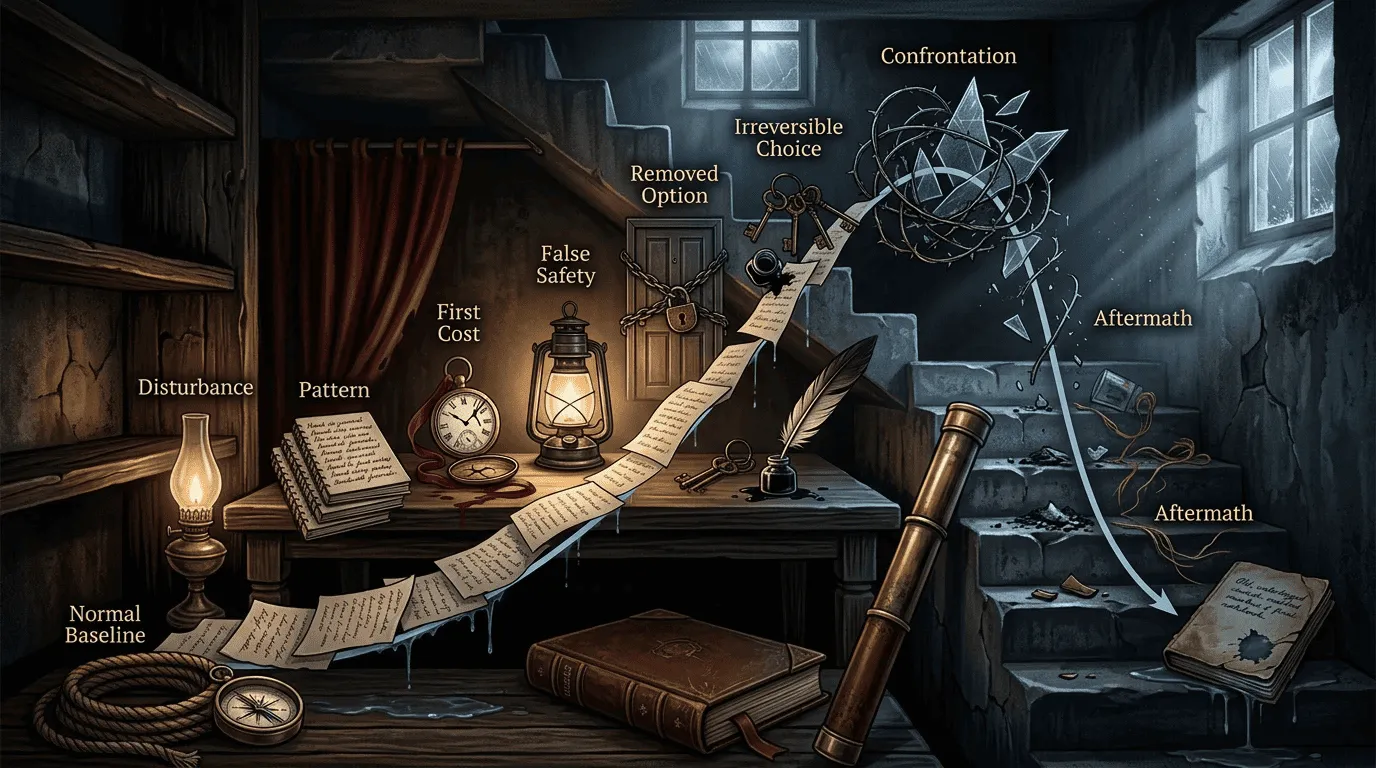
- Show the baseline. Let the reader see what normal safety or belief looks like. At the shelter, the archivist catalogs supplies while her sister sleeps upstairs.
- Introduce a disturbance. One small detail violates that normal: a transcript appears that morning and names an accident that will happen the next day in a room she has just left.
- Establish a pattern. The threat repeats, adapts, or leaves new evidence. Now the character has a reason to dread what may come next.
- Demand a first cost. Acting protects one thing and harms another. She prevents a fall, then discovers that she cannot remember the private joke she and her sister shared at the old pier.
- Offer false safety. The first intervention works: the predicted fall does not happen. The next sheet predicts a minor pipe burst in an empty storage room. She prevents the pipe from bursting. No one is hurt, and the shelter’s routine resumes. The two gaps in her shared history already warn her that each success has a price. But because the second accident is smaller and easy to contain, she treats the memory losses as a price she can manage and mistakes control of the physical accidents for control of the larger threat.
- Remove the easy option. The next sheet names a stairwell accident during a supply run. Rerouting the supply run or closing the stairwell would require an explanation she cannot give without alarming the evacuees. Preventing the earlier accidents did not stop the warnings or restore control.
- Force an irreversible choice. The protagonist chooses which value to protect, knowing success will not be free.
- Confront the central fear. The climax makes the emotional violation unavoidable, not just the threat visible.
- Show the aftermath. Survival changes what the character can recover, trust, or consider safe.
The middle often goes flat when a scene increases description but not consequence. If a chapter adds another warning, another chase, or another disturbing image while leaving every relationship and option intact, it may be louder without being more frightening. Ask what became impossible after this scene. If the answer is “nothing,” the escalation needs a cost.
Anticipation and surprise should not do the same job. Anticipation lets the reader see danger approaching before the character can fully respond: the reader has seen a transcript predict a stairwell accident for the next day, and, when that day arrives, knows the sister is carrying supplies toward it. That gap gives dread time to grow.
Delayed confirmation can keep the reader unsure whether the prediction is literal, whether the character has read it correctly, or whether it can be prevented. A sudden scare is useful when it breaks a fragile plan or forces a new response, such as the stairwell going dark before the archivist can reach her sister. It cannot carry the whole sequence by itself. After the shock, leave a new cost, rule, or unavailable option behind.
Give readers room to breathe without resetting the story
Relief gives horror a rhythm that lets dread return with force. A meal, a quiet conversation, a repaired radio, or a moment of warmth between the sisters can make the shelter feel briefly ordinary while an unresolved strain remains between them.
Relief should not erase what has changed. After the first memory loss, the archivist’s sister asks about their private joke from the day at the old pier. The archivist cannot answer, and her sister hears the silence as indifference.
Make the climax pay off the fear, not only the plot
The climax should answer the question at the center of the novel. In this case, the question is not only whether the shelter survives the storm. It is whether protecting another person is still meaningful when the act of protection alters memory and identity but leaves external evidence intact.
That is why aftermath matters. A final confrontation can end immediate danger, but horror often lingers because the character cannot return to the same understanding of home, body, relationship, or reality.
✍️ Write fear through POV and sensory detail
Prose cannot lean on lighting, a soundtrack, or an actor’s expression in the way a film can. It has different tools: what the character notices, what they avoid noticing, how they interpret a detail, and what their body tells them before their mind agrees.
Start with perception rather than an instruction to feel afraid.
Weak version:
Mara was terrified when she heard a noise in the stairwell.
More specific version:
The stairwell door clicked once. Mara kept sorting the wet transcripts until the paper slid under her thumb. A second click came from the other side, patient enough to sound like someone waiting for permission.
The first version tells the reader Mara is terrified. The second lets the sound interrupt an ordinary action and shows her hesitation without explaining it away. Naming fear can be right in another scene; here, the particular perception and hesitation create the pressure.
Describe what the character notices before what the reader should feel
Choose details the character would genuinely attend to in that moment. In close POV, a hallway can become frightening when the exit sign is lit but the floor beneath it is dry, even though rainwater has tracked across every other corridor. A familiar voice using the wrong childhood nickname can create a different kind of unease.
Avoid filling every sentence with ominous adjectives. Precision is usually more effective than a large pile of “dark,” “terrifying,” or “sinister” language.
Use the body as evidence, not as a shortcut
Physical response works best when it is specific to the character and situation. Dry mouth, shaking hands, nausea, or a racing heart can be useful, but repeating them on cue flattens the scene.
A more revealing reaction is often an action that fear interrupts or distorts: a hand that will not turn a doorknob, a character rereading a line because the meaning refuses to settle, someone speaking too quickly to keep another person from noticing their fear. The body becomes evidence of a changing relationship to danger.
Let sentence shape support the pressure
Longer sentences can trap the reader in an accumulating observation. Shorter ones can register a realization or a break in control. Use either deliberately.
Do not write prose like a screenplay. “The camera pans,” “a jump scare happens,” and “the music swells” ask the reader to import effects the novel has not created. Put the pressure in the character’s attention and the sentence on the page.
⚠️ Use violence and gore only when they do story work
Gore is optional. A graphic depiction earns its place when it leaves a visible consequence: it narrows a character’s choices, exposes a fracture in a relationship, establishes a costly threat rule, or gives the aftermath an image the character cannot dismiss.
A scare can work through a sound, an interruption, or a revelation that shifts the scene. Graphic detail controls how explicitly the harm is shown. Ask whether the scene would still matter if the graphic detail were removed. If it would, the detail may not belong in the draft.
Do not use sexual violence, abuse of children, or other severe trauma as a shortcut to make a story feel extreme. If difficult material is genuinely part of the story, it needs purpose, restraint, and appropriate framing; it should never be treated as an easy escalation button.
Even a non-graphic scare should displace something: trust, an option, a plan, or the character’s sense of safety.
✅ Revise your horror draft with reader-facing tests
A first draft can contain good scenes and still fail to build dread across a novel. Revision is where you check the connections between those scenes.
After a full draft, look for five failure points: a fear source that stays generic too long; an escalation that leaves every option and relationship intact; a setting constraint that could be moved to any location; a reveal that changes neither what the protagonist knows nor what they must do; and a relief scene that resets the story instead of carrying forward a consequence.
If the prose relies on repeated bodily shorthand for fear, replace at least one reaction with a specific interrupted action. Then check the aftermath: what cannot simply return to normal?
One practical revision method is to write a one-line consequence beside every major scare. In the shelter novel, “a transcript predicts a fall” is only an event. “She prevents the fall and cannot remember the private joke she and her sister shared at the old pier” changes the relationship and introduces a new fear. If several scenes produce only the first kind of note, the novel may have activity without a pressure curve.
🗂️ Keep your horror plan visible while you draft
Once you know the fear source, threat limits, reveal boundaries, character cost, and pressure curve, the next challenge is keeping those decisions visible from chapter to chapter. This matters whether you draft manually, use AI assistance, or combine the two.
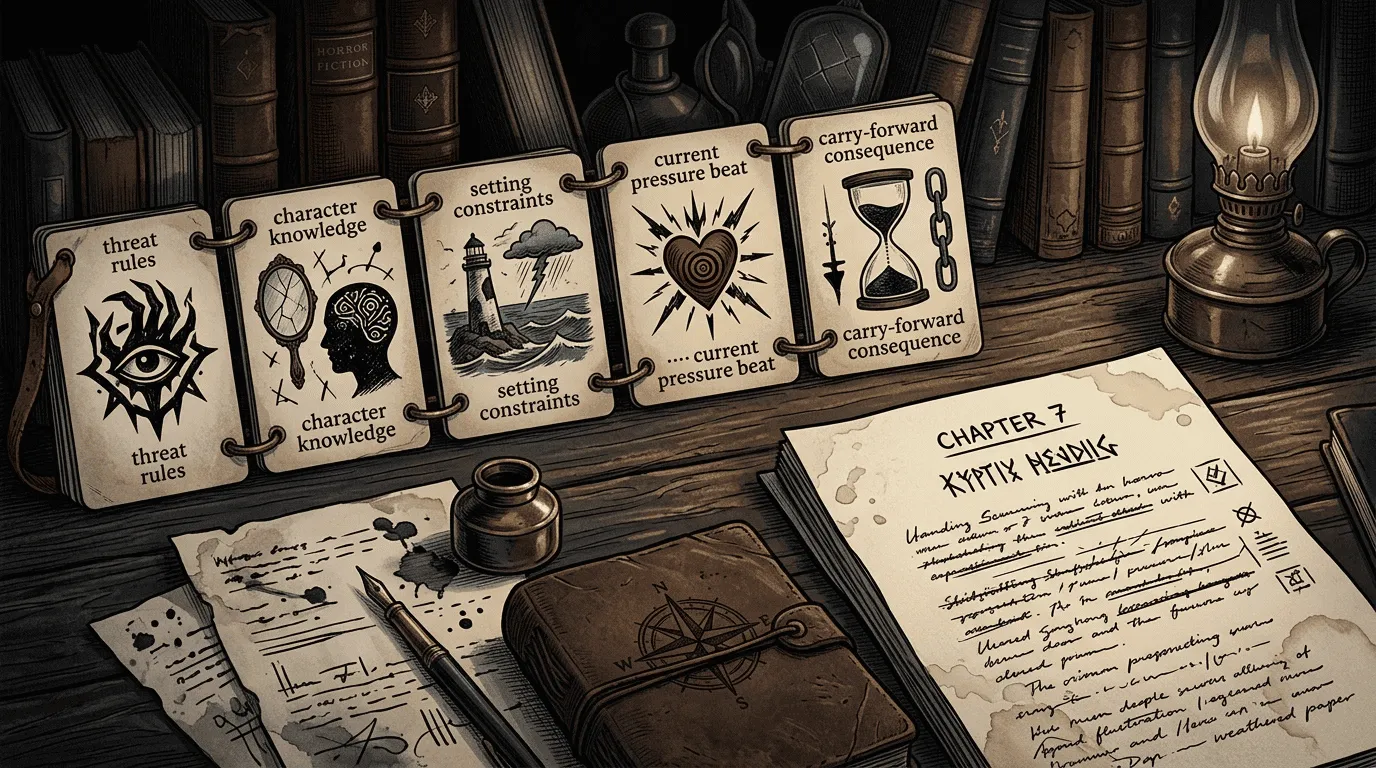
Keep a short horror note beside the chapter you are writing:
- the current fear and what it threatens;
- the known threat rules and limits, plus what the reader and protagonist each know;
- the protagonist’s goal, vulnerability, reason to stay, and setting constraints;
- the current pressure beat, its carried-forward consequence, and the next irreversible choice;
- content limits the draft should not cross casually.
For a broader look at the mechanics beneath the curve, see SeaBell’s guide to writing tension in fiction. When you are ready to turn one current horror decision into a draftable scene, SeaBell’s scene card template is a practical next step for shaping that decision into a scene plan.
For writers using SeaBell alongside AI-assisted drafting, put the current fear, rule, constrained choice, and consequence at the top of the scene card before you draft. That keeps the next scene tied to a specific problem and a cost that carries forward. This extra note is most useful in a long draft with changing character states and reveal limits; a short experiment may not need it.
❓ FAQs about writing horror fiction
Is horror difficult to write?
Horror can be demanding because a novel has to sustain dread after the first scare. The hard part is not inventing frightening events; it is making each one alter a choice, relationship, or understanding while allowing the intensity to rise and fall.
How do you write horror without relying on gore?
Use anticipation, close POV, sensory detail, and a personal consequence to carry the scene even when the harm stays off-page. The test is what changes afterward: if nothing changes, gore would only be decoration.
Does a horror novel need a monster?
No. The threat may come from a person, a setting, a social system, the body, memory, or grief. Whatever the source, it must press the protagonist into choices that reveal a cost; vague unease alone rarely carries a novel.
Should you explain the monster in a horror novel?
Explain only enough to make the protagonist’s choices intelligible. Explain a rule when knowing it makes the next choice worse; leave the rest of the threat’s history a mystery if it adds no pressure.
How should you start a horror novel?
Start with a normal routine, relationship, or place that the protagonist relies on, then break one expectation. The first disturbance should create a question or constraint the character cannot simply set aside.
How long should a horror novel be?
There is no universal length for a horror novel. Story scope, subgenre, publishing route, audience, and the state of the draft all matter. Check current market or submission guidance when length affects a publishing decision, but do not stretch or compress a story merely to hit an unverified range.
Is horror the same as thriller?
Thriller tension usually centers on outmaneuvering danger; horror asks what the danger changes even after apparent success. A hybrid can do both, but decide which question governs the chapter.
Can AI help write a horror novel?
AI can suggest scene variations or help compare a passage against an established story rule. Keep the character’s current knowledge and the cost of acting in view, then treat any generated passage that breaks those limits as material to revise.
🌘 End with the consequence, not the scare
Readers remember horror when the threat leaves consequences beyond the immediate scene or final confrontation. It changes what the character can trust and what they must give up to act.
Imagine the archivist gets everyone out of the shelter but cannot remember the private joke she and her sister shared at the old pier. Her sister remembers it, and the silence between them becomes part of the aftermath. The immediate danger may be over; the cost is not. Give the ending a concrete irreversible change in the character’s body, relationship, belief, or sense of reality. That is what lets a frightening premise outlast its final scare.
Related Posts
Writing Tension in Fiction: Lessons from The Bear | SeaBell
Learn how to build writing tension through opposing goals, stakes, time pressure, subtext, and unresolved relationships, using The Bear as a practical fiction-writing example.
Scene Card Template for Novel Writers | SeaBell
Copy a scene card template for fiction writing, see a filled example, and turn your scene plan into a focused AI drafting brief