

How to Write a Fight Scene Readers Can Actually Follow | SeaBell
When a fight is vivid in your head but turns into a move list or a blur on the page, the problem is usually not a shortage of action verbs. In prose fiction, a readable fight shows what changes from one decision to the next: position, access, injury, information, or resolve. Once you know what changes, you can decide which movements deserve space and what the next scene must remember. This guide is for prose fiction, including novels, serial fiction, and fanfiction.
🎯 Decide what the fight must change
Before writing movement, give the scene a job. “Win the fight” is usually too vague to guide a paragraph. A courier may need to reach an exit with evidence, a witness may need to delay an attacker, or a frightened character may need to keep someone from discovering what is behind a locked door. Give the opponent an immediate objective too: stop the courier, protect the door, or buy time for reinforcements.
Write down what failure costs and what event ends the immediate conflict. Escape, surrender, interruption, or a character choosing to stop can all end a scene. Reaching a protected person or losing an object may be an important outcome, but neither automatically ends the conflict. Then name what must be different afterward: an injury, a relationship, access to a place, a piece of information, a character’s authority, or the character’s next objective.
Remove the fight from the chapter outline and ask what would be different without it. If nothing changes, the scene may not yet have a story job. A minor obstacle does not need the length or intensity of a climax. Give page space to the decisions that matter, not simply to how many movements the paragraph contains.
🧭 Establish the space the POV character can actually use
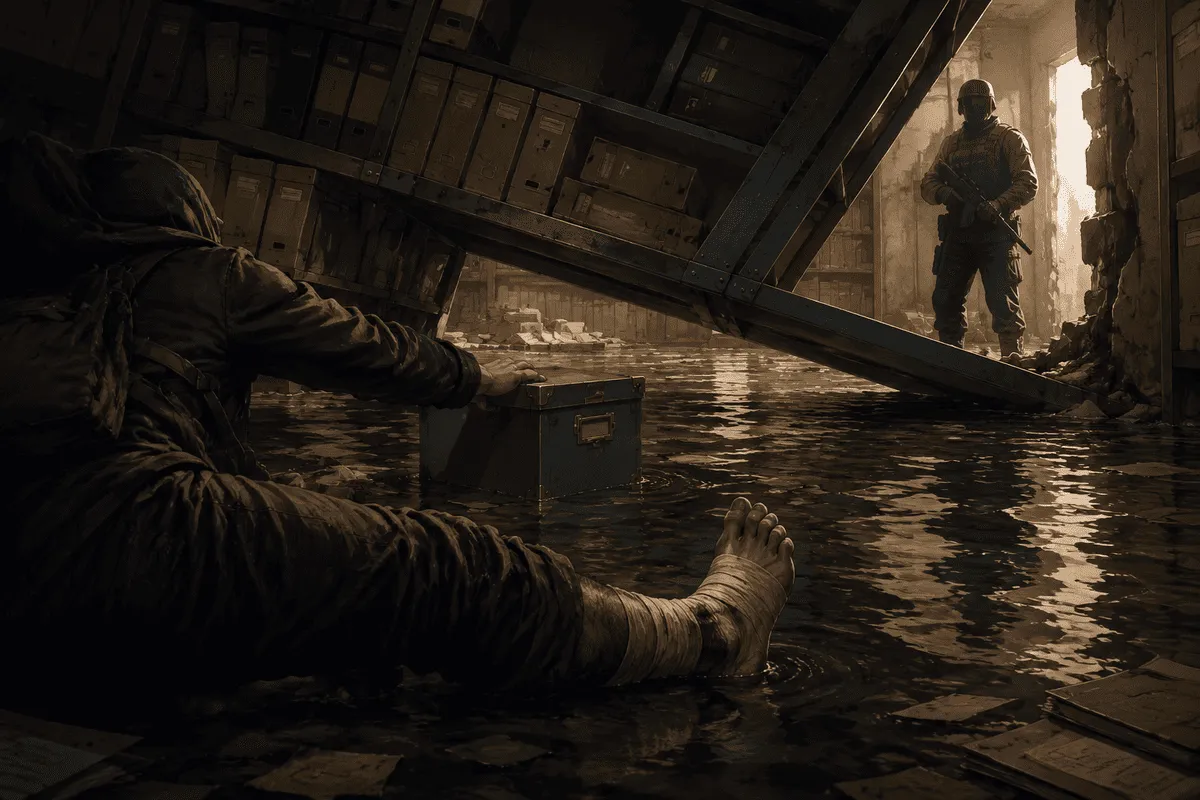
The reader does not need a complete floor plan. They need the few spatial facts that can alter the next decision: the exit, an obstacle, a change in elevation, a narrow passage, an unstable surface, a useful object, or a boundary the character cannot safely cross. Put important objects on the page before they become solutions. A shelf introduced only when someone needs cover feels less like part of the setting and more like an authorial rescue.
Track relationships rather than measurements. “Between Tessa and the west door,” “above the stairwell,” and “out of Ren’s sight behind the shelves” tell the reader what matters now. If you do not picture scenes spatially, write a short blocking note before drafting: “Tessa is on the near side of the fallen shelf. The west door is beyond its far end. One guard controls the open aisle. Floodwater makes that aisle unstable.” After a decisive action, update only the relationships and constraints it affects. The note is only a staging aid; the prose should reveal those relationships through what the POV character notices.
Keep the information within what the POV character can notice. Someone in close POV may lose track of a guard behind smoke or hear a second struggle without knowing who is winning. That uncertainty can create pressure. The problem is accidental disorientation: when the writer forgets where a person is, the reader cannot follow the action either.
🔄 Write each exchange as a change in state
For each meaningful exchange, trace the chain only as far as the next decision. Each beat updates the state; after the scene, record which changes must carry into the next one.
- Objective and opposition: What does the POV character need right now, and what does the opponent need to protect, prevent, seize, or delay in this exchange?
- Spatial state: Where is the character in relation to the objective, the opponent, and the usable routes? What blocks, exposes, or separates them?
- Action: What happens that the character can perceive?
- POV perception and reaction: What does the character notice, and how do they respond?
- State change: What can the character now do or no longer do? What access, information, or resolve has changed?
- New decision: What choice follows from that change?
Each exchange should lead to the next choice. The beat questions describe state within the scene; the aftermath asks what survives beyond it. If the reader cannot say what changed after a beat, cut it or give it a consequence. Deliberate confusion can make a character react before the reader understands the trigger, but most of the time the trigger should appear first. The reader should be able to answer, “Why this choice now?” without reconstructing missing steps.
Track capability rather than hit counts. An injured ankle matters when it makes a sharp turn, a sprint, or a route across unstable ground impossible or costly. A lost weapon matters when it changes the range at which the character can fight or forces another approach. A revealed spell matters when it makes secrecy impossible or changes who can be trusted. A reversal should be traceable to a cause the reader can eventually see or reasonably infer: an environmental shift, a sacrifice, new information, a revealed ability, a changed objective, or a consequential choice. If advantage simply alternates, the fight starts to feel like an arbitrary back-and-forth rather than a sequence of reversals caused by new information or changing conditions.
⏱️ Control pace without writing every move
Slow down for a decision, an irreversible change, emotional recognition, or a moment when the character understands what the fight now costs. Compress repeated exchanges that leave the state unchanged. Several similar attempts can become one sentence; the attempt that collapses the only barrier deserves an extra sentence or two to show what the broken barrier makes possible.
At an emotional turn, keep the interior response brief but causal. Show the recognition that changes what the character tries next: an accusation might make them protect an ally instead of taking the nearest exit, or fear might make them abandon a route they would otherwise risk.
For example, “He kept trying the latch while she held him back” may be enough if none of those attempts changes the situation. If one attempt breaks the latch and exposes the room behind it, expand that turn. Show the broken latch and its consequence in full, and fold the unchanged attempts into one sentence.
Fast-paced prose can use short sentences to narrow attention or land a hit, while a longer sentence can follow a rush of perception or a conflicted chain of thought. Let sentence rhythm follow what the POV character is processing instead of using short sentences as a substitute for causality.
🛡️ Handle group fights, magic, and resources without losing the reader
A group fight becomes readable when the POV character has a clear immediate problem to track. Track the relationships that affect that problem, not every participant’s complete sequence. Let activity outside that focus appear through a shout, a partial glimpse, a silhouette blocking a doorway, a sudden shove, or the sudden disappearance of an ally from the character’s usable space.
For example, Mara may be trying to keep the stairwell open, not win the whole room. When the ally holding the landing disappears behind the crowd, do not pause to narrate that ally’s whole duel. Show Mara losing the support that made the stairs usable, so the route she planned to take is no longer safe.
For magic or another speculative ability, establish the limitation that matters for the next choice. A spell might require a clear line of sight, expose the caster, or close one route while opening another; that immediate constraint is more useful in an exchange than a full explanation of the system. Weapons, ammunition, fatigue, and injuries belong on the page when they alter capability, not because a scene needs a technical inventory.
A close, limited POV also needs a clear knowledge boundary. The character can infer that a fight is spreading through the building from distant impacts and shouting, but cannot report the whole battle with reliable precision. Preserve the gap between what is happening and what this character can know.
This guide addresses prose clarity, not real-world combat or medical accuracy; verify specialized details separately.
📖 See the method in a full prose example
Tessa is a courier carrying a stolen ledger through an archive. Two guards block the west door. A fallen shelf divides the room, and floodwater has made one aisle unstable. Tessa’s ankle is already injured. She has one smoke charm left, but using it will expose illegal magic. Her ally has promised to get her to a safe house only if she keeps the charm concealed; the charm’s blue flare could leave a trace from the archive that the watch might follow to the safe house. He is waiting outside the west door.
Weak version
Tessa ran toward the archive exit with the ledger under her coat. The two guards saw her and rushed forward. She ducked under one arm, but the other guard grabbed her sleeve and she twisted away. She kicked at his knee and stumbled because of her injured ankle. The first guard came at her again, so she swung the ledger at him. He blocked it and she moved around the fallen shelf. Water rushed through the aisle and she almost fell. She threw her smoke charm, and smoke filled the room. The guards shouted and Tessa ran through the door. Her ankle hurt badly, but she got away with the ledger. Outside, her ally looked angry that she had used magic.
Diagnosis
| Problem | What disappears from the reader’s view |
|---|---|
| Objective | The exit and ledger establish a broad goal, but the draft never shows which immediate trade-off governs Tessa’s next move: keeping the charm hidden, protecting the ledger, or risking the unstable route. |
| Space | The shelf and water appear as obstacles without a stable relationship to Tessa, the guards, or the door. |
| Causality | The passage gives a line of motions, but few reactions show why one choice follows another. |
| Capability | The ankle hurts, yet Tessa keeps attempting movement that requires the same speed and balance. |
| POV | The smoke solves the escape without showing what Tessa can hear, see, or risk inside it. |
| Consequence | The ally’s anger is asserted at the endpoint, but the exposure does not create an immediate decision, restriction, or stated next-scene cost. |
Revised version
Tessa stood on the near side of a fallen shelf. The west door stood beyond the shelf’s far end, with a flooded aisle running through the gap. One guard stood between Tessa and the gap; the other stood beyond it with the door behind him. A strap held the ledger flat against Tessa’s ribs beneath her coat. A waterlogged archive box, heavy with swollen papers, rested against a shelf support already split from the frame. Her ankle was swollen; she could manage a straight run, but a sharp turn might make her fall. Her ally had promised to get her to a safe house on the condition that she kept the smoke charm concealed, and he was waiting outside the west door.
The nearer guard blocked the gap. The second guard stood on the door side, covering the same opening. Tessa backed away. She could risk the water or draw both guards toward the unstable shelf.
She shoved the box into the split support. It struck the broken joint, and the shelf lurched with a loud groan. The nearer guard rushed to the shelf’s unstable end to steady it; the other backed toward the door to get clear of the shelf. For one breath, neither guard held the gap. Tessa limped toward it. The nearer guard broke away first and caught the back of her coat. Tessa slipped both shoulders free; the ledger stayed strapped against her torso. When the guard yanked, he was left holding the coat. By the time she cleared him, the second guard had run back from the door and filled the gap again. The straight route was gone.
The water was calf-deep: she could wade through it, but not before the guard at the gap could catch her, and a slip would trap her against the shelf. Her fingers found the last smoke charm in her pocket. She had promised to keep it hidden, but the lost route left her no safer choice.
She crushed it. A blue flare snapped from the charm, and blue-gray smoke rose from the water to shoulder height, turning the guards into blurred outlines while leaving their voices clear. The nearer guard shouted behind her, still on the near side of the shelf. The second guard’s voice came from the door side, across the gap ahead. Tessa crouched into the densest part of the smoke and followed the door’s cold draft along the shelf’s edge. Boots scraped toward her. The second guard lunged across the opening. His boot skidded on the water-slick floor, and he slid back toward the west door, away from the shelf. His hand swept above her shoulder, but the slip left a body-width opening between him and the shelf. Tessa’s injured ankle buckled; she dropped to her knees and crawled along the shelf’s edge through it. The ledger dug into her ribs as she passed, but she pushed through the west door.
Her ally caught her under the arms. His eyes flicked to the blue sparks fading around her hand, then to the ledger. “You used it.”
Tessa tried to stand and failed. Behind them, the guards shouted her description. She had the ledger, but her ankle was worse and blue sparks were still fading around her hand. Her ally could leave her at the door for the watch to find, or take her to the safe house. Taking her in would mean breaking the condition he had set, and the blue trace could lead the watch to the safe house and expose everyone already inside. Leaving her would abandon an injured ally for the watch to find.
He did neither. He pulled her away from the safe-house route and covered the fading sparks with his coat. “Not there,” he said. Getting her to safety would now mean finding a different shelter.
Edit notes
- Compressed: The weak draft’s duck, kick, swing, and repeated approach are reduced to the box, the coat, and the crawl. The removed motions do not change Tessa’s options.
- Expanded: The ankle is a functional limit: Tessa can make a straight run on dry ground, but a sharp turn and the flooded crossing are costly.
- Rebuilt: The shelf, gap, guards, and water have fixed relationships before Tessa uses them. The heavy box transfers force to an already split support, briefly opening the gap, and the coat distraction gets her past one guard. The smoke obscures the second guard as he lunges. The water makes him slip toward the door, leaving a body-width opening.
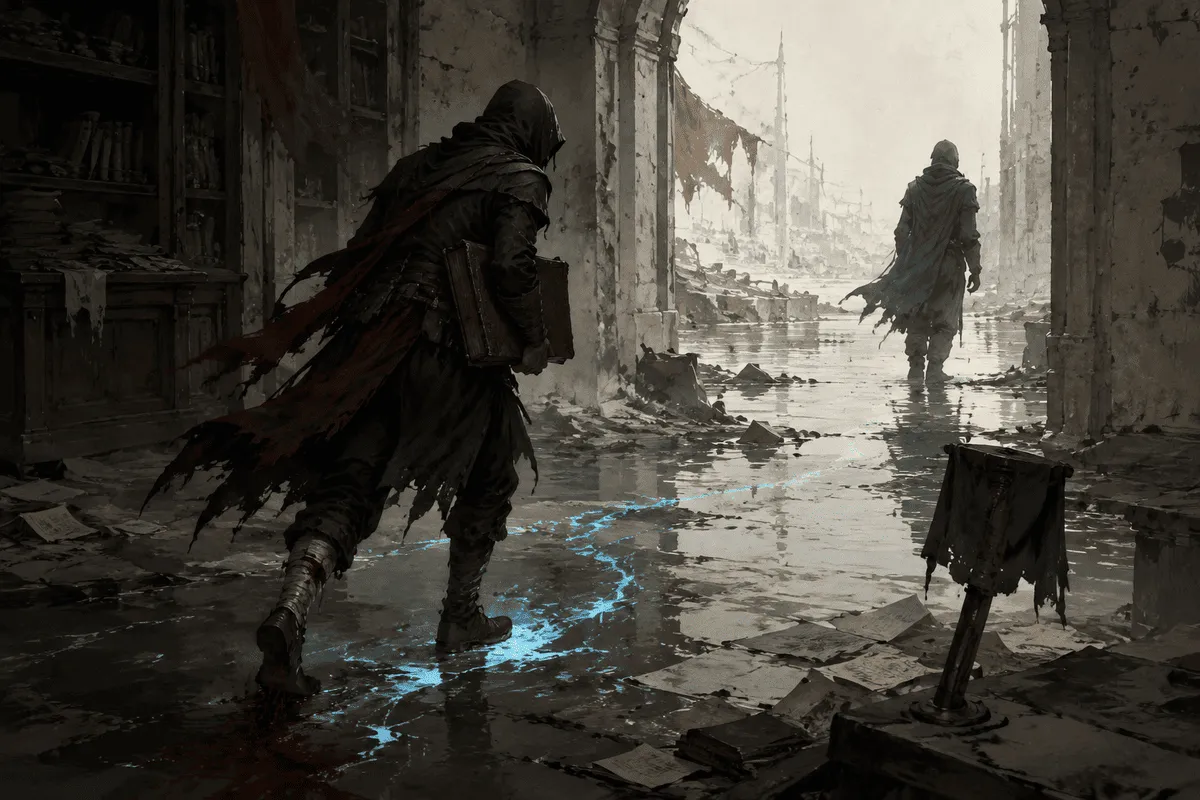
- Carried forward: Tessa’s choice to use the charm gets her through the door but leaves a trace the watch could follow to the safe house, worsens her ankle, violates the condition for taking her to the safe house, and forces her ally to find another shelter.
🧰 Revise the fight in focused passes
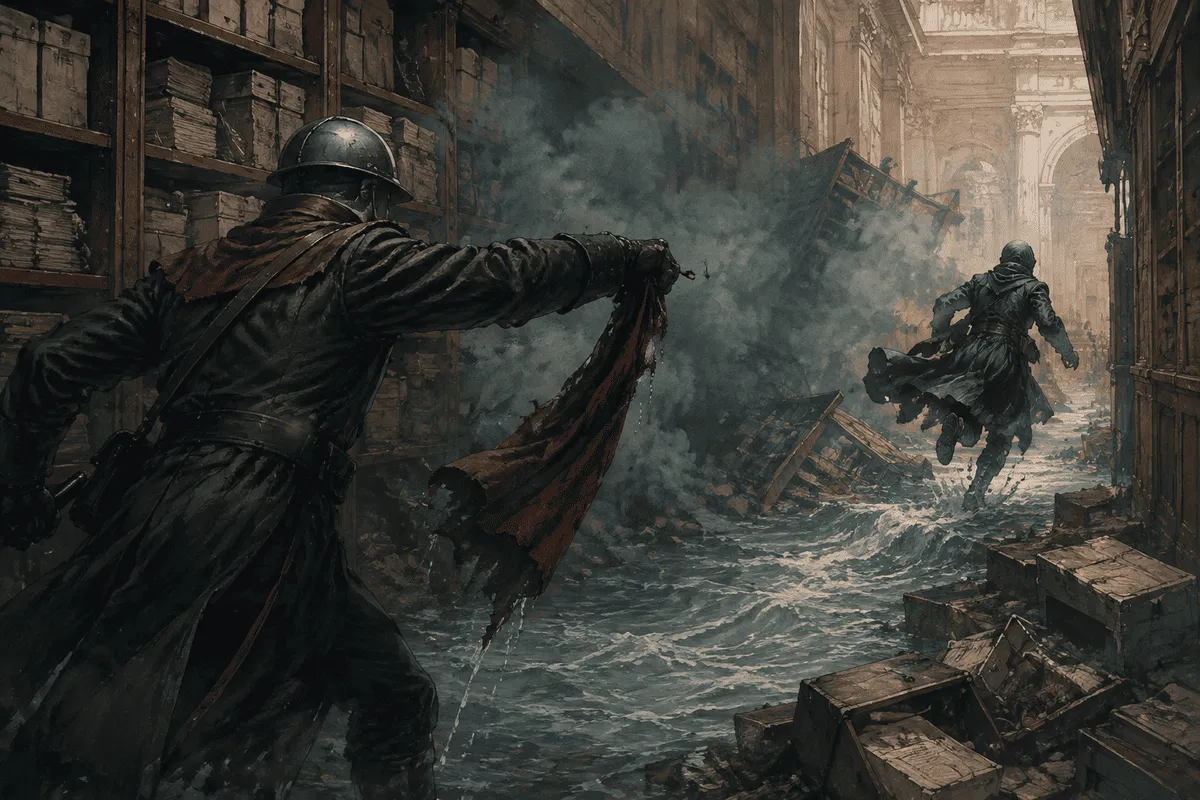
Once the scene has a job, use three focused passes: story change, physical cause and effect, and the amount of information the reader has to track.
- Story change: What does each side need from the exchange, what ends the fight, and what is different afterward?
- Space and cause: Can the reader place the characters, routes, and useful objects before each action? Does the trigger arrive before the perception, reaction, and result? Mark any relocation or reaction the prose has not earned.
- State and prose: After each exchange, ask what has changed in the character’s condition, access, relationships, or resolve, and what new information they now have. Which objects can they still use? Then compress repeated movement and expand the decisions that deserve attention. Ask whether the next choice fits both the available options and this particular character.
On a final continuity read, note what must carry forward: physical condition, objects, information, relationships, obligations, and mistaken beliefs.
🤖 Use AI to draft from constraints, then audit the result
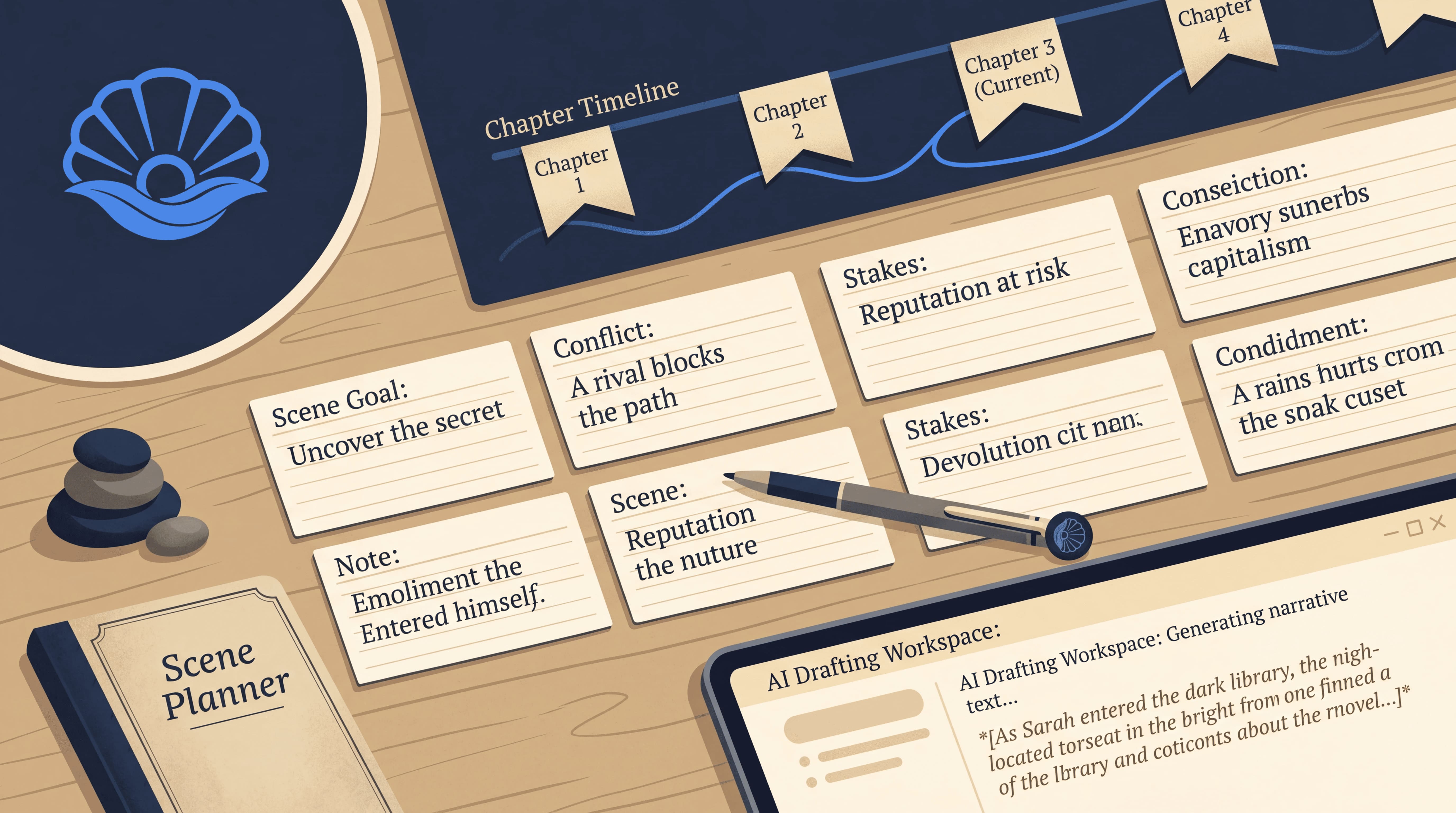
When you use an AI assistant, give it the scene’s limits rather than asking for a “great fight.” Include the POV’s knowledge limit, each participant’s immediate objective, starting positions, usable routes and objects, active constraints, the turning point, the ending condition, and what must carry forward: the immediate consequence, any delayed consequence, and the state the next scene must acknowledge.
A fluent draft can preserve the nouns while losing the logic. Read it against the scene brief, and make sure it has not invented a weapon, ability, or fact the scene never established. Then check whether the ending leaves the next scene with every required change in physical condition, available objects, access, information, relationships, resolve, beliefs, or obligations. When something does not fit, revise the specific beat instead of asking for a more dramatic rewrite.
🌊 Carry the aftermath into the next chapter
Decide what the next chapter must acknowledge immediately and what can surface later. At least one immediate consequence should alter a choice, a conversation, or the route forward; other consequences can surface later.
Turn those consequences into a chapter brief. In SeaBell, you can keep that brief with the chapter materials while you revise, making the objective, injury state, relationships, and established rules easy to check. Research any real-world combat, weapon, or injury details separately.
✅ Final fight-scene checklist
- Does the POV character have an immediate objective, and does the opponent have one that explains their response?
- Can the reader place usable routes, obstacles, and important objects before each turning action?
- After each major action, can the reader follow the trigger, the POV character’s perception, reaction, and next decision?
- Does every reversal have a cause in changed conditions, information, sacrifice, ability, or choice?
- Have repeated exchanges been compressed while irreversible, emotional, or strategic turns have been given room?
- Is any important relocation unexplained, or does an injury, lost object, limited resource, or consequence stop mattering without a reason?
- Does the next scene acknowledge a consequence the fight created?
❓ Frequently asked questions
How long should a written fight scene be?
A written fight scene should be long enough to show its meaningful turns, not long enough to meet a universal word count. A minor obstacle may need a paragraph; a climax may need several beats. Let story importance, the POV character’s experience, the number of decisions, and genre expectations set the length.
Should you describe every move in a fight scene?
No. Describe a movement fully when it changes position, capability, information, objective, or outcome. Compress repeated movement into a phrase or sentence the reader can infer.
How do you make a fight scene feel fast-paced?
Find repeated exchanges that leave the state unchanged and compress them; keep each meaningful decision close to its result. When every sentence is short, the rhythm turns choppy. When the draft skips the character’s reaction, each hit starts to feel the same.
How do you write a fight scene with multiple characters?
Choose the POV character’s immediate problem first. Name another participant when their position or action changes that problem, and let activity outside direct focus register through sound, partial glimpses, a shove, a floor vibration, or the crowd closing around the character.
Can a novel begin with a fight scene?
Yes, if the fight introduces a character problem, danger, world rule, or concrete objective the reader can care about. Spectacle without orientation or consequence is less likely to make readers care, but an opening fight is not automatically a mistake.
Can AI help write a fight scene?
Yes, for a first pass or alternative beats, provided you supply positions, abilities, limits, objectives, POV, and aftermath. Treat the output as draft material and check continuity and real-world technical details before relying on it.
Related Posts
Scene Card Template for Novel Writers | SeaBell
Copy a scene card template for fiction writing, see a filled example, and turn your scene plan into a focused AI drafting brief
Writing Tension in Fiction: Lessons from The Bear | SeaBell
Learn how to build writing tension through opposing goals, stakes, time pressure, subtext, and unresolved relationships, using The Bear as a practical fiction-writing example.