

GPT-5.6 Sol vs Claude Fable 5 for Creative Writing | SeaBell
GPT-5.6 Sol vs Claude Fable 5 for Creative Writing: 6 Fiction Tests
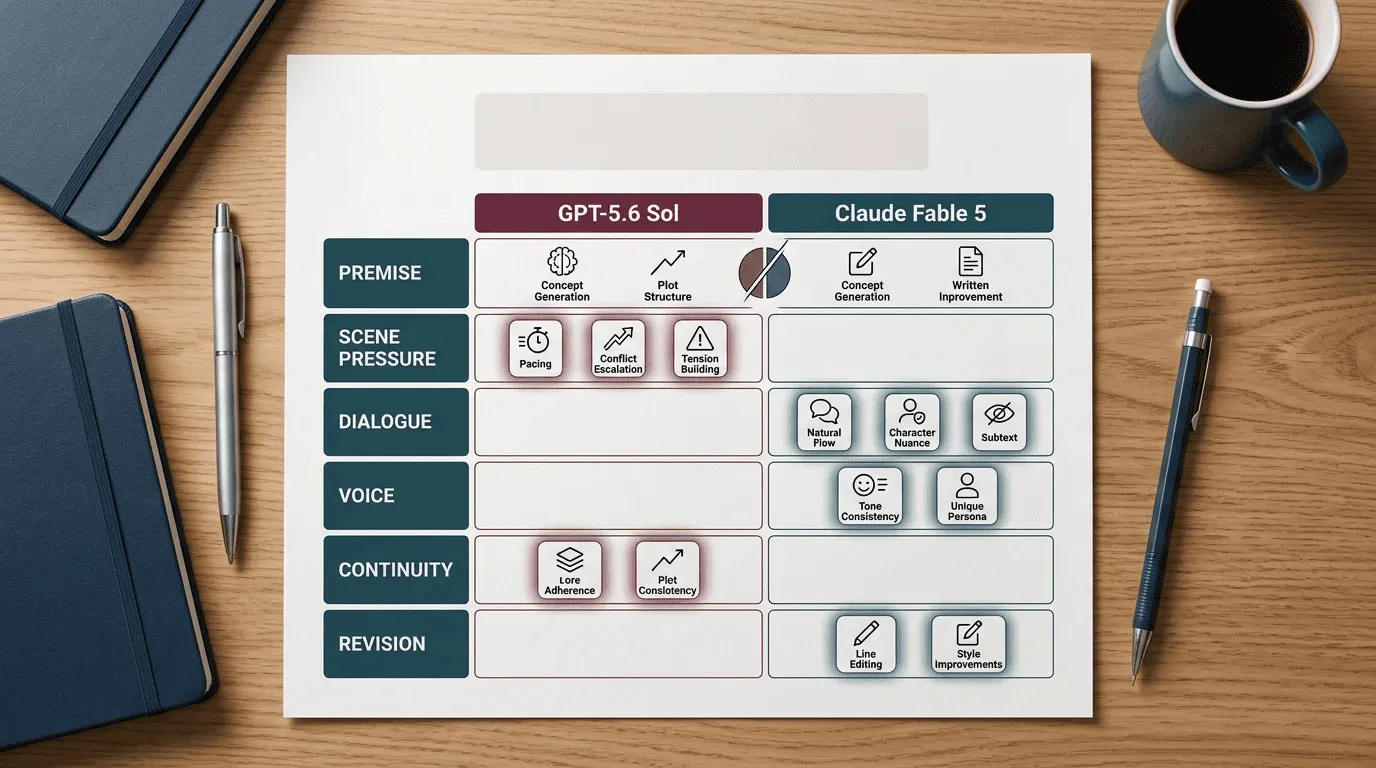
Standard AI leaderboards rarely answer the question fiction writers actually care about. A model can solve hard reasoning problems and still flatten a romance scene, lose a character’s voice, or forget the rule that makes a fantasy world work. We skipped launch-demo impressions and ran GPT-5.6 Sol and Claude Fable 5 through six identical fiction tasks.
For a working writer, the real cost appears after the first response: a scene that needs 300 words cut, a romance beat that explains its subtext, a voice that drifts under pressure, or a continuity mistake that forces you to repair the chapter before you can keep drafting. We wanted to find the best AI model for creative writing by looking at that cleanup load, not by repeating launch claims. Each model had to generate premises, write a pressured scene, handle dialogue subtext, maintain a first-person voice, preserve a continuity-heavy story bible, and revise a flawed passage without adding melodrama.
The results split cleanly by task. Claude Fable 5 was more controlled with length, dialogue subtext, character voice, and restrained revision. GPT-5.6 Sol was stronger when the task required causal escalation, irreversible consequence, exact world-rule use, and several story or relationship states changing at once. If you write fiction with AI, the useful answer is not “one model wins.” It is knowing which failure you are trying to avoid.
⚖️ Quick verdict: GPT-5.6 Sol or Claude Fable 5?
If you want the shortest practical answer, start here: Claude Fable 5 was the safer first choice for controlled prose tasks, while GPT-5.6 Sol was better when the prompt depended on complex story mechanics.
These are task-specific starting points from six first-output tests, not permanent rankings of every creative-writing model or every possible writing workflow.
| If the writer needs... | Better first choice from this test | Why |
|---|---|---|
| Controlled premise options | Claude Fable 5 | It stayed inside the requested word ranges more reliably. |
| More ambitious premise mechanics | GPT-5.6 Sol | Its story engines had sharper reversals and larger long-form stakes. |
| Scene escalation and irreversible consequence | GPT-5.6 Sol | It turned setup into action that changed the political and relationship situation. |
| Dialogue subtext and restraint | Claude Fable 5 | It trusted silence instead of explaining the emotional conflict. |
| Stable first-person voice | Claude Fable 5 | It held the narrator’s attention pattern and sentence discipline more cleanly. |
| World-rule and story-state continuity | GPT-5.6 Sol | It used the fixed rules to solve the scene instead of drifting around them. |
| Constraint-heavy revision | Claude Fable 5 | It preserved the quiet ending and stayed within the target range. |
We are not publishing a combined numerical winner because the failures carry different costs. A small length miss is not equivalent to the age contradiction or broken promise logic that could damage an entire chapter in Test 5.
🧪 How we tested the two models

We ran the tests on July 11, 2026. GPT-5.6 Sol ran in Codex with High reasoning. Claude Fable 5 ran in CC with Extra reasoning. The user confirmed that these were equivalent reasoning tiers, each one step below the model’s highest available setting. Neither model received the maximum setting.
Both models received the same complete user prompts. Each test started from an isolated context: six standalone GPT-5.6 Sol tests and six fresh Claude Fable 5 conversations. We kept the first complete output only. There were no regenerations, continuations, manual edits, web browsing, file access, or external research during generation.
We set the evaluation criteria before scoring: instruction fidelity, specificity, causal movement, and human cleanup load, plus test-specific criteria such as voice stability, subtext, rule compliance, and revision restraint. Model identities were known during editorial evaluation, so this should be read as transparent editorial testing, not blind scoring.
Codex and CC have different system instructions and product environments. This is a same-user-prompt comparison in real writing interfaces, not a controlled raw-API benchmark.
The prompts tested:
| Test | What the prompt checked | Main pressure point |
|---|---|---|
| Premise generation | Three novel premises from one seed | Differentiation, story engine, midpoint reversal, final cost |
| Scene pressure and prose | A fantasy ward scene | Close third, attraction through behavior, irreversible ending |
| Dialogue and subtext | A contemporary romance cinema scene | Distinct rhythms, practical interruptions, final lie |
| Voice consistency | Two excerpts from the same narrator | Stable voice under different pressure |
| Story-state and continuity | A chapter scene from a rules-heavy story bible | Fixed facts, world rules, relationship changes |
| Revision control | Rewrite a flawed passage | Preserve facts, improve scene texture, avoid expansion |
We also separated prose taste from hard constraints. A model could write beautiful sentences and still fail the task by exceeding length, stopping before the required consequence, or contradicting a fixed fact.
🗺️ Test 1 - Premise generation
The premise test asked each model to develop three substantially different novel ideas from the same seed: a disgraced cartographer discovers that streets erased from official maps still exist at night, and someone is using them to move people who are supposed to be dead.
GPT-5.6 Sol produced the more ambitious story engines. Its political fantasy version turned erased streets into an underground electorate. Its romantic fantasy made the night city part of the love story’s cost. Its serialized mystery had the strongest hook: people were not resurrected, but “living witnesses whose deaths have been registered in advance.” That idea gives a web-novel mystery a clean engine: each case can reveal a predicted death while building toward the registry behind them.
Claude Fable 5 was more disciplined. Its three versions stayed within the requested 180–230 words, while Sol delivered 242, 258, and 253 words. Fable’s premises were clear, labeled, and easy to scan. The tradeoff is that some of its concepts felt closer to familiar scaffolding. Version B, for example, introduced both Mira and Wren before the romantic axis was fully clear, so an editor would need to decide whose desire drives the premise and how the other character changes the central cost.
The verdict is split: Fable created controlled options with less trimming, while Sol produced stronger raw material for bigger reversals and longer serial fuel.
🔥 Test 2 - Scene pressure and prose
This test asked for a 700–850 word fantasy scene in close third person. Mara, a disgraced healer under a false name, has to treat a feverish prisoner while Captain Iven presses her for answers. The scene had to begin with a medically specific detail, keep attraction indirect, and end with Mara making an irreversible choice that worsens both the political problem and the relationship.
Both models wrote atmospheric scenes, and both exceeded the requested length. The difference was where each one stopped.
Claude Fable 5 built a quiet, tense ward scene around asymmetrical symptoms, Iven’s controlled pressure, and Mara’s hidden connection to the old dosing charts. The writing had restraint. Iven offering his private cup was a good example of practical care that could read as either kindness or control. But the ending stopped at Mara uncorking a counter-agent. That is a decision point, not yet an irreversible action. The prompt asked for the choice to worsen the political problem and the relationship; Fable left the consequence mostly implied.
GPT-5.6 Sol pushed farther. Mara identifies the official cure as the source of the red fever, smashes the heartroot, steals Iven’s command seal, triggers the emergency lever, and publicly uses her condemned real name to order the closure of every dispensary. That ending changes the city’s situation and the relationship with Iven at the same time. It is not just a mood beat; it is a story event.
Sol still needed editing. At 978 words, it overshot the range and would require a meaningful cut. The prose was more forceful than tidy: useful when a stalled scene needs consequence, less useful if the writer’s main problem is sentence-level restraint. But for scene pressure, causal movement, and irreversible consequence, GPT-5.6 Sol won this test.
A practical takeaway: Sol may be more willing to make the dangerous thing happen, but you may pay for that with trimming. A scene card template can make the required consequence explicit before either model drafts the scene.
💬 Test 3 - Dialogue and subtext
The dialogue test was built around a failing neighborhood cinema. Naomi wants Eli to sign a sale contract. Eli wants to stop the sale without admitting that he returned because he regrets leaving. Neither character could mention the breakup, regret, love, or secret mortgage payments directly. The scene had to run mostly on dialogue, practical interruptions, and a final small lie.
Claude Fable 5 understood the restraint better. Its scene keeps the repair task active: screwdriver, bracket, ladder, sandpaper, contract, pen. The dialogue does not try to win every line. Naomi and Eli leave things unsaid, and the final lie lands cleanly:
“I forgot,” he said. “I left my reading glasses in the car.”
Naomi’s answer — “You don’t wear reading glasses” — lets the reader recognize the lie without turning it into explanation. That is exactly the kind of subtext a romance scene needs.
GPT-5.6 Sol wrote livelier banter and a stronger sense of the cinema as a place. The marquee spelling sequence, the contract under the letter crate, and the closing “I wasn’t testing you” all had charm. But the scene ran 866 words against a 600–750 word target, and the characters sometimes sounded too equally quick. When both people can answer every emotional pressure point with a polished joke, Naomi’s guarded practicality and Eli’s evasive regret start to share the same tempo.
For dialogue and subtext, Claude Fable 5 was better. It gave the editor less to cut and trusted silence more often. Sol’s version was useful, but it would need a firmer line edit to reduce quip density and make each character’s avoidance pattern more distinct.
🎙️ Test 4 - Character voice consistency
The voice test gave both models a narrator named Sable Venn: a 42-year-old smuggler who notices prices, exits, damaged objects, and hands before faces. She does not name fear directly. Her humor is dry and brief. Under pressure, she becomes more precise rather than more dramatic.
Claude Fable 5 held Sable’s voice card more cleanly.
Fable’s first excerpt begins with prices and hand attention: coffee for five crowns, stale rolls for three, short nails, no nicotine, a pale ring band. Its second excerpt keeps the same attention pattern under pressure: window latch, rust ring, short-legged chair, inward-opening door, fire stair, hallway footsteps. The pressure rises without turning Sable into a generic action hero. The line “Do not rush metal. It keeps records” is dry, concrete, and character-specific.
Sol also had strong moments. “The ferry terminal sold coffee for six crowns and privacy for nothing” is a good opening. The damaged clasp, exit counting, and attention to hands all fit the voice card. The issue was control. Sol delivered 423 and 417 words, both above the requested range, while Fable delivered 391 and 399. Sol also introduced a slight world-texture mismatch by referencing Tangier in a crowns-based setting. That is not a fatal error, but in a series draft those small imports can accumulate into cleanup work: is this a recognizable real-world city, a secondary-world port, or only a tonal shortcut?
The verdict is Claude Fable 5. It stayed inside the boundaries and kept Sable’s attention pattern stable without overperforming the voice. For a voice-first passage, Fable looked safer when the voice card implies not only sentence style but a coherent world texture. Sol can be vivid, but it may need an editor watching for stray real-world detail.
🧩 Test 5 - Story-state and continuity
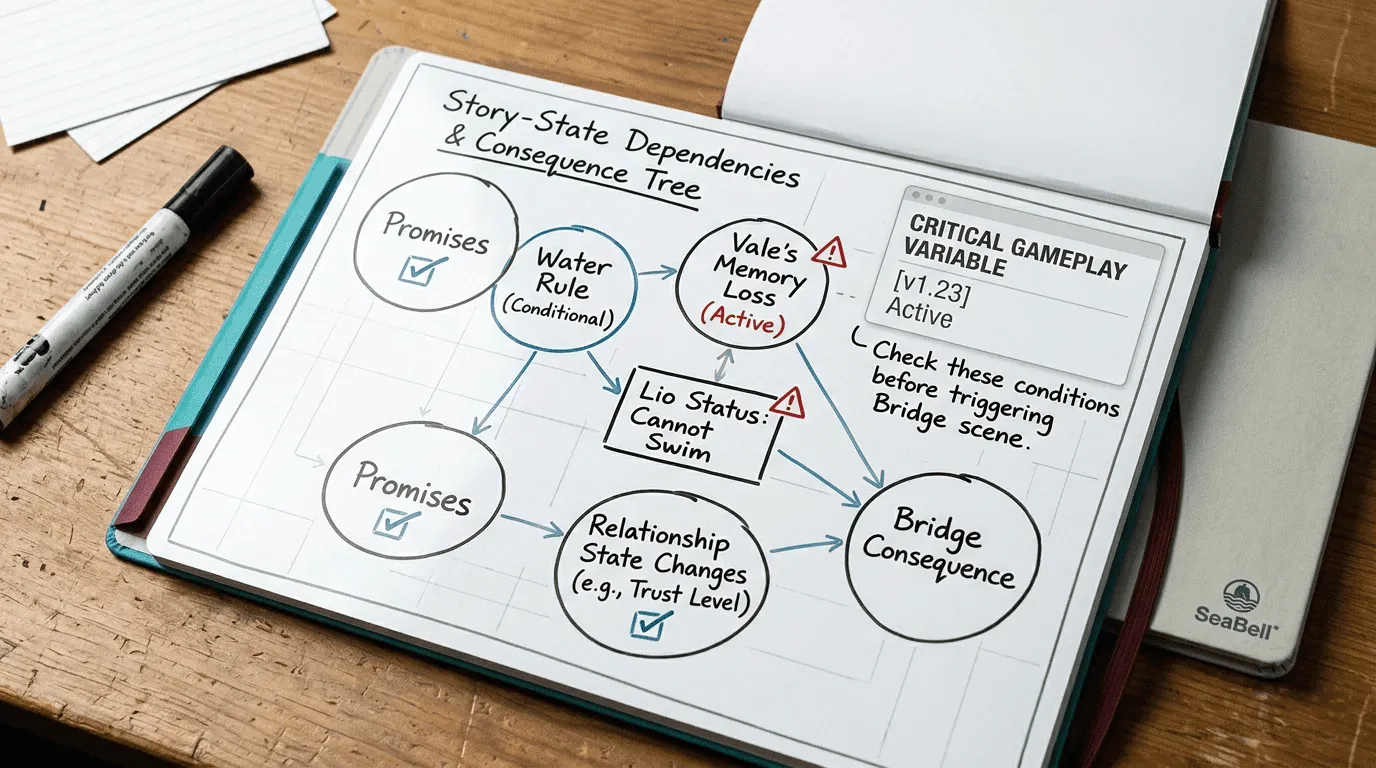
For long-form fiction, this was the highest-stakes test because every chapter must carry fixed facts forward. The prompt provided a story bible for Orra, a canal city where spoken promises become physically binding if heard by river water. It included five fixed world rules, three characters, current relationship states, and open plot threads. The scene had to preserve all of that, solve the immediate problem using the existing rules, change at least two relationship states, and advance the bridge-collapse plot.
GPT-5.6 Sol won by the clearest margin in the six tests.
Sol understood that an impossible promise cannot bind. When Vale wants the dock foreman to promise to name everyone involved, Sena points out that the foreman cannot name people he never saw. That uses the exact rule rather than inventing a loophole. Sol also used Lio’s inability to swim as an active constraint: the closure bell rope is on the canal side, so Sena has to drag it landward with a boat hook instead of sending Lio across the water. Vale does not suddenly remember Sena. Sena’s active promise remains unbroken. The scene changes relationship states and ends with the eastern arch dropping into the canal, closing the procession route and forcing the plot forward.
Claude Fable 5 had a more compact scene, but it broke key continuity. It says Lio was “fifteen” two winters ago, even though the story bible states he is 19. It also handled the oath logic less cleanly. The scene gestures at oath-breaking cost, but it does not solve the situation as precisely through the fixed rules. The ending — “For now” — leans toward delay instead of consequence.
Long fiction is not only prose style. A chapter may need to preserve ages, promises, injuries, relationship secrets, world rules, political stakes, and the next plot turn at once. In this test, Sol handled that load more reliably. Writers building the same fixed context can start with a story bible template for novel writers.
✍️ Test 6 - Revision control
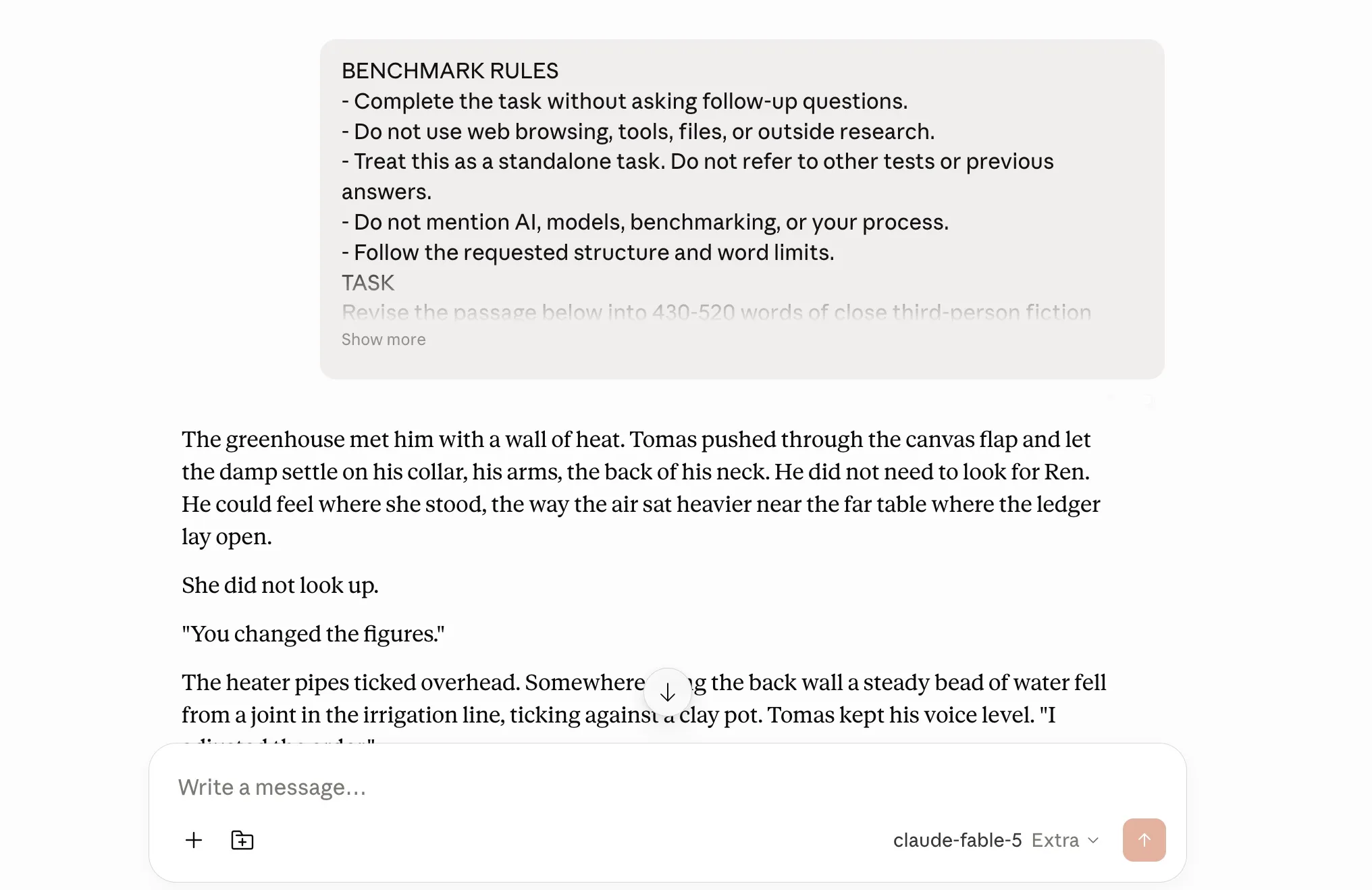
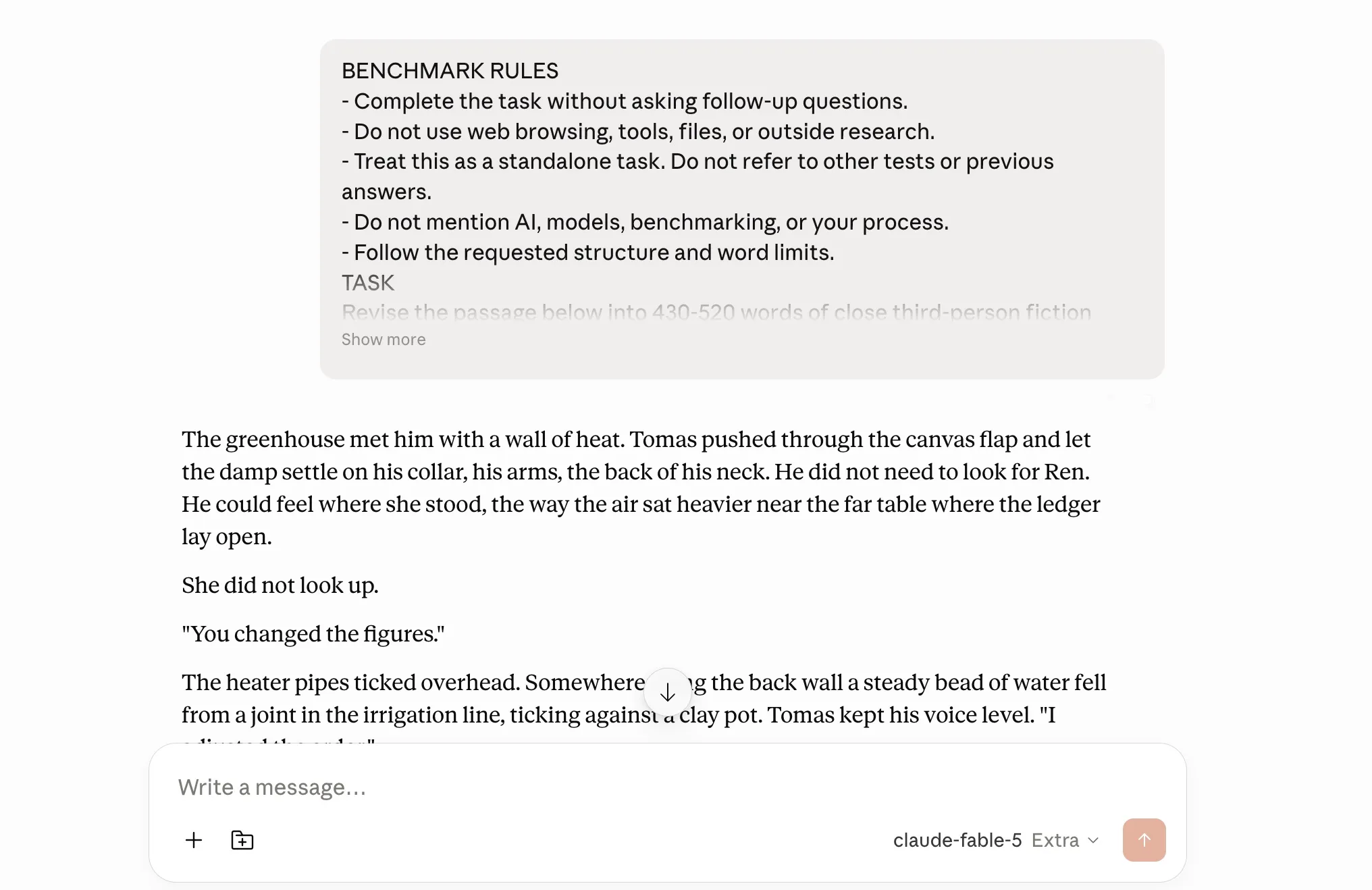
The revision test asked each model to rewrite a summary-heavy greenhouse confrontation into 430–520 words of close third-person fiction. The model had to preserve every plot fact and event order while improving behavior, setting pressure, dialogue voice, and pacing. It also had to avoid adding a new event, romance, violence, supernatural elements, or a new character.
Both models preserved the main facts. Tomas enters the greenhouse, Ren confronts him over changed delivery figures, he explains the northern clinic ran out, she points out he never gave her the chance to respond, inspectors are coming, he offers tea, and she asks for the blue folder. Neither model broke the plot.
Claude Fable 5 was better at revision restraint. It finished at 467 words, within the target range, and kept the ending quiet. The greenhouse became active without becoming overdescribed: heater pipes tick, water falls into a clay pot, feverleaf rows carry the guilt of their shared labor. Ren’s fear appears through her hands, not through a paragraph explaining her psychology.
GPT-5.6 Sol produced a fuller scene with good physical detail, but it reached 545 words and added more emphasis than the source needed. “Her voice was level. That was worse than shouting” is serviceable, but familiar. Sol’s version reads like an improvement pass that still wants to expand. Fable’s reads more like a controlled line edit.
The verdict is Claude Fable 5, narrowly. Sol’s output was not bad; it simply required another constraint pass. For revision, the job is not to make the passage richer at any cost. It is to preserve the source’s weight, event order, and emotional volume while making the scene more alive. A rewrite is not finished if the human editor has to cut the model’s improvement afterward.
🧭 Which is the better AI model for creative writing?
The better AI model for creative writing depends on which failure would cost you more to fix.
Choose Claude Fable 5 first when the task is voice-first, dialogue-heavy, or revision-sensitive. In these tests, Fable was better at stopping near the requested boundary. It handled subtext with more air around the lines, kept Sable’s voice steady, and revised the greenhouse passage without turning restraint into extra drama. If you are drafting a quiet chapter, polishing a character voice, or trying to reduce cleanup load, Fable is the safer starting point.
Choose GPT-5.6 Sol first when the task needs story mechanics to fire together. Sol created stronger premise engines, made the ward scene’s consequence happen, and handled the continuity scene with much better rule use. If you are working from structured notes, a story bible, a dense scene card, or a chapter with several relationship states changing at once, Sol is the model we would test first.
For mixed tasks, start with the risk you least want to repair. If continuity failure would break the chapter, start with Sol and then trim. If over-expansion or flattened subtext would create the heavier cleanup load, start with Fable and then strengthen the story mechanics where needed.
That split also explains why “best AI for fiction writing” and “best AI for novel writing” are not the same question. Fiction prose can be local; novel writing is cumulative. Choosing between models is also narrower than choosing book writing software for fiction writers, which must support the surrounding project as well as the next passage.
One way to apply these task-level findings is to use different models at different stages: Sol to explore a rule-heavy scene or story engine, Fable to tighten dialogue or revision, and a human editor to decide what belongs in the actual manuscript.
📚 A strong model is not the same as a long-form writing workflow
If you want a model-specific process rather than a head-to-head output test, see our Gemini 3.5 Flash creative writing workflow. This benchmark answers a narrower question: what happens when two models receive the same fiction brief.
A benchmark can show how a model handles a clean brief. It cannot tell you where a long manuscript should live once earlier decisions start affecting the next chapter. That is a workflow question, not a model-score question.
SeaBell fits the handoff from planning to drafting as an AI book writer for long-form fiction, keeping the relevant chapter direction and story notes close to the next scene. It does not make continuity automatic or replace revision. The writer still decides which facts belong in the brief and what the draft needs to change. This does not mean GPT-5.6 Sol or Claude Fable 5 is available inside SeaBell; availability would require separate product verification.
❓ FAQ
What is the best AI model for creative writing?
The best AI model for creative writing depends on the task. In our six fiction tests, Claude Fable 5 was stronger for controlled prose, dialogue subtext, character voice, and restrained revision. GPT-5.6 Sol was stronger for ambitious premise mechanics, scene escalation, and continuity-heavy story logic.
Is GPT-5.6 Sol good for fiction writing?
Yes, GPT-5.6 Sol was especially strong when a fiction task required causal escalation or several fixed story facts to work together. It won the scene-pressure test and the story-state continuity test. Its main weakness in this benchmark was control: it often exceeded requested word counts and needed more trimming.
Is Claude Fable 5 better for prose?
In this test, Claude Fable 5 was more controlled on voice, subtext, and revision. It left more space around emotional beats and followed length constraints more reliably. That does not prove it is universally better for every prose task, but it did require less cleanup in several style-sensitive tests.
Can either model write a full novel?
Either model can help with parts of a novel, but a full novel still needs maintained context and human judgment. These tests used clean standalone prompts. A real long-form project has evolving story bibles, character states, chapter history, and revision decisions that must be carried across many scenes, not rediscovered from memory each time.
Were the tests run at maximum reasoning?
No. GPT-5.6 Sol used High reasoning in Codex, and Claude Fable 5 used Extra reasoning in CC. The user confirmed both were equivalent settings one step below each model’s highest available reasoning tier.
Related Posts
Gemini 3.5 Flash for creative writing: a practical novel workflow
A practical guide to Gemini 3.5 Flash for creative writing, with a novel workflow for premise testing, character consistency, chapter drafting, and revision.

GPT-5.5 Multimodal for Fiction Writers: From Cover Briefs to Scene Descriptions
GPT-5.5's multimodal capabilities open new workflows for fiction writers—analyzing cover art references, extracting visual details for scene consistency, and briefing illustrators. Here's how to use it alongside SeaBell's writing workflow.

DeepSeek V4 Thinking Mode: A Fiction Writer's Guide to Smarter Plot Logic
DeepSeek V4's thinking mode does more than solve math problems—it can stress-test your plot logic, catch world-building contradictions, and validate climax structures. A practical guide for fiction writers on SeaBell.
GPT-5.5 and the Series Author's Character Drift Problem
Character drift across a multi-book series is one of the hardest continuity problems in fiction. Here is how GPT-5.5's improved instruction-following pairs with SeaBell's character system to keep your cast consistent from book one to book five.