

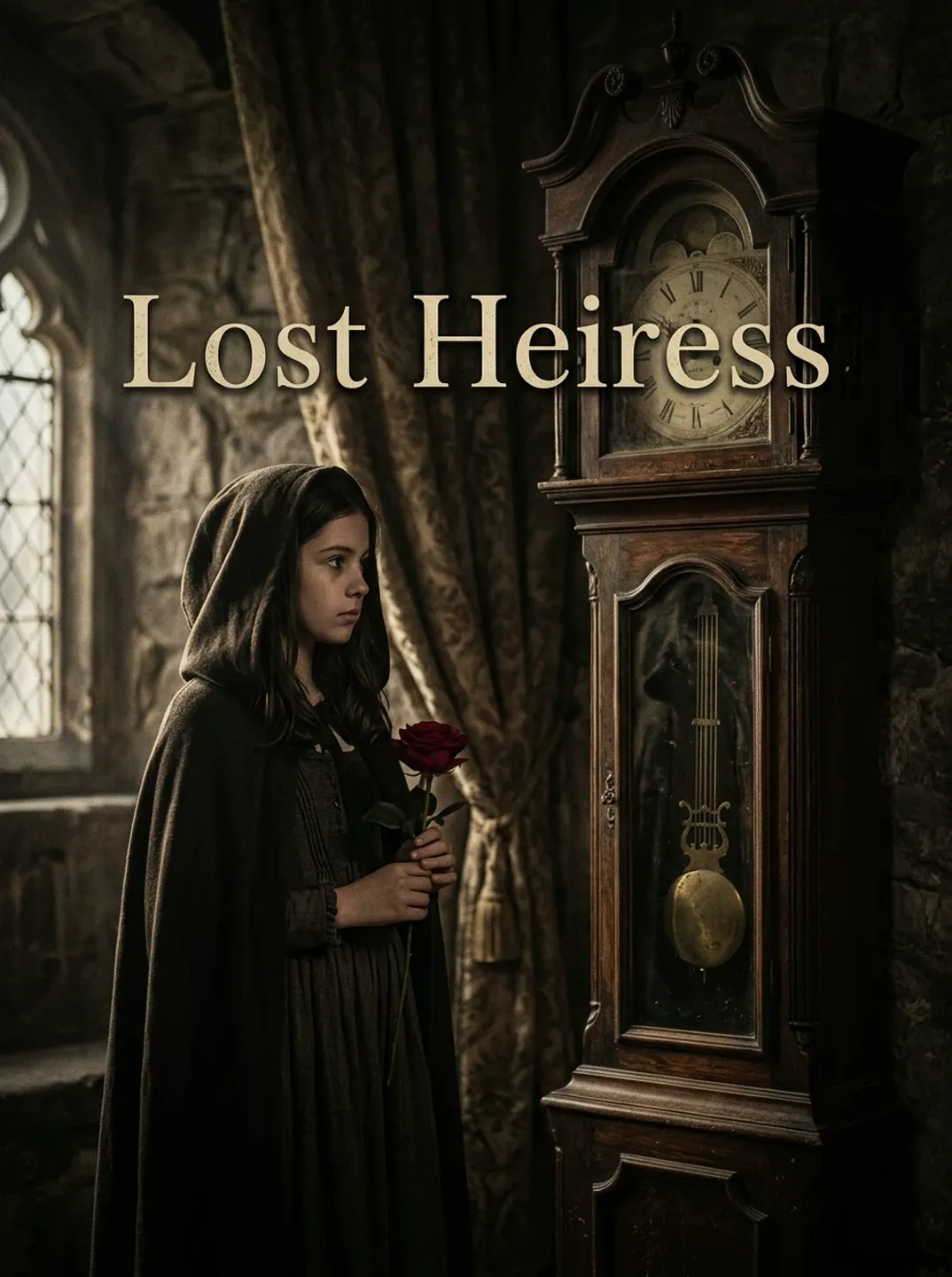
Lost heiress
简介
A girl who has transmigrated into a lost heiress's Otome world, she is exploring a house that seems to know it's not truly her.
章节1
# CHAPTER ONE
The floor was cold through her cheek.
That was the first thing. A cold that went deeper than stone—seeping like damp through a leaf, right into the hollow where her jaw bone pressed against the boards. She lay there a moment, cataloguing the pressure points: her hip, her outstretched arm, the odd twist of one ankle caught beneath the other. Someone had fallen. Someone was still falling.
She opened her eyes to a forest of table legs.
Oak. Heavy, turned, polished to a sick gleam. Beyond them, a bed with a brass headboard, the sheets thrown back in a sculptor's hurry. A wardrobe the size of a small car, its doors ajar, showing dark shapes on hangers. A window with yellowed lace curtains, and beyond the glass, a black sky eating a black garden.
Her mouth tasted of copper and dust.
She pushed herself up. It took a second try—her arms didn't remember themselves, tendons firing a beat behind her will. The room swam. She stayed on one knee, breathing through her nose until the tilt settled, and then she looked at her hands.
They were not her hands.
Hers were short-nailed, calloused from the barre in the cheap dance studio back home, tattooed with a tiny rune on the left wrist that she'd gotten at seventeen and regretted at eighteen. These hands were pale, long-fingered, naked of ink. A thin silver ring was wedged on the right ring finger, sized wrong, biting just slightly into the knuckle.
"Okay," she said. Her voice was not her voice either. It came out higher, wheezed a little at the edges, as if the throat were too narrow. "Okay."
She had thought that moving into a new body would feel like putting on a costume. It didn't. It felt like standing at the edge of a cliff and being told the cliff was now her spine.
The room smelled of cedar and dust and something floral gone sour at the bottom of a vase. She got to her feet, wobbling, and walked. Actually walked—put one foot in front of the other—because standing still was worse. The floorboards sang beneath her. Her thighs ached. She was wearing a dark wool skirt, stockings, a cream blouse gone grey at the elbows. The clothes fit like they'd been sewn on someone slightly thinner, waistband loose enough to notch over her hip bones.
Her reflection in the wardrobe mirror was a stranger.
Dark hair in an elaborate updo, gone loose and flyaway. A face that was oval and pale and set with eyes the color of thin tea. A bruise was rising along one cheekbone, blooming like a tide under skin. She touched it; the skin was warm, tender, wrong.
This will sound familiar, she thought. This will be the bus. That was what had been in her head when she fell asleep: the Number 47 bus, its shuddering diesel engine, a paperback clutched in her lap. The title had been embossed in gold lettering. **A Fair Maiden's Fate: A Romance of the Lost Heiress.** The cover had been painted in that particular soft-focus style—a girl in a white gown turning to face a manor house on a hill, three silhouettes lurking in the foreground like the shadows of an unanswered question.
She had been on her way to work, one stop past her shift, and she had been thinking that the plot was thin, that the heroine needed a spine, that the mysterious necklace mentioned in the first chapter was probably going to be—
—this.
Her hand went to her throat. There was a chain there, thin and cold like a filament of ice, and on it hung a key.
No. Correction. On it hung a key that was not a key. It was gold, about the length of her little finger, but its teeth were elaborately carved, curled like a fern frond, utterly decorative. Worthless. The kind of thing a jewelry designer thought looked expensive and no locksmith would touch.
She lifted it. It caught the lamplight and threw a skittering gleam across the ceiling.
The room around her was the kind of room that feature in photographs of "distressed country manor" sales. A four-poster bed with heavy damask hangings, a vanity table cluttered with silver-backed brushes and a tray of powder that had yellowed in its compact. A threadbare Persian rug lay under the window, its pattern worn to a memory at the center. And everywhere, on the walls, in the frames, across the mantelshelf crowded with porcelain figurines, she felt the strange negative weight of absence: the things that had been taken away, leaving only their shadows in the dust.
One drawer of the vanity was open. Empty.
The wardrobe gaped, clothes hanging in ordered rows, but there was a gap in the middle of the rail—a whole woman's worth of garments missing, as if someone had been packed up in a hurry and the hangers left behind like ribs.
A clock on the mantel had stopped at 2:47. Which meant nothing, and also meant everything, because no one had wound it for a very long time.
She picked up the silver-backed brush. It was heavy, engraved with initials she chose not to read yet. Tarnished in the troughs of the lettering. Someone had used this brush a thousand times, and then one day had not used it again.
On the far side of the vanity lay a photograph in a tarnished frame. She tipped it toward the lamplight.
A man and a woman, wedding dress, morning suit, posed stiffly before the same windows that looked onto the black garden now. The woman's dark hair was pinned in the same style, the same oval face, the same tea-colored eyes. Her mother, then. And the man beside her—sharp-jawed, unsmiling, one hand on the woman's elbow with a grip that looked, even through the tarnish, performative.
Her mother had been pretty, in that brittle way of painted china. Her father had looked at the camera like he was doing it a favor.
She set the frame back down, facedown, so the dust would settle on the glass.
The door was at the far side of the room. She crossed to it and put her hand on the knob.
It was locked.
She checked. She turned it both ways. The keyhole was a full brass affair, and there was no key in it. She crouched and looked through the gap: blackness, the suggestion of a hallway, a strip of carpet runner.
She rapped on the door—first politely, then harder. The sound thudded dully into the house and came back to her, unanswered.
"Hello?" Her new voice cracked on the second syllable. "Is anyone—hello?"
Nothing. The house ate the sound.
She stood there for a long moment, hand flat on the wood, feeling the grain pressure into her palm. No footsteps. No voice. No draft under the door. The silence was dense as water, and in it she heard what she was beginning to suspect: she was not alone in the house, but she might as well have been.
She went back to the window. The latch was stiff but gave with a screech. Cool night air poured in, and with it the sound of leaves stirring—a shiver of black shrubbery, a distant, patient sigh of what might have been a road, or the sea.
The drop from the window was two floors' worth of ivy-darkened wall down to a slate terrace. Possible, in daylight, with the right shoes. At night, with this skirt, with no torch—no, flashlight—no, she already was what she was, a girl without pockets—it was a fantasy.
Beyond the terrace, that black garden. Beyond the garden, nothing she could see; the horizon shrugged off the sky. She leaned out, twisting, trying to find a landmark—a roofline, a spire, the spread of a village's lights—but there was only the massed darkness, and the smell of wet leaves, and somewhere beneath it, faint, like something remembered rather than heard, the green-gold shimmer of a body of water.
She closed the window. Latched it. Pulled the lace curtains back into place.
The candles on the mantelpiece were real. She had a matchbook in the vanity's second drawer, dry, only a few matches left, and she lit the nearest candle, then three more, until the room wore its shadows differently. Wax gathered in warm pools. The light breathed.
She sat on the edge of the bed, which sighed under her the way it must have sighed under the last person to lie there. Her reflection in the wardrobe mirror was still a stranger, but the stranger had her posture now, the same slump of tired suspicion.
"All right," she said to the stranger. "You've woken up in a locked room, in a stranger's body, in what looks like a gothic novel's first chapter. Fine. Good. Who are you?"
The stranger had no answer.
She stood and went to the vanity desk, where among the silver-backed brushes lay a closed leather journal. Foxed at the edges, the lock cracked, one hinge loose. It had been there all along; she'd simply not seen it, the way you don't see the one thing you actually need until you stop looking for everything else.
She flicked the broken lock open.
The first page was dated twenty-one years ago. Ink had bled through the paper, sepia and stubborn, and the handwriting was a child's—looping, proud, uneven, back when the letters were still growing into themselves.
*Today I let a moth in. It was the size of my thumb. I did not kill it. I am its witness.*
She turned the pages, skimming, her eye catching on dates and fragments like fish flashing in dark water.
*9, Rue des Granges. The roof leaks. Mother says we are not poor, we are merely resting between fortunes.*
*Aunt E. says when the wind changes, the world will know our name. I think I understand what she means, but I do not like the look in her eye when she says it.*
*A boy in the square bit me. I bit him back. Mother locked me in my room and I did not care, because I knew that I had been right.*
The handwriting firmed. The dates skipped years. The address changed: *11, Cour du Soleil.* Then *Château de—* a name blurred by a water stain, then *Kestrel House, the coast road, Devon.*
The last entry was dated four years ago. It was shorter than the others, the hand hurried, the ink blotted.
*I have thirteen dresses and four pairs of shoes and a key I do not understand. I am seventeen. I asked Mother about the key. She said it was mine to find her own answer. I told her that was not an answer. She said that was the point.*
She closed the journal. The key on the chain around her neck pressed against her collarbone, patient as a held breath.
On the inside cover, in that same childish, proud, growing hand, a name was written, the letters firm despite the years of wear:
**Aurelia Voss.**
She spoke it aloud to the candlelit room, letting the syllables settle into the silence like matching coins.
"Aurelia Voss."
The clock remained stopped at 2:47. The wind nosed at the window. Far off, beyond the black garden, beyond the road that might have been the sea, something answered her name—or at least she told herself it was an answer.
She was locked in a room, wearing a dead girl's face, wearing a dead girl's key, and the house was waiting to see what she would do with it.
最新章节
### Chapter 4
The silver key was a small, everyday thing. Aurelia held it up to the li
### Chapter 3
The passage was a wound of cold air, and Aurelia stood in it until th
Chapter 2
The key had left a shallow crescent in the skin over her breastbone. She
# CHAPTER ONE
The floor was cold through her cheek.
That was the first th