
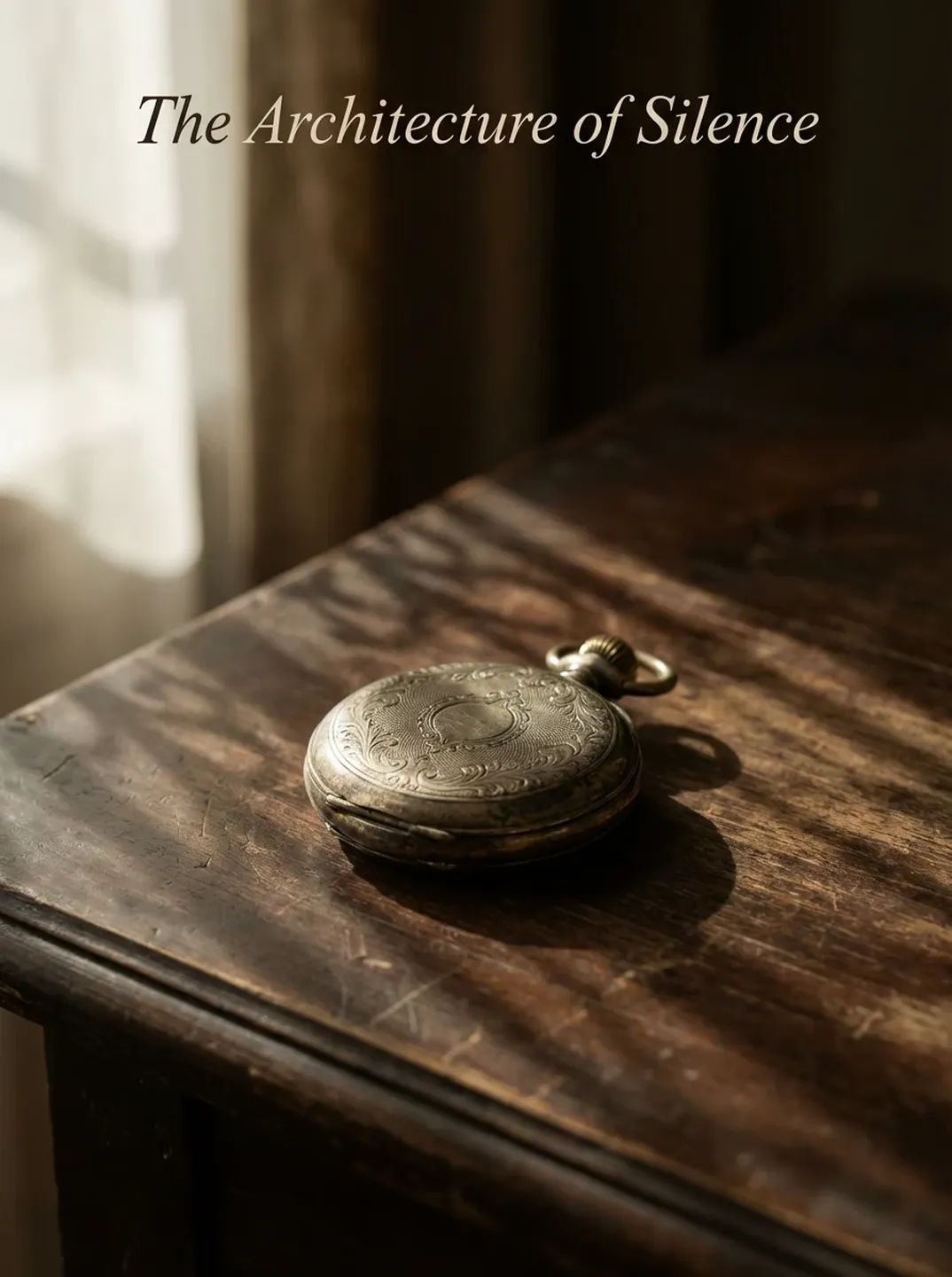
The Architecture of Silence
简介
When restorer Lia Mendonça purchases a tarnished Victorian pocket watch from a Lisbon antique shop, she uncovers more than a hidden note — she uncovers a century-old silence.
Inside the watch lies a confession dated 1931, describing a death officially ruled an accident but witnessed as murder. As Lia investigates, she discovers her own family was tied to the aftermath of that fall — not as victims, but as beneficiaries of a financial consolidation that shaped powerful institutions still standing today. With the help of historian Tomás Vidal, whose lineage is equally entangled in the events of 1931, Lia traces a hidden architecture of influence built on discretion, inheritance, and calculated silence.
When intimidation escalates and legal “inspections” threaten her livelihood, Lia must decide whether exposing the truth will dismantle corruption — or fracture everything her family has preserved for generations.
章节1
The bell above the door of *Antigualhas de Santos* did not chime so much as gasp, a dull, rusted complaint against the driving rain. Lia Mendonça shook her umbrella, sending a spray of cold water onto the warped floorboards. The shop smelled of beeswax, wet wool, and time that had curdled in the dark.
“Mr. Santos?”
Her voice was swallowed by the clutter. Stacks of leather-bound encyclopedias formed leaning towers in the shadows; brass lamps, bereft of oil, hung like sleeping bats from the rafters. The only light came from a single oil lamp on the counter, its flame jittering as the draft from the door followed Lia inside.
“In the back, Miss Mendonça,” a voice rasped.
Elias Santos emerged from behind a velvet curtain, wiping grease-stained hands on a rag. He was as worn as his inventory, his skin mapped with the geography of eighty years. “You are late. The storm?”
“The traffic on the bridge was a nightmare.” Lia moved toward the counter, her gaze sweeping the glass display case. She wasn’t here for conversation. Her fingers, usually steady enough to re-seat the hairspring of a chronometer, twitched inside her pockets. “Do you have it?”
Santos didn’t smile. He reached under the counter and produced a small, velvet-wrapped bundle. He laid it on the scratched glass with a reverence that made the air in the shop grow heavy.
“Found in an estate sale in Sintra,” he murmured. “The family claimed it hadn’t been touched since the thirties. They wanted it gone. Said it was… unlucky.”
Lia pulled the fabric away.
It was a Victorian hunter-case pocket watch, silver tarnished to the color of a bruised sky. The engraving on the lid was worn smooth, an intricate pattern of vines choking a central crest she couldn’t quite make out. It was heavy—heavier than a modern timepiece, dense with the weight of its own mechanisms.
She picked it up. Cold. It bit into her palm.
“Does it run?” she asked.
“No.” Santos leaned in, his eyes reflecting the singular flame of the lamp. “The mainspring is intact. The balance wheel moves freely. But it refuses to tick.”
Lia pressed the release catch. The lid sprang open with a sharp *snick*.
The face was porcelain, white as bone, spiderwebbed with hairline cracks. The hands were delicate black arrows, frozen.
*11:42.*
A chill that had nothing to do with the rain walked up Lia’s spine. It wasn’t just stopped; it felt arrested. Seized. As if the mechanism had been strangled.
“How much?”
“For you? Two hundred.” Santos looked away, toward the dark window where the rain lashed against the glass like thrown gravel. “Take it. Get it out of here.”
***
Lia’s workshop was a sanctuary of controlled silence. Located in the loft of her apartment in Alfama, it was a clean, white space that smelled of solvent and lavender. Here, the chaos of the world was dismantled, cleaned, and reassembled into order.
She set the watch on her workbench under the halo of the magnifying lamp. Outside, the storm continued to batter Lisbon, turning the Tagus River into a churning grey soup, but in here, there was only the focus of the lens.
She donned her loupe. The world narrowed to a circle of illuminated detail.
“Let’s see why you’re so stubborn,” she whispered.
She selected a case knife, the steel blade gleaming. With practiced pressure, she sought the seam of the case back. It resisted. Years of grime and oxidation had sealed it shut, a metal mouth refusing to speak. She applied a fraction more torque.
*Crack.*
The back popped off. A waft of stale air released—scent of dry paper and old iron.
Lia frowned. The movement was beautiful, a landscape of brass gears and ruby jewels, but something was wrong. There was a discrepancy in the thickness of the case. The inner dust cover sat too high.
She probed the edge of the dust cover with fine tweezers. It shifted. It wasn't screwed down; it was wedged.
With a delicate twist, she pried it loose.
It wasn’t a dust cover. It was a false bottom.
Lia set her tools down. Her heart hammered a rhythm the watch had long forgotten. Resting in the hidden cavity, folded into a square the size of a postage stamp, was a piece of paper. The edges were yellowed, the texture brittle as dead leaves.
She used the tweezers to extract it, terrified it would disintegrate into dust before she could read it. She laid it on the cutting mat and, using two probes, gently unfolded it.
The ink was faded to a rusty brown, written with a frantic, jagged hand.
*October 4, 1931*
*They say he fell. The papers will say it was the wine, or the stairs. But I saw the push. I saw the hand on his chest. It was no accident. It was murder. If they find this, I am next. God forgive my silence.*
Lia sat back, the breath leaving her lungs in a rush. The rain drummed against the skylight, frantic now, manic.
1931. A murder disguised as a fall. And someone had hidden the proof inside the very instrument that measured the victim's final moments.
She looked at the watch face again. *11:42.*
Was that when he died? Was the watch in his pocket when he hit the ground, the impact shattering the balance staff, freezing time forever at the moment of betrayal?
Her phone buzzed on the workbench, the vibration sounding like a drill in the quiet room.
Unknown Number.
Lia stared at it. She was unlisted. Only clients and…
She picked it up. “Hello?”
Silence. Not the empty silence of a disconnected line, but a living silence. She could hear the wet, ragged sound of breathing. And in the background, faint but distinct, the rhythmic *tock-tock-tock* of a grandfather clock.
“Who is this?” Lia asked, her voice tighter than she intended.
“The mechanism is delicate, Ms. Mendonça,” a voice said. It was digital, distorted, synthesized into an unrecognizable baritone. “Some things are broken for a reason. Repairing them helps no one.”
“Who act—?”
“Return the purchase. Tomorrow. Before noon. Or we will dismantle more than just a watch.”
The line went dead.
Lia stood frozen, the phone still pressed to her ear. The sanctuary of her workshop suddenly felt like a glass cage. She looked at the skylight. Was there a shadow moving across the roof, or just the play of rain and streetlights?
She looked back at the note. *I saw the push.*
She couldn't return it. To return it was to bury the truth again. That was a violation of everything she was. She was a restorer. She brought things back to the light.
She needed help. She needed someone who knew the shape of the past, someone who knew where the bodies of 1931 were buried.
She grabbed her laptop and typed a name into the search bar. A name she had seen on a book jacket in Santos’s shop weeks ago, a historian who had been discredited for his "obsessive theories" about Lisbon's elite families.
*Tomás Vidal.*
His profile picture showed a man with tired eyes and a jaw set in permanent defiance. He looked like a man who was used to hitting walls.
Lia found an email address. She began to type, her fingers flying, weaving the first thread of a tapestry she didn't yet know would strangle them both.
*Subject: A murder in 1931. I have the time of death.*
As she hit send, a fuse blew in the hallway. The lights in the apartment died instantly.
Lia was plunged into darkness, save for the weak, grey light of the storm filtering through the glass. In the sudden silence, she heard it.
From the workbench. From the disassembled pieces of silver and brass.
*Tick.*
*Tick.*
*Tick.*
The watch had started.
All on its own.
最新章节
The workshop was quiet.
Not the brittle quiet of fear.
Not the padded silence
Reform does not arrive like thunder.
It begins as documentation.
Three days a
They did not rush.
Rushing belonged to panic.
Precision belonged to architec
The attack did not come at night.
It came at 4:18 p.m., in full daylight, while the
你可能喜欢
暂无推荐
暂无推荐小说,请稍后再试