
개요
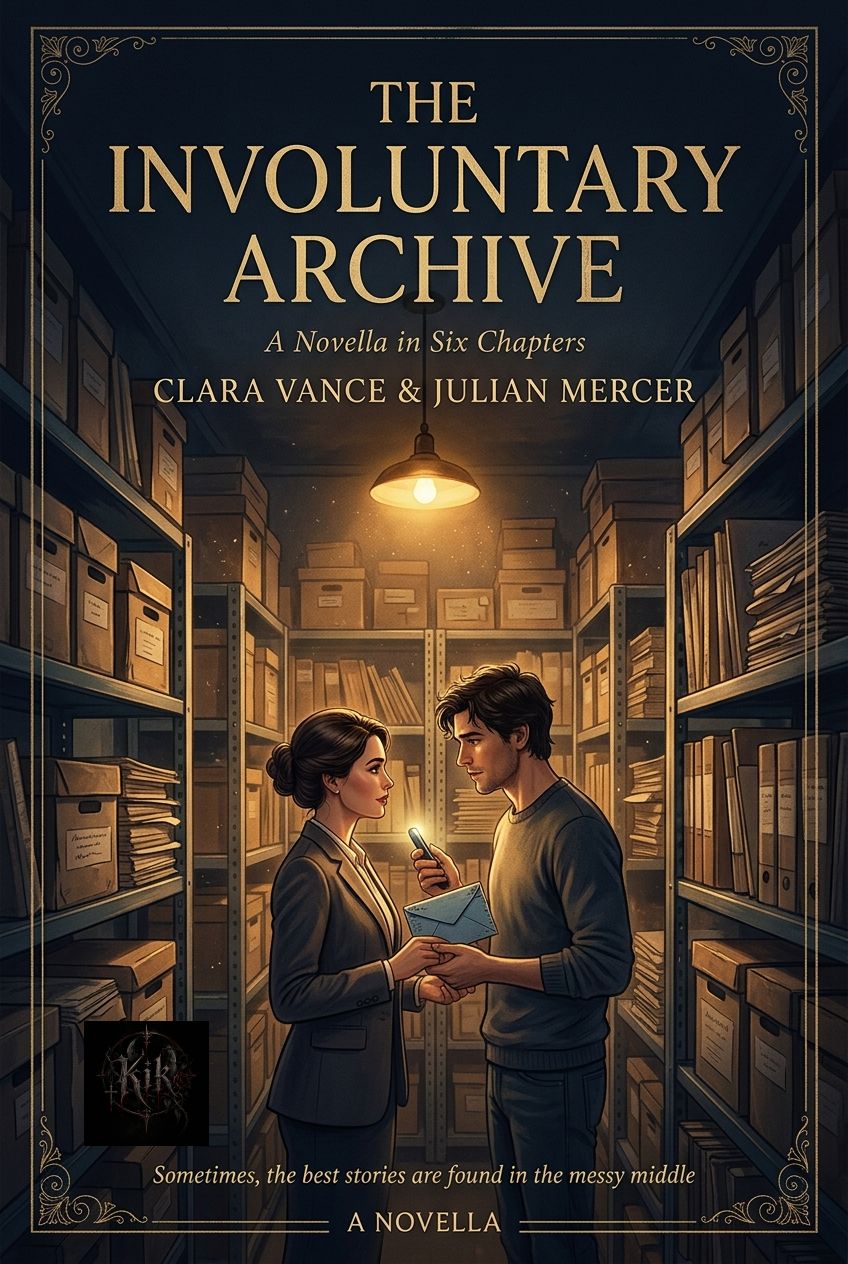
*The Involuntary Archive* is a workplace romance set at Harrison & Cole Publishing. Clara Vance, a structured senior manuscript editor, and Julian Mercer, a chaotic acquisitions editor, have maintained a bitter professional rivalry for years.
When managing editor Arthur Pendelton announces his retirement, he assigns them a joint legacy project: organizing sixty years of forgotten company archives in sub-basement three to compile a 75th Anniversary Anthology.
Forced to spend hours together in the dim, paper-filled basement, their contrasting methods clash—and slowly evolve. When a severe rainstorm locks them inside during a power outage, they step away from work and open up about their pasts. As they uncover historic love letters and long-lost manuscripts together, the boundary between professional friction and personal attraction begins to blur.
장1
The fifth floor of the Harrison & Cole Publishing House smelled perpetually of three distinct things: stale hazelnut roast lingering in ceramic mugs, the warm metallic friction of high-capacity copy machines, and the quiet, immovable tension that had existed between Clara Vance and Julian Mercer for nearly three years. It was an institution built on paper, tradition, and prestige, located in a weathered stone building in the heart of the city where the windows rattled slightly whenever the heavy transit buses rumbled down the avenue below.
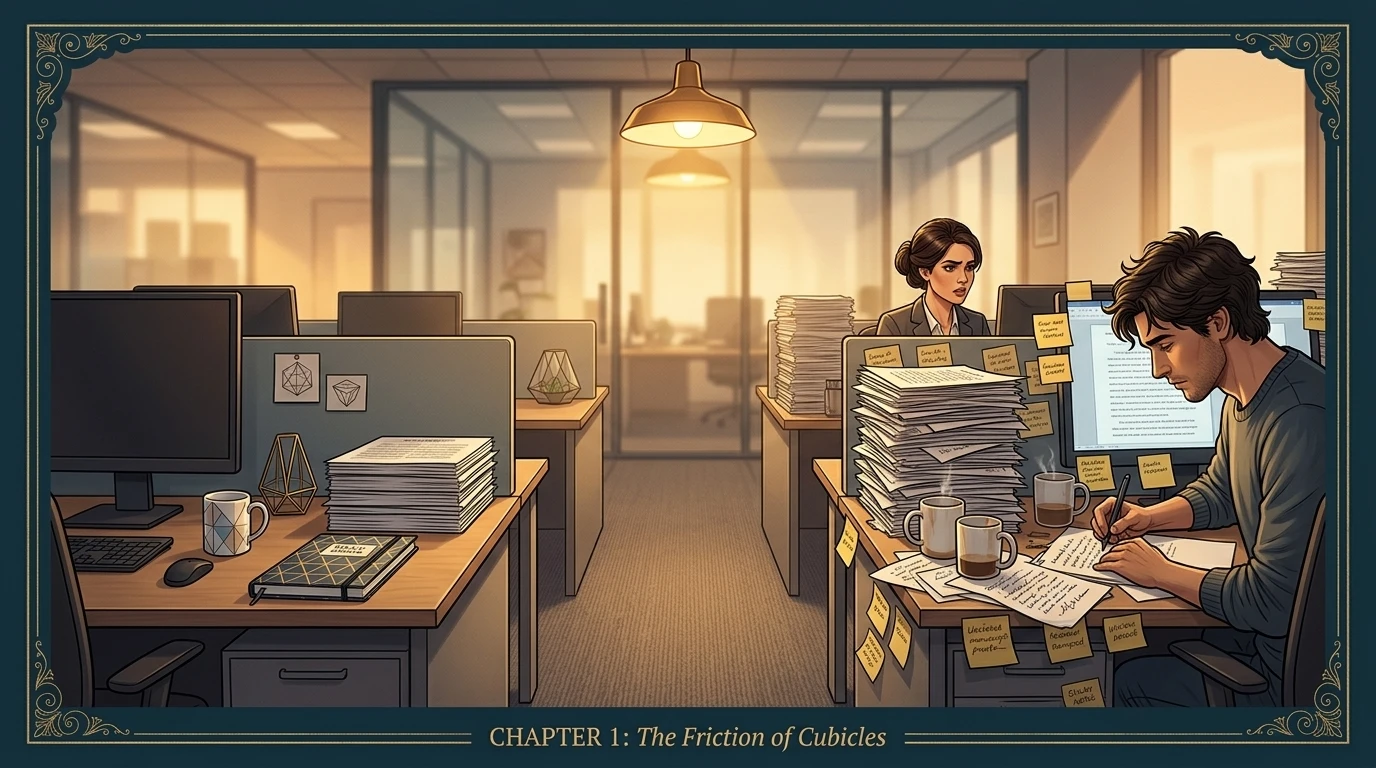
Clara Vance sat at her desk, her back impeccably straight against the ergonomic mesh of her executive chair, her fingers moving across her mechanical keyboard with the precise, unwavering rhythm of a concert pianist adhering to a strict tempo. On the exact left corner of her polished mahogany desk sat three HB pencils, freshly sharpened to identical taper lengths, aligned parallel to a leather-bound, color-coded daily planner. In the center sat a pristine white ceramic mug featuring a clean blue geometric grid pattern, containing tea that was always drunk at precisely sixty-five degrees Celsius. Everything in Clara's workspace served an unambiguous, verified, and repeatable function. She was the senior manuscript editor, the firm's unyielding bulwark against grammatical decay, structural ambiguity, and catastrophic scheduling oversights.
Across the narrow carpeted aisle, separated by a modest three-foot partition that felt more like a demilitarized zone, sat Julian Mercer. Julian’s workspace, by stark and horrifying contrast, resembled the active archaeological excavation site of a manic literary scholar. Stacks of unread manuscript proofs towered like leaning obelisks at the corners of his desk, precariously balanced on top of half-annotated galleys, mismatched sticky notes of vibrant neon pink and yellow, and no fewer than three distinct coffee cups containing dark, forgotten espresso rings. Julian was the firm’s star acquisitions editor—a man who operated entirely on raw aesthetic intuition, unpredictable creative fervor, and an unapologetic, sweeping disregard for corporate timelines. He discovered raw talent in slush piles where others saw only garbage, but he lost his security keycard at least twice a month and routinely turned in crucial acquisition memos written on the backs of cloth napkins.
The friction between them was not merely a matter of office logistics or differing housekeeping standards; it was a fundamental clash of worldviews. Clara viewed a manuscript as an intricate piece of architecture that required exact blueprints, foundational stability, and strict adherence to structural mechanics. Julian viewed a manuscript as an organic, living creature that needed to be allowed to run wild, even if it tripped over its own feet or tore through the narrative framework in the process.
Every Monday morning production meeting was a battleground of quiet, deadly polite warfare. If Clara presented a streamlined, logically sequenced quarterly editing schedule designed to minimize author stress and editorial overtime, Julian would interject with a languid wave of his hand and a counter-proposal about 'preserving the crucial artistic organic evolution of the text.' If Julian praised a chaotic, experimental debut novel from an unknown author, Clara would calmly open her leather folder and read off forty-two distinct plot inconsistencies, three historical inaccuracies on page seven, and a severe pacing drop in the third act.
To understand the depth of this rivalry, one had to examine the history of the firm's major acquisitions over the preceding three years. In autumn, Clara had painstakingly edited an eight-hundred-page historical biography, correcting over twelve thousand individual footnotes and ensuring that every citation matched international archival standards. Meanwhile, Julian had spent that exact same autumn championing a minimalist poetry collection written by an obscure barista from Seattle. When both books were published in the same week, Clara's biography received praise from academic journals for its rigorous accuracy, while Julian's poetry collection became a surprising viral sensation on social media, selling out three press runs. Neither could acknowledge that the other possessed a valid form of talent, choosing instead to view each other's success as a baffling anomaly in an otherwise logical world.
On this particular morning, as rain glistened against the tall windowpanes of the fifth floor, Clara was reviewing the final proofs for an upcoming mystery manuscript. She paused at line fourteen on page ninety-two. A character was described as using a smartphone model in a scene explicitly set in the spring of 2004. Clara made a crisp red mark in the margin, referencing the exact commercial release date of the technology. Across the aisle, Julian was humming a disorganized tune while flipping through a handwritten manuscript sent in by an untried author from Vermont. He made no notes in the margins, opting instead to leave faint thumbprints of cinnamon bagel crumbs along the edges of the thick linen paper.
'Good morning, Clara,' Julian said softly, breaking the silent atmosphere of the early morning. He leaned back in his leather swivel chair until the old metal spring groaned in loud, squeaking protest, tossing a loosely stapled set of manuscript pages onto his blotter.
Clara did not immediately turn her head. She deliberately finished typing her current sentence, placed a precise period, saved the draft to the cloud server, and then swiveled her chair exactly forty-five degrees to face him. Her expression was a mask of professional neutrality. 'Good morning, Julian. I assume you have finally come to deliver the signed contract addendum for the Sterling poetry anthology?'
Julian offered a lopsided, slightly self-deprecating grin—a smile that had famously disarmed difficult authors and charmed half the sales department, but which left Clara entirely unimpressed. 'The Sterling contract is undergoing a brief phase of intuitive refinement, Clara. True artistic perfection cannot be shackled to arbitrary calendar dates created by corporate accountants.'
To understand the depth of this rivalry, one had to examine the history of the firm's major acquisitions over the preceding three years. In autumn, Clara had painstakingly edited an eight-hundred-page historical biography, correcting over twelve thousand individual footnotes and ensuring that every citation matched international archival standards. Meanwhile, Julian had spent that exact same autumn championing a minimalist poetry collection written by an obscure barista from Seattle. When both books were published in the same week, Clara's biography received praise from academic journals for its rigorous accuracy, while Julian's poetry collection became a surprising viral sensation on social media, selling out three press runs. Neither could acknowledge that the other possessed a valid form of talent, choosing instead to view each other's success as a baffling anomaly in an otherwise logical world.
On this particular morning, as rain glistened against the tall windowpanes of the fifth floor, Clara was reviewing the final proofs for an upcoming mystery manuscript. She paused at line fourteen on page ninety-two. A character was described as using a smartphone model in a scene explicitly set in the spring of 2004. Clara made a crisp red mark in the margin, referencing the exact commercial release date of the technology. Across the aisle, Julian was humming a disorganized tune while flipping through a handwritten manuscript sent in by an untried author from Vermont. He made no notes in the margins, opting instead to leave faint thumbprints of cinnamon bagel crumbs along the edges of the thick linen paper.
'Good morning, Clara,' Julian said softly, breaking the silent atmosphere of the early morning. He leaned back in his leather swivel chair until the old metal spring groaned in loud, squeaking protest, tossing a loosely stapled set of manuscript pages onto his blotter.
Clara did not immediately turn her head. She deliberately finished typing her current sentence, placed a precise period, saved the draft to the cloud server, and then swiveled her chair exactly forty-five degrees to face him. Her expression was a mask of professional neutrality. 'Good morning, Julian. I assume you have finally come to deliver the signed contract addendum for the Sterling poetry anthology?'
Julian offered a lopsided, slightly self-deprecating grin—a smile that had famously disarmed difficult authors and charmed half the sales department, but which left Clara entirely unimpressed. 'The Sterling contract is undergoing a brief phase of intuitive refinement, Clara. True artistic perfection cannot be shackled to arbitrary calendar dates created by corporate accountants.'
To understand the depth of this rivalry, one had to examine the history of the firm's major acquisitions over the preceding three years. In autumn, Clara had painstakingly edited an eight-hundred-page historical biography, correcting over twelve thousand individual footnotes and ensuring that every citation matched international archival standards. Meanwhile, Julian had spent that exact same autumn championing a minimalist poetry collection written by an obscure barista from Seattle. When both books were published in the same week, Clara's biography received praise from academic journals for its rigorous accuracy, while Julian's poetry collection became a surprising viral sensation on social media, selling out three press runs. Neither could acknowledge that the other possessed a valid form of talent, choosing instead to view each other's success as a baffling anomaly in an otherwise logical world.
On this particular morning, as rain glistened against the tall windowpanes of the fifth floor, Clara was reviewing the final proofs for an upcoming mystery manuscript. She paused at line fourteen on page ninety-two. A character was described as using a smartphone model in a scene explicitly set in the spring of 2004. Clara made a crisp red mark in the margin, referencing the exact commercial release date of the technology. Across the aisle, Julian was humming a disorganized tune while flipping through a handwritten manuscript sent in by an untried author from Vermont. He made no notes in the margins, opting instead to leave faint thumbprints of cinnamon bagel crumbs along the edges of the thick linen paper.
'Good morning, Clara,' Julian said softly, breaking the silent atmosphere of the early morning. He leaned back in his leather swivel chair until the old metal spring groaned in loud, squeaking protest, tossing a loosely stapled set of manuscript pages onto his blotter.
Clara did not immediately turn her head. She deliberately finished typing her current sentence, placed a precise period, saved the draft to the cloud server, and then swiveled her chair exactly forty-five degrees to face him. Her expression was a mask of professional neutrality. 'Good morning, Julian. I assume you have finally come to deliver the signed contract addendum for the Sterling poetry anthology?'
Julian offered a lopsided, slightly self-deprecating grin—a smile that had famously disarmed difficult authors and charmed half the sales department, but which left Clara entirely unimpressed. 'The Sterling contract is undergoing a brief phase of intuitive refinement, Clara. True artistic perfection cannot be shackled to arbitrary calendar dates created by corporate accountants.'
To understand the depth of this rivalry, one had to examine the history of the firm's major acquisitions over the preceding three years. In autumn, Clara had painstakingly edited an eight-hundred-page historical biography, correcting over twelve thousand individual footnotes and ensuring that every citation matched international archival standards. Meanwhile, Julian had spent that exact same autumn championing a minimalist poetry collection written by an obscure barista from Seattle. When both books were published in the same week, Clara's biography received praise from academic journals for its rigorous accuracy, while Julian's poetry collection became a surprising viral sensation on social media, selling out three press runs. Neither could acknowledge that the other possessed a valid form of talent, choosing instead to view each other's success as a baffling anomaly in an otherwise logical world.
On this particular morning, as rain glistened against the tall windowpanes of the fifth floor, Clara was reviewing the final proofs for an upcoming mystery manuscript. She paused at line fourteen on page ninety-two. A character was described as using a smartphone model in a scene explicitly set in the spring of 2004. Clara made a crisp red mark in the margin, referencing the exact commercial release date of the technology. Across the aisle, Julian was humming a disorganized tune while flipping through a handwritten manuscript sent in by an untried author from Vermont. He made no notes in the margins, opting instead to leave faint thumbprints of cinnamon bagel crumbs along the edges of the thick linen paper.
'Good morning, Clara,' Julian said softly, breaking the silent atmosphere of the early morning. He leaned back in his leather swivel chair until the old metal spring groaned in loud, squeaking protest, tossing a loosely stapled set of manuscript pages onto his blotter.
Clara did not immediately turn her head. She deliberately finished typing her current sentence, placed a precise period, saved the draft to the cloud server, and then swiveled her chair exactly forty-five degrees to face him. Her expression was a mask of professional neutrality. 'Good morning, Julian. I assume you have finally come to deliver the signed contract addendum for the Sterling poetry anthology?'
Julian offered a lopsided, slightly self-deprecating grin—a smile that had famously disarmed difficult authors and charmed half the sales department, but which left Clara entirely unimpressed. 'The Sterling contract is undergoing a brief phase of intuitive refinement, Clara. True artistic perfection cannot be shackled to arbitrary calendar dates created by corporate accountants.'
To understand the depth of this rivalry, one had to examine the history of the firm's major acquisitions over the preceding three years. In autumn, Clara had painstakingly edited an eight-hundred-page historical biography, correcting over twelve thousand individual footnotes and ensuring that every citation matched international archival standards. Meanwhile, Julian had spent that exact same autumn championing a minimalist poetry collection written by an obscure barista from Seattle. When both books were published in the same week, Clara's biography received praise from academic journals for its rigorous accuracy, while Julian's poetry collection became a surprising viral sensation on social media, selling out three press runs. Neither could acknowledge that the other possessed a valid form of talent, choosing instead to view each other's success as a baffling anomaly in an otherwise logical world.
On this particular morning, as rain glistened against the tall windowpanes of the fifth floor, Clara was reviewing the final proofs for an upcoming mystery manuscript. She paused at line fourteen on page ninety-two. A character was described as using a smartphone model in a scene explicitly set in the spring of 2004. Clara made a crisp red mark in the margin, referencing the exact commercial release date of the technology. Across the aisle, Julian was humming a disorganized tune while flipping through a handwritten manuscript sent in by an untried author from Vermont. He made no notes in the margins, opting instead to leave faint thumbprints of cinnamon bagel crumbs along the edges of the thick linen paper.
'Good morning, Clara,' Julian said softly, breaking the silent atmosphere of the early morning. He leaned back in his leather swivel chair until the old metal spring groaned in loud, squeaking protest, tossing a loosely stapled set of manuscript pages onto his blotter.
Clara did not immediately turn her head. She deliberately finished typing her current sentence, placed a precise period, saved the draft to the cloud server, and then swiveled her chair exactly forty-five degrees to face him. Her expression was a mask of professional neutrality. 'Good morning, Julian. I assume you have finally come to deliver the signed contract addendum for the Sterling poetry anthology?'
Julian offered a lopsided, slightly self-deprecating grin—a smile that had famously disarmed difficult authors and charmed half the sales department, but which left Clara entirely unimpressed. 'The Sterling contract is undergoing a brief phase of intuitive refinement, Clara. True artistic perfection cannot be shackled to arbitrary calendar dates created by corporate accountants.'
'It is not an arbitrary calendar date, Julian,' Clara replied, her voice remaining perfectly level, smooth, and laced with the lethal coldness of absolute factual correctness. 'It is a legally binding deadline agreed upon six weeks ago by executive leadership, the author's literary agency, and our printing facility in Ohio. If that file is not uploaded to the pre-press server by five o'clock this evening, our assigned press window collapses, and the entire autumn release schedule slips into the next fiscal quarter.'
Julian rested his chin in his palm, his dark, slightly disheveled hair falling over his forehead as his amber-flecked eyes sparked with vexing amusement. 'You live your life inside neat little plastic compartments, don't you, Clara? Everything labeled, organized, stamped, and filed away before the poor thing even has a chance to catch its breath.'
'And you live your life inside a perpetual category-five hurricane of missed deadlines, lost receipts, and lukewarm coffee,' Clara countered without missing a beat, her gaze unflinching. 'Some of us prefer structural integrity over continuous organizational panic.'
Before Julian could launch into his usual eloquent defense of creative chaos, the heavy oak doors at the end of the hallway swung open. The rhythmic, echoing footsteps of Arthur Pendelton, the senior managing director of Harrison & Cole, resonated down the corridor. Arthur was a legend in the publishing industry—a tall, weathered man with silver hair, wire-rimmed spectacles, and a formidable reputation for having guided the house through four decades of literary shifts. His impending retirement at the end of the season had been the primary topic of hushed watercooler speculation for months.
Arthur stopped at the threshold of their cubicle aisle, holding a thick, faded yellow folder beneath his arm. He looked between Clara and Julian, his sharp gray eyes assessing their stiff postures with an expression that hovered somewhere between deep exhaustion and quiet, conspiratorial amusement.
'Clara. Julian. In my office. Right now, if you please,' Arthur said, turning sharply on his heel without waiting for a verbal response.
Clara exchanged a brief, wary look with Julian. Julian shrugged nonchalantly, running his fingers through his messy hair as he pushed himself up from his chair. Clara carefully smoothed the front of her tailored navy blazer, placed her pen precisely in its velvet-lined tray, and followed them into Arthur’s corner office.