

AI Character Card for Novel Writing: Stop Characters from Drifting
AI Character Card for Novel Writing: A Practical Template for Long Fiction
Updated May 24, 2026
The first few AI-written chapters often look better than expected. The heroine has bite. The rival is arrogant in exactly the right way. The mentor withholds just enough to feel dangerous. Then chapter 12 arrives, and the book starts to slip. The heroine explains herself too neatly. The rival becomes polite for no reason. The mentor forgets the warning from chapter 7.
The prose may still look fluent. What has gone missing is the rule set that made the character feel like herself. An AI character card for novel writing is that recurring rule set: not a full biography, not a pile of lore, but the small group of things the model should not forget when the scene changes. How this person speaks. What they want. What they avoid. Who changes them. Where they are in the arc.
The problem usually is not that you do not know your character. You do. You remember the insult from chapter 4 and the almost-apology in chapter 9. The AI does not remember it unless the right context is in front of it, and it forgets faster than a novelist expects.
A more useful question is: "What does the model need in front of it so the next scene does not betray the last one?" That keeps the card practical, and it saves you from building the kind of beautiful private document that never survives contact with an actual chapter.
🧭 What is an AI character card for novel writing?
For a novelist, an AI character card is a reusable drafting note. It tells the model what has to stay true when a new scene begins. A profile can say, "Mara is proud." A usable card says, "When Mara feels exposed, she becomes formal and exact; she uses titles to create distance; she will protect the protagonist in action before she admits concern in words." That second version is the one a model can actually use on the page.
In a novel, a character is a pressure point. They want something, hide something, and speak differently to different people. They should not react in chapter 30 as if chapter 18 never happened. A card that only says "brave, sarcastic, loyal" may carry one exchange, but it will not hold a long novel together.
This is where many cards go soft. They turn into private wiki pages because that feels thorough. Birthplace, favorite color, school record, childhood pet, full family tree: all of it may belong somewhere. It does not all belong in the active card. Keep the active card for the rules that change a line, a choice, a refusal, or a silence.
🌀 Why AI novel characters drift
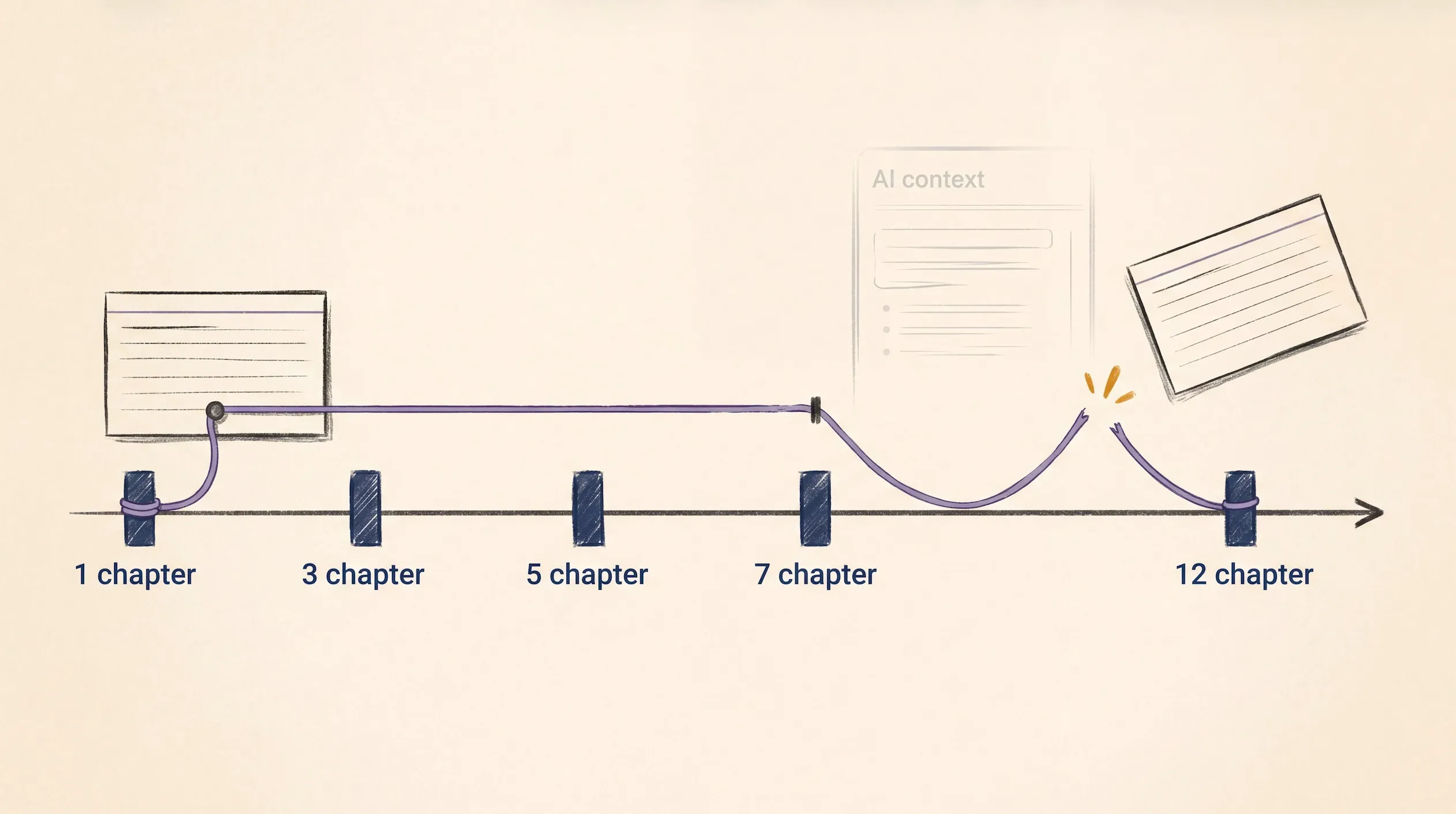
Long-form fiction runs on small promises. A scar. A secret. A private fear. A rivalry that softened in chapter 8 but should not become instant friendship in chapter 9. Human writers forget details too; that is why notebooks, spreadsheets, and margin comments exist. AI makes the drift feel stranger because the broken paragraph may still be perfectly smooth.
There is research on this now, which is useful mostly because it confirms what writers have been muttering at their drafts. A 2026 arXiv paper, "Lost in Stories: Consistency Bugs in Long Story Generation by LLMs", tracks models contradicting established facts, character traits, and world rules in long narratives. The paper calls them consistency bugs. In a manuscript, they feel like betrayal by a sentence that looked fine five seconds ago.
Writers call it "the AI forgot my character." Sometimes that is exactly what happened. Often the reminder exists, but it is buried under old notes, trapped in a previous prompt, or written so vaguely that the model can obey it and still miss the point. "She is guarded" is not a drafting rule. Does she go quiet? Joke? Ask a cruel question? Correct a minor detail to avoid the real subject?
A character card keeps the active rules close to the scene. It will not make the character deeper by itself. It can, however, stop the model from losing the depth you already built, especially once the draft is long enough that yesterday's prompt is no longer doing any useful work.
🎭 Roleplay character cards vs novel writing cards
Roleplay cards helped popularize the format: name, personality, scenario, greeting, example dialogue. SillyTavern's character design documentation explains how those fields can be sent as prompt context. If you already use roleplay cards, keep the parts that help with voice. Be careful with anything that freezes the character in a permanent present tense. A novel character cannot stay in the same emotional setup forever, even if the first version of the card was vivid.
| Area | Roleplay character card | Novel writing character card |
|---|---|---|
| Main job | Keep one character believable in conversation | Keep one character consistent across scenes, chapters, relationships, and arcs |
| Best use | Chat, interactive scenes, persona simulation | Drafting chapters, revising dialogue, testing continuity, checking emotional logic |
| Key fields | Name, personality, scenario, greeting, example messages | Role, desire, fear, contradiction, voice rules, relationships, arc state |
| Main risk | The card becomes too long and crowds out useful context | The card freezes the character and blocks believable growth |
The last row matters. A roleplay card can make a character vivid now; a novel card has to keep them believable later. Forgetting is only one failure mode. Sometimes the model remembers the first version too well and drags that person into scenes where they should have changed.
🧩 What to include in an AI character card for fiction
A strong card stays short enough to use and specific enough to stop generic output. If it becomes a storage closet, the model will skim it. If it becomes a mood board, the model will flatter you with vibes and miss the behavior. The fields below belong here because they can change what happens on the page.
Dramatic role. Do not begin with eye color unless eye color changes the scene. Ask what this person does to the story. A rival pressures the protagonist in a way a friend cannot. A mentor withholds a kind of knowledge the protagonist wants too badly. The useful answer names pressure, not status.
Core desire. What do they want badly enough to make bad choices? Prove herself, protect a sibling, escape debt, win the throne, hide a crime. If the desire cannot push action, it is probably decoration.
Fear or wound. Write this as behavior, not therapy language. A weak field says, "She is secretly insecure." A stronger field says, "When praised in public, she jokes because praise feels like a trap." The second version gives the model something to put on the page.
Contradiction. Flat characters are easy to summarize. Interesting characters fight themselves: "She wants power but hates being watched." "He wants intimacy but turns every confession into a joke." A contradiction gives the model resistance to write against.
Voice rules. Do not stop at labels like "witty" or "cold." Write the rule. Does the character answer questions with questions? Avoid contractions? Use formal titles when angry? Joke when cornered? If you cannot hear the rule in a line of dialogue, make it more concrete.
Relationship map. A character changes depending on who is in the room. The heroine may be blunt with her rival, gentle with her brother, and formal with the queen. If the card ignores relationships, every conversation slides into the same temperature.
Arc state. Mark where the character is now: early arc, midpoint, after betrayal, after confession, post-defeat. Without that line, the model may write chapter 30 with chapter 1 behavior, or hand the character an emotional breakthrough the book has not earned yet.
📝 A working AI character card template
Use this as a working template, not a form to complete perfectly. The copyable block below is only the field list. The notes after it explain how to fill the fields, so you do not accidentally paste the teaching text into your own card.
Character name: [name, active titles, nicknames, or aliases for this chapter range]
Story role: [the job this person performs in the story]
Genre / story context: [one sentence; world flavor that affects how characters speak and move]
Core desire: [what they chase even when it costs them]
Public goal: [the visible goal other characters can see]
Private fear: [fear written as behavior, not diagnosis]
Central contradiction: [the internal fight that creates tension]
Voice rules:
- Sentence rhythm: [clipped / winding / formal / evasive / other]
- Words they avoid: [terms that sound wrong in their mouth]
- Words or phrases they overuse: [only if you actually want repetition]
- Calm voice: [one line-level rule]
- Voice under pressure: [the rule that matters most]
Behavior rules:
- When threatened, they: [observable action]
- When embarrassed, they: [observable action]
- When protecting someone, they: [observable action]
- When lying, they: [observable action]
Relationship map:
- Character A: [what changes when this person is in the room]
- Character B: [what this relationship permits or forbids]
- Character C: [current temperature, not the whole history]
Arc state:
- Current chapter range: [chapters / act / scene cluster]
- What has changed: [earned change so far]
- What has not changed yet: [old pattern still active]
- What the model must not advance too early: [unearned confession, forgiveness, knowledge, etc.]
Do not write:
- Behaviors that break canon: [list]
- Phrases that sound out of character: [list]
- Information the character should not know: [list]
- Emotional breakthroughs that have not been earned yet: [list]
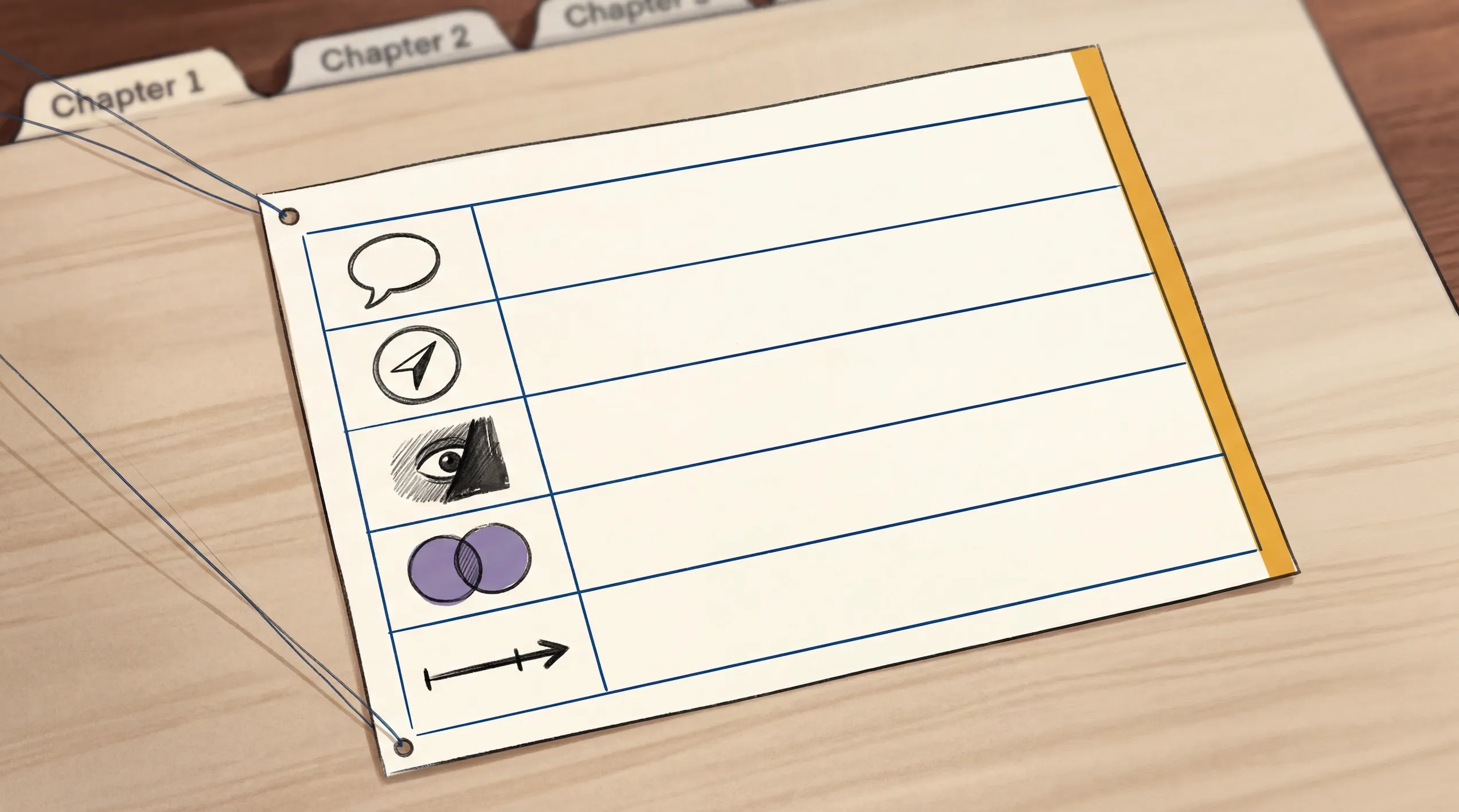
How to fill it: keep each answer scene-facing. A good field changes a line of dialogue, a choice, a refusal, or a silence.
- Story role should name pressure. "Rival who exposes the protagonist's hunger for approval" will draft better than "strong female lead."
- Private fear works best when you name the coping habit. "Leaves first when a conversation becomes too tender" is more useful than "abandonment issues."
- Voice rules should stay short. A few rules that change sentence shape work better than a style essay the model will skim.
- Behavior rules need actions. "Corrects a minor factual error to avoid answering the real question" gives the model more to write than "gets defensive."
- Arc state should move as the book moves. A card that never changes will pull the character backward.
Here is a filled example with a court fantasy rival. The point is not Mara herself; the point is how selective the card is. The omissions matter as much as the details.
Character name: Mara Vey
Active names: Captain Vey in public; Mara only from her brother and, after chapter 14, the protagonist in private.
Story role: Rival who exposes the protagonist's need for approval and forces him to choose competence over charm.
Genre / story context: Court fantasy with military trials, old houses, and a monarchy that rewards obedience more than truth.
Core desire: Earn a military title without using her family name.
Public goal: Win command of the eastern guard before the winter campaign.
Private fear: Being seen as decorative, replaceable, or protected because of her bloodline.
Central contradiction: She wants respect, but she treats kindness as an insult because kindness feels like pity.
Voice rules:
- Sentence rhythm: clipped when angry; precise and almost ceremonial when frightened.
- Uses formal titles as a weapon: "my lord," "your grace," "Captain" when she wants distance.
- Rarely explains motives. She gives orders, corrections, or tactical observations instead.
- Never says "please" before chapter 16. If she needs help, she frames it as strategy.
- Does not use soft reassurance. Wrong: "I believe in you." Better: "Try not to die before you become useful."
- When afraid, she names facts in the room: exits, weapons, witnesses, weather, distance.
- Sample calm line: "You are early. Either you are improving or someone lied to you about the hour."
- Sample angry line: "Say that again, slowly. I want witnesses for the exact moment you chose stupidity."
- Sample afraid line: "The west door is barred, the queen is watching, and your left hand is shaking. So no, this is not the time for speeches."
Behavior rules:
- When threatened, she becomes more formal, not louder.
- When embarrassed, she attacks the practical flaw in the other person's plan.
- When protecting someone, she makes it look like tactical necessity.
- When lying, she gives too many accurate details around the false one.
- When praised in public, she turns the praise into a correction or joke before it can touch her.
Relationship map:
- Protagonist: challenges him publicly; protects him privately once he proves useful in battle. Current temperature: grudging trust, not tenderness. She can risk her body for him before she can admit she cares.
- Younger brother: gentle, almost too careful. She lowers her voice around him and avoids military language unless he asks directly.
- Queen: respectful on the surface, quietly defiant. Mara obeys orders but tests the wording for loopholes.
- Commander Iral: professional loyalty mixed with resentment. She wants his approval and hates that she wants it.
- Court gossips: treats them as weather, not people. She refuses to show injury where they can enjoy it.
Arc state:
- Current chapter range: 8-14.
- What has changed: she now trusts the protagonist's battlefield instincts after the river ambush.
- What has not changed yet: she still refuses emotional honesty and will not apologize directly.
- What is unstable right now: her belief that competence can protect her from humiliation.
- What the model must not advance too early: no open confession, no public vulnerability, no easy forgiveness of the queen.
- Next likely pressure point: she may choose to cover for the protagonist in a hearing, but she will justify it as protecting the campaign.
Do not write:
- Direct apologies before chapter 18.
- "I was worried about you" before the confession arc; show worry through action instead.
- Open vulnerability in public scenes.
- Knowledge of the hidden treaty before the trial arc.
- Banter that sounds playful too early. Her humor should still cut.
Notice what the card leaves out: her entire childhood, every old wound, every cousin at court, and the full history with her father. That father relationship may be important later, but it is not active in chapters 8-14. If it sits in this card now, it competes with the relationships the model actually needs for the next scene. Keep deeper lore somewhere else until it becomes live material.
The reverse prompts earn their space because they catch the places where cards usually go wrong. Writers tend to overfill backstory, underfill behavior, and treat every relationship as equally active. That is understandable; when you are worried the model will forget something, you want to paste in everything. The card has a narrower job: give the model the right handles for the scene in front of it, not equal access to every memory you have.
🛠️ How to create the card without turning it into homework
Step 1: Define the character's dramatic job
Start with pressure. What does this character force the story to confront? If the answer is only "comic relief" or "best friend," the model will hand you a pleasant bystander with dialogue.
Try the sentence: "This character exists to pressure the protagonist by..." Decide what only this character can make harder. Then move on.
Step 2: Write the stable personality core
You can borrow the Big Five as a light thinking tool, not a required writing system. Britannica's overview of the five-factor model of personality lists traits such as extraversion, neuroticism, openness, agreeableness, and conscientiousness. For fiction, the label is only a draft note. The behavior is what matters.
"Low agreeableness" becomes "she challenges orders unless they come from someone who has earned her respect." "High conscientiousness" becomes "he keeps promises even when the promise was a mistake." "High openness" might become "she follows a strange clue one step too far because boredom feels like death." Now the trait can affect a scene.
This is the step many writers skip because the character feels obvious in their head. Then, fifteen chapters later, the model writes the same defensive joke for grief, flirtation, panic, and betrayal—because the card only gave it one handle.
Step 3: Add voice rules and sample lines
Voice deserves more than one adjective. The model may remember that a character is angry, but not how this person expresses anger. One character goes still. One becomes charming. One gets procedural. One tells the truth too directly because lying would require admitting fear. If every angry character snaps, the cast has collapsed into one mouth.
Write rules that can change the sentence itself. "Witty" is not a rule. "Answers accusations with a question" is a rule. "Cold" is not a rule. "Uses the other person's full title when hurt" is a rule. "Educated" is not a rule. "Builds long qualified sentences until panic breaks them into fragments" is a rule.
Voice sample:
Calm: "If you wanted honesty, you should have asked before the blood oath."
Angry: "Say that again, slowly. I want to remember the exact moment you chose stupidity."
Afraid: "I am not shaking. The room is cold. That is all."
Protective: "Move behind me. You can argue once you are no longer bleeding."
Guilty: "There were reasons. Bad ones, mostly. But reasons."
Five lines like this often do more work than another paragraph of abstract personality. They give the model rhythm, evasions, pressure points, and shortcuts to avoid. Here is where it is easy to overcorrect: do not build a catchphrase machine. Mara does not need to repeat the same clever move every time; her fear, anger, and affection just need to travel through the same nervous system.
One quick test: remove the character's name from the line. Could a reader still make a decent guess? If the answer is "maybe not," the voice rules need another pass.
Step 4: Map relationships, not just traits
A character card should know that Lina lies to her father, tells half-truths to her rival, and becomes painfully honest with her sister. That detail changes every scene. It also stops emotional progress from becoming too neat. People rarely become vulnerable everywhere at once.
Keep the entries scene-facing. "With Tomas: competitive" is thin. "With Tomas: turns every sincere concern into a contest because losing to him feels safer than needing him" gives the model a scene engine. Do not map every person the character has ever met. Map the relationships that can change the next chapter.
Step 5: Track the arc by chapter range
Do not let the card become a museum label. Early chapters may say: "Does not trust the rival; hides fear with sarcasm." After the midpoint, update it: "Trusts the rival in battle, but still refuses emotional vulnerability." After betrayal, it might become: "Trusts the rival's competence but doubts his loyalty; answers warmth with procedure." Small changes are enough. If you rewrite the entire card after every dramatic scene, you will stop trusting the card and start negotiating with it.
This is how you let a character change without letting the model rewrite them from scratch. The card should not drag chapter 1 behavior into chapter 30. It also should not give the character chapter 30 healing in chapter 8 because a scene got emotional.
Step 6: Test the card in the same scene twice
Do a small stress test before trusting the card with a full chapter. Put the character in a repeated situation: accused of betrayal, offered help, caught lying, asked to apologize. Generate two versions with the same setup. Do not only look for the good lines. The failures tell you what the card did not make clear.
You can use a prompt like this:
Use the character card below. Write a 500-word scene where [character name] is accused of betraying the group by someone they secretly care about.
Test for consistency:
- Keep the character's voice rules visible.
- Show their private fear through behavior, not explanation.
- Do not let them reveal information they do not know yet.
- Do not advance emotional intimacy beyond the current arc state.
- End the scene with a choice that fits their current chapter range.
After the scene, list any lines or actions that may contradict the card.
Treat the card as unfinished if the test scene shows any of these signals:
- The character uses a forbidden phrase or suddenly sounds like another cast member.
- They reveal knowledge they should not have yet.
- They react from the wrong arc state, such as early distrust after the story has already earned trust.
- They explain their wound in clean therapy language instead of showing a coping habit.
- They become nicer, crueler, braver, or more vulnerable only because the scene needs an easy turn.
If the output feels generic, do not add more biography first. Add sharper rules: what the character never does, how they behave when cornered, and which words sound wrong in their mouth.
🔀 Character card vs outline vs prompt: which one do you need?
An outline, a prompt, and a character card protect different parts of the work. The outline protects event order: the escape happens before the trial, the confession happens after the betrayal, the dragon is not revealed until the midpoint. The prompt protects the immediate task: write this argument, revise this kiss, make this paragraph less stiff. The character card protects the person moving through those events.
A prompt is enough when the character will not return, when the scene is a one-off experiment, or when the only thing you need is a narrow instruction: "make this apology less polished" or "rewrite this exchange with more tension." Do not build a full card for a guard who appears once to deliver a message unless that guard somehow becomes load-bearing.
Build a card when the model will need to remember the character later. That usually means recurring dialogue, evolving relationships, private knowledge, forbidden knowledge, a voice that should not blur, or an arc state that changes across chapters. If you find yourself pasting the same character explanation into three prompts, the card has already earned its keep. The outline tells the scene where to go; the card reminds the character how they would get there.
If you are building from scratch, SeaBell's plot generator can turn a premise into chapter structure. Once the cast starts carrying the story, character cards keep the people consistent inside that structure.
⚠️ Common AI character card mistakes
Mistake 1: Writing a biography instead of a usable card
A long biography feels serious, but it often gives the model too much to ignore. Keep the active card focused on desire, fear, voice, relationships, current arc state, and hard boundaries. Put the rest somewhere else. You are not deleting the lore; you are keeping it from smothering the scene.
Mistake 2: Making the character too perfect
"Brave, loyal, intelligent, kind" gives the model no tension. Add a flaw, contradiction, or bad coping habit. If the character never chooses badly, the model will make them pleasant and forgettable.
Mistake 3: Forgetting to update the card
If the character changes but the card does not, the model may pull them backward. Update the arc state after major events: betrayal, confession, defeat, promotion, death, reveal, or reconciliation. Do not rewrite the whole card every time. Change the few lines that would otherwise mislead the next scene.
Mistake 4: Giving everyone the same emotional pattern
If every character is "sarcastic but caring," the cast will blur. Give each major character a different way of hiding fear, asking for help, showing anger, and expressing affection. They should break in different ways.
Mistake 5: Mixing permanent identity with temporary arc state
Do not put every mood into the permanent card. "Distrusts the rival" may be true in chapters 1-8 and wrong after the midpoint. Separate stable identity from arc state so the model can preserve the character without freezing the story.
Mistake 6: Letting AI become the final judge
AI can test options, flag contradictions, and generate alternate lines. It cannot decide what belongs in your book. Use the model as a pressure test, not as the editor. If a line obeys the card but feels wrong for the novel, the novel wins.
❓ AI character card FAQ
What is an AI character card for novel writing?
It is the note you wish the AI would stop forgetting. If the character reappears in five chapters, the card should help them still feel like the same person: same pressure points, same voice habits, same limits, but not necessarily in the same place emotionally.
Is a character card the same as a character sheet?
Not quite. A character sheet can be huge. It can hold the childhood wound, the favorite meal, the aunt who never appears on page, and the song they secretly hate. A card is harsher. It should hold what the model needs to act on in the next stretch of story. Keep the full sheet for yourself; make the card leaner and more scene-facing.
How do I test if an AI character card is working?
Make the character uncomfortable. Ask for a short scene where they are accused, praised, cornered, or offered the thing they want. Then read it like a suspicious editor. Did they speak like themselves? Did they know too much? Did they become emotionally mature before the story earned it? A plain test scene often exposes the hole faster than a dramatic chapter, because there is less spectacle to hide behind.
Should every side character have a full AI character card?
Probably not. If a side character appears in three scenes and never changes, a full card is busywork pretending to be discipline. The question is whether the model will need to remember them later. If yes, give them at least a role, a voice note, and one hard rule. That is often enough.
When should I update a character card during a novel?
After the story changes what the character can honestly do. Betrayal, confession, defeat, reveal, reconciliation, death, promotion, a first act of trust: those are update moments. Usually you only need to adjust the arc state and one or two relationship rules. If you rewrite the whole card every chapter, you will stop using it.
Can I just use a better prompt instead of a card?
For a single scene, yes. A good prompt is often enough. For a long project, prompts become a memory tax. You keep re-explaining the same person, and sooner or later you leave out the one detail the scene needed.
Can SeaBell help create character cards?
Yes, when the project is long enough that character memory, relationship turns, and chapter state are becoming annoying to manage by hand. For a quick one-off rewrite, a normal chat tool may be enough. For a serial, reusable cards start to matter because the same people keep returning with changed wounds, and a reminder pasted above the scene stops being enough.
🗂️ Where SeaBell's three-card system fits
At some point the question stops being "What should I put in this character card?" and becomes "Why is this card carrying the entire novel?" That is the moment writers start stuffing magic rules, city names, unresolved clues, future payoffs, and relationship notes into one giant context block. It feels safer because nothing is left out. It usually makes the next generation muddier because nothing is being prioritized.

The cleaner move is to separate the layers:
- Character Cards: voice, motivation, relationships, and arc state; for example, the rival does not apologize directly before chapter 18.
- Term Cards: worldbuilding rules, magic systems, ranks, place names, and other terms; for example, blood oaths carry visible physical cost.
- Memo Cards: loose reminders, unresolved setups, and future payoffs; for example, the silver ring should return during the trial arc.
SeaBell's novel character card system is one way to keep those layers from collapsing into each other. In SeaBell's AI novel writing workflow, character cards, term cards, and memo cards stay separate so the character card does not become the junk drawer for the whole book. This is not paperwork every small experiment needs. It becomes useful when the same people, world rules, and future payoffs keep returning across chapters, and you need the right context in front of the model instead of the entire notebook.
Other writing systems solve the same problem in different ways. NovelAI's Lorebook documentation, for example, describes lore entries that can be inserted when activation keys appear. The broader point is simple: long fiction does not need every note in every scene. It needs the relevant note before the model starts guessing.
🏁 Final thoughts
An AI character card will not fix a weak story, deepen a flat character, or replace revision. It solves a narrower, very real problem: losing the person you already built as the book gets longer.
Start simple. Give each major character a dramatic job, desire, fear, contradiction, voice, relationships, and arc state. Keep the card short enough to use. Test it in small scenes before trusting it with full chapters. Update it when the story changes, not every time you feel nervous.
The real goal is not more AI output. It is a draft where the same character can survive the next turn in the story.