

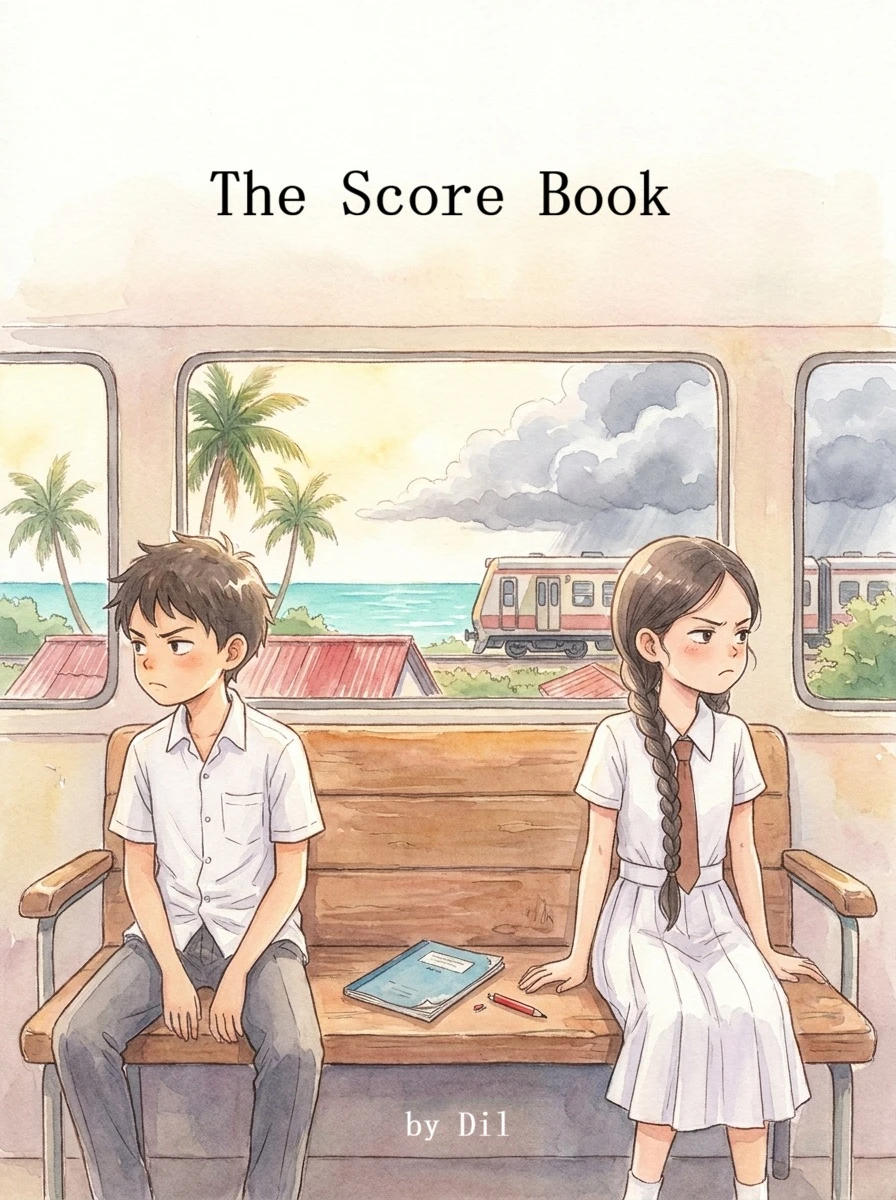
The Score Book
Sinossi
Sachith and Nethmi have fought since Grade One, and the proof is a battered blue exercise book that records every quarrel, from window seats to Maths marks. Then one rainy afternoon she quietly tilts her umbrella over him, and he starts to feel something he can’t name. Through monsoon storms, Avurudu games and the pressure of their final exams, pride keeps turning every near-miss into another fight. But there is a missing first page and half a red pencil, and the truth about how it all began has been waiting for twelve years.
One-line tagline: Twelve years of fighting takes more attention than most people give to loving.
Capitolo1
Grade 1, June. Red pencil. Winner: me. — No, me. — Both write “I am sorry” twenty times. — Hemamali Teacher
The 7:10 bus to Galle had one window seat left, and Sachith Wijesekara had seen it first.
This was a fact, and he intended to state it clearly, for the record, before anyone could dispute it.
“I saw it first,” he said.
“You saw it first with your eyes,” said Nethmi Rathnayake, who was already sitting in it. “I saw it first with my bag.”
Her school bag had come through the open window while the bus was still sliding into the Pitiwella halt, a throw so practised that the conductor had not even looked up. Every child on the Galle road knew the law of the window: the bag lands, the seat is claimed. Sachith knew the law perfectly well. He simply believed that laws could be wrong.
The seat beside her, on the aisle, was empty. He could have taken it and been at peace. He did not consider this an option.
“That’s not a rule,” he said. “That’s a habit.”
“Most rules are habits with better lawyers.”
“Where did you even get that?”
“From you. Grade Nine. You said it about the canteen queue.”
He had. This made it worse.
“Galle, Galle, Hikkaduwa, Galle!” bawled the conductor, slapping the side of the bus. “Move in, move in, children, the sea won’t wait for you!”
Behind them, at the halt, Mr. Fazil was lifting vadai out of his wok with the calm of a man who had watched this exact scene every school morning for twelve years. His one raised eyebrow floated through the steam.
“Same as yesterday?” he called.
“Worse!” they answered together, and then glared at each other for agreeing.
Sachith dropped into the aisle seat, and that was the humiliation of it. It was a Friday in mid-March, not summer and not monsoon but the island holding its breath. Over the sea the sky had stacked itself into grey towers that had not yet made up their minds. The air smelled of hot tarmac and frying oil and a storm that was thinking about it.
“Machan, give up,” said Ruwan, leaning over from the seat behind, his hair still wet from the well. “You give up with such style.”
“I have never given up.”
“Exactly. That’s the style.”
Sachith ignored him and unzipped his bag. Out came the Score Book.
It was a hundred-and-sixty-page exercise book, Mr. Fazil’s finest, its blue cover worn soft as cloth by twelve years of bags and rain. On the front, in a Grade One scrawl that nobody had ever had the heart to erase, it said SCORE BOOK. The first S was backwards. It was nearly full now. Every fight they had ever had lived in there: the date, the dispute, the winner. Any entry had to carry two signatures, the way a treaty does.
He uncapped his pen and wrote: Entry 1,897. Window seat (bag versus eyes). Winner:
He paused.
“Put ‘disputed,’” said Nethmi, without turning from the window.
“It’s not disputed.”
“I dispute it. Write: N.R. disputes.”
He wrote it, jaw tight, and held out the pen. She took it and initialled the line in her small, quick, annoyingly neat hand, and for a moment her fingers were very near his. He pulled the book back like a man snatching meat from a dog.
“Careful, Genius,” she said. “You’ll tear it.”
She called him Genius when she wished him to know it was not a compliment. She was small and quick, with a long plait that she flicked over her shoulder whenever she won an argument, and a pen tucked behind her ear that she never remembered was there. She had come second to him in Maths for three terms in a row, by margins small enough to keep him awake at night and, he suspected, to do worse to her. The rank board outside Gunasekara Sir’s room said so, in black and white. Five months to the A/L, and the only thing that mattered more than the rank board was the window seat.
He reached into his pencil case for a fresh pen, and there it was, as always, rolling against the ruler: Exhibit A.
Half a red pencil. Snapped clean in the middle, the stub dull with age. He had never sharpened it, never lent it, never lost it. When people asked, he said it was evidence. Nobody had ever asked what it was evidence of.
Nethmi’s eyes touched the stub and slid away so fast that Sachith, who read everything she did as an insult, decided that she was sneering at it.
“What?” he said.
“Nothing. Your handwriting’s getting worse.”
The bus shuddered and began to roll, the whole road swaying between coconut palms and tin-roofed shops. Somewhere behind them an aunty with a basket of mangoes was telling a stranger that the monsoon would be early this year, and the stranger was telling her it would be late. The sea flashed through the gaps between the houses.
He should have been thinking about Maths. Instead he was thinking about three weeks ago, on his own front verandah, when his mother had set down the teapot and announced to the whole table, in front of both of them: “Twelve years of fighting. I give them till the A/L results.”
And Nethmi’s mother, Sumithra Aunty, had said, “Till the wedding, you mean,” and the two women had laughed until they had to hold on to the table.
Sachith and Nethmi had looked at the ceiling in perfect synchrony. Neither had mentioned it since. It was the only subject on which they had never needed to argue.
The railway crossing came up without warning. The bus braked hard, the bell started clanging, and the 7:25 coastal train howled past, a long blur of blue and silver.
Nethmi, who was not holding on, slid sideways across the seat and landed against his shoulder.
Her plait swung across his arm. She smelled of jasmine hair oil and chalk dust. For one second, perhaps two, neither of them moved.
Then they sprang apart as though the other had caught fire.
“Watch where you’re going!”
“It was the bus! It was the bus!”
“You did that on purpose!”
“I would sooner sit on a cobra!”
The aunty with the mangoes looked at the stranger. The stranger looked at the aunty. Ruwan, in the seat behind, put his forehead against the rail in front of him and began, very quietly, to shake.
Sachith opened the Score Book again, mostly to have somewhere to put his eyes. He flipped back through the pages to check the rule about disputed entries, through years of small handwriting turning slowly into larger, and then back to the beginning, where the pages ran out.
There was no first page.
He had known this, in the way you know the shape of your own front door. But he had never looked at it. At the binding, where Entry One should have been, there was only a ragged stub of paper, torn out long ago. Hemamali Teacher’s twenty apology lines. The red pencil. The beginning of everything, and it was simply gone.
When? Grade Four? Five? Who had said what? He tried to remember, and discovered, to his own surprise, that he had never once asked.
Beside him, Nethmi had stopped talking.
She was looking at the torn edge under his thumb. She looked at it for exactly as long as it took him to notice that she was looking. Then she turned her face to the sea.
“Genius,” she said, a little too lightly. “You’re blocking my view.”
He closed the book.
Somewhere out over the water, very far away, the thunder cleared its throat.
Ultimi capitoli
The last page. Still blank.
He got two hundred metres.
At the second lantern gate, th
(In pencil, in a different hand.) Mar 27. Umbrella. He pretended not to notice. Idiot. For three wee
Entry 1,971. Nobody wins. Nobody is speaking. By the time school reopened after the holidays, the ka
Avurudu entry (unfinished). Kana mutti. Winner: — The new year began, as it always did, with a small