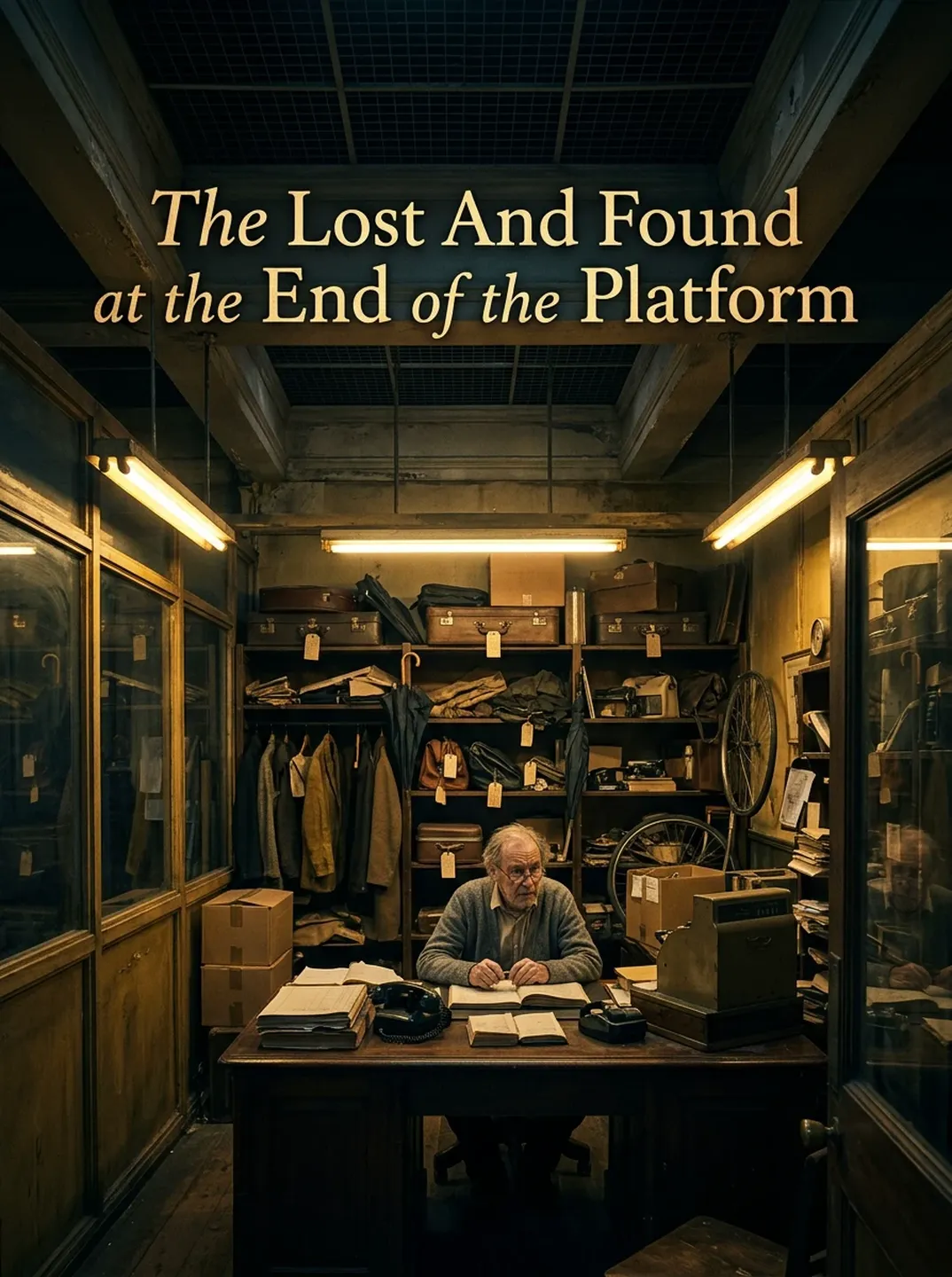


The Divine After Sales Office
Synopsis
Every wish has a price. Some come with a lifetime warranty.
Tucked away on the forgotten seventh floor of a derelict shopping mall is an office unlike any other. It handles complaints that no ordinary customer service department would dare entertain.
A man who wished for eternal life wants to die. A woman whose prayer saved her brother wants to know why everyone else in her family is paying the price. And somewhere in an impossible warehouse, billions of forgotten wishes are waiting to be fulfilled.
When Nikhil Deshpande, an ordinary customer service executive, finds himself working at the Divine After-Sales Office, he discovers that even miracles come with terms and conditions. Behind the divine paperwork, mysterious vouchers and endless complaint registers lies a secret that could change everything humanity believes about the gods.
The gods, it turns out, have a problem of their own.
As wishes begin to malfunction across worlds, Nikhil must unravel a cosmic conspiracy.
Chapitre1
The termination letter was already turning to pulp in his pocket.
Nikhil Deshpande stood under the awning of a closed pharmacy and watched the rain erase the street. It was the kind of Mumbai monsoon that made the city forget itself — autorickshaws abandoned at intersections, chaiwallahs covering their pots with plastic sheets, the gutters overflowing with gray water that smelled of wet concrete and old garbage. His phone had died twenty minutes ago. The battery had been at four percent when he'd walked out of the Vikas Insurance building for the last time, and he'd used those four percent checking his messages. There were none.
He'd worked at Vikas for eleven years. Eleven years of "Your call is important to us" and "I understand your frustration, sir" and "Let me escalate this to my supervisor." Eleven years of Mrs. Sharma from Andheri calling every Tuesday to dispute her premium increase, of Mr. Joshi from Dadar insisting his heart surgery had been a pre-existing condition that definitely wasn't pre-existing, of a thousand voices pitched in the same register of grievance and disappointment.
His manager had called him into the glass-walled office at 4:47 PM.
"Nikhil, sit down."
Nikhil had not sat down. He'd stood with his arms crossed and watched Mr. Venkatesan's mustache twitch the way it always did before bad news, and he'd known what was coming — the quarterly numbers, the restructuring, the "we value your contribution but." What he hadn't expected was his own voice, calm and detached, cutting through the corporate language like a blade through wet paper.
"Just say you're firing me, Venky. I've been handling complaints for eleven years. I know a complaint when I hear one."
And Venky's mustache had stopped twitching.
The termination letter was three paragraphs. The first paragraph thanked him. The third paragraph wished him well. The second paragraph, the one that mattered, had been written by someone who'd clearly been trained to avoid the word "fired" the way a priest avoids the word "damned." *Due to organizational restructuring and a reassessment of operational priorities, your position has been identified as redundant.*
Redundant. He'd turned the word over in his mind as he'd walked out of the air-conditioned lobby into the wet heat of the evening. His position. His eleven years of absorbing other people's anger, of knowing exactly how long to pause before saying "I completely understand," of defusing the irate and comforting the desperate — redundant. As if he'd been a spare part. As if customer service was something you could trim like fat from a budget.
The rain intensified. Nikhil pressed himself closer to the pharmacy's metal shutter and watched a street dog shake itself under a parked truck. He needed shelter. He needed a working phone. He needed, if he was being honest, a drink that would make the afternoon feel like something that had happened to someone else.
That was when he noticed the mall.
It stood at the end of the street, a six-story concrete box with a glass facade that had once been gold-tinted but was now the color of dirty dishwater. He'd passed it a hundred times without seeing it. Everyone had. Grand Paragon Shopping Centre — a name that had been aspirational in the 1990s and was now just sad. The anchor stores had closed first: the department store, the cinema, the food court with its plastic palm trees and its promises of American-style pizza. The smaller shops had followed, one by one, until all that remained was a shell with boarded-up windows and a padlocked entrance.
Except the entrance wasn't padlocked.
The chain hung loose. The padlock was on the ground, half-submerged in a puddle that reflected the gray sky. A gap in the boarded-up doors was wide enough for a man to slip through, if the man was thin enough and desperate enough.
Nikhil checked his pocket. The termination letter had become a ball of wet paper, the ink already bleeding into illegibility. He had nothing to protect from the rain. No documents, no dignity, no reason not to step through a gap into an abandoned building that might collapse and save the universe the trouble of figuring out what to do with him next.
He slipped through.
Inside, the mall was dark and echoing. The emergency lights had died years ago, but the glass roof — cracked in places, sealed in others — let in enough gray light to see by. The escalators were frozen waterfalls of rust. The central fountain was a dry crater filled with plastic plants and a single abandoned sandal. The smell was damp plaster and pigeon droppings and something else, something sweet and chemical that reminded him of the air freshener his mother used to spray in the bathroom before guests arrived.
His footsteps squeaked on the marble floor. The sound traveled up to the third-floor balcony and came back a half-second too late, as if the building was listening and taking its time to respond.
He walked past a shuttered mobile phone shop. Past a bookstore whose shelves were still stacked with yellowed paperbacks — self-help, mostly. *How to Win Friends and Influence People.* *The Secret.* *The Power of Positive Thinking.* All the books people bought when they wanted the universe to give them something without asking what the universe would take in return.
The elevator was at the far end of the ground floor, next to what had once been a vending machine. The machine's glass front was smashed, its coils empty except for a single packet of chips that looked like it had been there since before Nikhil had started at Vikas. The elevator doors were closed. Above them, a floor indicator — dark, dead, like everything else in the building.
Nikhil pressed the call button.
He had no idea why he pressed it. Habit. Muscle memory. Eleven years of pressing buttons and waiting for things to happen, of navigating systems designed by people who'd never had to use them. The button was cold under his thumb, and nothing happened, which was exactly what he'd expected.
He was turning away when the indicator light flickered on.
Floor 1. Then 2. Then 3. The numbers climbed with a mechanical hum that sounded like it was coming from very far away, as if the elevator was descending through another building entirely. Nikhil took a step back. The doors were still closed, but he could feel the vibration through the floor — a low, regular pulse that matched his heartbeat and then, after a moment, seemed to be leading it.
Floor 5. Floor 6.
The doors opened.
The elevator was clean. That was the first wrong thing. The second was the light — warm and steady, no flicker, no buzz, the kind of light that should not exist in a building that had been abandoned for longer than some of his colleagues had been alive. The third was the mirror on the back wall. It reflected a man in a wet shirt, his hair plastered to his forehead, his eyes slightly too wide.
He stepped inside.
The buttons went up to six. But there was a seventh button, positioned slightly apart from the others, unmarked. Nikhil looked at it for a long moment. It was a button like any other button — round plastic, slightly yellowed with age, the number worn away. But it was there, and elevators did not have buttons for floors that did not exist, and if he pressed it, nothing would happen, and then he could go back to standing in the rain and being unemployed and redundant.
He pressed it.
The doors closed. The elevator rose. The floor indicator counted: 2, 3, 4, 5, 6.
It did not stop at 6.
The 6 blinked and went dark, and there was a pause — a long, humming pause during which Nikhil felt the weight of the building pressing down on him — and then a sound. It was not a bell. It was more like a breath released, a sigh from somewhere inside the walls, and the doors opened onto a corridor that should not have been there.
The corridor was white. Clean white, institutional white, the white of hospital waiting rooms and government offices and places where people waited for bad news. Fluorescent lights hummed overhead. The floor was linoleum, buffed to a dull shine. At the end of the corridor was a door.
The door was made of frosted glass. On it, in gold lettering that looked freshly applied:
DIVINE AFTER-SALES OFFICE
Complaints · Revisions · Reconciliation
(No Appointment Necessary)
Nikhil stood in the elevator, one hand holding the doors open, and tried to think of a rational explanation. He failed. The rain must have done something to him. Exhaustion. Dehydration. Maybe he'd been hit by a car crossing the street and this was a coma dream. Maybe the padlock hadn't been real and the chain hadn't been real and he was still standing outside the pharmacy, hallucinating from the cold.
The corridor waited. The fluorescent lights hummed. The door at the end did not disappear.
He walked toward it.
The office was smaller than he'd expected. A desk. Two chairs. A filing cabinet. A telephone that looked like it had been manufactured in 1987 — beige plastic, coiled cord, actual buttons with actual numbers. A window that showed only gray light, no view, as if the building was suspended in cloud. And behind the desk, a woman.
She was in her mid-thirties, or possibly her mid-forties, or possibly older than she looked — the kind of age that was less a number than a quality of stillness. Her hair was pulled back in a bun that revealed the elegant architecture of her face: high cheekbones, dark eyes that held the light without reflecting it, a mouth that seemed to be holding back a smile. She wore a cream-colored sari with a gold border, and her hands were folded on the desk in front of her. No computer. No papers. No coffee cup. Just the hands, and the telephone, and the stillness.
"Nikhil Deshpande," she said. "Please, sit down."
Her voice was not warm and it was not cold. It was the voice of someone who had been waiting for him and was neither pleased nor displeased that he had arrived.
He did not sit down. "How do you know my name?"
"You worked at Vikas Insurance for eleven years. Customer Support, Tier Two. Your employee ID was VK-4429-SR. Your last performance review noted 'excellent conflict resolution skills' and 'a tendency toward sarcasm in high-stress situations.' You were terminated at 4:47 PM today. Your manager, Mr. Venkatesan, cited restructuring." She paused, and her eyes moved from his face to his left hand. "Your divorce was finalized fourteen months ago. Her name was Kavita. She kept the apartment. You kept the pressure cooker."
The hum of the fluorescent lights filled the room.
"I don't know what this is," Nikhil said.
"You do."
"It's a prank." His voice came out flatter than he intended. "Venky put you up to this. Or it's one of those hidden camera shows. Is there a camera? Let me guess — you're going to offer me a job. Some kind of cosmic customer service position. And then the host jumps out and tells me I should have seen the look on my face."
The woman — Meera, though she hadn't yet told him her name — opened a drawer in the desk and removed a single sheet of paper. The paper was cream-colored, thick, the kind of paper that contracts were printed on. She placed it on the desk and turned it so he could read it.
It was a job offer.
POSITION: Claims Resolution Specialist, Tier One
DIVISION: Divine After-Sales Office
SUPERVISOR: Meera (Senior Claims Officer, 7th Floor)
COMPENSATION: To be negotiated
HOURS: As required
The rest of the text was in a language Nikhil did not recognize — elegant script, looping and ancient, the characters shifting slightly when he tried to focus on them.
"Who are you?" he asked.
"Meera."
"That's not what I meant."
"I know what you meant." She leaned back slightly in her chair. "I am the senior claims officer for this office. I have been in this position for six hundred years. Before that, I was human. Before that, I was a mother. Those are the only things about me that matter for your purposes."
The telephone rang.
The sound was jarring — a mechanical trill, too loud for the small room, echoing off the white walls. Nikhil flinched. Meera did not. She looked at the phone, then at Nikhil, and her mouth did something that was not quite a smile.
"Answer it," she said. "It's for you."
"It's not for me."
"It will be."
The phone rang again. Three rings. Four. Nikhil had answered ten thousand phone calls in his career, had learned to read a caller's mood from the first syllable of the first word, had defused nuclear-level anger with nothing but his voice and his training and his hard-earned knowledge that most people just wanted to be heard. But his feet would not move.
"It's just a phone call," Meera said. "You've done it thousands of times."
"Not like this."
"No. Not like this."
The phone rang a fifth time. And because Nikhil Deshpande was a man who answered phones, because it was the only thing he'd ever been good at, because a part of him still believed that if he just picked up the receiver, everything would resolve into something ordinary and explainable — he crossed the room and lifted it to his ear.
"Divine After-Sales Office," he said. His voice was steady. Eleven years of practice. "How can I help you?"
The woman on the other end was crying. She was trying not to cry — he could hear the effort, the way her breath caught and steadied, the way she swallowed before speaking — but the tears were there, thickening her voice, making her words run together like wet ink.
"My name is Ananya Rao. I—" She stopped and breathed. "I made a wish. Years ago. I think it went wrong."
"What was the wish?"
"My brother was dying. He was seventeen. The doctors said three months, maybe four. I went to the temple every day. I prayed at the mosque. I lit candles at the church. I didn't care who was listening. I just wanted someone to listen." Her voice cracked. "And someone did. He got better. The doctors called it a miracle. They couldn't explain it. My brother walked out of the hospital three weeks later, and every test they ran came back clean, and I thought — I thought I had been heard."
Nikhil looked at Meera. She was watching him with those dark, lightless eyes, her expression unreadable.
"What happened next?" he asked.
"My mother died." The words came quickly now, as if she'd been holding them too long. "A heart attack. She was forty-nine and perfectly healthy and one morning she just didn't wake up. Then my father — a car accident, a year later. No other vehicles involved. He drove into a tree on an empty road in broad daylight. Then my aunt. Then my closest friend from university. Then my cousin who I grew up with, who was like a sister to me." She stopped. Nikhil could hear her breathing, ragged and uneven. "Every year since my brother recovered, someone I love has died. And I didn't see the pattern. I didn't want to see it. But last month, my niece — she's six years old — she was diagnosed with something the doctors can't explain. And I thought: it's happening again. It's still happening."
"And you think it's connected to the wish."
"I know it's connected to the wish. I asked God to save my brother. God saved my brother. And now everyone else around me is paying for it." Her voice dropped to something that was not a whisper but close. "I want to file a complaint. I want to cancel the wish. I want to give it back."
Nikhil's hand tightened on the receiver. He had heard complaints before. Thousands of them. People angry about premiums and deductibles and denied claims and fine print they should have read before signing. But he had never heard anyone ask to return a miracle.
"Can you do that?" Ananya asked. "Can you help me?"
He looked at Meera. Meera's expression had not changed, but her hands had moved — she was holding a file now, a thick manila folder with a red seal on the front. She slid it across the desk toward him.
"I don't know," he said into the phone. "I don't work here."
"You answered the phone," Ananya said. "Doesn't that mean you work here?"
The fluorescent lights hummed. The rain was still falling — he could hear it against the window that showed nothing but gray. And Nikhil Deshpande, who had lost his job and his marriage and most of his faith in the idea that the universe was anything other than indifferent, stood holding a telephone in an office that should not exist, listening to a woman ask him to undo a miracle.
"I'll look into it," he said.
"Thank you," Ananya whispered. "Thank you. I—" The line went dead.
Nikhil put the receiver down. His hand was shaking. He looked at Meera, at the file with the red seal, at the contract on the desk with his name already filled in.
"This isn't real," he said.
"It's real."
"It can't be."
"And yet." Meera gestured at the chair. "Sit down, Mr. Deshpande. Your first day begins now."
Derniers chapitres
The fluorescent lights hummed.
Nikhil watched the receiver, back in its cradle, as
The termination letter was already turning to pulp in his pocket.
Nikhil Deshpande stood unde