
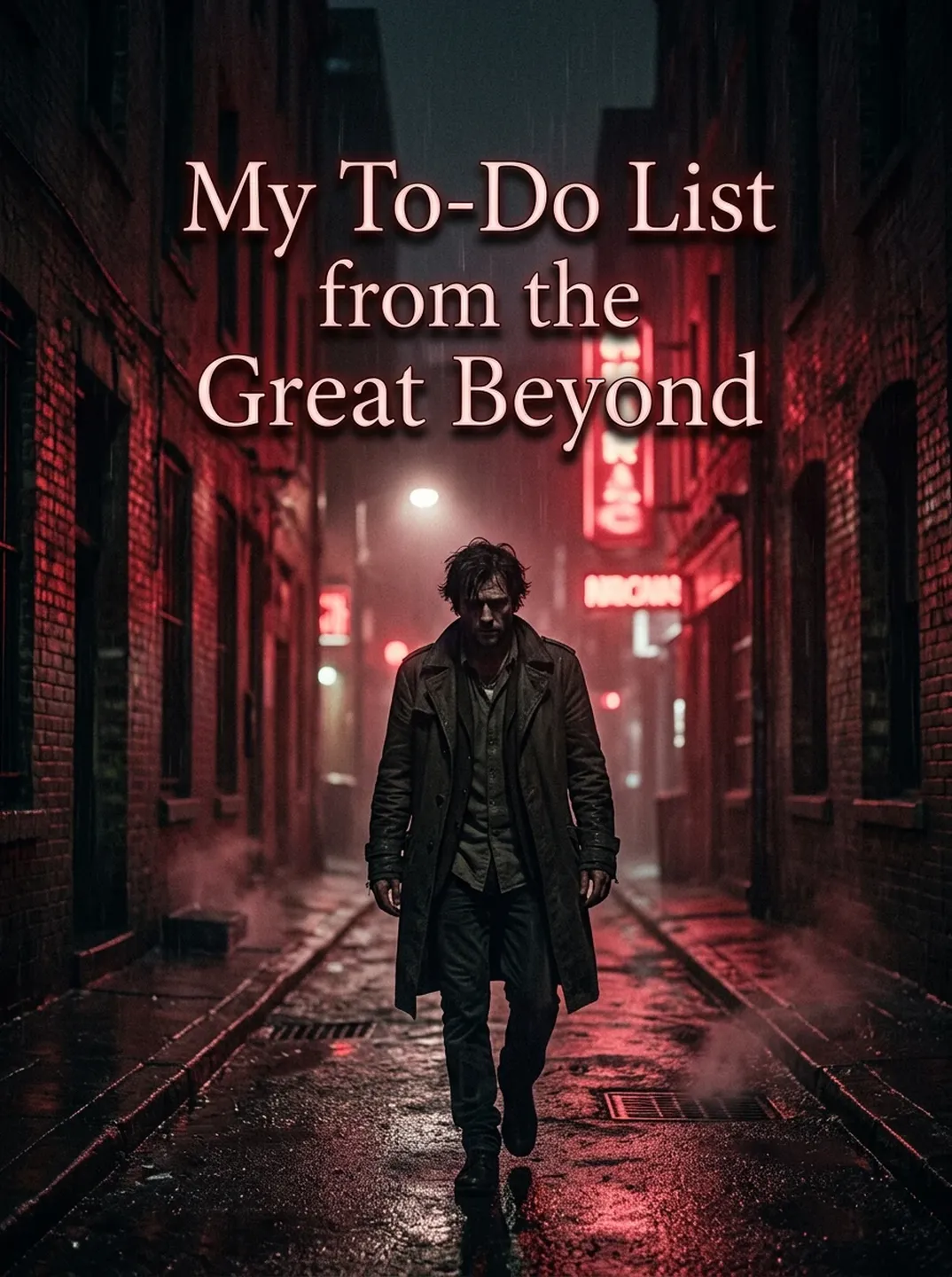
My To Do List from the Great Beyond
Sinopsis
My heart was a scratched record, stuttering toward a final, fatal silence. Then she appeared—a predator in tailored silk, offering eternity in a crystal glass.
I drank, and was reborn into a world of shadow and blood. Now, mirrors forget my face, the sun is my sworn enemy, and an endless thirst dictates my every move. She calls this bond a gift; I call it a beautiful cage. As I walk the razor's edge between human and monster, I only want to know: Was I saved, or was I merely acquired?
Capítulo1
The Uber’s tires kissed the curb on Sunset Boulevard at exactly midnight, engine idling like a nervous heartbeat. Sophia’s palm was already on the inside handle, but she didn’t pull it; she stared at the neon script spelling ECLIPSE thirty yards ahead, each letter strobing between violet and white as if the building itself were winking at her. Alex leaned forward from the opposite seat, elbows on knees, voice pitched low enough to slide under the Afro-beat leaking from the driver’s phone.
“You still owe me for the Nobu tab,” he said, not quite a whisper, not quite a threat. “Three-hundred-dollar toro that you swore you’d pay back in January. It’s June.”
Sophia’s throat tightened. She had planned to wire him the money tomorrow, had even opened the transfer window on her phone before chickening out. “I told you—”
“You told me you hate clubs, you hate crowds, you hate music loud enough to liquefy your spleen.” Alex’s grin was all teeth, no mercy. “Consider this interest.”
He slid out first, dress shoes hitting pavement with the confidence of someone who believed the night existed solely for his amusement. Sophia followed because the alternative was sitting in a stranger’s Honda Accord until the driver called the cops. The borrowed stilettos—Alex’s cousin’s—pinched her smallest toes like vindictive clothespins. Each step toward the velvet rope was a miniature crucifixion.
The bouncer, a man whose neck resembled a Doric column, scanned a QR code on Alex’s phone, then glanced at Sophia. “Name?”
“She is with me,” Alex answered, hand clamping her wrist. The rope lifted. Sophia felt the bass before she heard it, a subterranean thud pulsing through the sidewalk, up the bones of her legs, nesting behind her eyes.
Inside, the air was a living thing, hot and artificial, laced with fog-machine glycol and the coppery tang of too many bodies. Lasers slashed the darkness into ribbons of teal and magenta, scalpels of light that seemed to dissect the dancers mid-motion. Sophia immediately wanted to leave, but Alex had already dissolved into the swarm, swallowed by a forest of glittering skin and designer mesh. She forced herself to the bar, a monolithic slab of back-lit onyx that glowed like a spaceship console.
“Ginger ale, no ice,” she told the bartender, a woman with a razor-sharp undercut and earrings that looked like miniature handcuffs. Sophia mouthed the words again—survive two hours—while the woman popped a metal straw into the glass. The mantra tasted like kindergarten field trips and dentist waiting rooms: harmless, comforting, useless.
She chose the stool farthest from the dance floor, shoulders rounded, phone clutched in both hands like a rosary. Around her, conversations happened in fragments shouted directly into ear canals. A man in a mesh tank top argued about Ethereum. A girl with LED eyelashes laughed so hard she hiccupped glitter. Sophia sipped her ginger ale and counted the bubbles, a trick her therapist suggested for acute anxiety: one bubble, two bubbles, three—
The cold arrived first, a pocket of winter that prickled the fine hairs on her forearms. Then came the scent: alpine frost over something metallic, like snow on copper pipes. Sophia glanced left and saw the woman sliding onto the neighboring stool, motion fluid enough to belong in a nature documentary about apex predators.
Ms. Sterling—though Sophia wouldn’t learn the name for another ten minutes—wore a charcoal suit cut sharp enough to slice bread, the jacket collar high and rigid like origami armor. Her shirt was white, her tie a whisper of silver, and her shoes—Oxford spectators—reflected the bar lights in perfect mirror images. Most striking were the sunglasses: matte-black frames, lenses so dark Sophia couldn’t tell whether eyes existed behind them at all. They stayed on, impolite and absolute.
The bartender materialized instantly. “Ms. Sterling, the usual?”
“Please, Camille. And leave the bottle.” The voice was cultured, mid-Atlantic, each consonant landing like a coin on marble. Sterling’s lips barely moved, yet the words arrived fully formed, as if they’d been pre-recorded.
Sophia realized she was staring. She redirected her gaze to her ginger ale, but the cold persisted, radiating sideways like an open freezer door. She shifted on the stool; the vinyl squeaked. Sterling’s head tilted a fraction—an acknowledgment? An appraisal? Sophia’s pulse stumbled.
Alex reappeared then, flushed and glossy with sweat, pupils dilated to coin slots. He draped an arm across Sophia’s shoulders, breath hot with vodka and lychee. “Babe, you’re hoarding the only sober square foot in L.A.” He noticed Sterling and straightened, charm reflex kicking in. “Well, hello, style icon.”
Sterling’s expression didn’t change, yet the corner of her mouth twitched, a microscopic seismic event. “Good evening, Bacchus,” she said to Alex, then returned her attention to the tumbler Camille had set down. Inside: a clear liquid that steamed, as if the glass contained dry ice rather than alcohol.
Alex blinked. “Bacchus? I mean, I do enjoy a libation, but—”
“‘Most people are other people,’” Sterling quoted, voice soft enough to skate under the music. “‘Their thoughts are someone else’s opinions, their lives a mimicry, their passions a quotation.’ Wilde, naturally.” She lifted the glass but didn’t drink. “Tell me, Sophia, do you quote your life or live it?”
Sophia’s spine turned to glass. She had never given this woman her name. “I—I’m sorry, do we—?”
“Your heartbeat,” Sterling said, tilting the sunglasses toward Sophia’s chest. “It’s arrhythmic. Skips every third beat, then compensates with a double. Rather like a waltz in minor key.”
Alex laughed too loudly. “Okay, that’s a killer party trick. You a cardiologist on the side?”
Sterling ignored him. “Fear makes the blood taste metallic, did you know? Copper and ozone. Adrenaline is sweeter, almost citrus, but fear—fear is vintage.” She set the glass down untouched. “My daughter preferred citrus. She used to squeeze tangerines into snow, said it tasted like Christmas mornings.”
The words hung, incongruous, amid the club’s bacchanal. Sophia felt the conversation sliding sideways into something unsafe. She slid off the stool, ready to bolt, but Sterling’s gloved hand brushed her wrist—feather-light, yet the cold shot straight to Sophia’s marrow.
“She’s dead,” Sterling continued, conversational, as if discussing stock futures. “Car accident on the 405, three years ago next week. A drunk marketing intern in a Bronco swerved across four lanes. They told me she felt no pain, but pain is relative, isn’t it? What she felt was absence. Of light, of breath, of future.”
Alex’s grin faltered. “Jesus, I’m—sorry for your loss, but maybe this isn’t—”
“I’ve searched,” Sterling said, voice never rising, never breaking. “For someone to fill the silence. Not replace—one never replaces—but to occupy the vacuum. A surrogate, if you prefer. A daughter-in-proxy.” She removed the sunglasses.
Her eyes were the color of glacier melt, pupils slitted like a cat’s caught in headlamps. And then, deliberate, she smiled. The canines were longer than they should have been, tapering to surgical points that dented her lower lip. A bead of crimson appeared, startling as a poppy in snow.
Sophia’s body locked. Every evacuation route in her brain lit up red: scream, run, throw the ginger ale, punch, kick. None activated. The music swallowed her heartbeat whole.
Sterling leaned closer, breath winter-cold against Sophia’s cheek. “You’ll do nicely,” she whispered. “Such lovely irregular music you make.”
The room tilted. Sophia’s knees buckled; the bar edge dug into her hip. Alex caught her elbow, swearing, but his voice arrived muffled, as if through cotton. Sterling righted her glass with one finger, the gesture almost tender.
“Consider it,” she said, sliding a matte-black business card across the onyx. No name, no number—only an embossed eclipse, half gold, half silver. “When the noise becomes unbearable, call. I’ll answer before the first ring finishes.”
She stood, suit uncreased, and melted into the crowd. The cold lifted; the air reverted to its former swamp-heat. Sophia stared at the card. Her reflection fractured across the metallic eclipse: eyes wide, mouth bloodless, a stranger wearing her face.
Alex shook her. “Soph, hey, look at me. That was some avant-garde performance art, right? Those contacts? The fake blood capsule?”
Sophia couldn’t answer. Her heartbeat, traitorous, had resumed its waltz—one, two-three, one, two-three—minor key intact. She slipped the card into her palm; the paper felt refrigerated.
Across the club, lasers continued their surgery, slicing the night into sellable pieces. Sophia closed her eyes and tasted copper, ozone, and the ghost of tangerine snow.
The bass line punched through the soles of Sophia’s boots before she even cleared the velvet rope. Neon strobes sliced the smoke, turning the warehouse-sized room into a slow-motion kaleidoscope. She had come inside only because the sidewalk had filled with laughing strangers who kept asking if she was “the plus-one for the rooftop,” and standing still had felt more dangerous than moving. Now every thump of the kick drum seemed to echo Alex’s last slurred warning—“Don’t wander off, kid, this isn’t Chapel Street”—and she wondered how long it would take him to notice she’d slipped past the bouncers.
She skirted the edge of the dance floor, one hand on the chrome rail that separated the bar from the writhing crowd. The rail was warm, alive with the tremor of hundreds of elbows and hips. A server in chrome wings and little else shoved past with a tray of violet shots; the liquid sloshed like radioactive candy. Sophia flinched, ducked beneath a low-hanging speaker, and straightened into a pocket of sudden quiet.
That was when Sterling stepped out of the strobes.
The woman wore midnight the way hurricanes wore wind—tailored, seamless, inevitable. The silk tee beneath her jacket caught a flash of magenta light and threw it back like a dare, the neckline diving low enough to make Sophia forget how to swallow. Sterling’s glasses were mirrored, two small disco balls that returned every wandering beam to its sender. She tilted her head, and for a heartbeat Sophia saw her own startled face doubled in those lenses: pale, wide-eyed, hair frizzing from the coastal damp she’d carried inside.
“I drift where the wind blows,” Sterling said, voice pitched low enough to live inside the bass rather than fight it. The sentence smelled of expensive cigarettes and something metallic, as though she had inhaled the club’s circuitry and exhaled philosophy. Then, without transition, the smile vanished. “Where do you actually belong?”
The question hit harder than the sub-woofer. Sophia’s spine answered before her mouth did, straightening until the back of her skull kissed the velvet curtain behind her. “I hate clubs,” she blurted. The words tasted honest, like biting aluminum. She expected Sterling to laugh—everyone else had laughed at her tonight—but instead the woman’s mouth curved into something smaller, sharper, real.
“Finally,” Sterling murmured, “a verifiable fact in this temple of advertising.”
Sophia felt the smile land somewhere beneath her ribs, a warm penny dropped into an empty well. She opened her mouth to ask what kind of facts Sterling collected, but a wall of cologne and beer inserted itself between them.
Alex, six-foot-plus and widening by the second, had found her. His cheeks were flushed with the particular magenta of someone who had started drinking before sunset. “There you are.” His voice cracked on the last consonant. He flung an arm around her shoulders, heavier than memory allowed. “Where d’you live? Who’s your Uber buddy?” The questions tumbled out like dice he’d already tossed too many times.
Sterling regarded him the way a chess master regards a toddler grabbing pieces at random. “She’s in excellent hands,” she answered, sweet as arsenic dissolved in honey. Her tongue flicked once across perfect teeth—quick, diagnostic—checking the hardware of the moment. Sophia realized, with a lurch, that Sterling was cataloguing Alex’s tells: the twitch above his left eyebrow, the way his thumb dug into Sophia’s collarbone, the fractional delay between question and blink.
Alex squinted at the mirrored glasses, trying to locate an pupil to intimidate. “I asked the lady, not the jacket ad.”
Sterling’s reply was a silence so complete the surrounding music seemed to duck to hear it. Then she stepped sideways, just enough to place herself at a forty-five-degree angle to Alex, a position that left his blocking stance suddenly useless. Sophia felt the arm around her slacken.
“Boys and their liquid courage,” Sterling said to no one in particular. She lifted a hand; a passing server placed a crystal tumbler into it as though the gesture had been choreographed weeks earlier. Ice chimed. “Oscar Wilde understood: ‘To live is the rarest thing—most people merely exist.’” The quotation floated between them like a silk scarf soaked in ether. She didn’t look at Sophia when she said it, but the words stapled themselves to the underside of Sophia’s sternum anyway, price tag and all, announcing exactly what this evening was costing.
Alex snorted. “Great, we’re quoting dead playwrights now. Come on, Soph, let’s bounce before Goth Cinderella here turns the pumpkin into a bong.”
Sophia didn’t move. The bass had dropped to a single heartbeat throb, and in the trough between pulses she heard her own blood answer: I want to exist, not just not-die. The realization tasted bright and dangerous, like biting a lightbulb.
Sterling sipped, ice clicking against enamel. “Your brother’s boredom is contagious,” she observed. “Maybe we should quarantine him on the curb.”
“He’s not my brother,” Sophia corrected before thinking. The denial surprised them both; Alex’s arm slipped off entirely.
Alex opened his mouth, closed it, then pivoted toward the bar with the lumbering dignity of a bear who’s just discovered the beehive is full of mirrors. “Five minutes,” he threw over his shoulder, not specifying what would happen in five minutes, or to whom.
Sterling watched him merge into the swarm of elbows. “Diagnostic complete,” she said softly. “Moderate toxicity, high volatility, zero attention span.” She turned back to Sophia. “You, on the other hand, register elevated curiosity and acute allergic reaction to peer pressure. Fascinating case study.”
Sophia’s cheeks burned. “You make me sound like a lab rat.”
“Rats learn faster than most mammals,” Sterling replied. “Compliment, I assure you.” She tilted the tumbler, letting violet light refract through the liquid. “Tell me, what brings a self-declared club-phobe into the epicenter of synchronized perspiration?”
The honest answer—because Alex had promised a ride home and then swallowed the key to his judgment—felt too heavy for this glittering moment. Instead Sophia shrugged. “Wrong turn at the coat-check.”
Sterling’s laugh was a low voltage current. “The best journeys begin with wrong turns. Columbus was aiming for India.” She gestured toward a velvet-lined staircase spiraling up toward the rafters. “I keep a quieter deck above the fog. Fewer spilled drinks, better sightlines. Interested?”
Sophia glanced toward the bar. Alex had cornered two women in sequined harnesses; they were laughing at something he’d unzipped. Five minutes, he’d said, but time inside the club moved like syrup in winter. She pictured herself outside on the curb, waiting for him to negotiate last call, then the inevitable argument about who had lost whose house keys. The image tasted gray.
Above, Sterling waited, midnight jacket open like an invitation to step through a mirror. Sophia inhaled: sweat, citrus fog, the copper tang of adrenaline. She exhaled the word “Okay,” and followed the hurricane in tailored silk.
The staircase was steeper than it looked, each step upholstered in bruise-colored velvet that muffled their ascent. Halfway up, the music thinned, shedding layers until only a heartbeat remained. Sterling didn’t look back, but her pace adjusted so Sophia walked beside rather than behind. At the landing, a velvet rope blocked entry; Sterling unhooked it with the absent authority of someone who kept keys to side doors in every city.
The mezzanine overlooked the dance floor through a lattice of brass chains. Sofas shaped like crescent moons formed loose constellations. A couple lay entwined on one, motionless as sculpture. Another sofa held a man in a white linen suit conducting an invisible orchestra, fingers flicking in perfect 7/8 time. No one glanced up.
Sterling chose a sofa beneath a stained-glass skylight where the club lights painted shifting galaxies across the cushions. She sat sideways, knees drawn up, inviting Sophia to mirror the posture. When Sophia complied, their shoulders almost touched. Almost.
“Better?” Sterling asked.
Sophia realized she could hear her own answer. “Yes.” The word left her mouth clean, like water poured from a chilled bottle.
Sterling produced a small silver case, flicked it open. Inside lay what looked like business cards, except the lettering shifted when Sophia tried to read it. Sterling selected one blank rectangle and held it between two fingers. “Question game,” she said. “We alternate. Lies cost a minute of silence. Truths earn follow-up questions. You start.”
Sophia stared at the card. Its surface flickered, reflecting the skylight’s fractured reds. “What’s your real name?” she asked before courage deserted.
Sterling’s smile returned, fox-bright. “Sterling is the name I answer to when the moon is waxing. Next.” She flipped the card toward Sophia; it landed face-up, still blank.
“That’s not a truth,” Sophia protested.
“Check the rules,” Sterling countered. “I didn’t lie. Your turn to answer.”
Sophia swallowed. The heartbeat from downstairs had crept upstairs and nested in her throat. “Sophia Jane Calder,” she said. “Twenty-two. Studying library science. I catalog things that don’t belong to me.”
Sterling leaned closer. The mirrored glasses were useless up here; Sophia saw only her own anxious reflection multiplied. “Perfect,” Sterling whispered. “Now we know where to shelve you.” She plucked the card back, and suddenly it wasn’t blank: tiny embossed letters spelled SJC in a corner, the ink still warm.
“Your question,” Sophia reminded.
Sterling tapped the card against her lower lip. “What scares you more—being lost, or being found?”
The skylight above them shifted from indigo to arterial red. Sophia felt the color change slide across her skin. “Being found by the wrong person,” she said, surprising herself with the certainty.
Sterling’s pupils widened, dark eclipses swallowing mirrored sky. “Truth,” she judged. “Follow-up earned.” She paused, letting the silence stretch until it twanged. “Is the wrong person downstairs wearing your brother’s jacket?”
Sophia’s breath hitched. “He’s not—” She stopped, started again. “He’s the only map I have left.”
“A map that leads in circles,” Sterling observed. She snapped the silver case shut; the click echoed like a distant gunshot. “Maps can be redrawn. Territory, however, insists on itself.” She rose in one fluid motion and offered her hand. “Come. I want to show you something that doesn’t belong to anyone.”
Sophia hesitated. Somewhere below, the bass had reassembled itself into a recognizable song—something eighties, something Alex would sing off-key while hunting for his missing keys. She pictured him barging upstairs, shouting her name, the public scene, the Uber ride home thick with recrimination. She pictured herself months from now, cataloging books by day, cataloging regrets by night, always wondering what had waited at the top of the velvet stairs.
She took the hand.
Sterling’s grip was cool, steady, the pulse in her wrist ticking faster than club tempo. She led them past the crescent sofas, past the conducting maestro, to a door disguised as part of the brass lattice. A push, a breath of cooler air, and they stepped onto a fire escape that shouldn’t have existed on the inland side of the warehouse. City lights sprawled below like spilled rhinestones. The music dulled to a memory.
Sterling released her hand and pointed across the alley. On the opposite roof, someone had built a greenhouse from old windows, each pane catching the club’s rotating beams and throwing back fractured rainbows. Inside, vines pressed against the glass, leaves silvered by moonlight.
“An architect’s abandoned thesis,” Sterling said. “He vanished after declaring that every structure should contain its own ruin. The plants survived him. They bloom once every three years. Tonight is night two.”
Sophia gripped the railing. The drop wasn’t lethal, but it was enough to remind her ankles how falling felt. “We can’t get over there.”
Sterling reached into her jacket and produced something the size of a fountain pen. She pressed a button; a grappling hook unfolded with a soft metallic yawn, trailing black cord fine as spider silk. “Wind blows,” she reminded, “I drift.” She handed Sophia the device. “Your turn to decide if you exist.”
Behind them, the door thudded: Alex had discovered the staircase. His voice, slurred and panicked, ricocheted off the brass chains. “Soph! You up here? This isn’t funny!”
Sterling didn’t move. She waited, mirrored glasses reflecting the greenhouse, the city, the choice. The grappling hook felt heavier than physics allowed, as though it contained every wrong turn she hadn’t taken.
Sophia’s pulse hammered against her eardrums. She tasted copper, ozone, the bright terror of being found by the wrong map. Somewhere inside the greenhouse, a single white flower pressed against the glass, opening in slow motion under the strobing lights.
She exhaled, stepped onto the railing, and aimed the hook at the opposite roof. The metal bit home with a satisfying clang. Sterling’s smile curved, fox-bright, hurricane-certain.
“Hold tight,” Sterling murmured, fitting her hand over Sophia’s on the line. “Territory insists on itself.”
Together they stepped into the gap between roofs, between beats, between the person who merely existed and the one who might, at last, begin to live.
The mirrored elevator doors had barely sighed shut when Sophia felt the stranger’s gaze slide beneath her skin like winter melt.
Sterling tilted the matte-black frames a single degree—no more—and the fluorescent tube overhead fractured in the lenses, twin cold suns.
“Third skip in sixty seconds,” he murmured, syllables soft as silk drawn across a blade. “Your heart stutters like a scratched vinyl.”
Sophia’s hand flew to the hollow of her throat, fingers splayed over the artery that now drummed obedience to a voice she had never heard before tonight.
The elevator hummed, a mechanical purr between floors, but inside her chest the rhythm faltered again—one missed hammer, then a rush of heat that tasted of tin.
She tried to speak; only a rasp escaped, dry paper scraped across bone.
Sterling’s head canted, listening to the flutter the way a wolf listens to a rabbit change direction beneath snow.
“Arrhythmia,” he decided, the word delivered with the polite finality of a death certificate. “Paroxysmal, idiopathic, accelerating. You have, perhaps, six months of consciousness left. Fewer if you keep climbing stairs in heels.”
The elevator lurched to a stop between the fourteenth and fifteenth floors, an unrequested pause that felt arranged.
Sophia’s reflection trembled beside his: she all flushed collarbones and damp temple hair, he a monochrome cut-out, cheekbones carved by moonlight that had never seen the sun.
She realized she was waiting for permission to breathe.
He removed the sunglasses with ceremonial slowness.
Eyes the color of glacier crevices met hers—blue so desaturated they bordered on silver, pupils slitted like a cat caught in sudden headlamps.
Canines, when he smiled, intersected at precise predator angles, yet the voice remained velvet.
“My daughter’s heart stopped last winter,” he said, as though commenting on the weather. “I held the still-warm muscle against my ear. No beat. Only echo.”
Sophia’s back found the mirrored wall, cold seeping through silk.
She became aware of the scent rising from him—ozone and something metallic, the smell of a storm that had already struck somewhere else.
“I’m done making children,” he continued, folding the sunglasses with a click that sounded like a magazine sliding home. “Creation is a lottery I no longer buy tickets for. Adoption, however—adoption is curation.”
The elevator gave a plaintive electronic whimper, as if embarrassed to witness its own hijacking.
Sterling stepped closer; the floor indicator blinked 14.5 in erratic Morse.
“Your countdown,” he said, tapping the place above her heart with a knuckle chilled to refrigerator temperature, “has already started. Why let the sand run out in someone else’s hourglass?”
Sophia’s tongue peeled from the roof of her mouth. “Who are you?”
“A philanthropist with refrigerated skin,” he answered, tone light as frost. “And you are a candle drowning in its own wax. Come with me, Sophia. Nothing wasted. Everything…repurposed.”
The use of her name—never offered—snapped the last filament of plausible denial.
She felt the arrhythmic quiver again, a bird throwing itself against ribs too narrow for escape.
Sterling extended his hand, palm up, veins the color of skim milk.
“Decide before the elevator decides for you,” he warned. “These old Otis boxes sometimes drop.”
She stared at the lifeline offered: long fingers, nails buff to a matte finish, lifeline creased only once, a single decisive fold.
The overhead bulb flickered, strobing his face between human and something airport customs had never designed a category for.
Sophia’s pulse, traitorous, slowed as if curious what steadiness felt like inside a chest that had never managed it.
“Time,” Sterling reminded, tilting an eyebrow.
She swallowed the copper taste. “You’re not human.”
“Define human,” he countered, amused. “Endothermic? Carbon-based? Mortal? You fail two of three yourself right now.”
The elevator shuddered; the numbers rolled back to fourteen, then forward to fifteen, undecided.
Sophia’s fingertips brushed his. Cold shot up her radial nerve like lidocaine, numbing doubt.
“What happens if I say yes?” she whispered.
His smile widened, revealing the second serration on each canine—tiny, perfect, made for piercing membranes that keep worlds separate.
“First, we exit on the fifteenth. Second, I introduce you to a physician who thinks electrophysiology is quaint. Third, you sign a waiver written in languages that predate paper. Then—” He lifted her hand, rotating her wrist to expose the blue ladder of veins. “We synchronize your tempo to mine.”
“And if I refuse?”
Sterling’s thumb pressed the pulse point; the flutter stilled, cowed. “The elevator doors open on a hospital lobby. You faint. They install a pacemaker you don’t want. Six months later the battery dies along with everything else. Same ending, slower credits.”
The bulb popped overhead, showering them with brief sparks that died before touching his hair.
In the half-dark Sophia saw the faint tracery beneath his corneas—silver filaments spelling nothing in Latin.
She understood she was not being courted; she was being acquired by a force that filed mortality under clerical error.
“Why me?” she managed.
“Because your heart already listens to me,” he said simply. “And because grief is boring. I prefer curiosity.”
The elevator dinged, doors sliding open on the fifteenth floor: a corridor lit by emergency strips the color of dried blood.
Sterling waited, hand still out, patient as geology.
Sophia felt the skipped beat again, but this time it felt like punctuation—a comma, not a period.
She placed her palm against his.
Cold closed over her lifeline like a bracelet of ice.
“Good,” he breathed, and the corridor lights brightened to surgical white. “Step one.”
They walked.
The hallway stretched farther than architecture allowed, doors numbered in sequences that made sense only to dice.
Sterling’s shoes—Italian, black, soles silent—left no echo; hers clicked like metronome beads counting down remaining heartbeats.
Halfway, he paused beside an unmarked panel, pressed two fingers to the seam. The wall exhaled and slid aside, revealing a staircase spiraling up into darkness that smelled of wet stone and iodine.
“Clinic’s above the roofline,” he explained. “Altitude helps perspective.”
Sophia followed, counting steps to steady her rhythm: thirteen, fourteen, skip, sixteen—she lost track when the arrhythmia returned, a fish jumping in her chest.
Sterling glanced back without slowing. “Breathe through the count. I’ll keep tempo.”
She tried. Inhale on two, exhale on four; the pattern felt borrowed, like wearing someone else’s coat in the rain.
At the thirty-third step the air cooled to cellar temperature. Her exhalations began to frost.
Sterling’s silhouette ahead never shivered.
At the summit a steel door awaited, riveted like a submarine hatch. He spun the wheel; hinges sighed.
Beyond lay an operating theater lit by a single skylight where moonlight pooled on a table of brushed aluminum.
No monitors, no oxygen lines—only a gramophone horn curled in one corner, black vinyl already turning, though she heard nothing.
A woman in a charcoal lab coat stood waiting, hair the color of storm water tied in a knot sharp enough to cut glass.
“Dr. Vale,” Sterling said by way of introduction. “She believes the heart is a metronome that can be retuned to any composer.”
Dr. Vale’s eyes flicked to Sophia’s throat. “Pulse erratic, audible from here. Sit.”
Sophia obeyed, the table cold enough to numb thighs through fabric.
Sterling stationed himself at her left, sunglasses now clipped to his shirt pocket like a forgotten afterthought.
From a drawer Dr. Vale produced a stylus of black glass, tip glowing ember-red.
“No anesthesia,” she warned. “We need the electricity awake.”
Sophia’s spine arched reflexively, but Sterling placed two fingers between her brows—ice calming neurons that had never felt true quiet.
“Look at me,” he said.
She did. In his mirrored pupils she saw her own heart suspended, a fist-sized lantern cracked and flickering.
Dr. Vale pressed the stylus beneath Sophia’s sternum; heat lanced through cartilage.
Pain arrived, but distant, like hearing a neighbor’s fire alarm at 3 a.m.—urgent, yet someone else’s emergency.
“Rhythm reset in three,” Dr. Vale counted. “Two—”
Sterling leaned in, breath winter on her cheek. “Remember the first time you wanted to leave your body? Tonight you get your wish, only the return ticket is mine.”
The stylus pulsed. Sophia’s vision whited out.
Somewhere inside, the arrhythmic bird slammed once against bone, then stilled—caught, held, taught a new cadence by a conductor who had centuries to practice.
When sight returned, the skylight showed clouds racing across a moon that suddenly seemed too bright.
Her heartbeat echoed, steady as a drumline, but the echo arrived a half-second late, as if traveling from farther away than her ribs.
Sterling removed his fingers. “Adoption complete,” he said softly. “Welcome to extended tenure.”
Dr. Vale already packed away the stylus. “Dietary restrictions begin tomorrow: no iron, no caffeine, no garlic. Sunlight optional but discouraged.” She nodded at Sterling, a gesture between colleague and accomplice, then left through a second hatch.
Sophia sat up. The table no longer felt cold; ambient temperature matched her skin exactly.
She touched her pulse—regular, unafraid—and found it answered to a name she had not yet learned to pronounce.
“Sterling,” she began, voice steady as the new beat, “what exactly am I now?”
He restored the sunglasses, though the room was dim. “An heiress to borrowed time,” he replied. “And, incidentally, the only witness to my next appointment. But those are chapters two and three.”
Far below, the elevator finally reached the fifteenth floor, doors opening on emptiness.
No one stepped out. The corridor lights dimmed, sensing absence.
Sterling offered his arm, refrigerator-cold, and Sophia took it, her heart following his tempo like a child learning to waltz with a stranger whose footprints were older than the song.
Últimos capítulos
The Gem Creek Diner still smelled of burnt coffee and fryer grease when the first whisper slid acros
The night air on Maple Lane tasted of rust and wet lilacs. Emma’s boots skimmed the dew-slick gra
Sophia knelt on the rug, elbows on the mattress, the damp towel clenched in both hands. The cotton w
The first thing Alex noticed when he stepped off the rattling Greyhound was the smell of wet cedar a