
Anything For The Date
Sinopsis
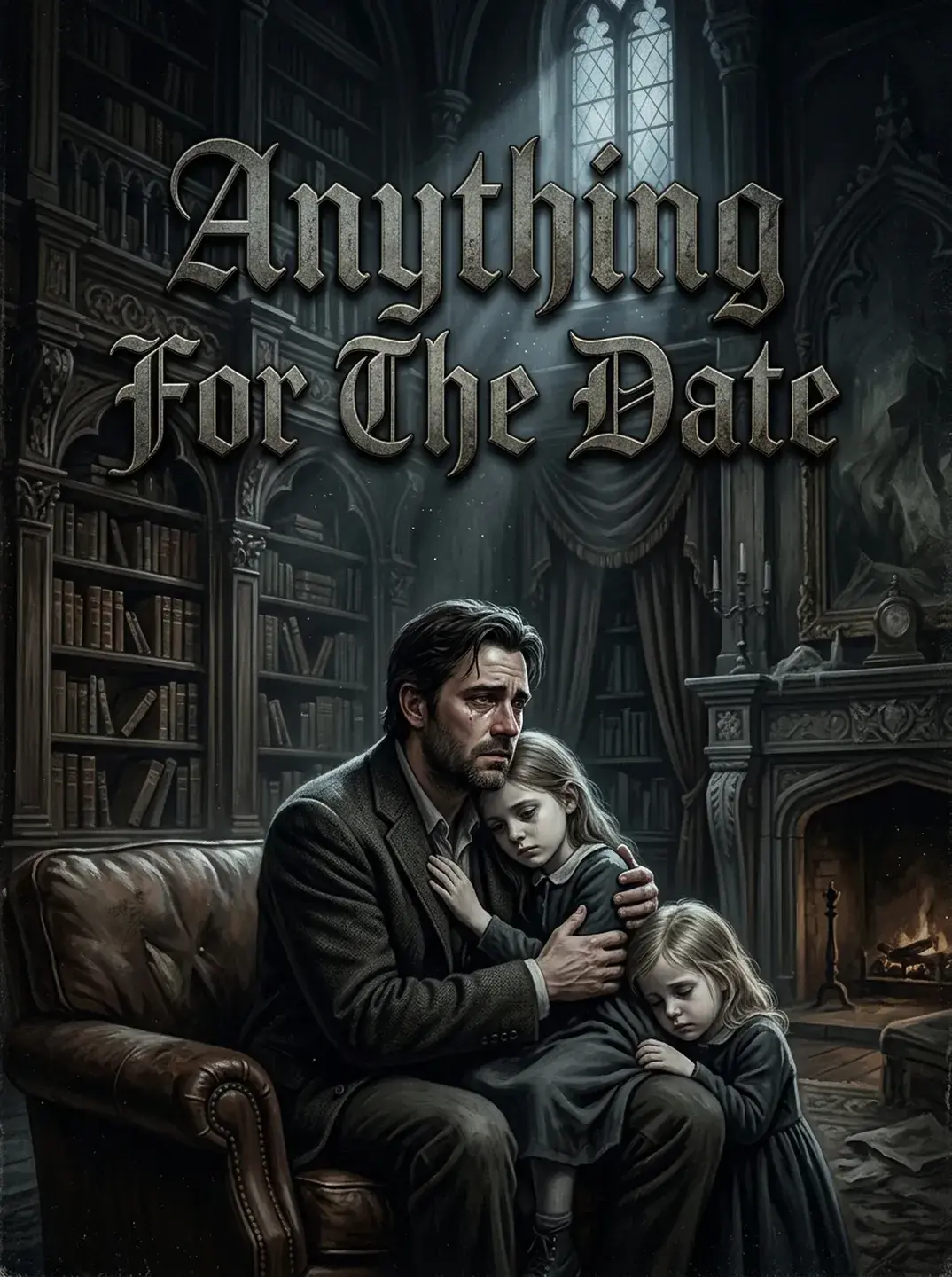
This story follows David Reggie, a famous film producer, going mad because of grief ever since his wife Claire dies. He still has his two daughters, one of which has a toxic breakup and immaturely believes after that she'll never believe in love again. In a state of moral desperation, and long devastation of grief due to losing his wife, David comes up with an evil, good idea for father-daughter bonding that might may or may not end in crazy tragedy. He decides to make a dating show where his daughters hidden through the world in a gothic wedding dress and where 12 guys compete to win her heart. Little does he know that she will end in tragedy, and the person least likely to win will.
Capítulo1
The sirens had hardly finished weeping before uniforms poured
across the set, boots stamping against the asphalt, radios chattering
like nervous birds. Someone shouted. Hands were everywhere. David
didn’t have time to fumble. One cuff closed around a wrist; the other
hung open, a cold promise in the air, because there wasn’t a second
hand to spare when his eyes caught Lily tearing toward the exit.
“Lily—” he croaked, reaching, fingers outstretched as if he could
lasso the echo of the child he’d been. “Sweetie. Please—don’t go—”
She tripped over the hem of her costume, veil snagging a nail, and
for a beat she looked impossibly small, all skin and panic. She hurled
a curse that cleaved him in half. “You’re a bad dad,” she spat—short,
savage, the sound of a door slamming.
The cop at David’s shoulder glanced down and froze. Blood smudged
David’s other hand where Sophie’s fall had skeed across the concrete;
the light caught it like a confession. The officer’s face shifted into a
hard, awful clarity.
“How dare you beat your daughter,” he said, as though reciting a line
he’d been taught for moments like this. The accusation landed
heavy, and David—still reaching, still apologizing—stumbled
forward.
Everything tightened. The officer barked a command, drew a taser,
and the world condensed to white noise and a jolt. David’s knees
gave. His eyes snapped shut, lashes wet. Someone else shouted for a
medic, but there was no arguing the tableau the broadcast feeds
were already framing: a father with bleeding hands on a stage that
had been, until minutes before, a theatre of manufactured love.
They carried him over a shoulder like a sack of bad props. The
camera panned away as the doors shut. That image of
him—half-handcuffed, mouth open as if to plead, then limp—was
the last of David we would see in this chapter.
•
Sophie’s name threaded through the chaos like a question with no
answer. The ambulance took her the opposite way, lights flaring as
if time itself had been set to emergency. At the hospital, a corridor
became a cathedral of soft shoes and fluorescent light. Nurses moved
like a choreography whose steps none of them wanted to rehearse
again.
She lay pale, lines of dried blood at the temple, breath shallow
beneath monitors that beeped with indifferent rhythm. Doctors
clustered at her bedside; their faces were clinical masks of
competence and worry, hands practiced and fumbling in the same
breath. “We can’t tell yet,” one surgeon said, and their words
scattered—suspicions, prognosis, the sharp gossip of the corridor.
Between vitals and whispered orders, the hospital staff traded
theories like trading cards: who had shoved whom, who had tripped
on a cable, whether the stunt had ever been authorized. Somewhere
between “unknown duration” and “possible recovery,” the
conversation inexplicably drifted to the show—the veiled beauty, the
mystery that had eaten the crew’s common sense. Nurses speculated,
doctors rolled their eyes, interns clicked on phones. If Sophie woke,
would she speak? If she never did, would the cameras forgive the
hole she left?
Anurse adjusted the sheet and left, her face curious. “Who is she,
really?” she murmured to another. Their gossip flickered, then was
swallowed by the steady beeping and the hush of suction machines.
Sophie’s slow breaths continued to be unreadable poetry.
•
Time folded then, and the story knotted. Back on the set the next
day—because life demanded spectacle even in the wake of
collapse—Lily ripped the veil away like a strip of bandage. For a
breath she felt naked, terrified, like a ship suddenly without ballast.
Then she saw him.
Hamie. He stood frozen at the foot of the stage, cheeks flushed,
hands hiding something behind his back. His awkwardness, which
had been a comic charm in lighter moments, was now raw and
earnest. He swallowed, cleared his throat, set a small guitar on his
knee, and began to sing.
“Lily, oh Lily, you light up my life,” his voice quivered like a thread
catching flame. The words were clumsy and perfect, the melody a
thin, honest thing. He pressed one hand to his chest, the other
behind his back. When he knelt, the world did that soft, ridiculous
thing it sometimes does in stories: the edges blur, the noise fades.
“I know we haven’t known each other long,” he said, voice small,
“but I’m infatuated with you. Will you marry me?”
There was silence like a held breath. Then something in Lily
reopened. Years of bruises and absence, of being traded for ratings
and quieted for convenience, pooled and then dissolved under the
warm current of someone’s small, brave adoration. She kissed
him—quick, impulsive, raw—and he slipped a ring onto her finger
with shaking hands. They walked out together, not as an ending but
as a tiny defiance. When he offered her a ride, and then, in the same
breath, the promise of a couch in his mother’s basement—“you can
stay, if you want”—Lily chose to go. It was not rescue. It was
reprieve, and for now, it was enough.
Afew days later she sat at Sophie’s bedside with Hamie collapsed
against her shoulder, his face streaked wet with tears of sympathy.
Nurses hovered, doctors murmured updates that softened into lists
of routine tests and possible recovery timelines. Lily smiled and said
she was fine, because it had always been easier to tell people lies than
to make them carry the kind of sorrow she’d learned to cradle alone.
Everyone looked at her like she was both a miracle and an exhibit:
pity in their eyes, sympathy in their hands. The hospital room
hummed with obligations; Lily folded them into the small map of
her life—the map she’d carry out of this place with Hamie at her
side.
•
Elsewhere, trial proceedings began to feel less like justice and more
like a theater of condemnation. David, gaunt and hollow-eyed, had
no counsel who could match the new chorus of hungry voices
circling him. Jasmine Vance—polished, opportunistic, and now at
his elbow—saw him as a salvage job. “We can make season two,” she
whispered, her breath warm and poisonous. “We’ll restore your fame.
I’ll hold your hand. I’ll be your new wife. You don’t need anyone
else.”
He was susceptible in ways he had not imagined—broken men are
always most pliable when someone promises to rearrange the world
back to their dreams. “Okay,” he said once, then again, until the
words felt less like choice than surrender. He nodded because the
tide of his own shame had finally worn him down to pebble.
In the hush after the verdicts and the diagnoses, the narrator
paused—not to defend, not to condemn—but to mark the line: that
was the moment he lost himself. The moment Sophie slipped into a
silence thick enough to be called a coma for a time no one could yet
measure. The moment Lily, exhausted and astonished, found
something like love at the edge of a studio lot, where crumbs fell
from a half-eaten baguette and a mustache-twitching doctor refused
to look away. It was messy, unfair, human—exactly the kind of
ending that television would never stop replaying.
To be continued.
Últimos capítulos
Some people build houses. Others build businesses.
David Reggies built illusions.
Onsoundst
David didn’t sleep. The thought kept circling in his mind like a
restless moth around a flame
David kissed Lily’s forehead softly, the veil of her gothic costume
still resting on her lap f
Amonthpassed in silence and anticipation.
Whenthe curtain finally lifted, the studio looked l