
Red doors, yellow doors, or Max and Selena save Alice
Synopsis
A harmless teenage ritual in 2001 St. Petersburg goes horribly wrong. Obsessed with a fictional romance hero, 18-year-old Alice hypnotizes herself—and her soul plummets into the grim, dangerous reality of 1820s Birmingham, leaving her body in a coma.
To save her, Max and Selena Wolf—a werewolf and vampire detective duo—must strike a desperate deal with the Keeper of Time, cross two centuries, and face the horrors of the past.
Step into the labyrinth of the subconscious. Alter literary history. Avoid the silhouettes.
Can you pull her out, or will you both be locked inside forever? Your choices shape the mind.
Chapter1
The fog did not merely sit upon St. Petersburg; it owned it. It was a thick, pale animal that pressed its damp belly against the windowpanes of the university dormitory, leaving behind a trail of condensation that wept down the glass in long, jagged streaks. Inside the room, the air tasted of cold stone, burnt dust from the radiator, and the metallic tang of an old electric kettle that had been boiled one too many times.
Alice Gromova sat huddled in a sweater that had lost its shape years ago, her fingers curled around the frayed edges of a paperback. The book was her sanctuary. Its cover featured a sprawling manor under a bruised sky, the title *Black Country* embossed in a font that promised secrets and shadows. To anyone else, the book was a cheap translation, a bit of transient fluff sold at a metro kiosk, but to Alice, it was a map to a place where the sun actually felt warm, even when it was hidden by clouds.
She didn't look at the stacks of differential equations piled on her desk. The math-mech faculty was a choice made by a version of herself she no longer recognized—a girl who believed in logic and the clean, indisputable truth of numbers. Now, numbers felt like a cage. They were too thin, too skeletal to hold the weight of her longing.
She turned a page, her thumb grazing the print. Luke Preston.
The name alone sent a low thrum of static through her chest. In the book, Luke was a man of iron and silk, a master of a Birmingham forge who carried the soot of the industrial revolution on his hands and the poetry of a dying age in his eyes. He was stern, unreachable, and utterly devoted to a woman who didn't deserve him. Alice had read the description of his study—the smell of old leather, the flicker of a fire, the way he looked when the light hit the sharp line of his jaw—so many times that she could close her eyes and walk through the room herself.
Luke was real. He had to be. He was more real than the gray corridors of the dorm, more real than the smell of cabbage soup wafting from the communal kitchen, and certainly more real than the boys in her year who smelled of cigarettes and cheap beer and talked of nothing but Dostoevsky or Doom.
"Alice? You’re doing it again."
The voice broke the spell. Alice didn't jump; she simply exhaled, a slow, mournful sound. Her roommate, Katya, was standing by the door, shaking a wet umbrella. Drops of rain flew off the nylon, hitting the floor with a rhythmic *pitter-patter*.
"Doing what?" Alice asked, her voice raspy from hours of silence.
"Living in that book. You look like you’re waiting for someone to ghost through the wall and sweep you away." Katya tossed her bag onto her bed and sighed. "You missed the lecture on topological spaces. Smirnov was looking for you. He says if you skip one more, you’re out."
Alice looked at the window. The fog was turning a bruised purple as the sun dipped behind the Neva. "Topological spaces," she whispered. "The study of properties that are preserved under continuous deformations. Like stretching. Or twisting."
"Exactly. Don't let your brain stretch too far, Alice. It might snap."
Katya sat down, her expression softening. She reached out and tapped the cover of *Black Country*. "Is he still in the forge? Your Mr. Preston?"
"He's not just a character, Katya. He’s... a state of being."
Katya rolled her eyes, but there was a flicker of something else there—a shadow of the rumors that had been circulating through the dorms for weeks. It was a secret language spoken in the smoking areas and the back rows of lecture halls. Stories of students who found a way out. Not a way out of the city, but a way out of the *now*.
"Listen," Katya said, lowering her voice. "People are talking about the Doors again. In the third-year block. They say Lena from the chemistry department did it. She was out for three days. When she woke up, she smelled like lavender and horse hair. She said she’d been to a garden in Versailles."
Alice’s heart gave a sudden, violent kick against her ribs. She had heard the whispers. *Red Doors, Yellow Doors.* A game. A ritual. A way to walk through the corridors of the mind until you found a threshold that led somewhere else.
"They say it’s dangerous," Alice said, though her eyes were already drifting back to the book.
"Dangerous is an understatement," Katya whispered, leaning in. "They say you have to have a guide. Someone to chant the words. Someone to pull you back if you get stuck. If you see an old woman, you run. If you see a black door, you never, ever open it. Because the black door isn't a room. It's a hole. You fall in, and your body stays here, staring at the ceiling, but you... you’re just gone."
Alice felt a chill that had nothing to do with the drafty window. "And the other doors? The ones that aren't black?"
"Those are the layers. The colors are just labels your brain puts on things it can’t understand. But if you find the right one... if you focus on a place, a person... they say you can step right into the dream."
Katya stood up, the moment of intimacy breaking. "But it’s just a game, Alice. Hypnosis. Brain tricks. Don't go getting ideas. You’re already halfway to the nineteenth century as it is."
Katya left to go to the kitchen, the door clicking shut behind her. Alice was alone again with the fog and the silence.
She looked down at the book. She imagined Luke Preston standing in his study, looking out at the soot-stained sky of Birmingham, perhaps feeling a strange, phantom cold, as if someone from a distant, gray future were reaching out to him.
Alice’s hand moved to her bedside drawer. Inside was a small, silver-colored tape recorder, a gift from her grandmother, Masha. It was a sturdy thing, meant for recording lectures, but Alice had used it to capture other things. The sound of the wind. The rhythm of her own breathing.
The rumors of the game were not just rumors to Alice; they were an invitation. The students spoke of it as a thrill, a way to get high without the cost of drugs, but Alice saw it as a bridge. If the mind was a house of many doors, then surely one of those doors led to the Black Country. Surely one of those doors opened onto a world where the soot was honest and the love was absolute.
She closed the book and rested her forehead against the cool, laminated cover.
*Luke,* she thought. *Wait for me.*
The following days were a blur of sensory overload. The university felt louder than usual—the screech of tram wheels on the tracks outside, the frantic scratching of pens during exams, the smell of damp wool in the cloakrooms. Alice felt skinless, as if the world were too sharp, too bright. She spent her lunch hours in the library, not studying her theorems, but searching for anything that resembled the ritual.
She found it in the margins of a borrowed notebook, scribbled in frantic, shaky handwriting.
*The Chant: Red doors, yellow doors, any other color doors.*
*The Guide: Must be steady. Must not let go. Must keep the rhythm.*
*The Warning: Beware the shadows. The mind creates guardians. The old woman is the end of the line. The black door is the void.*
Alice read the words until they burned into her retina. She didn't want a guide. She didn't trust the other students with their sweaty palms and their mocking laughter. They wanted to see Versailles or a beach in Bali. They didn't understand the gravity of a soul that didn't fit its century.
That evening, the fog turned into a freezing rain that turned the streets into sheets of black glass. Alice sat on her bed, the tape recorder in her lap. Katya was out at a party, the kind of party Alice avoided—loud music, filtered cigarettes, and the desperate, frantic energy of youth trying to prove it was alive.
Alice pressed 'Record.'
"Red doors," she whispered into the small plastic grate of the microphone. "Yellow doors. Any other color doors."
She repeated it, over and over, trying to find a cadence that felt like a heartbeat. She closed her eyes and focused on the image of Luke Preston. She visualized the texture of his coat, the heat of the forge, the weight of the English air.
*Red doors, yellow doors, any other color doors...*
Her voice on the tape sounded strange—detached, like it belonged to someone else. It was the voice of a girl who was already halfway across the threshold.
She stopped the recording and hit 'Rewind.' The tape hissed, a sound like a distant sea.
She knew what she was doing was a form of madness. Her grandmother, Masha, would have been horrified. Masha, who had survived the Siege, who knew the value of a solid floor and a crust of bread, would never understand the desire to dissolve into a story. Masha believed in the endurance of the flesh. Alice believed in the escape of the spirit.
Alice lay back on her pillow, the headphones over her ears. She felt the heavy, rhythmic thrum of the city outside—the heartbeat of St. Petersburg, a city built on a swamp, a city that was itself a kind of ghost.
She pressed 'Play.'
*Red doors, yellow doors, any other color doors...*
Her own voice flowed into her ears, steady and hypnotic. She closed her eyes.
At first, there was only the dark. Then, the dark began to shift. It wasn't the flat black of closed eyelids, but a vast, echoing space. She felt herself growing heavy, her limbs sinking into the mattress until the mattress was no longer there. She was floating in a void that smelled of ozone and old paper.
Then, the doors appeared.
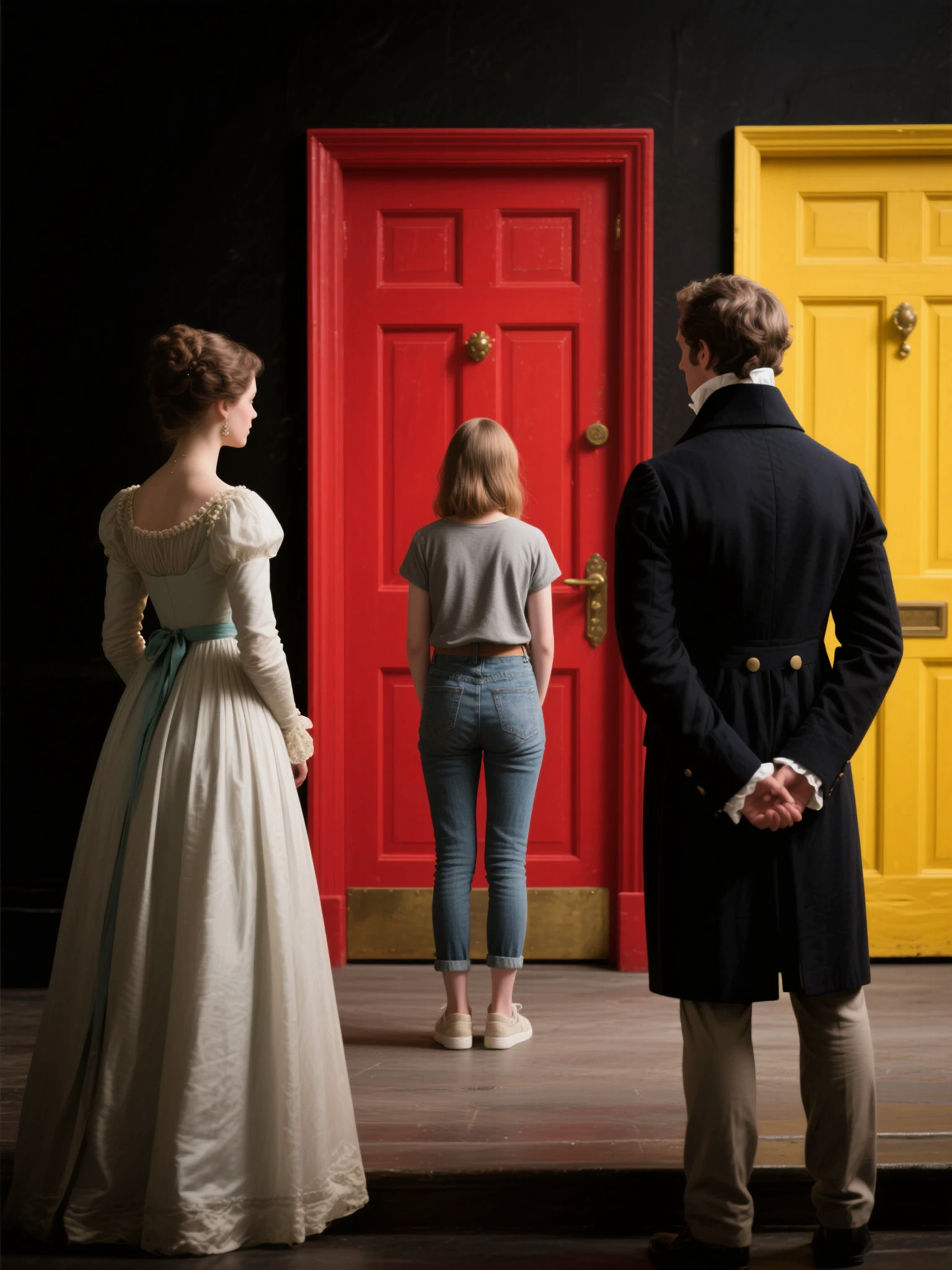
They weren't real doors, not at first. They were flashes of color in the gloom. A vibrant, arterial red. A sickly, sulfurous yellow. A deep, bruised plum. They stretched out in a line that defied perspective, an infinite hallway made of light and shadow.
*Walk down the hall,* her recorded voice commanded. *Find the door that calls to you.*
Alice moved. She didn't use her legs; she simply willed herself forward. The red door pulsated with a dull heat. She reached out, her fingers ghosting over the wood. It felt warm, like a fever. Behind it, she heard the sound of screaming—not human, but the scream of wind through a high mountain pass. She moved on.
The yellow door smelled of citrus and rot. She bypassed it.
She walked for what felt like hours, the hallway stretching and bending. The deeper she went, the more the air changed. It became heavy, thick with the scent of coal smoke and wet earth.
Then, she saw it.
It wasn't red or yellow. It was the color of a winter sky over a Birmingham slum—a heavy, leaden gray. The wood was rough-hewn, the handle made of cold, unpolished iron.
*Open it,* the tape whispered.
Alice reached out. Her hand shook. To her left, further down the hall, a door of absolute, light-consuming black stood silent. She felt its pull—a cold, gravitational tug that promised a sleep from which no one would ever wake her. It was tempting. The void was easy. The void was quiet.
But the gray door... the gray door promised Luke.
She gripped the iron handle. It was so cold it burned her palm. She turned it, and the sound of the hinges was the sound of an entire century grinding into motion.
A blast of air hit her. It wasn't the clean, cold air of the Neva. It was thick, greasy, and smelled of things she didn't recognize—animal waste, unwashed bodies, and the suffocating, sulfurous tang of coal fire.
She stepped through.
The world of St. Petersburg, 2001, vanished. The hum of the refrigerator, the distant sound of the tram, the comfort of her lumpy mattress—all gone.
Alice opened her eyes.
She was standing in a narrow alleyway. The ground beneath her feet was not a floor, but a treacherous mix of mud and cobblestones, slick with a substance she realized with a jolt of horror was manure. The walls of the buildings on either side were black with soot, the brickwork weeping with moisture. Above her, the sky was a low, suffocating blanket of smoke, so thick it obscured the sun.
The silence of her room had been replaced by a cacophony of violence. The roar of distant machinery, the rhythmic clatter of iron-rimmed wheels on stone, and the shouts of people whose voices sounded like gravel in a blender.
She looked down at her hands. They were pale, trembling, and already beginning to smudge with the grime of the air. She was wearing her oversized sweater and jeans, clothes that felt impossibly thin and alien in this world of heavy wool and stiff leather.
A man rounded the corner. He was hunched, his face a mask of dirt and exhaustion, carrying a crate of rusted iron parts. He stopped, his eyes raking over Alice with a look of such raw, predatory confusion that she took an instinctive step back.
"Wha’s this then?" he rasped. His accent was thick, a guttural sound that she barely recognized as English. "A changeling? Or just a stray bird from the manor?"
Alice couldn't speak. Her lungs were burning, protesting the acrid air. This wasn't the *Black Country* of the book. Where was the romance? Where was the noble suffering? This was a place of filth and sharp edges.
The man dropped the crate with a heavy *clank* and moved toward her. "You’ve got fine skin, girl. Fine skin for a place like this. Let’s see what you’re hiding under that strange wool."
Alice turned and ran.
She stumbled through the mud, her sneakers slipping on the stones. She burst out of the alleyway onto a main street, but the sight that met her was even worse. A sea of people, all of them looking as if they had been forged in the same dark furnace. Children with hollow eyes and blackened faces sat in the gutters. Wagons pulled by skeletal horses lunged through the crowds. The air was a physical weight, a gray hand pressing down on her throat.
"Luke!" she cried out, but her voice was lost in the roar of the Industrial Age. "Luke Preston!"
No one answered. There were no manor houses here. No fireside chats about poetry. There was only the grind of the machine and the smell of the end of the world.
Alice realized then, with a terror that bypassed her mind and went straight to her marrow, that she had opened the door.
But she didn't know how to close it.
Back in St. Petersburg, in a room that felt a thousand years away, a silver tape recorder continued to spin. The tape reached its end. The plastic clicked. The silence that followed was absolute.
Alice Gromova lay on her bed, her eyes open, her pupils fixed on a point that didn't exist. She wasn't breathing the air of the dorm anymore. She was breathing the smoke of 1824.
And in the fog-choked streets of Birmingham, a young girl in a blue sweater began to scream, realization finally catching up to her. The dream was not a sanctuary.
The dream was a trap.
Latest Chapters
`The air in the house on Great Charles Street was no longer merely stagnant; it was charg
The air inside the "Fangs and Tails" agency on the Moika was usually heavy with the scent of anci
Birmingham 1824 did not offer the luxury of a horizon. It offered a vertical, soot-stained enclos
The air in Birmingham did not circulate; it stagnated, a thick soup of coal-dust, rendere