

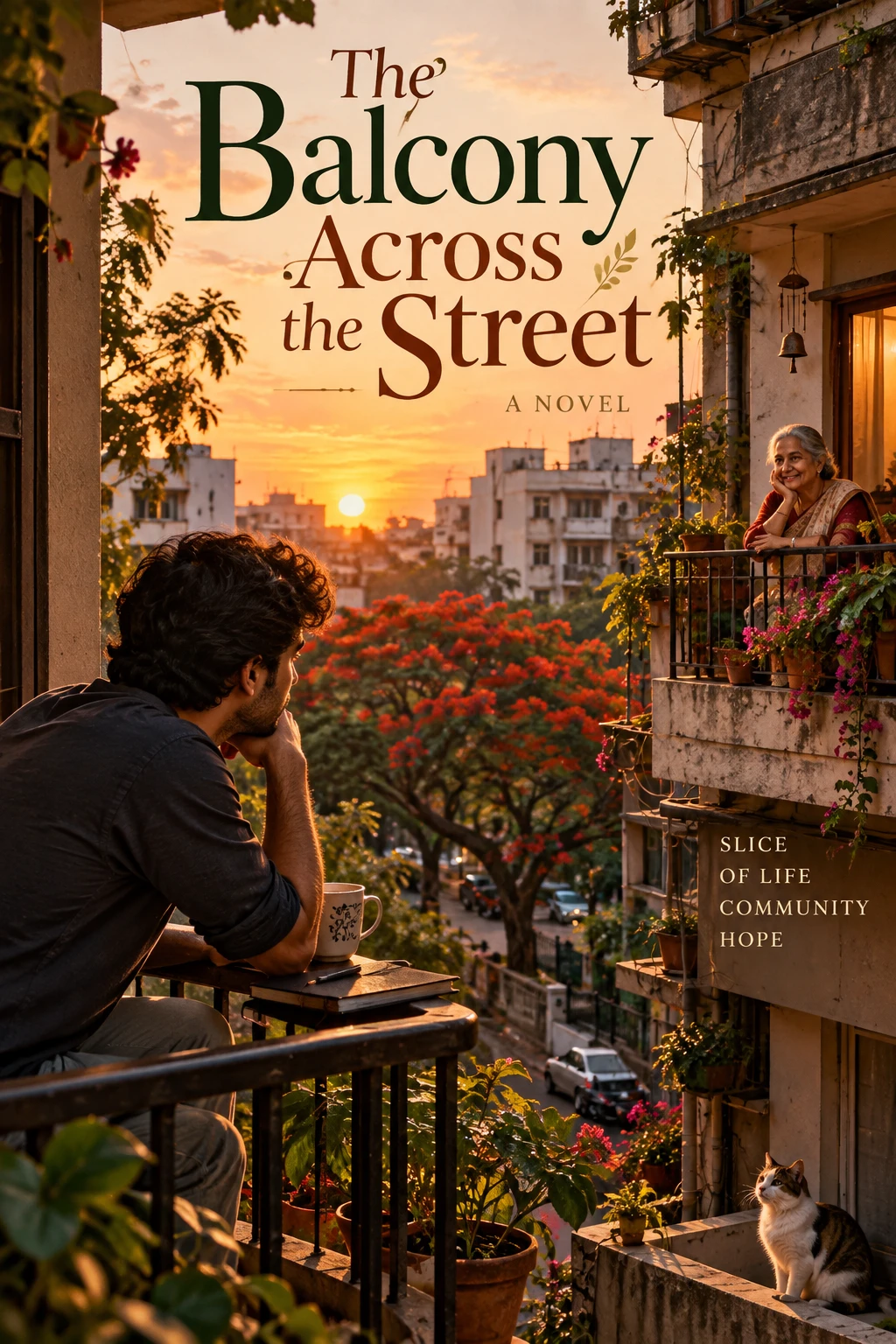
The Balcony Across the Street
Synopsis
The Balcony Across the Street Tag: Reality Sub-tag: Slice of Life · Community · Hope Chapter List 1. A Balcony Full of Strangers 2. Six O'Clock Rituals 3. Rain Between Balconies 4. The Notice on the Gate 5. Things We Never Say 6. Cracks in Concrete 7. The Last Evening Together 8. The Balcony That Remained ============================================================ When 29-year-old accountant Aarav Kulkarni moves into the aging Saraswati Apartments in Pune after a painful breakup and an unwanted job transfer, he expects the building to be just another temporary address. Instead, his evening ritual of sitting on his balcony slowly draws him into the ordinary lives unfolding across the lane. A retired teacher who still writes handwritten letters, a delivery rider chasing his dream of becoming a civil servant, a young couple learning to survive marriage, and a widow who feeds stray cats become unlikely companions through shared cups of tea, borrowed sugar, festivals, power cuts.
Chapter1
============================================================
The first thing Aarav Kulkarni noticed about Saraswati Apartments was that nothing matched.
The faded blue gate leaned slightly to one side. The cream paint had surrendered years ago to monsoon stains. One balcony displayed expensive hanging plants while the next held cracked buckets turned upside down to dry. A satellite dish pointed stubbornly toward the sky from a roof where pigeons had already claimed ownership.
It looked like a place that had stopped trying to impress anyone.
That suited him.
The tempo unloaded his luggage with the casual violence reserved for rented lives. One suitcase. Two cardboard boxes of books. A folded mattress. A steel trunk inherited from his father. Everything he owned fit into less space than the promises he had once made.
"First floor," the driver said.
"I know."
The driver shrugged and left.
Room 103 welcomed him with stale air, dusty windows, and a ceiling fan that groaned like an elderly uncle forced to dance at a wedding.
His landlord had called it "well ventilated."
That turned out to mean two windows and a balcony.
The balcony faced another apartment building across a narrow lane.
Not close enough to invade privacy.
Not far enough to ignore people.
He placed a plastic chair outside without thinking. By evening he would realize that chair would become the most important piece of furniture in his life.
***
Three months earlier, Aarav had imagined thirty differently.
Not glamorous. Just stable.
He had expected promotions. Weekend movies. Maybe an engagement.
Instead, he got silence.
Meera's final message still lived somewhere inside his phone.
"We've become polite roommates before even getting married."
He never deleted it.
Never replied either.
His manager's conversation had arrived two weeks later.
"Nothing personal."
Those words always meant it was personal.
The company wasn't firing him. They were transferring him from Mumbai to Pune after restructuring the finance department.
Same salary.
Smaller office.
Less visibility.
Corporate language had a beautiful way of making disappointment sound reasonable.
So here he was.
Twenty-nine.
Single.
Living alone.
Watching strangers.
***
At exactly six o'clock something unusual happened.
The building across the street came alive.
Not dramatically.
Quietly.
Like someone slowly raising the volume on everyday existence.
An elderly woman stepped onto a second-floor balcony carrying a teacup.
She wore a crisp cotton saree and spectacles hanging from a black thread. She unfolded a newspaper with ceremonial precision.
Next door, a young man in a red delivery jacket collapsed onto a plastic stool, removed his helmet, and attacked a packet of biscuits with the desperation of someone who had forgotten lunch.
On the third floor, loud voices erupted.
A couple.
Newly married, judging by the wedding garlands still hanging near their door.
They weren't fighting exactly.
They were arguing with the confidence of two people convinced tomorrow would give them another chance.
Somewhere downstairs, pressure cookers whistled.
Children chased a punctured football.
Someone practiced an old Kishore Kumar song badly enough to make the original singer reconsider immortality.
Aarav watched.
Not intentionally.
His eyes simply had nowhere else to go.
The elderly woman looked up briefly.
Their eyes met.
She smiled.
A small smile.
The kind exchanged between neighbors who weren't neighbors yet.
He nodded awkwardly.
That became their first conversation.
***
The next morning introduced Kamala Tai.
She arrived before sunrise carrying two stainless steel bowls.
One held milk.
The other held leftovers.
She whistled once.
Cats emerged from impossible places.
Under scooters.
Behind flowerpots.
Inside abandoned drainpipes.
Five.
Then eight.
Then eleven.
Each seemed to know exactly where to stand.
"You've got competition," came a voice.
Aarav turned.
The society secretary stood nearby.
Mr. Deshpande.
White moustache.
Ironed shirt.
Permanent expression of someone preparing to complain about maintenance charges.
"They'll adopt you if you're not careful."
"I've never had a cat."
"They don't ask permission."
He wasn't wrong.
One orange kitten stared at Aarav with outrageous confidence before returning to breakfast.
Kamala Tai noticed him watching.
"New boy?"
He laughed despite himself.
"I'm twenty-nine."
"To me that's new."
She returned to feeding cats.
Conversation finished.
Somehow satisfying.
***
The office occupied the fifth floor of a glass building on Senapati Bapat Road.
Inside, everything resembled every other corporate office in India.
Grey partitions.
Artificial plants.
Coffee machine.
Motivational posters celebrating teamwork.
Nobody spoke during lunch unless Excel crashed.
His desk overlooked another office building.
Even his window had become ordinary.
During lunch he caught himself wondering whether the delivery rider had eaten today.
He didn't know the man's name.
Still wondered.
The thought embarrassed him.
When had strangers begun occupying space inside his head?
***
Friday evening brought rain.
Not gentle rain.
Proper Pune rain.
The kind that attacked sideways.
Water flooded the lane within minutes.
Motorcycles tilted dangerously.
Children celebrated.
Adults calculated drying times for laundry.
Aarav stood under his balcony roof watching the storm.
Across the street, the elderly teacher hurried to rescue clothes from the railing.
One bedsheet slipped.
Wind caught it.
The white cloth floated downward like surrender.
Before she could react, the delivery rider sprinted through rain, caught the bedsheet before it touched muddy water, and climbed two flights carrying it over his head.
The old woman laughed.
Actually laughed.
He couldn't hear words.
Only gestures.
She insisted he take something.
He refused.
She forced a steel dabba into his hands.
He surrendered.
Minutes later he returned home holding food and smiling.
Aarav realized something strange.
The entire exchange had lasted perhaps three minutes.
Yet it felt more meaningful than most meetings he attended all week.
***
Saturday morning he bought groceries from the corner kirana.
The owner didn't ask his name.
He asked only one question.
"Monthly account?"
"No."
"New tenant?"
"Yes."
"Good. Don't forget coriander."
Every Indian shopkeeper possessed mysterious confidence about coriander.
Back home, he discovered a newspaper folded outside his door.
Not his.
He crossed the corridor.
Room 104.
Locked.
He waited.
An hour later, the occupant arrived.
The elderly teacher.
She blinked.
"Oh."
She laughed softly.
"I've been delivering newspapers incorrectly for three days."
"You have?"
"I thought you were Mr. Pawar."
"I'm afraid not."
"I'm Leela Joshi."
"Aarav."
She nodded as though storing the name carefully.
"I taught Marathi for thirty-eight years."
"I work in finance."
She made a sympathetic face.
"My condolences."
He laughed unexpectedly.
That became their second conversation.
***
Days acquired rhythm.
Wake.
Office.
Return.
Balcony.
Observe.
Without planning it, he began assigning stories.
The delivery rider became "Helmet."
The arguing couple became "Third Floor."
The teacher became "Letters."
Because every Thursday she wrote one.
Long.
Blue inland letter.
Neat handwriting.
She sealed it carefully before walking to the post box herself.
Who still wrote letters?
Apparently Leela Joshi did.
One evening curiosity defeated caution.
"Who do you write to?"
She looked at him.
"My son."
"Does he reply?"
"Sometimes."
Pause.
"Life becomes busy."
She smiled.
Not bitterly.
Acceptingly.
That somehow hurt more.
***
The delivery rider finally acquired a name accidentally.
Someone downstairs shouted.
"Sameer!"
The young man looked up.
Aarav mentally corrected his invisible notebook.
Sameer.
Twenty-something.
Delivery rider.
Biscuit enthusiast.
Potential civil servant.
He discovered the last detail by accident too.
One evening Sameer sat on his balcony reading thick books.
Polity.
History.
Current affairs.
Highlighter.
Sticky notes.
Helmet beside him.
Aarav watched until Sameer noticed.
"MPSC."
Sameer raised the book proudly.
"Attempt number two."
"Good luck."
Sameer grinned.
"Luck is expensive."
Then he returned to studying.
***
The third-floor arguments continued.
Some days about electricity bills.
Some days about visiting parents.
Some days about groceries.
One evening silence replaced shouting.
The silence felt heavier.
The next morning Aarav saw Rohit carrying two cups of tea onto their balcony.
Nisha accepted one.
They stood without speaking.
Watching rainwater drip.
Ordinary peace.
Fragile.
Real.
He found himself relieved.
It surprised him how invested he'd become in people who didn't know his birthday.
***
Sunday arrived carrying sunlight after days of rain.
The society organized a cleaning drive that nobody seemed enthusiastic about.
Kamala Tai recruited volunteers by emotional blackmail.
"If you don't help, the cats will judge you."
Aarav helped.
So did Sameer.
Even Rohit joined after pretending not to notice.
Leela supervised instead of sweeping.
Teachers never truly retired.
Someone played old songs through a Bluetooth speaker.
Children sprayed each other with hoses.
Dust became mud.
Mud became laughter.
Around noon everyone gathered near the entrance sharing poha served on paper plates.
Nobody made speeches.
Nobody called it community building.
They simply ate together.
A little girl handed Aarav an extra lemon.
"Uncle."
He almost protested.
Instead he accepted.
Time had quietly promoted him.
As evening settled, he carried his chair onto the balcony again.
Lights flickered alive across the lane.
Leela unfolded another newspaper.
Sameer opened another textbook.
Kamala Tai counted cats.
Nisha laughed at something Rohit whispered.
The lane filled with familiar sounds.
Pressure cookers.
Scooters.
Television serials.
Someone practicing a flute.
Nothing extraordinary happened.
No dramatic confession.
No miraculous transformation.
Just ordinary people surviving another day.
For the first time in months, Aarav didn't feel like he was merely passing through life.
He felt like he had arrived somewhere.
Not because the apartment was beautiful.
Not because his problems had disappeared.
But because across a narrow street, framed by concrete balconies and drying clothes, strangers had unknowingly begun teaching him that loneliness wasn't always the absence of people.
Sometimes it was simply the absence of looking up.
And every evening at six o'clock, Saraswati Apartments looked up together.
============================================================
Latest Chapters
After moving, everyone searched for familiar rhythms. Leela learned which hour sunlight entered her
Every box became a story. Kamala Tai found her wedding bangles wrapped inside newspaper from 1998.
Without announcing it publicly, residents created a small emergency envelope. Nobody called it char
One evening Leela showed Aarav a stack of unsent letters addressed to her late husband. "I kept wri