
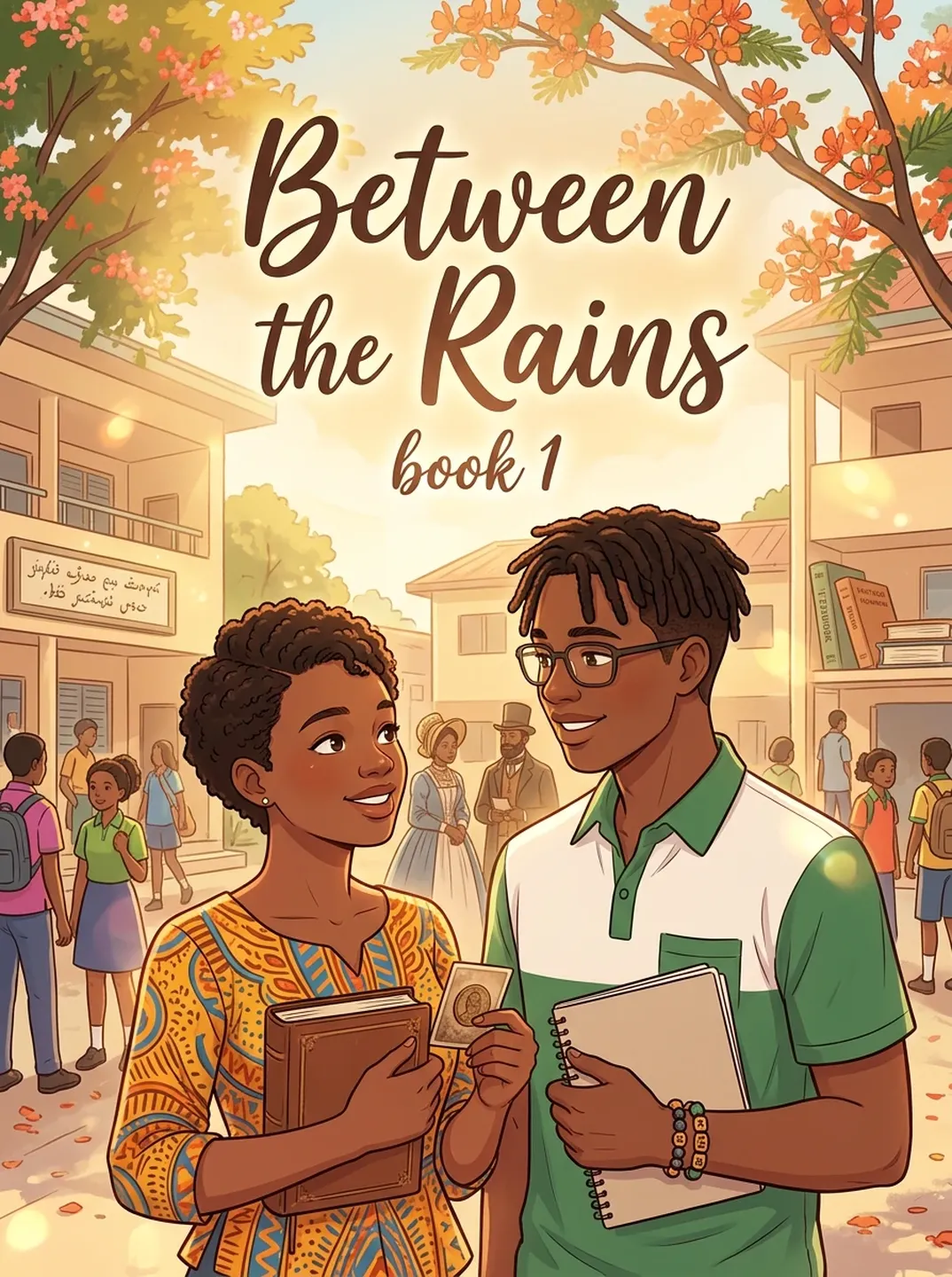
Between the Rains book 1
Synopsis
Nneoma Igwe, a scholarship student at FGC Lagos, begins experiencing time loops the same week she arrives at the prestigious Nigerian school. Reliving the same Tuesday repeatedly across seven months, she accumulates knowledge of events, people, and herself. Throughout the loops, Tobe Anya—a fellow student—is the first to notice something different about her. He falls in love with her quiet completeness, and she with his attentive presence. As Nneoma navigates historical time slips (1914, 1960, 1967) that connect her to Nigeria's past and her family's lineage, she learns that time is flexible but not controllable, and that the moments between loops are where real living happens. The central tension: Nneoma must decide whether to tell Tobe she loves him—a confession she keeps deferring until she understands there is no "right moment," only moments. The loop breaks when Tobe calls her name across the membrane of time, and she follows him home.
Chapter1
--------------------------------------------------------------------------------
The library at FGC had the smell of all school libraries — old paper and
ambition and the specific dust that accumulates in places where knowledge is
stored without sufficient ventilation. Nneoma came here in the evenings not only
to study but because the library had a quality of timelessness that felt
appropriate to her current situation. She sat at the table by the east window
and worked on her history essays and occasionally looked up to find Tobe at the
table across from her, reading with the focused attention that was one of the
things she was not examining. FGC Lagos had become, across seven months of
impossible time, the most known place Nneoma had ever been — known the way her
mother's kitchen was known, the way the path from the bus stop to her house was
known, the way things are known when you have been present to them repeatedly
and with full attention. She was also, still, learning it. She was also, still,
learning him. Nneoma Igwe arrives at FGC Lagos on scholarship the same week she
begins looping through time.
He had been looking for her for three days — the three days she was in the 1914
loop, the three days he had no explanation for her absence but went looking
anyway because the school felt wrong without her specific quality of presence,
wrong in the way a calculation feels wrong before you can identify the error.
She appeared in the courtyard on the fourth morning with the specific exhaustion
of someone who has lived three days of impossible history and the specific
expression of someone who is very glad to be back. He had said: 'Where were
you?' She had said: 'Somewhere complicated.' He had said: 'Are you well?' She
had said: 'I am now.' He had understood that this answer was not simple and had
filed it for later and had handed her the tea he had been carrying since he saw
her cross the courtyard. It was still warm The accumulation of loops had given
Nneoma something that she had not expected: not just knowledge of events but
knowledge of people, including knowledge of herself, which was perhaps the most
valuable thing the loops had produced. She had seen herself from the outside —
in other people's responses to her, in the gaps between what she said and what
she meant, in the moments when she had said the true thing instead of the
careful thing and watched what happened. What happened was usually better than
what would have happened if she had been careful. She was filing this
observation
The loop to October 1960 began in the middle of a history lesson. The classroom
became transparent — not disappeared but layered over itself with another time,
the way light refracts when it passes through something complicated. Nneoma saw
the history classroom and she also saw Lagos on independence morning: the crowds
and the flags and the specific collective joy of a million people who had been
told they could not govern themselves agreeing simultaneously that they could.
She was in both places. She was in neither. She was in the membrane between
them, which was where she spent more and more time — between what had been and
what was, between the loop and the present, between what she knew and what she
was still learning Time, she had concluded, was more flexible than physics
suggested and less controllable than she had initially hoped. The loops did not
respond to her wishes — they responded to something else, something she had
begun to theorize about in the margins of her history essays, some quality of
historical gravity that pulled events into repetition near moments of
significance. She was significant to something. She had not yet determined what.
She was writing it down
In the fourteenth loop, under the science block awning with the rain making the
courtyard invisible, she had understood something that the previous thirteen
loops had been building toward. It was not dramatic — it was the specific
undramatic understanding that comes after a long accumulation of evidence, the
kind of understanding that feels obvious in retrospect and was always
approaching. She was in love with Tobechukwu Anya in the specific way that she
did most things: completely, with full awareness, without the ability to not
notice it now that she had noticed it. She stood in the rain-noise and held this
understanding and did not say it. She was not yet ready to say it. But she held
it carefully, the way you hold something fragile and valuable, and she did not
let it go She had been managing the feeling — sorting it into a category of
things to be addressed when the loops resolved, when she had more information,
when the right moment arrived. The loops had taught her something useful about
this approach: there was no right moment. There were only moments. The moments
were the whole thing. She had known this abstractly from her grandmother's
sayings. She was learning it now in her body, which was where real learning
happened
Nigeria's history, which she was living inside one day and studying in class the
next, had acquired for her the texture of something personal rather than
academic. She understood the independence celebrations not as an event in a
textbook but as a day she had stood in, briefly, in the membrane between her
classroom and October 1960. She understood the colonial years not as a
historical condition but as the air her great-grandmother had breathed, the
weight her family had carried. This understanding had changed her history essays
in ways that her teacher had noted as unusually vivid. She was unusually vivid.
She had always been unusually vivid. The loops had made her more so
The first Tuesday I understood what was happening, I sat in the assembly hall at
morning prayers and thought: I have been here before. Not in the vague way that
people mean when they say that — not deja vu, not the familiar feel of routine —
but specifically, with the precise memory of the last Tuesday still fully
present alongside this one. Both Tuesdays in the same head. I counted my
memories: Tuesday the first, Tuesday the second. I was on the third. I went
through the day with the extraordinary attention of someone who is carrying two
previous days simultaneously, and I noticed everything. I noticed Tobe Anya, who
was in two of my classes and who I had spoken to once, and I noticed that he
noticed something was different about me. He noticed before I had decided how to
explain it to myself She sat in the evening with the notebook she had filled
across seven months of loops — the observations, the patterns, the things she
had learned about time and about this school and about herself — and she wrote
about today. She always wrote about today even in the loops, even when today was
a version she had already written about. Each writing was different. Each day,
however repeated, produced something new, because she was new each time she
lived it. This was the thing the loops had been teaching her since the
beginning. She was ready to be taught it now
She went to sleep with the compound settling around her — the dormitory sounds,
the generator hum, the Lagos night doing what it always did, being the specific
enormous complicated city that had been producing people like her for
generations. She was one of those people. She was also, across the loops,
becoming something she did not have a category for yet. The becoming was not
frightening. The becoming was the most interesting thing. She was curious about
what she was becoming. She was also curious about whether she would say the
thing tomorrow that she had been saving for the right moment. Tomorrow, she had
decided, was the moment. It was always tomorrow and it was always the moment and
she was always deciding and she was going to do it now
--------------------------------------------------------------------------------
Latest Chapters
-------------------------------------------------------------------------------- The loop began — a
-------------------------------------------------------------------------------- The library at FGC
-------------------------------------------------------------------------------- The morning I deci
-------------------------------------------------------------------------------- The Federal Govern