
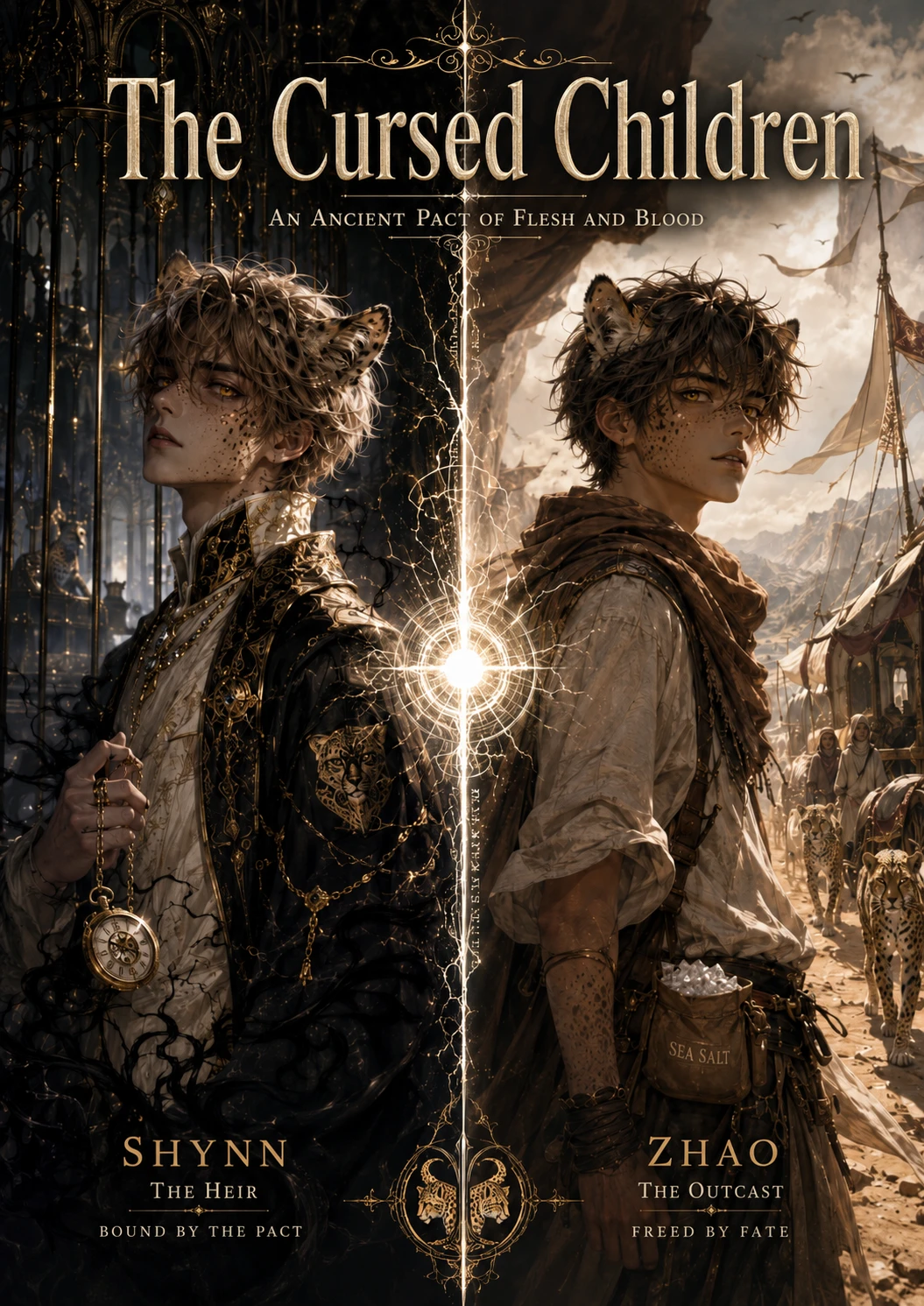
The Cursed Children - An Ancient Pact of Flesh and Blood
Synopsis
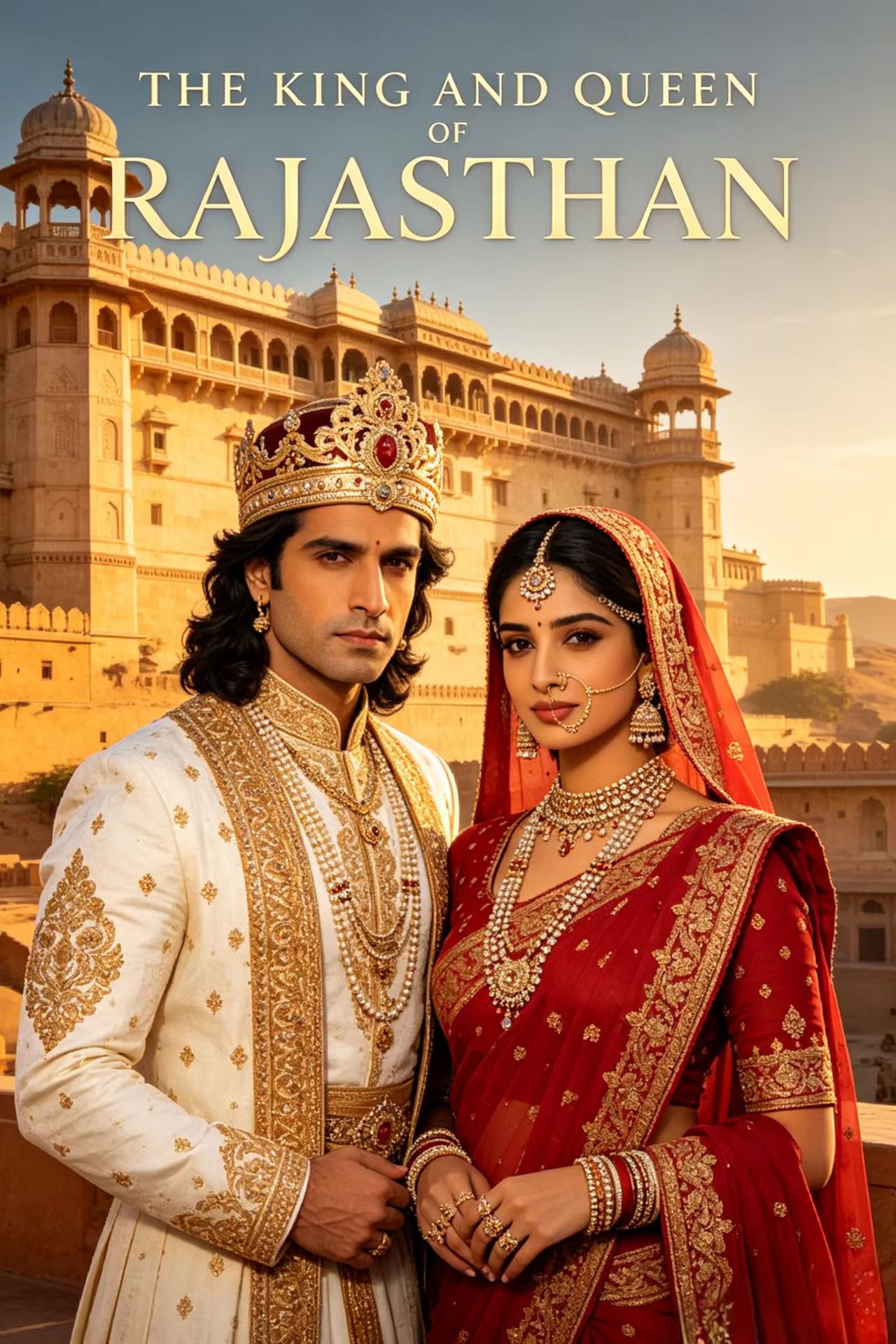
Originally written in French and translated into English with AI; please feel free to point out any mistakes in the comments. Thank you for your help.In a beastkin world ruled by ancient bloodlines, treaties, and forbidden pacts, the Cheetah Dynasty hides a secret capable of breaking the kingdom’s fragile balance.Zhao has never known palaces. Raised by traveling merchants, he grew up among dust, salt, caravans, and open roads, far from noble intrigues. But strange signs begin to follow him: shifting words, impossible dreams, and whispers of a white light.Meanwhile, the official heir of the Cheetah throne grows inside a palace of silk, silence, and lies.When Zhao’s path leads him to the neutral lands of the Felines and the mysterious White Core, a buried truth awakens. Two separated lives, one forbidden birth, and a pact of blood may drag every family toward war.
Chapter1
The First Lady’s birthing chamber reeked of musk, sweat, and blood.
Beneath the tall windows of the Cheetah estate, the night stretched like an open wound. The moon, almost red, bathed the gardens in a sickly light. The statues of ancient felines, lined along the terraces, seemed to turn their gaze away from the palace, as if even stone refused to witness what was unfolding behind its walls.
Inside the room, the silk sheets had become a ruined mass, stained and torn by the First Lady’s unsheathed claws. Her tawny fur, usually smoothed with aristocratic precision, clung to her face and neck. Every breath left her like something ripped from her body.
Around the bed, the palace midwives were not alone.
Figures draped in dark veils stood in the corners, almost motionless. Their thin, membranous ears twitched at every cry. Their presence had brought with it the smell of damp cellars, black wax, and scorched honey. A smell that did not belong to the sunlit domains of the Cheetah Dynasty.
The ritual was over.
Or at least, it should have been.
“Again, my Lady,” breathed a soft voice, too soft, like the rustle of leather wings. “The throne demands its price.”
The First Lady screamed.
The first child’s cry tore through the air almost immediately. Powerful. Alive. A cry strong enough to make the candle flames tremble. The midwives exchanged a look of terrified relief. The heir had been born.
They lifted the newborn toward the light.
He was a little cheetah-kin, covered in damp golden down. His eyes, already half open, held a strange depth, an amber shade almost too dark. He cried with a fierce will to live that seemed to challenge the entire night.
The First Lady reached for him with trembling arms.
But before they could place him against her, her body arched again.
A second pain cut through her.
Colder.
Deeper.
As if something beneath the flesh refused to let the birth end.
The midwives froze.
Then a second child entered the world.
His cry was weaker. Shorter. And yet, in the silence that followed, it seemed sharper than the first. He did not carry the same violent vitality as his brother. He barely breathed, curled in the trembling hands of the midwife, a fragile little body still covered in blood and warmth.
The Bat figures stiffened.
In one corner of the chamber, an old Cheetah matriarch, her face as hard as marble, slowly stepped forward. Her scars gleamed beneath the red moonlight.
“Two,” whispered one of the shadows.
A single word.
Enough to freeze the room.
The matriarch looked at the newborns. At the first, still crying. At the second, too calm, too silent, as if he were already listening to a world no one else could hear.
“The people are waiting for an heir,” she said in a low voice. “Not a riddle. Not proof of our desperation.”
The First Lady turned a feverish gaze toward her.
“Give them to me…”
No one moved.
The matriarch raised one hand.
“Only one child was born tonight.”
The First Lady understood. Her mouth opened, but no sound came out. They placed the firstborn in her arms, the one whose cry still filled the room. The one the world was meant to see. The one the throne could accept.
“Shynn,” someone breathed.
The name fell like a seal.
The First Lady held the child tightly against her. He was warm. Alive. Beautiful. And yet, when he nestled against her chest, a sudden cold swept through the chamber. The flames flickered. For a single heartbeat, every shadow seemed to bend toward him.
The second child was carried away.
The First Lady turned her head, eyes drowned in pain.
“He… he is alive…”
The matriarch did not blink.
“He was stillborn. Do you understand?”
The sentence was not information.
It was an order.
In the corridor, two servants moved quickly—too quickly. One of them, Maric, kept his eyes fixed straight ahead. The other, Lysra, held the bundle of cloth against her chest, where the newborn stirred faintly.
Rain lashed the tall windows. Thunder rolled above the estate. Each crack of the storm seemed to cover their disobedience.
“We can’t do this,” Lysra whispered.
“We have no choice.”
“Yes. We do.”
Maric stopped dead.
“If we bring him back, they’ll kill him. If we keep him, they’ll kill us with him.”
Lysra lowered her eyes to the child.
He was not crying. His tiny clawed hand had caught a fold of her sleeve. His clear amber eyes reflected the lightning beyond the glass.
“Look at him, Maric. He isn’t a mistake. He isn’t a monster. He is an infant.”
The silence that followed was heavier than the rain.
Then Maric cursed under his breath.
“The southern roads. There was a caravan near the cliffs.”
Lysra lifted her head sharply.
“The merchants?”
“They leave at dawn. If they cross the border before the palace starts looking for a body that officially no longer exists…”
He did not finish.
They did not need more.
Beneath the storm, they crossed the drenched gardens, avoiding patrols, statues, and the lanterns still burning in the rain. At the edge of the estate, beyond a low wall covered in ivy, several wagons waited under the downpour. Draft beasts blew steam into the mud. Thick canvas sheets, stained with salt and road dust, snapped in the wind.
Near one wagon, a broad-shouldered bear-kin was tightening the straps of a harness. His brown fur was soaked, his face tired but gentle. A vixen stood nearby, arms crossed against the cold, her ears twitching at every roll of thunder.
Lysra emerged from the night.
The vixen took a step back, startled.
“By the roads… What are you—”
“Take him.”
Lysra pushed the bundle into her arms before she could refuse.
The vixen froze.
The newborn opened his eyes.
For one second, the world seemed to hold its breath.
“He has no name,” Lysra said, her voice breaking. “No past. No family. Nothing you can claim. But he needs to live.”
Maric dropped a heavy purse into the bear-kin’s hand.
“Leave at dawn. Ask nothing. Do not return to the palace.”
“Why us?” the bear-kin asked, wary.
Lysra looked at the child, then at the black road beyond the wagons.
“Because no one suspects those who carry salt.”
The two servants were already stepping back.
“Wait!” the vixen called. “Who is he?”
Lysra hesitated.
Then she shook her head.
“A child who must not die.”
And she vanished into the rain with Maric.
The vixen remained there, the newborn in her arms. For a long moment, she did not move. Her companion came closer, his expression grave.
“Miri…”
“He’s freezing,” she whispered.
“Miri.”
“Look at him, Solan.”
The bear-kin lowered his gaze.
The little cheetah breathed calmly, his cheek pressed against the wet fabric of Miri’s dress. He was so small that Solan’s massive hand could almost have covered his entire back.
For years, Miri had hoped for a child. For years, the road had given her markets, exhaustion, coins, difficult winters, but never what she had asked for in silence.
And now the storm had placed a son in her arms.
“We know nothing about him,” Solan said.
“Then he’ll have nothing to carry.”
“He could bring trouble.”
“All children bring trouble.”
Solan sighed. A long, weary bear’s breath, defeated before he had truly fought.
“He’ll need a name.”
Miri looked at the newborn. His amber eyes glowed faintly beneath the canvas of the wagon.
“Zhao,” she said. “Maybe he’ll shine better on the road than in their palaces.”
Solan raised his eyes toward the dark spires of the estate above, where lights still trembled behind the rain.
“Then we leave before dawn.”
The years did not pass as dates.
They passed as landscapes.
For Zhao, the world was first the swaying of a wagon, the creaking of axles, the smell of damp leather, Miri’s songs, and the warmth of Solan’s arm on nights when the cold bit all the way to the bone.
He grew up without marble, without silk, without servants.
He grew up with dust.
At five, he could recognize lands by scent alone. The red dust of the Wolf roads, heavy and metallic. The pale powder of the mountain passes. The dark mud of the feline forests, clinging to wheels as if the earth wanted to hold travelers back.
He was fast.
Too fast, sometimes.
His young cheetah-kin body leapt between crates and stalls with an ease that made the other merchants laugh.
“Zhao! The salt sack is leaking!” Solan shouted.
And Zhao was already there, hands beneath the tear, catching the white grains before they vanished into the dust.
He knew how to count losses before he could properly write numbers. He knew that a dry blanket was worth more than a beautiful speech. That a warm bowl could save a day. That a customer who smiled too much was often hiding a bad bargain.
He loved that life.
He loved Miri, her fine hands able to mend a sail, a sleeve, or a wound with the same patience. He loved Solan, his gruff voice, his reassuring silences, the way he pretended not to notice when Zhao stole an overripe fig from a stall.
He loved roads because they did not ask who you had been before.
They only asked whether you knew how to move forward.
Yet on certain days, the world would tear—just barely.
One second.
One breath.
Zhao would be standing in the middle of a noisy market, surrounded by the smell of spices, dried fish, and warm bread, and then everything would become silent. Voices drifted away. Colors faded.
He would see a high golden ceiling, covered in patterns he did not know.
He would feel cold fabric against his skin.
And sometimes, in an impossible reflection, two eyes identical to his own would stare back from a place filled with shadow.
“Zhao?”
Miri’s hand would settle on his shoulder.
“You drifted away again.”
He would blink, swallow, then reach for the small pouch of salt tied to his belt. He would take a few grains between his fingers and rub them until he felt their dry bite against his skin.
The salt was real.
The road was real.
The rest was only a poorly fastened dream.
“I’m fine, Ma.”
She did not always believe him.
But she never forced the answer.
At seven, the caravan passed near the capital.
Solan refused to enter. The taxes were too heavy, the guards too curious, the walls too tall to inspire trust. So they camped on a ridge, at a distance, where the road fires seemed tiny beneath the stars.
Zhao climbed onto the roof of the wagon and watched the palace.
The spires of the Cheetah Dynasty rose far away, gilded by the last light of day. They were so high they seemed to prick the sky. The windows shone like eyes.
“Why do they live up there?” he asked.
Solan, busy stirring the soup, did not even raise his head.
“Because they’re afraid of the ground.”
Zhao wrinkled his muzzle.
“The ground?”
“The higher you climb, the less you have to smell the sweat of those who hold you up.”
Miri shot her companion a look, half amused, half tired.
“Solan…”
“What? It’s true.”
Zhao kept staring at the palace.
“They look rich.”
“Wealth does not always make walls less cold,” Miri said more softly.
Far from there, behind those walls, another child was learning how to hold a scepter.
Shynn did not know the dust of the roads. He knew smooth corridors, official prayers, and gazes that weighed on his shoulders before he was old enough to understand them.
They repeated that he was the only heir.
The only hope.
The only son.
His mother dressed him with care. She smoothed his fur, hiding the places where it seemed duller, more fragile. She watched his tremors, his silences, his moments of absence. When a physician frowned, she dismissed him. When a servant spoke too much, they disappeared from the apartments.
“You must be strong, Shynn,” she often whispered, laying her hands on his shoulders. “Do you understand? You must be perfect.”
Shynn nodded.
Because he loved her.
Because she trembled when she said those words.
Because he did not yet know that love could become a cage.
One day, during a ceremony before envoys from the Wolf family, Shynn had to display the speed promised by his blood. He dashed across the pale stones of the courtyard, thinner and paler than other children his age.
For a few seconds, he was magnificent.
Then his stride broke.
His ears flattened against his skull. His breath caught. He collapsed before reaching the line drawn on the ground.
A murmur crossed the assembly.
The First Lady was on him at once, throwing her cloak around the child to hide his too-dark eyes, his clenched claws, the cold sweat on his skin.
“The heat,” she said, her voice too high. “Nothing but the heat.”
Later, alone in his room, Shynn sat in the dark. Before him, a small mechanical watch lay open, revealing its tiny gears. He adjusted one piece. Then another.
Tick.
Tick.
Tick.
The steady sound helped him breathe.
He did not know why silence frightened him.
He did not know why, on certain evenings, he dreamed of a road he had never walked.
Zhao’s tenth year was approaching when Solan’s caravan took the road toward the neutral feline lands.
The borders there were calmer. The markets better guarded. Ancient roads crossed forests where travelers spoke more quietly, without quite knowing why.
That day, the air was heavy. The cicadas sang so loudly that the trees seemed to vibrate. Zhao walked ahead of the first wagon, a piece of licorice between his teeth, eyes alert for stones that could break a wheel.
They reached an old crossroads marked by a signpost eaten by lichen.
“We stop here for the night!” Solan called. “Zhao, go gather kindling before Miri decides to feed us nothing but dark looks.”
“I heard that,” Miri grumbled from the wagon.
Zhao smiled and slipped toward the grove.
He gathered a few dry branches. Then his gaze returned, for no reason, to the old sign.
He could have sworn it said:
SOUTHERN ROAD
OLD WELL
MIST PASSAGE
Nothing strange.
Nothing important.
He looked away.
Yet a brutal shiver climbed up his spine.
The cicadas stopped singing.
The wind died.
Zhao slowly turned back.
The sign was still there. Same gray wood. Same lichen. Same rusted nails.
But the words had changed.
They no longer gave directions.
YOUR THRONE
Zhao dropped the branches.
They fell at his feet with a dry crack.
He stood motionless, his heart pounding so hard he could hear it in his ears. The letters seemed carved into the wood as if they had always been there. Then they shivered, as if something were crawling beneath the bark.
He took one step forward.
Reached out.
His fingers brushed the sign.
At once, the words vanished.
SOUTHERN ROAD
OLD WELL
MIST PASSAGE
The world breathed again.
The cicadas began to sing.
“Zhao?” Miri called from afar. “Did you get lost in three branches?”
He did not answer immediately.
His hand dropped to his pouch of salt. He gripped a handful so tightly that the crystals dug into his skin. The pain brought him back to himself.
He was only a merchant’s son.
A road boy.
A child who knew good salt from bad, how to bargain over a crate of spices, and how to avoid ruts.
He had no throne.
He wanted none.
“Zhao!”
At last, he stepped back.
“I’m coming!”
His voice sounded normal.
Almost.
That evening, by the fire, he barely ate. He stared for a long time at his hands, stained with earth and scratched by branches. Miri watched him without saying anything. Solan said nothing either, but he served him a second ladle of soup, as if warmth could answer questions no one dared ask.
That night, Zhao dreamed.
He did not dream of roads.
He dreamed of a core of white light, so pure it hurt. He dreamed of a golden palace. He dreamed of a shadow that looked like him, standing behind dark glass, one hand pressed against his own without ever being able to touch it.
Far away, in the palace apartments, Shynn woke with a start.
The small watch beside his bed had stopped.
For the first time in his life, he heard the silence.
And Zhao’s childhood ended there, at the foot of a lying sign, beneath the patient gaze of a world that had never forgotten the crime of his birth.
Latest Chapters
La pluie frappait les vitres de la chambre dorée.
Elle n’était pas violente. Pas encore. El
Zhao remained on his knees before the White Core long after the vision had faded.
The cold
The uproar of the Assembly of Families saturated the high halls of the Cheetah palace.
It w
The leather of the harnesses creaked beneath the weight of the beasts, a familiar sound that, und