
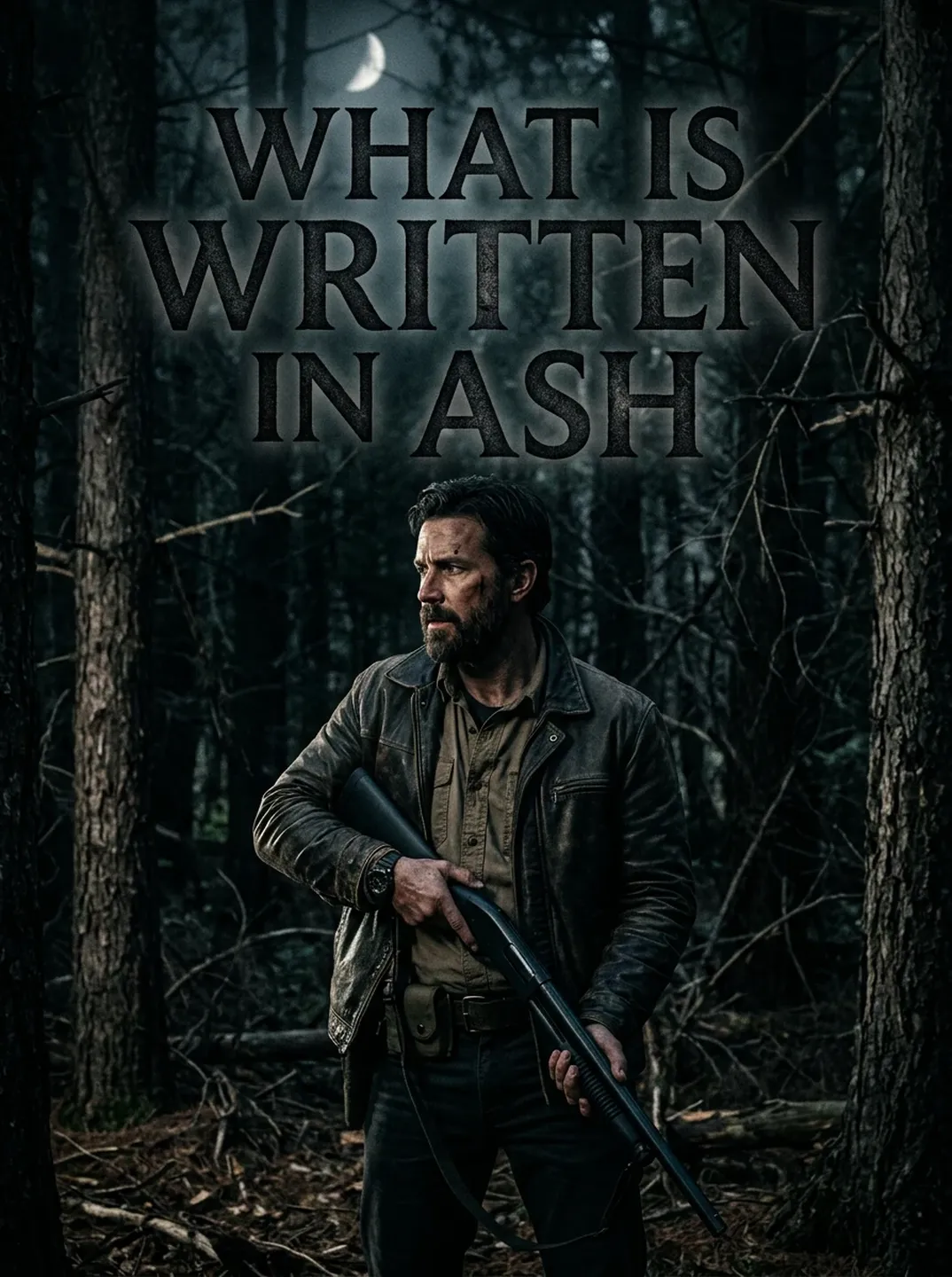
What Is Written in Ash
Synopsis
A lone protector, Jordan Blake, finds his own haunted past mirrored in a mysteriously abandoned infant tied to a supernatural debt. Hunted by the relentless agents of an ancient, ledger-keeping evil known as the Morgenstern, he must go on the run through the dark backwoods of America. Every choice is a gamble, and the only collateral he has left is a child whose soul is already on the auction block.
Chapter1
The shriek sliced through the March dusk like a splinter of glass, too sharp for the hour, too human for the birds that wheeled above the Montrose flats. Jordan Blake paused on the gravel shoulder of County Road 17, grocery sack bumping against his hip, and listened. A second cry followed—ragged, rising, wrong. Not a crow, though it had the rusty edge of one; not a child, though it pulsed with the panic of something newly born. The sound seemed to come from the field itself, from the black seams between last year’s corn stubble and the thaw-soaked earth that smelled of ammonium and rot.
He told himself it was only a trickster, the way Grandma Morag had warned: corbies that wore the voices of widows, wailing to lure the curious off the path. Yet the hair on his forearms lifted as if the air had been charged by an approaching storm. Jordan shifted the canvas strap higher on his shoulder, felt the weight of oranges and canned beans knock against his ribs, and stepped off the gravel.
Mud swallowed his boots to the ankle, releasing a sigh of fertilizer and decay. Each footfall made a wet kissing sound; the cry answered, steadier now, a single note drawn so thin it threatened to snap. Thirty yards ahead, where the tractor rows met the access lane, a dark knot lay curled like a dropped glove. Jordan’s pulse stumbled. He tasted iron at the back of his throat.
He crossed the low electric fence—one gloved hand on the sagging wire, the other clutching his groceries—and felt the faint tingle of dormant current. The hum of the charger box at the corner post was dead; March storms had killed the power again. Beyond the wire the field dipped, forming a shallow bowl that caught the last light. There, in the center of that bowl, the bundle moved.
Jordan’s mind cataloged the impossibilities: no tire tracks, no footprints except his own filling with brown water, no vehicle lights retreating along the road. Whoever had come this far had either flown or walked backward in their own tracks, brushing the impressions away. He had seen that trick once, in the army, when a instructor showed them how to ghost across sand. The memory arrived uninvited, carrying the taste of gun oil and the smell of cordite. He pushed it down.
Ten paces. Five. The cry cracked, became a hiccupping whimper. Jordan crouched, knees popping, and set the grocery sack beside him. The canvas slumped, spilling a single orange that rolled in a lazy arc and stopped against the bundle. A tiny fist, mottled with cold, flailed free of the blanket and closed on air.
Not a crow. Not a prank.
A baby—newborn, slick remnants of birth still glistening on the curled shell of its ear, umbilical cord severed rough and blue. The blanket was a cheap acrylic thing, zebra print, already sodden. Whoever had left the child had also tucked a folded square of parchment beneath the folds. Jordan’s fingertips brushed the paper; it was warm, as if it had just come from a printer, yet the ink smelled of smoke and something older—musk and iron.
The infant’s face was scarlet from screaming, mouth a dark O, eyes squeezed shut. A girl, he thought, though he couldn’t say why. Her hair was black and lay wet against her scalp in tiny whorls that reminded him of ripples on a pond. He slipped off his coat, wool and lined with flannel, and wrapped her in it, zebra blanket and all. The moment the fabric touched her chin the crying stopped. The silence felt louder.
Jordan’s throat burned. Thirty-two years ago he had been the thing in the ditch: found at dawn by a deputy heading home, umbilical cord still attached, no note, no footprint except the deputy’s own. The county had named him Blake because the road ran along the old Blake farmstead. He had grown up in foster homes telling himself the abandonment was a fluke, a frightened girl’s mistake, nothing woven into his blood. Now the field seemed to tilt, past and present sliding together like wet glass.
A gust swept the flats, rattling the stubble. Dusk was bleeding into true dark; the horizon had swallowed the sun. He should call DSS, should flag down the next pickup, should do anything but stand here with his life cracked open. Instead he slipped a finger into the infant’s fist. Her grip was ferocious, nails like flakes of mica. She opened her eyes—storm-gray, almost silver—and stared straight through him.
The parchment shifted. Blocky letters, hand-drawn:
Lunaris keep her until the moon turns.
Do not trust the Morgenstern.
Burn the blanket before the third dawn.
No signature. No date. Jordan’s heartbeat felt like boots on gravel. He had heard the name Morgenstern once, whispered by Grandma Morag while she braided thistle into the lintel to keep the night out. “Old-country insurance,” she’d called it, same way other grandmas hung horseshoes. He had thought it superstition, the way children think all monsters are superstition until they find one in the mirror.
A low drone drifted across the field—an engine, still distant, traveling without lights. Jordan’s instincts, honed by two tours and a childhood of listening for footsteps that never came, snapped taut. He scooped the baby against his chest, grabbed the grocery sack, and retreated the way he had come, walking backward, pressing his own boot prints flat with each step. The drone grew louder, became a growl. Headlights flicked on, sudden and blinding, sweeping the road where he had stood moments earlier. Jordan slid into the ditch on the far side, crouched among last year’s cattails and meltwater. The vehicle—black SUV, no plate visible—crept along the gravel, taillights painting the fog the color of drying blood.
When the sound faded west toward Copper Ridge, Jordan exhaled. The infant had fallen asleep against him, breath fluttering like a trapped moth. He felt the small weight settle into the hollow beneath his collarbone, a perfect fit, as if someone had carved it there years ago and waited for the missing piece to click home.
He climbed the ditch, boots squelching, and started toward the lights of Montrose twinkling two miles off. Every few steps he glanced back; the field lay empty, yet he sensed a line drawn between the child and the darkness, a thread that might snap or strangle. The parchment crackled in his pocket. Burn the blanket. Easy enough. But Lunaris? The word tasted of frost and copper, like the air before snow.
Halfway home the moon rose, a thin blade over the Carolina pines. The baby stirred, made a soft clicking sound with her tongue. Jordan hummed without thinking, an old lullaby Morag had sung in Gaelic, the words half-forgotten. The tune felt like walking backward in his own tracks, brushing the past smooth. Ahead, the porch light of his rented farmhouse burned steady, a single star nailed to the siding. He shifted the child higher, felt her heartbeat flicker against his like two moths beating at the same jar.
Inside, he laid her on the kitchen table beneath the hanging lamp. Shadows fled to the corners. The zebra blanket went into the wood-stove; flames leapt turquoise and violet, colors no burning acrylic should make, and the room filled with the scent of pepper and ozone. Jordan opened his grocery sack, pulled out a carton of milk, realized how useless it was. He had no bottles, no formula, no crib—only a bachelor’s larder of coffee, beans, and the loneliness he had cultivated like a cactus.
The infant watched him, eyes reflecting the stove-fire. He warmed water in a saucepan, dipped a clean handkerchief, wrung it out, and wiped the birth-slick from her temples. She pursed her lips, gave a sigh that seemed too world-weary for hours-old lungs. On the inside of her left wrist, faint as a vein, a crescent mark pulsed silver when the cloth passed over it. Jordan’s own wrist tingled; he bore a similar birthmark, pale and forgotten, hidden under the ink of an old regiment tattoo. He had never told anyone, not the army docs, not the foster shrinks, not the girlfriend who left after his second deployment. The mirror of marks felt like a lock clicking shut.
A knock rattled the front door—three measured taps, polite and final. Jordan’s hand went to the knife block out of habit. Through the peephole he saw Mrs. Blackthorne, his landlady, wrapped in a quilted coat the color of storm clouds. Her silver hair was pinned so tight it seemed to stretch the wrinkles from her face. She never visited after dusk; she believed the land changed ownership at night and spoke in dreams.
He cracked the door. “Evening, ma’am.”
Her gaze dropped to the bundle in the crook of his arm. “I saw the light in the stove chimney,” she said. “Smelled something burning that shouldn’t burn.” She stepped inside without waiting, boots tracking snowmelt across the pine boards. Her eyes—paler than the baby’s, almost white—fixed on the table where the parchment lay exposed.
“You’ve been chosen,” she murmured, voice like wind through dry husks. “Same as you were chosen, Jordan Blake.” She reached into her coat, produced a small glass vial filled with quicksilver draught. “She’ll need a drop on the tongue each night until the moon turns. No more, no less.”
Jordan shifted the infant to his other arm. “You knew my grandmother.”
“I knew the stories.” Mrs. Blackthorne uncorked the vial; the liquid inside moved like living mercury, forming brief glyphs before dissolving. “The Morgenstern will come. They keep the Night Ledger—names written in blood and starlight. Your grandmother paid ancestral policy for thirty-three years to keep you off that list. The child has no such protection.”
Outside, a gust rattled the windowpanes. Jordan felt the farmhouse tilt slightly, as if the foundation had shrugged. “What do they want?”
“To balance the scales. To take what was promised.” She set the vial beside the parchment. “There’s a place, Blackwood Forest, an old logging road. At the next new moon, leave the Lunaris under the cedar split by lightning. Walk away. Don’t look back.”
The infant whimpered, as understanding passed between her and the old woman like static. Jordan’s chest tightened. “And if I don’t?”
Mrs. Blackthorne’s smile was thin, almost kind. “Then the Morgenstern will come for both of you. And they will not knock.” She turned to leave, coat brushing the doorframe. At the threshold she paused. “Burn your own blanket, Jordan. The third dawn is two days hence.”
The door shut with the softness of snow falling on fur. Jordan stood in the sudden hush, feeling the farmhouse settle back onto its bones. The baby opened her eyes, stared up at him with that storm-gray clarity. He touched the crescent on her wrist; it pulsed once, warm as a heartbeat against his thumb.
Outside, the moon climbed higher, polishing the stubbled field to silver. Somewhere along County Road 17, fresh tire tracks now carved the mud, heading east toward Copper Ridge and the state highway beyond. Jordan lifted the child, felt her breath mingle with his, and understood that the path he had walked backward was gone—erased by wheels that ran without lights—and whatever trail he left from this moment forward would be the only one that mattered.
The wind came off the empty fields like a blade, shaving heat from every living thing.
Jordan Blake felt it first across the back of his neck, then down the open throat of his canvas coat, but he did not stop walking.
He was following the smell of blood—iron-sweet, almost floral—carried on air that tasted of diesel and thawing earth.
Somewhere ahead a coyote yipped once, the sound sharp as a snapped twig, then vanished into the low roar of the interstate two miles south.
Jordan’s boots crunched through the frost-crusted stubble; each step wrote a dark moon into the dirt.
He told himself he was only checking fence line for Mr. Hollis, the tenant farmer who still paid in cash and never asked questions.
But the smell tugged him on, past the barbed boundary, down the slope toward the cottonwoods that lined the icy tongue of the Aspen Hollow.
That was where he found her: a woman in a gray hospital gown, barefoot, hair plastered to her skull by sweat and field dust.
She knelt in the reeds, spine curved like a bow drawn for the last arrow, arms cradled around the secret she was already leaving.
Jordan’s flashlight beam trembled across the scene—red footprints, torn plastic bracelet, the glint of an IV port still taped to her hand.
Her lips moved without voice.
He dropped to his knees, mud soaking through denim in seconds.
“Hey, hey—stay with me.”
She lifted her face. Eyes the color of storm water met his, and in them he saw the moment after lightning when the world has already cracked but hasn’t yet admitted the sound.
She pushed the bundle toward him.
A thin cry, more bird than human, slipped free.
Jordan set the flashlight in the frost-bit grass so he could take the baby with both hands.
The woman’s fingers were blue at the tips; still, she managed to brush the infant’s cheek once, a gesture so soft it felt like forgiveness.
Then the strength ran out of her like water from a broken glass.
She sagged sideways.
Jordan caught her shoulder, but her head rolled, and he knew.
The sound that left his throat wasn’t a word, only air shaped by loss.
He checked anyway—two fingers at the carotid, watching the chest.
Nothing.
The baby, startled by the silence, began to keen, a rising note that sliced the night open.
Jordan scooped the child against the fleece lining of his coat, zipping the zipper halfway so only the small dark head showed.
The tiny body vibrated with cold and shock; he could feel the heart fluttering like a trapped moth.
“Okay, kid,” he whispered, voice cracking. “I’ve got you. That’s the easy part.”
He looked back at the woman.
Snowflakes drifted now, fat and slow, erasing the footprints even as he watched.
No wallet, no phone, no car in sight—only the bracelet: Riverside General, Patient 317, no name.
He took off his coat, wrapped her face and shoulders, a useless courtesy that still felt mandatory.
The baby hiccupped, then screamed again, louder, the sound ricocheting off the frozen creek.
Jordan’s pulse hammered; he could feel it in his gums.
Calling 911 meant county DSS, forms, questions, foster homes that smelled like bleach and canned peas.
He knew because he’d lived in seven of them before age ten, back when his own mother vanished from a different riverbank.
But the infant’s lips were already tinting blue.
Hypothermia didn’t care about Jordan’s nightmares.
He exhaled a curse that fogged the air and pulled the smartphone from his pocket with a hand that shook hard enough to blur the screen.
No bars.
Of course.
Copper Ridge was a dead zone until you hit the crossroads.
He stood, knees popping, and started walking upslope toward County Road 17, each step a negotiation between speed and the need to keep the baby level.
The child’s eyes opened—slate-gray, pupils blown wide—reflecting nothing and everything: the starless sky, the snow, the stranger who had become geography.
Jordan felt the stare punch clean through his ribs.
At the gravel shoulder he paused, scanning.
Two miles east, the grain silos of Hawthorne glinted like the abandoned towers of some fairy-tale prison.
No headlights either direction.
He adjusted the bundle so the small mouth wasn’t pressed against damp flannel, and began the mile-and-a-half trudge toward town.
Halfway there, the baby started the rhythmic hitch-cry of exhaustion, fists beating tiny drums against Jordan’s chest.
Jordan’s own chest answered with a burn that tasted like panic.
He tried humming—some half-remembered lullaby his maybe-mother had sung—and was startled when the crying eased.
Snow thickened, turning the beam of his flashlight into a pale rod.
By the time the first porch light appeared, his jeans were soaked to the thigh and his toes had gone numb.
Hawthorne’s main drag consisted of six storefronts, the blinking red of a single four-way, and the Brass Rail Bar & Grill, closed on Tuesdays.
Jordan headed for the lone house with a lit kitchen window: Mrs. Blackthorne’s Queen Anne, painted funeral-home violet, gingerbread trim sagging like old frosting.
He banged on the door with the flat of his hand.
No answer.
He tried again, adding his boot this time.
A curtain twitched; seconds later the door cracked against a chain.
Mrs. Blackthorne’s face emerged—curlers, cigarette, eyes sharp enough to file taxes.
“What in God’s name—Jordan?”
“I need your bathroom, hot water, and whatever towel you’re least fond of.”
She looked from his mud-caked clothes to the squirming bundle.
Her mouth formed a perfect O.
Chain slid, door flew wide.
“Bring it in—him—her—what is that?”
“Foundling,” Jordan said, stepping into the blast of central heat.
The baby sensed the temperature shift and wailed anew.
Mrs. Blackthorne led the way down a hallway lined with porcelain cats.
The bathroom smelled of rose potpourri and menthol rub.
She yanked the shower curtain aside, started the tap.
Jordan set the infant on a bathmat, then hesitated.
“Turn around,” he told her.
“I raised four boys, Blake. Nothing I haven’t seen.”
“Not yours,” he said, quieter.
Something in his tone made her pivot without protest, pulling the door halfway shut.
Jordan peeled the sodden blanket away.
The baby was smaller than his forearm, gender obvious now—male—umbilical still clamped with a plastic clip from the hospital.
He rinsed him under the faucet, cupping water over the tiny back, watching mud swirl pink into the tub.
No bruises, no deformities, just perfect skin and the frantic pulse at the fontanel.
He wrapped the boy in a towel patterned with yellow ducks, then called, “Okay.”
Mrs. Blackthorne re-entered carrying a flannel nightgown she’d clearly boiled for softness a thousand times.
Together they swaddled the infant, who was now staring at the overhead light as if it held the answer to every question he would ever ask.
“Ambulance?” she asked.
“On its way,” Jordan lied.
She studied him. “You look like hell. Sit before you fall.”
He lowered himself onto the closed toilet lid.
The adrenaline drain made his limbs feel injected with sand.
Mrs. Blackthorne disappeared, returned with a mug of coffee cut with brandy.
He wrapped both hands around it, letting the steam bathe his face.
From the living room came the crackle of her police scanner; she kept it on like other people kept birds.
“Any chatter about a missing mom?” he asked.
She shook her head. “Only thing tonight is a stolen tractor out on the Cooper Ridge highway.”
Jordan sipped. The coffee tasted like earth and forgiveness.
The baby yawned, a cavernous pink triangle, then hiccupped again.
“Boy needs formula,” she declared. “I’ve got canned milk, but that’s 1940s nonsense. You stay; I’ll run to the pantry fridge.”
She left.
Jordan listened to the old house creak, to the hot-water pipe knock that sounded like someone trying to break in.
He looked down at the child.
“Lunaris,” he said, the word arriving unbidden.
The baby blinked.
Jordan felt an inexplicable warmth flood his sternum, as if the syllable had activated a pilot light he hadn’t known was there.
Mrs. Blackthorne returned with a bottle of ready-to-feed and a plastic nipple still in sterilizer wrap.
The baby latched so hard the glass rang.
Jordan’s shoulders loosened one notch.
Outside, sirens finally wailed—distant but approaching.
Mrs. Blackthorne followed his gaze toward the window.
“They’ll take him to Riverside General,” she said softly. “Then DSS. You know the dance.”
Jordan’s jaw tightened.
He pulled the steel-clad Fieldbook from his coat, flipped to a blank page, and wrote in cramped capitals:
FOUND 02:17 A.M. ASPEN HOLLOW.
MOTHER DECEASED.
NO ID.
He tore the sheet free, folded it, and tucked it inside the towel folds.
“Insurance,” he muttered.
Mrs. Blackthorne laid a hand on his arm.
“You did the humane thing, son. Don’t let the devils in your head tell you otherwise.”
He nodded, but the devils had tenure.
The ambulance lights strobed violet across the lace curtains.
Two EMTs—one barely shaving, one counting retirement days—filled the doorway.
Jordan surrendered the infant like a broken treaty, answering questions in monosyllables.
When they rolled the stretcher out, the younger EMT paused.
“You coming, sir? You’re the only witness.”
Jordan glanced at Mrs. Blackthorne, who gave him the smallest push between the shoulder blades.
He followed the flashing lights into the snow, coat still unzipped, heart thudding against the empty space where the baby’s heartbeat had been.
Behind him, the porch bulb buzzed and went dark, as if the house had already forgotten they existed.
Jordan Blake angled his pickup off County Road 17, tires spitting gravel like angry hornets. The first farmhouse appeared through the mist—white clapboard bleached to the color of old bone, its rust-red barn slouching behind it like a drunk companion. He killed the engine, stepped into ankle-deep sludge, and cradled the screaming bundle against his chest. The baby’s face, tomato-red and wrinkled, looked too small for such hurricane-force lungs.
Everyone out here used the side door; front doors were for salesmen and undertakers. Jordan hooked a boot on the single concrete step and rapped hard. The sound was swallowed by fog and rain. He waited, counting heartbeats—his own, then the infant’s vibrating against his sternum. Nothing but the wet hush of soybean fields and the sour smell of silage.
He knocked again, louder. “Jordan Blake—found a baby. Need help, now.”
The house pretended to be empty, yet a lace curtain flicked, a ghost of movement. Jordan’s jaw knotted; he felt the grind in his molars. Somewhere inside, a floorboard creaked—deliberate, taunting. Rural folks prized privacy the way city folk prized Wi-Fi; strangers ranked only slightly above tax collectors.
The baby hit a new octave. Jordan rocked automatically, useless shushing noises lost under the wail. He pictured the tiny lungs flaring like forge bellows, heat escaping faster than it could be replaced. Hypothermia didn’t need freezing weather—wet skin and wind would do. He shifted the blanket higher, but the flannel was already damp as a dish-rag.
A woman—any woman—who’d nursed her own would know what to do. Could he find such a soul before the kid’s core temp slipped under ninety-five? He scanned the horizon: two silos, a collapsed corn crib, nothing else. The next mailbox squatted a quarter-mile west, barely visible through the drizzle.
Jordan pivoted, boots sliding in muck that wanted to suck the soles off. The lane back to the road seemed longer now, the mud grabbing at each step like hands from a grave. He clutched the baby tighter, feeling the frantic heartbeat flutter against his wrist—a hummingbird trapped under skin.
The second house crouched behind a hedge of overgrown lilacs, roofline sagging like a tired dog’s back. One gutter dangled, pouring a waterfall onto the stoop. Jordan hunched under the drip and hammered the paneled door. Paint flakes stuck to his knuckles.
Long moment. The baby paused, gulped air, then screamed louder, as if insulted by the silence. Jordan’s ears rang. He shifted weight, counted Mississippis. At seven, shuffling footsteps approached. The door cracked, chain still latched, and a watery blue eye peered out.
“What?” The voice was paper-thin, male, annoyed.
“Found this infant on the blacktop up by Copper Ridge. No note, nothing. Kid’s freezing. You got formula, hot water, anything?”
The eye narrowed. “Ain’t no daycare.”
“I’m not asking you to adopt him—just warm him up till I can get to Riverside General.”
“Riverside’s forty minutes.”
“Then help me make those forty minutes count.”
The door shut. Chain scraped, and the man emerged—stooped, overalls over a long-john shirt, gray stubble like frost. He smelled of menthol and mouse bait. “Bring ’im in.”
Inside, the air was thick with kerosene and last night’s cabbage. A recliner sagged in front of a muted television playing a fishing show. The old man shuffled to the kitchen, filled a saucepan, set it on a gas stove. “Got powdered milk. Wife used it before the cancer took her. Might be older than the hills.”
Jordan peeled the blanket away. The baby’s lips were dusky, skin mottled. He laid the kid on the cracked Formica, hands trembling now, unsure where to touch first. “We need skin-to-skin. You got plastic wrap, foil, anything to trap heat?”
The farmer produced a battered heating pad. Jordan stripped off his flannel, wrapped the infant against his bare chest, then slid the heating pad between shirt and denim jacket. The baby’s cry hitched, surprised by the sudden warmth.
“Name’s Earl,” the man said, spooning powder into a jelly jar. “You?”
“Jordan.”
“Figures. City shoes.” Earl nodded at Jordan’s soaked sneakers. “Social worker?”
“Used to be. DSS budget cuts.”
Earl snorted. “Government can’t keep kids alive, so they dump ’em on the road.” He shook the jar, dissolving clumps. “You driving this one straight to the hospital?”
“Need to check one more house first. Woman with kids—maybe she’s got breast milk stored.”
“Next place is the Greers. Sable Greer. Husband run off. She’s got twins, still nursing.” Earl tested the formula on his wrist. “Woman’s got opinions, though. Don’t like visitors.”
“I’ll risk it.” Jordan accepted the jar, dripped warm milk onto a plastic spoon. The baby rooted, latched, sucked so hard the spoon clicked teeth. Half the milk dribbled down the tiny chin, but some went in. Color crept back into the cheeks.
Earl watched, arms crossed. “Road’ll suck you down. Use my tractor lane—cuts a mile.” He scribbled directions on a feed-store receipt. “Tell Sable Earl sent you. She owes me for a starter motor.”
Jordan rewrapped the infant, now drowsy but still fidgety. “Appreciate it.”
“Don’t thank me. Just keep that kid breathing.” Earl opened a drawer, pulled out a foil emergency blanket still in its wrapper. “Take this. Found it in a deer-hunting kit.”
Outside, rain had eased to a misting drizzle. Jordan tucked the reflective blanket around the baby, climbed into the pickup, and eased down the tractor lane—two ruts separated by a grassy spine. Alder branches scraped the windows. The truck lurched; the baby startled, then settled.
Half a mile later, the lane spilled into a gravel circle facing a single-wide trailer painted barn-red. Chickens scattered as Jordan stepped out. A plastic play-kitchen, half-melted, sat in a mud puddle. Diapers—clean ones—flapped on a line strung between the trailer and a tilting ash tree.
He climbed the wooden stoop, knocked. Inside, twin toddlers shrieked in stereo, a sound almost matching the infant’s earlier volume. Footsteps thudded; the door yanked inward, and a woman in a faded purple robe glared. Auburn hair twisted into a knot, eyes sharp as broken glass.
“Whatever you’re selling, I’m poor.”
Jordan lifted the bundle. “Not selling. Earl said you might help.”
Recognition flickered. “Earl McCreedy? That old coot still alive?”
“Barely. Look, found this baby on the road. No ID, maybe three days old. I’m heading to Riverside, but he needs milk now.”
Sable Greer’s gaze dropped to the infant. Her expression softened so fast Jordan wondered if he’d imagined the scowl. “Bring him in.”
Interior smelled of baby powder and burnt toast. Toys carpeted the linoleum. She cleared a space on the couch, accepted the infant like fragile contraband. “Skin temp’s low,” she murmured, pressing lips to the tiny forehead. “How long outside?”
“Twenty minutes in the rain, maybe longer in the car.”
She disappeared into a back room, returned with a labeled pouch of frozen milk. “I pump extra for the twins. This one’s from yesterday—safe.” She warmed it under tap water, filled a bottle, tested. The baby latched greedily, eyes rolling back.
Jordan exhaled so hard his knees nearly buckled. He leaned against the doorframe, watching the stranger’s robe slip to reveal a milk-stained camisole. One twin tugged his pant leg; the other banged a pot lid like cymbals.
“Sit before you fall,” Sable ordered. “Coffee?”
“I’m good.” But he sank onto a folding chair anyway. “You ever hear of newborns abandoned around here?”
“Not in Hawthorne County. We gossip too much.” She traced a circle on the baby’s palm; fingers curled around hers. “Could be a scared teenager from Riverbend. Could be someone passing through on Highway 41.”
Jordan rubbed his temples. “Police’ll want DNA. Hospitals too. Kid’ll end up in foster care before the ink dries.”
“Better than dead in a ditch.” She lifted the bottle; milk was half gone. “You planning to keep him?”
The question hit like a tire iron. Jordan’s throat closed. Images flashed: empty apartment, overtime spreadsheets, fridge with nothing but takeout boxes. “I’m single. Work security night shifts. Not exactly father material.”
“Single beats abusive.” She burped the infant, a delicate pat between tiny shoulders. “I’d take him, but I’m already drowning. Daycare costs more than my mortgage.”
Jordan studied her: purple robe cinched tight, twins now stacking blocks on her bare feet. Determination carved lines at the corners of her mouth. “You’re doing it alone?”
“Husband’s idea of commitment was not changing his phone number when he left.” She met his gaze. “What’s your plan?”
“Get him to Riverside, file the foundling report. After that—” He spread hands. “System chews people up.”
“System also gives vaccines and places to sleep.” She re-swaddled the baby, tucked the foil blanket. “Tell you what: you drive careful, I’ll call ahead. Nurse friend owes me. She’ll meet you at the ramp, skip the waiting room.”
Jordan felt something loosen in his chest—like a seatbelt unclicking after a crash. “That’d help.”
Sable scribbled on a grocery receipt, pressed it into his palm. Her fingers were cold but steady. “Name’s Dana Rourke. Tell her Sable sent you. And—” She hesitated, then kissed the baby’s forehead, quick, defiant. “Tell him he mattered to someone today.”
Jordan swallowed hard. “You could come. Moral support.”
“Twins nap in twenty minutes. If I move them, they’ll howl till sunset.” She stepped back, arms folding across her stomach as if holding herself in place. “Go. Before I change my mind.”
Outside, clouds parted just enough to let a blade of sunlight spear the yard. Steam rose from the chicken-scratched mud. Jordan strapped the car seat—borrowed from Earl—into the pickup, settled the baby inside. The infant blinked, drowsy, lips twitching in a phantom suck.
Engine roared to life. Jordan shifted into drive, checked mirror. Sable stood on the stoop, twins now balanced on her hips, all three waving. He lifted two fingers off the wheel in salute, then rolled out, tires crunching gravel.
Highway 41 stretched ahead, slick asphalt disappearing into pine walls. The baby sighed, a sound so small Jordan almost missed it. He glanced over: tiny fists unclenched, eyes sliding shut. For the first time since dawn, quiet.
Jordan’s own eyes stung. He cracked the window, let cold air slap him awake. Forty minutes to Riverside. Forty minutes of decisions that could bend a life—or three—into shapes he couldn’t yet imagine.
He pressed the accelerator, felt the truck surge forward, and followed the yellow line into a future neither of them had asked for.
Latest Chapters
The Carolina Pines thinned to ragged sentinels as Nathaniel Knox banked the glider in a tight spiral
Victor Drax pivoted on the soft carpet of needles, the snap of twigs still echoing between the tall
The scream hit the air like a siren stripped of its skin—raw, jagged, impossible to ignore. Jorda
The plastic laundry-basket bit into Jordan Blake’s forearm, its rim a dull saw against sunburned ski
You Might Also Like
No Recommendations
No recommendations right now—check back later!