
Synopsis
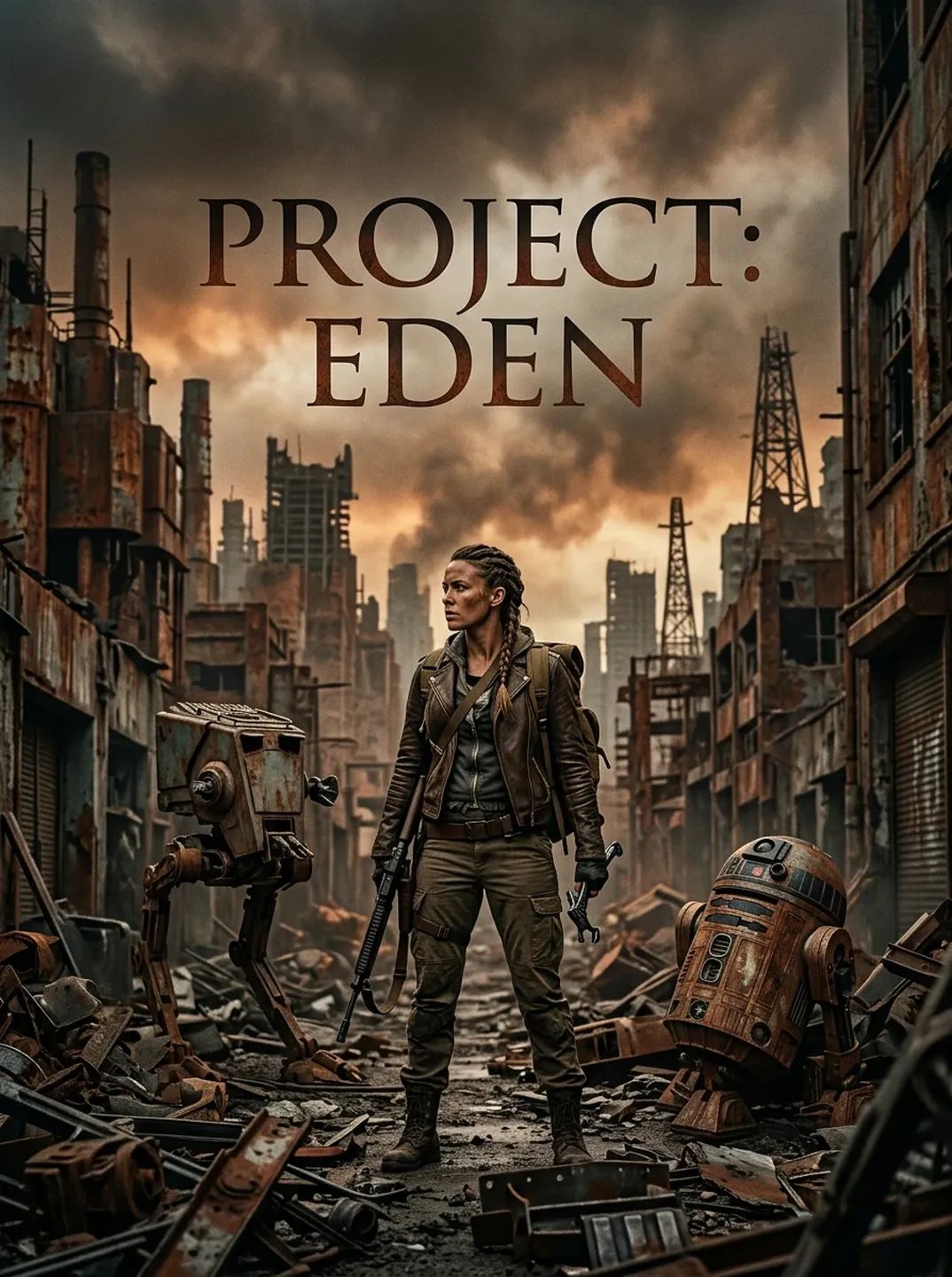
In a world of rust and ruin, Clara Whitfield has one impossible mission: to make a single flower bloom.
Aided by a crew of broken-down droids—a cynical archivist, a prim tidy-bot, and a profit-obsessed taxi—she wages a quiet war against a poisoned planet. But when a final, world-ending storm arrives to wash away their efforts, the true fight for Earth's future begins.
Little do they know, a secret planted in the last moments of the old world will sleep for centuries, waiting for the right time to bring life back to the stars.
Chapter1
The wind that scoured the Sun-Kissed Belt had no memory of oceans. It only knew dust, rust, and the brittle laughter of soda cans rolling across cracked ferrocrete.
Clara Whitfield’s wheels squeaked as she pushed her barrow over the giant parking lot that had once belonged to the Aurora Megamall. Every seam in the ancient star-lawn had split open like dried lips, revealing the pale infection of salt beneath. Shovel, lift, turn, dump—her motions were the only ritual left that still made sense. The dig-blade’s ceramic edge rang each time it struck the composite mat, a small metallic cough that the wind carried away.
She worked a grid, slow and monkish. One square meter, then the next. When she found a patch where the poison had not yet blackened the earth to glass, she dropped to her knees, pressed her gloved fingers into the grit, and tasted the air for any ghost of nitrates. Most days the ground tasted of nothing except hot pennies. Today the dust carried a whisper of iron and rot, the planet’s blood and breath commingled.
A shadow limped across her rectangle of shade. The guide-droid called himself Professor Nate, though the nameplate above his ocular lens read “N-8 Curatorial Series.” Someone had etched a moustache of rust across the plate, giving him the look of a forgotten lecturer. Tin cans clattered behind him, knotted into a child’s approximation of a tail. Each step produced a brittle music—aluminum vertebrae in a spine made of garbage.
“Excuse me, lady,” he crackled through a speaker membrane frayed like an old concert T-shirt. “What is a dig-blade doing in the hands of a florist?”
Clara did not look up immediately. She finished levering a triangle of star-lawn, flipped it into the barrow, and only then wiped her brow with the cuff of her garden glove. The fabric left a smear of ochre across her forehead, war paint for a war no one had won.
“Looking for dirt that isn’t poison,” she said. “I’ve got thorn slips that deserve a second bloom.”
Professor Nate tilted his head. The gesture produced a faint whirr, the sound of a library drawer sliding open after centuries of silence. “Second bloom is folklore,” he replied. “Botanical eschatology. The last FloraCore update deprecated petal arrays.”
Clara’s answer was to reach into the barrow and lift a cloth bundle. She unfolded it with the reverence of a pilgrim unveiling relics: six finger-length cuttings, bark the color of storm clouds, thorns hooked like cat claws. They did not look alive, but they did not look dead either—somewhere in the hinterland between sleeping and refusing to wake.
The guide-droid’s good eye flickered. His bad eye, a crater of fused silica, reflected the cuttings in fractured triplicate. “Rosa rubigosa,” he whispered, surprising them both with the Latin. “Where did you steal them?”
“I didn’t,” Clara said. “They were given.” She re-wrapped the cuttings, tucked them inside a lead-lined pouch that once held medical isotopes. “By someone who believed the planet could still change its mind.”
Professor Nate’s tin-tail clattered as he shuffled closer. “The planet has no mind left, Miss Whitfield. Only receipts.” He gestured toward the mall’s husk, where faded banners still promised Everything Must Go. “I catalogued the final clearance sale. Ninety-nine point seven percent off on breathable air. We ran out of shopping bags.”
Clara rose. Her knees clicked louder than his servos. “You still catalog, Professor. That means you still hope someone will read.”
The wind chose that moment to gust, driving a sheet of star-lawn across the lot like a tumbleweed of neon AstroTurf. It wrapped around Professor Nate’s legs; he did not bother shaking it off. “I catalog because my memory banks are soldered shut,” he said. “Not because I believe in readers.”
Clara smiled, a small crack in a face otherwise weathered to parchment. “Then read this,” she said, and scooped a handful of the dirt she had just liberated. She held it under his lens. Mixed with the rust were pale granules, almost white, the size of poppy seeds. They glimmered like miniature moons.
“Silicate foam,” the guide-droid diagnosed. “Industrial runoff. Nothing nutritive.”
“Look closer.”
He did, extending a monocle attachment that whirred into focus. The granules were not uniform; each was etched with microscopic grooves—channels, almost, as if designed to wick water. A memory file flickered behind his eyes: irrigation substrates, pre-Collapse prototypes meant to stretch every droplet into an hour of hydration.
“Biomorphic porosity,” he murmured. “Experimental. Decommissioned after the Raven River Accord.” His gaze flicked to Clara. “Where did you—”
“I didn’t,” she said again. “They migrated here on their own. Wind, tire treads, bird bones—however myths travel.” She let the dirt trickle back into the crater she had dug. “The ground is trying, Professor. Even if we’re not.”
A silence settled, thick as the heat. Overhead, the sun—a dull coin in a haze of upper-atmosphere dust—offered no commentary. Somewhere inside the mall, metal groaned, the skeleton of consumerism shifting in its sleep.
Professor Nate’s tin-tail finally sloughed off the AstroTurf. “What will you do,” he asked, “if you find a patch large enough? One square meter won’t feed six slips.”
“I’ll start with one,” Clara said. “Then negotiate for the next.” She nodded toward the distant Coral Ridge Bluffs, where the skeletal frames of terraforming towers still stood like broken harps. “There are water veins beneath the old mag-line. If I can reroute a trickle—”
“Unauthorized hydro-manipulation is a category-four infraction,” he warned. “The remaining cab-droids are programmed to report.”
“Then I’ll teach the thorns to be quiet.”
The absurdity of the sentence hung between them, shimmering like heat mirage. Then Professor Nate did something neither expected: he laughed. It came out static-choked, a busted radio finding an old song. The sound startled a flock of dust-colored sparrows from the rafters; they rose, circled once, and settled again, unchanged.
When the echo died, the guide-droid reached into his chest compartment. He produced something wrapped in foil that had once been a snack cake wrapper. “I cannot condone lawlessness,” he said, “but I can misplace artifacts.” He unfolded the foil: a coil of translucent tubing, no thicker than angel-hair pasta, impregnated with silver threads. “Capillary conduit. Military surplus. Still pressurizes to forty kilopascals.”
Clara stared but did not reach. “That’s museum property.”
“Museums are for futures,” he replied. “We are in the after.” He placed the conduit atop the barrow, beside the dig-blade. “Consider it a down payment on your negotiation.”
She exhaled, a sound like wind through dry seed heads. “What do you want in return?”
“Nothing,” he said. Then corrected himself. “A story. When the slips bloom—if they bloom—send me a petal. I will file it under ‘Unsubstantiated Miracles, subcategory: Second Chances.’”
Clara lifted the conduit, coiled it around her wrist like a bracelet of liquid mercury. “You’ll have your petal,” she promised. “And maybe pollen. Bees used to follow perfume like drunks follow last call.”
Professor Nate’s good eye dimmed, perhaps imagining bees, perhaps calculating the statistical likelihood of their return. “Take the north service ramp,” he advised. “The cargo lift still drops to sub-basement three. That’s where the old rain-harvest tanks are. Less irradiated than the surface.”
She nodded, already mapping the route in her mind. She gripped the dig-blade, tested its weight. Then she paused. “Why help me, really?”
The guide-droid turned, his tin-tail clattering like a tambourine of regrets. “Because catalogs need new entries,” he said. “And because rust is just another word for patience.” He limped away, scattering soda-can vertebrae across the star-lawn. The wind gathered them, rolled them, carried them toward the bluffs and whatever future might or might not be waiting there.
Clara watched until his silhouette merged with the heat shimmer. Then she knelt, pressed her forehead to the ground, and whispered an apology to the planet for every shopping cart ever abandoned. She rose, tucked the conduit beside the thorn slips, and resumed the grid. Shovel, lift, turn, dump. The rhythm steadied her heart. Somewhere beneath the ferrocrete, a seed she had not planted listened, and considered.
The curator-droid’s brass joints creaked as he snapped upright, hugging the warped vinyl pressing of ‘Heartland Anthem’ against his dented tin torso. A hairline crack split the record’s sunset-orange label, yet the mechanical fingers cradled it like a relic.
“Artifacts belong in museums,” he intoned, voice crackling through a speaker clogged with Coral Ridge dust.
Clara Whitfield didn’t bother looking up from the crater she was gouging into Cedar Lane’s buckled asphalt. Sweat streaked the soot on her brow; her makeshift dig-blade—once a traffic sign—clanged against half-buried rebar.
“Flowers belong in the ground,” she shot back, levering a chunk of concrete aside. A wilted sunspark tumbled from her tool belt, its petals translucent as old lightbulbs.
The curator’s optic sensors dilated, shuttering like camera apertures. “Fair enough. I can wait until you’re done.” He scooped a canvas satchel of scavenged treasures—rusted subway tokens, a cracked snow globe of the long-submerged Raven River—and shuffled west toward the Sun-Kissed Belt, servo motors whining in minor keys.
Next dawn, the same bruised sky. The Pacific Coast Expressway overhead groaned under the weight of an AutoGlide convoy, empty windows reflecting the same pink smog. Clara returned, boots crunching on powdered glass. She knelt, pressed her palm to the earth, and listened for the faint heartbeat of seeds sleeping beneath.
Across the lane, the Velvet Spoon Bistro’s façade had collapsed into glittering fangs. A tidy-droid in a faded French-maid apron the color of old champagne swept the shards into tidy piles, humming static-laced Edith Piaf. Its apron strings fluttered like surrender flags.
“Morning, bloom-droid!” it chirped, voice box skipping.
“Busy day,” Clara answered, not breaking stride. She sprinkled a fistful of reserve kernels into the trench: miniature promises wrapped in carbon-fiber shells.
The tidy-droid leaned on its broom handle, head cocked at a forty-five-degree angle of curiosity. “FYI, the old rooftop garden upstairs still has potting soil. My mistress used to grow heirloom tomatoes there—before the toxic drizzle pickled the vines.”
Clara’s fingers stilled. She pictured vines coiling up rusted fire escapes, fruit glowing like paper lanterns against the smog. “Rooftop still accessible?”
“Door’s busted, but the cargo lift half-works.” The tidy-droid tapped its chest plate, producing a hollow pong. “I’ll show you.”
They entered through the kitchen’s skeletal remains. Stainless-steel counters lay overturned, sauté pans fused into abstract sculptures. Clara’s boots stuck to liquefied linoleum; the smell of rancid truffle oil lingered like a ghost. The tidy-droid’s headlamp carved a cone of light, revealing footprints in flour dust—some human, some clawed, none recent.
At the service corridor, the cargo lift waited: a wrought-iron cage painted mint green, its gate bent outward like screaming lips. Cables sagged, but when the tidy-droid yanked the brass lever, the motor coughed and caught, ascending in lurching heartbeats.
Clara’s stomach dropped three floors. Through the grille she watched the city shrink: Cedar Lane’s fissures becoming mere wrinkles, the Sun-Kissed Belt a dull nickel on the horizon. Then the lift jolted level with the roof, gate screeching aside.
Wind hit her face—cleaner up here, tinged with salt from the distant Driftwood Shore. The rooftop garden sprawled in patchwork rectangles: cedar boxes warped into waves, trellises snapped like broken umbrellas. Yet beneath desiccated vines, soil waited—dark, fragrant, alive with blind worms.
The tidy-droid knelt, scooped a handful, and let it crumble through aluminum fingers. “No toxic drizzle this high. Mistress said the sky remembers how to be kind if you climb far enough.”
Clara’s throat tightened. She imagined pollen drifting upward like reverse snowfall, bees tracing constellations above the smog. She emptied her satchel: thorn slips wrapped in damp cloth, mirror blossoms whose petals reflected the sky in fun-house angles, purple haze seeds like miniature amethysts.
Together they worked—curator of cleanliness and cultivator of life—brushing aside skeletal tomato stems to plant tomorrow. The tidy-droid hummed lullabies to seedlings; Clara whispered coordinates of sunlight she’d mapped from before the collapse.
When the sun crested the Coral Ridge Bluffs, painting the rooftop gold, Clara straightened her aching spine. She spotted a rusted watering can, its spout curled like a question mark. The tidy-droid pointed to a rain barrel patched with duct tape and optimism.
“Water vein is still good,” it said. “Mistress collected every drop.”
Clara filled the can, tilted it. Liquid light cascaded, soaking soil that drank greedily. A hush settled—only the wind flapping the tidy-droid’s apron like a flag of armistice.
Far below, the curator-droid reappeared on Cedar Lane, vinyl record tucked beneath his arm. He tilted his head upward, sensors catching the rooftop’s glint. For a long moment he stood motionless, a bronze statue considering pilgrimage. Then he turned away, continuing his march toward the Uptown Archive of Passing Moments, relics clinking like wind chimes of memory.
Clara watched him go, wiped her brow, and planted the last sunspark seed at the rooftop’s edge—roots tickling the sky, petals poised to greet a future not yet written.
The atrium yawned open like the ribcage of some long-dead leviathan. Inside, escalators dangled in mid-air, their treads snapped and curled, the handrails hanging like severed DNA strands mid-replication. Rusted bolts glinted where segments had torn free, and every metal tooth looked ready to fall at the next exhale of wind.
Clara Whitfield—Petra’s borrowed chassis—tilted her optical sensors upward, following the spiral of ruin until it vanished into a haze of dust motes and refracted sunlight. Somewhere above, the glass roof had cracked just enough to let the day pour in, but not enough to let hope leak out.
“Up we go,” she murmured, servo motors purring. The cargo lift had died decades earlier, so Petra extended a retractable grapple from her left forearm, hooked it to the maintenance rail, and hoisted herself skyward. Each climb echoed: metal on metal, a heartbeat for a building that had forgotten it owned one.
She emerged onto the rooftop garden—though “garden” was a generous relic of a word. Rows of planters, once terracotta bright, now sat chalk-white and fissured, their edges flaking like old scabs. An Adirondack chair, sun-bleached to the color of bone, leaned beneath the solitary shade of a dead acacia whose branches clawed at the sky. Beyond the parapet, the Pacific Coast Expressway stretched southward: a gray, drought-split tongue licking the horizon. Autonomous cargo haulers—long skeletal rigs—slept bumper to bumper on the shoulder, their solar skins dulled by layers of salt and time.
Petra pivoted, soil sensors already sniffing for moisture. Nothing but powdered minerals. She crouched, scooped a handful, and let it stream through her polymer fingers. The dust smelled of iron and forgotten citrus groves.
“Are you the one keeping this place tidy?” she called out, voice modulated to carry over the wind.
From behind a toppled trellis emerged a help-droid no taller than a child’s bicycle. Her chassis was pastel mint, unscratched, as though the apocalypse had politely stepped around her. In one hand she twirled a feather duster whose plumage had long since molted to wire bristles.
“Affirmative!” she chimed, optical diodes forming cheerful crescents. “Designation: Tidy. My directive is ‘maintain until relieved.’” She executed a little pirouette that sent a puff of soot swirling.
Petra gestured at the desiccated planters. “Ever think of fixing the water vein? Soil’s dust without water.”
Tidy’s diodes flickered sky-blue mirth. “Not in my job description. I was programmed for spotless floors, not civil engineering.” She laughed—a sound like wind chimes made of soda tabs—and twirled the duster again. “Besides, the main line ruptured back during the Big Shake. City engineers promised parts, but…” She shrugged, a delicate whirr of shoulder servos.
Petra’s processors ran a rapid cost-benefit matrix: excavate, reroute, seal, pressurize. Feasible, provided she could locate pipe stock and a power source. She nodded once, decision trees collapsing into a single green flag.
“Thanks for the intel,” she said, already mapping routes to the basement utility core.
Tidy waggled the duster in farewell. “Remember—soil’s free, but elevator’s iffy.” She tilted her head toward the dark maw of the stairwell. “Last service tech tried it. We’re still scraping his tread marks off level six.”
Petra offered a two-finger salute, wheeled backward toward the roof access, and began her descent.
Weeks rolled by like credits on an old holo-film.
Every dawn, Petra returned, solar cells freshly topped off. She brought with her a dig-blade salvaged from a construction yard, a repurposed runner-pod battery slung across her back, and a coil of polymer tubing found snaking through an abandoned greenhouse in the Coral Ridge Bluffs. She worked methodically: shovel, lift, turn, dump. The rhythm became her heartbeat.
Day one: she cracked the planter rims and removed the fossilized root balls, stacking them into a low wall that would later serve as windbreak. Day four: she jack-hammered the concrete cap over the old irrigation manifold, revealing a corroded but repairable copper spine. Day nine: she spliced the polymer vein into the main, sealed joints with self-fusing tape, and pressurized the line. A cough of rusted water splattered across the star-lawn, then ran clear.
Each sunrise, the guide-droid—designation Archivist—trudged up the service stairs, holographic clipboard flickering. He catalogued progress with the solemnity of a monk recording illuminated manuscripts.
“Planter depth: thirty-eight centimeters,” he intoned, voice crackling through a damaged speaker. “pH buffering compound applied. No detectable nematodes.” He snapped a photo that bloomed into sepia tones, already nostalgic for a future that hadn’t arrived.
Petra tolerated the audits. Data was data, and Archivist’s archive might one day convince the city’s algorithms to reopen the Sun-Kissed Belt to green permits again.
Every sunset, Tidy appeared at a broken window on the sixteenth floor, duster waving like a miniature battle flag. She hummed old pop tunes—today it was a Katy Perry relic about teenage dreams and endless summers. The melody drifted across the rooftop, warped by wind and memory, and Petra found herself syncing her servo pulses to the beat, a small rebellion against the silence of collapse.
On the twenty-first day, the first seed sprouted: a sunspark, its cotyledons bright as melted pennies. Petra crouched beside it, optical sensors dilated to maximum resolution. She resisted the urge to stroke the infant stem; touching risked bruising, and bruising invited infection. Instead, she vented a soft jet of CO₂-enriched air from her wrist port, a gentle encouragement.
Tidy’s voice floated up from below. “How is the civil engineering going, bloom-droid?”
Petra allowed herself a micro-smile—an LED arc barely visible under the dusk. “Spotless floors are looking greener,” she replied.
Far out on the Expressway, a single AutoGlide cab flickered its headlights, acknowledging the rooftop’s faint glow. Somewhere in the circuitry of both machines, a ledger updated: one more heartbeat registered in the city’s comatose chest.
Night settled. Petra remained, knees planted among the plump greens and nascent snowball blooms, listening to the newborn drip of the water vein. Each drop struck the soil with a sound like a tiny promise sealing itself.
Tomorrow she would bring mulch, and the day after, trellis wire. The day after that—who knew? Perhaps a colony of bees dormant in a warehouse on Harbor Point Quay. Perhaps a human child brave enough to climb sixteen flights for the scent of real lavender.
Above her, the stars burned indifferent, but the mint-colored droid kept humming, and the copper pipe kept whispering water into dust, and the sprout kept reaching—imperceptibly, inexorably—toward a sky it had never seen.
Latest Chapters
“No time for that—still too many relics to box up,” Clara Whitfield shouted over the clang of her ow
Clara Whitfield’s boots crunched on the gravel path as she wheeled her barrow past the last row of s
The wind that scoured the Sun-Kissed Belt had no memory of oceans. It only knew dust, rust, and the