
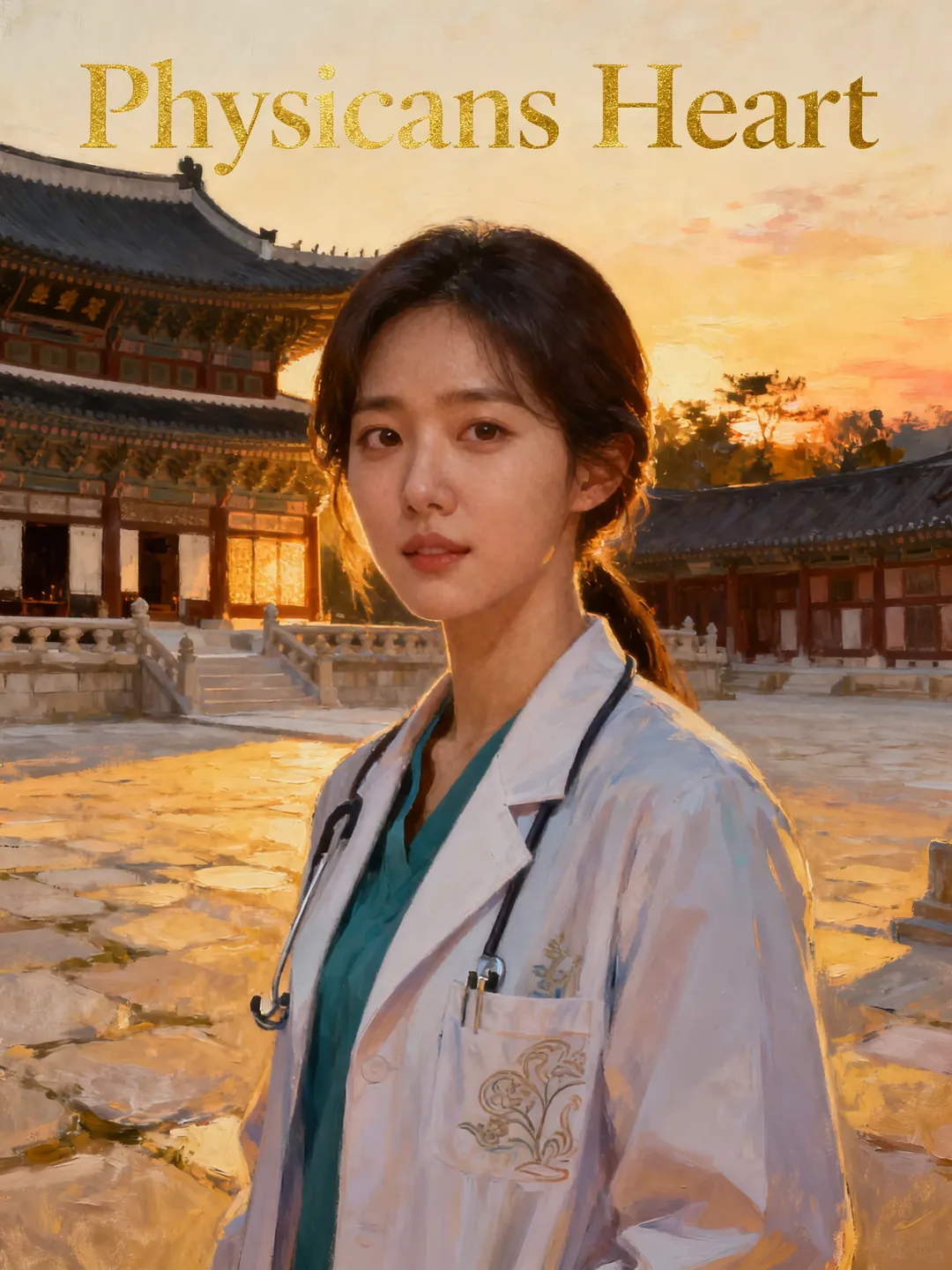
Physicans Heart
Synopsis
The PROTAGONIST Cha Eunso
Age 24 at the start. Daughter of a disgraced village herbalist in
the fictional Joseon-adjacent Kingdom of Haewon. Brilliant,
stubborn, and fiercely self-taught in medicine after watching her
father die unable to afford a royal physician. She arrives at the
capital in disguise, passes the Royal Medical Bureau's entrance
examination with the highest score of the morning session, and
begins the long, dangerous, magnificent climb from village poverty
to becoming the first female Royal Physician in Haewon's history.
Chapter1
Chapter 1: The Herbalist's Daughter
The morning her father died, Cha Eunso ground the last of the willow bark into powder with the same steady motion he had taught her, because steady motion was what the hands needed when the rest of the body was failing to hold itself together.
It was not enough. It had not been enough for three days, and she had known it had not been enough, but she had kept grinding because stopping would have been a kind of admission she was not ready to make at twenty-two. At twenty-two she was still young enough to believe that sufficient effort could undo insufficient medicine, or at least she had been until the fourth morning, when the fever broke in the wrong direction.
She sat with him for the two hours after. She held his hand, which she was allowed to do now that there was no more to be done with her hands. She said the things that needed to be said in the quiet of the village herbalist's hut, with the smell of medicinal compounds hanging in the air and the morning outside making its indifferent noise.
She said: I am going to be better at this than you. I am going to be the best there is.
She did not say it to hurt him. She was not even sure he could hear her by then. She said it because it was true and because truth, her father had taught her, was the foundation of diagnosis, and diagnosis was the foundation of medicine, and medicine was everything they had.
She had watched him die of a treatable fever because the treatment that would have saved him - a specific compounded tincture that required herbs available only through the Royal Medical Bureau's licensed physicians - was not available to a village herbalist who could not afford the Bureau fee, who could not travel to the capital while ill, who could not ask a royal physician to make the journey for what a village could pay.
She sat with her father's hand in hers and thought about the tincture. She had read the compound in his texts. She could have made it herself. She had not been able to obtain the primary herb, which was restricted by Bureau policy to licensed practitioners.
She thought about this very precisely and with great care, because thinking about it precisely was the only way to make it useful rather than simply unbearable.
Then she got up and began preparing for the capital.
The journey took six days on the main road and five more through the mountain pass, which she took because it was cheaper and she was counting every coin. She carried her father's medicine chest on her back - worn leather, brass clasps, the initials C.H. for Cha Hyungmun burned into the front. It was heavier than it should have been for someone walking five days through mountains. She did not put it down.
She arrived in the capital city Hanyang on a market morning, when the streets were full of people who all seemed to know where they were going and to be going there quickly. She had been to the capital twice before, both times as a child in her father's company. She remembered it as large. It was considerably larger than she remembered.
She found lodging at a herbalist's stall in the outer market district - she offered two weeks of work in exchange for a sleeping space, and the stall owner, who was understaffed and overworked, accepted without asking too many questions.
She spent three days walking the city before she allowed herself to approach the Bureau.
The Royal Medical Bureau occupied a walled compound in the eastern district, between the court administrative buildings and the noble family residences. Its walls were white plaster over stone, high enough to suggest both authority and exclusion. The main gate was guarded by two soldiers and flanked by a notice board that she stood in front of for twenty minutes reading every notice in order from top to bottom.
The entrance examination was posted quarterly. The next one was in eleven days.
She had eleven days.
She went back to the market stall, told the owner she would be studying in the evenings, and began.
She had her father's texts - twelve volumes, worn and annotated in his cramped handwriting, with her own additions in the margins from the past four years. She had the Bureau's published examination syllabus, which she had purchased at a bookseller's for a price she had calculated as four days of food. She had the specific knowledge of someone who had been practicing informal medicine since the age of nine, when her father first showed her how to tell safe mushrooms from toxic ones by the smell of their gill surface.
She had not slept longer than four hours in any given night since the mountain pass. She did not sleep much during the eleven days either.
On the morning of the examination, she dressed in the plainest of her two sets of work clothes, tucked her hair under a scholar's cap she had borrowed from the stall owner's son, and presented herself at the Bureau gate as Cha Eunsoo of the northern province, age twenty-four, male.
The guard looked at her for a moment. She met his gaze with the composure of someone who had not come this far to be stopped at a gate.
He checked his list. He found the name. He let her in.
She sat the examination in a room with forty-three other applicants, most of them at least five years older than her stated age and several of them clearly from noble or scholarly families who had been preparing since childhood. She read the first question and understood that she knew the answer. She read the second question and understood that she knew that answer as well. She settled into the examination with the specific relief of recognizing the work.
Three hours later, walking back to the market district with her examination completed and submitted, she allowed herself one minute of feeling something before filing it away and beginning to think about what came next.
What came next was waiting. What came after waiting was either acceptance or the next examination. She did not plan for rejection because planning for it would require considering it, and she had not climbed five days through a mountain pass to consider rejection.
She ate noodles at a market stall for the first time in two weeks - real food, not travel rations - and thought about her father, and thought about the Bureau's walls, and thought about the tincture that would have saved him, and thought: I will make that tincture for someone else. I will make every tincture for everyone who comes to me.
She thought: I am going to be the best physician in this kingdom.
She ate her noodles. She went back to work at the herb stall. She waited.
Latest Chapters
Chapter 999: She says Jiho He says yes She The letter from her mother arrived on the same morn
Chapter 998: He says I would like to keep She had been a physician for 7 years now - officiall
Chapter 997: He says I have been choosing you "Eunso's mother," said Physician Dok Hyunjo, wit
Chapter 996: He says I have been choosing you The case that arrived that morning was not, on i