
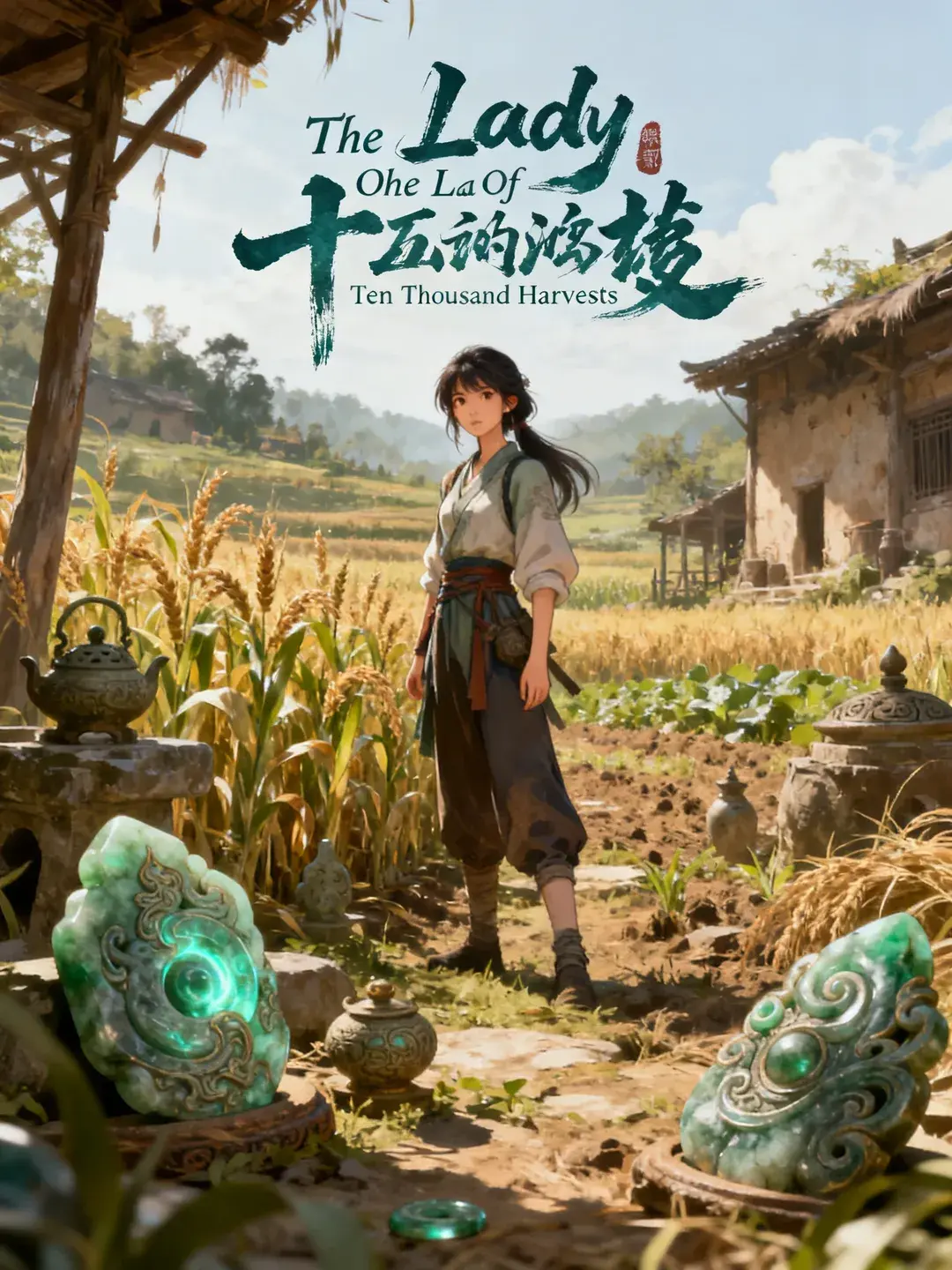
The Lady Of Ten Thousand Harvests
Synopsis
Shen Liuli — an agricultural scientist who died at 29 with her research unfinished — transmigrates into the body of a meek farmer's daughter in the failing Shen family. She wakes up, reads the betrothal contract, says "all right" to the ceiling, and gets to work.
The family farm carries a broken celestial covenant. Inside a jade ring found in the collapsed storage room: a three-li cultivation space, a divine seed vault of extinct crops, and the ghost of her ancestor — who built the covenant a hundred years ago and has been waiting ever since.
What neither of them knows yet: Shen Liuli has been farming this land for five thousand years, in form after form, and the soil remembers every one of them.
Chapter1
----------------------------------------------------------------------
She came back in spring.
This was appropriate, she would think later, because spring was the
season of new planting, of things beginning again after the long cold
silence of winter, of soil that had been waiting with the deep patience
of the earth itself for someone to ask it what it wanted to grow.
She came back in a body that was not hers — or rather, it was hers now,
entirely and irrevocably, and the previous occupant had left it in a
state that any agricultural scientist worth her credentials would have
classified as dangerously depleted: malnourished, underwatered, subject
to stresses that had been permitted to continue unchecked for too long.
She took inventory.
This was the first and most important step of any assessment, a
principle she had held since her first laboratory position at
twenty-three: before you do anything else, know what you have. The
body's condition: acceptable, recoverable with attention and adequate
nutrition. The room: small, southeast-facing window, morning light, a
pallet on the floor, a chest with a broken latch, a table with a
betrothal contract on it. The sound of the household beyond the door:
two voices, one male and stressed, one male and placating, neither of
them aware yet that the person they were discussing had different
occupants than yesterday.
She read the betrothal contract. It took her forty seconds because she
read quickly and because the contract was not complex — a document that
transferred use rights over fifteen of the family's remaining farm mu to
the Liu family in exchange for taking their eldest daughter as a formal
bride in the spring season.
Their eldest daughter. Her. Shen Liuli, age sixteen, youngest daughter
of the late merchant Shen Gangtao and his wife Madam Zhou, betrothed to
Liu Jianguo of the eastern Liu family, which wanted land and had found a
family willing to give it in exchange for debt relief.
She set down the contract. She looked at the ceiling.
"All right," she said. The word landed in the small room with the weight
of someone who had said all right to the ceiling of a different room
once, in another life, when she had understood at twenty-nine that she
was going to die before her research was finished.
She had said it then too. And then she had come back.
---
She walked the land before breakfast.
This surprised the household — the old Liuli had not been well enough to
walk the back garden without assistance, let alone ten mu of farmland
before the sun was fully up. But she did it, in borrowed clothes that
were too big for the malnourished frame she had inherited, with the
careful methodical stride of someone cataloguing what they see.
The farmland: ten mu of ancestral Shen family land, two of which were
currently planted in last-season's failed millet crop, uncleared, the
dead stalks standing in rows like a reproach. Three more fallow. The
remaining five leased to a neighbor and yielding almost nothing because
the soil was failing across the entire district.
The soil. She crouched and picked up a handful from the nearest field.
Grey-beige, cracked at the surface, desiccated. She brought it to her
nose and breathed.
The smell: dry, yes. Depleted of active microbial community, yes. But
not dead. She had held dead soil before, in the laboratory of her
previous life, and dead soil smelled of its own absence — a kind of
non-smell that was the olfactory equivalent of a stopped clock. This
soil did not smell like absence. It smelled like exhaustion. Like
something that had been drawing on reserves it could not replenish, for
longer than soil should have to.
She stood up. She said, to no one, to the field: "You are not dead. You
are waiting."
She put the handful of soil in her pocket and walked back to the
compound.
---
She found the ring by accident, which was the correct way to find things
of this nature: not by seeking but by being present in the right place
with the right quality of attention.
The storage building's roof had partially collapsed three years ago and
not been repaired because there was no money for timber. She went in
through the gap in the wall to see what the family still had — seed
stock, tools, anything that could be used in the coming season — and
found the ring half-buried under a section of collapsed roofing tile in
the far corner.
Jade, green as young wheat, carved all over with scenes so small and
fine that she needed to move it into the shaft of daylight coming
through the collapsed section to see them: a woman kneeling at a
planting mound, hands in the earth; the same woman at harvest, arms
full; stylized soil layers, root systems, the geometry of crop rotation
rendered in miniature with perfect botanical accuracy.
She recognized the botanical accuracy. It was the same standard she had
applied to her own research illustrations.
She picked it up. It was warm immediately, with a warmth that came from
within the stone rather than from ambient temperature.
A voice, old and carrying the patience of someone who had been in a ring
for ninety years: "I wondered when you would find me."
She did not drop the ring. She had spent six years in a laboratory where
experiments could and did produce unexpected sounds, smells, and
occasionally presences. She held the ring steady and said: "Who are
you."
"I am what remains of your ancestor Shen Huanong," the voice said. It
sounded female, elderly, and accustomed to being taken seriously. "The
greatest farming cultivator of the Wanhua dynasty, who made a covenant
she should not have made and is now spending her afterlife in a ring
trying to help her descendants undo the damage."
"The covenant that broke the land," Liuli said.
A pause. "You know about it."
"I know about it now," she said. "The soil told me."
Another pause, longer. Then, with the tone of someone revising a
significant assessment: "You are not who I expected."
"I am Shen Liuli," she said. "I am her body with a different mind. The
original was too frightened to manage what needs to be done." She
thought about the betrothal contract on the table. "What needs to be
done is considerable."
"Yes," said the voice of Shen Huanong, great farming ancestor. "Show me
your hands."
She held out her hands in the light coming through the collapsed roof:
rough palms for a sixteen-year-old, the hands of someone who had spent
years in laboratories and fieldwork, carrying experience that the body
she wore had not had time to accumulate.
The ring on her finger — she had not noticed when it had moved from her
grip to her finger — pulsed once. Warm. Alive. Ready.
"Better," said the ancestor. "Come inside. Let me show you what you have
to work with."
---
The space inside the ring was three li of the most beautiful
agricultural land she had ever seen.
In her previous life she had worked at four research stations across two
continents. She had seen the rice paddies of the southern coast in flood
season, the terraced wheat fields of the highland provinces,
experimental plots in controlled environments where every variable was
accounted for. She had loved all of them with the passionate exactness
of someone whose work was also her devotion.
This space exceeded all of them.
The soil was the deep mahogany-brown of earth at the peak of its
biological activity, the color that meant a thriving microbial
community, adequate moisture, correct mineralization. A spirit spring
glowed soft gold at the center, its light the warm amber of
late-afternoon sun, its water flowing through channels to the
cultivation beds in a pattern she recognized immediately as an ancient
flood-and-channel irrigation system she had studied in her doctorate
research.
Twelve cultivation beds, empty but humming. And along the eastern wall,
a seed vault.
She went to the seed vault first, because she was a scientist and
scientists always go to the data first.
Silk bags, each labeled in an ancient hand, each containing seeds she
had only read about: varieties extinct in the mortal realm for two to
four hundred years, divine crop strains that the cultivation texts
referenced as theoretical rather than accessible. The Heavenly Millet of
the First Emperor's gardens. The Five-Cloud Wheat that was said to grow
in moonlight. The Earth-Root Yam that could survive in soil with zero
surface moisture by accessing underground water channels through
symbiotic root systems.
She stood at the seed vault for a long time.
The ancestor's voice said, gently: "They have been waiting for someone
who could grow them."
She looked at her hands. She thought about the soil sample in her pocket
— exhausted, waiting, not dead.
She said: "I can grow them."
She took the first seed bag from the shelf. She walked to the nearest
cultivation bed. She began.
Outside the ring, in the mortal world, the sun was coming up over the
Shen family's depleted land, and the soil below it — grey and cracked
and waiting — trembled once, very slightly, like something underground
turning over in its sleep.
----------------------------------------------------------------------
Latest Chapters
---------------------------------------------------------------------- The spring cultivation cycle
---------------------------------------------------------------------- The spring cultivation cycle
---------------------------------------------------------------------- "Tujin," said a divine tribu
---------------------------------------------------------------------- "Tujin," said a divine tribu