
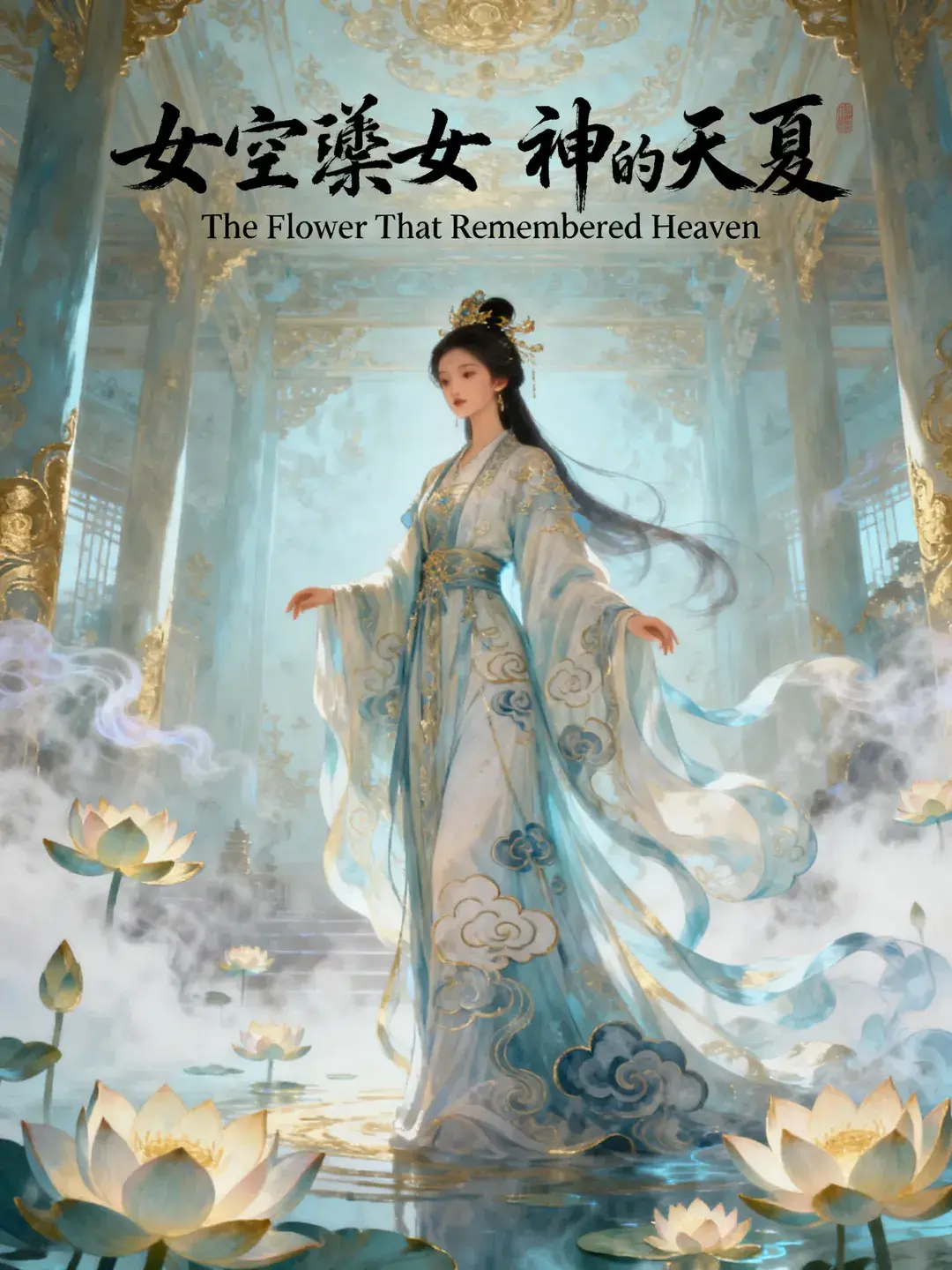
The Flower That Remembered Heaven
Synopsis
In the Nine Heavens celestial court, the goddess Ling Xia saves a falling mortal child during a forbidden hour. Her punishment: three thousand years of cultivation stripped, cast into the mortal realm for three lifetimes.
She wakes as Wei Mingzhu — youngest daughter of a ruined merchant family, no memories, only the inexplicable familiarity of the sky. She has no divine power except one thing she cannot explain: when she heals, her hands glow pale violet. She calls it her gift. Her teacher calls it divine fire.
She rises from village healer to Imperial Bureau cultivator to the first Celestial Physician in heaven's history — a title created for her because nothing existing was enough.
Meanwhile, the God of War has been watching from the Watching Mirror for three lifetimes. This time, he descends.
Chapter1
----------------------------------------------------------------------
The first thing she knew was the cold.
Not the damp cold of early morning or the cutting cold of high winter,
but a specific cold she had no word for — the cold of something that had
been warm and vast and was now neither, the cold of a vessel suddenly
empty of what it had held.
She woke on a stone floor with her cheek against it, which was cold too
but in the ordinary mortal way. Above her was a ceiling with a cracked
roof tile. Through the crack, a slot of sky.
She stared at it. The sky was the grey of before-dawn, and she knew it
immediately and completely — the way you know your own face, the way you
know the particular light of the room you grew up in. She knew this sky.
Not this specific patch of it, not this cracked-tile frame, but the sky
itself. It was familiar in a way that nothing else was.
She did not know her name.
She did not know where she was. She did not know how she had come to be
on this floor. She did not know the cold or the ceiling or the smell of
the room, which was woodsmoke and dried herbs and the particular
sourness of a building that had been through better days and remembered
them without pleasure.
What she knew: the sky.
"Mingzhu."
She turned her head. A young man was crouching beside her, his face worn
with the specific tired quality of someone who worried a great deal and
slept too little. He had kind eyes and rough hands and he was looking at
her with an expression so relieved it was almost distressing to witness.
"Mingzhu," he said again. "You are awake. You have been unconscious
since I found you last night."
She said the word he had said: "Mingzhu."
He said: "Yes. That is your name. You are Wei Mingzhu. I am your
brother, Wei Changyi. Do you — do you know me?"
She looked at him. She did not know him. She knew the sky.
She said: "I know the sky." And then, because this was clearly not the
answer he needed: "I believe you. About the name. And the brother."
He exhaled. He helped her sit up, which required more assistance than
she expected — not from weakness but from a disorientation that went
beyond physical, as though her sense of where her body was in space was
still calibrating to a new set of rules.
"You collapsed," he said. "I found you in the courtyard. You were not
there when I went to bed and you were there when I came out at midnight
and—" He stopped. "Are you hurt?"
She checked, with the efficient diagnostic attention that came to her as
naturally as breathing. She said: "No. I am not hurt." A pause. "I do
not know why I am not hurt."
He looked at her with the carefully maintained expression of a person
deciding not to ask the question that would require the most complicated
answer.
"The physician will come in the morning," he said. "Until then—" He
looked around the room. She looked too. A small room, a pallet, a window
with a broken shutter tied shut with rope. A worn-smooth table. A shelf
with medicinal herbs in cloth bundles. "Do you remember any of this?"
She looked at the herbs. Something shifted in her chest — not a memory
exactly, but a recognition. She knew what each bundle was. She knew
their names and their properties and their interactions and three
separate methods of preparation for each. She knew this the way she knew
the sky — completely and without origin.
She said: "I know the herbs."
Changyi looked at the shelf. He said: "You always did know those. Mother
says you drove away her last kitchen girl by reorganizing all the herb
storage. You were twelve."
She held the information carefully, like something that might crack.
Twelve years old. So there was a before. She had simply lost access to
it.
She said: "I will need paper. And ink."
He said: "Now?"
She said: "When the physician comes. I want to take notes."
He looked at her. He said: "You never took notes before. You said
writing things down made you think slower."
She considered this. She said: "I think I have changed." She said it
without drama, as an observation. She looked at the crack in the roof
tile and the slot of grey morning sky. She said: "Tell me about the
family. Tell me everything."
He told her. He told her about the merchant house that had been
respectable and the gambling that had not been and the trading license
that was gone and the Silver Plum Inn that remained, which was what you
got when a merchant family lost its trade goods but kept the building.
He told her about the debt and the interest and the creditors and his
mother who had been bitter for three years and would probably be bitter
for three more.
He told her about the town — Qingfeng town, in the northern province of
Changhe, where the plum blossoms bloomed in spring and the river flooded
every five years with the reliability of a rude relative who never
knocked.
She listened to all of it with the complete attention she gave to
everything, filing each piece with the systematic precision that was
apparently native to her, this self she was reconstructing piece by
piece.
When he finished she said: "The herbs on the shelf. The combinations are
wrong."
He blinked. He said: "Wrong."
She said: "The winter root should not be stored beside the dried
hawthorn — the hawthorn's moisture content affects winter root's
potency. And the four-leaf grass is grouped incorrectly by color instead
of by season of harvest, which will cause anyone preparing it to mistake
spring-harvest for autumn-harvest. They have very different properties."
He looked at the shelf. He looked at her. He said: "You really have
changed."
She said: "Yes." She looked at the sky again through the cracked tile.
She said: "I think I have come from somewhere. I think I am trying to
remember what it was like there."
She thought: wherever I was, the sky was bigger. But the sky here is the
same sky. They are connected, the sky I know and the sky I can see. That
means I have not lost everything.
She thought: I will find the rest.
She got up, because the herbs needed reorganizing and the morning was
coming and she had work to do.
----------------------------------------------------------------------
Latest Chapters
---------------------------------------------------------------------- The divine fire in her chest
---------------------------------------------------------------------- "the celestial court herald,
---------------------------------------------------------------------- The spring in the northern d
---------------------------------------------------------------------- The spring plum blossoms had