
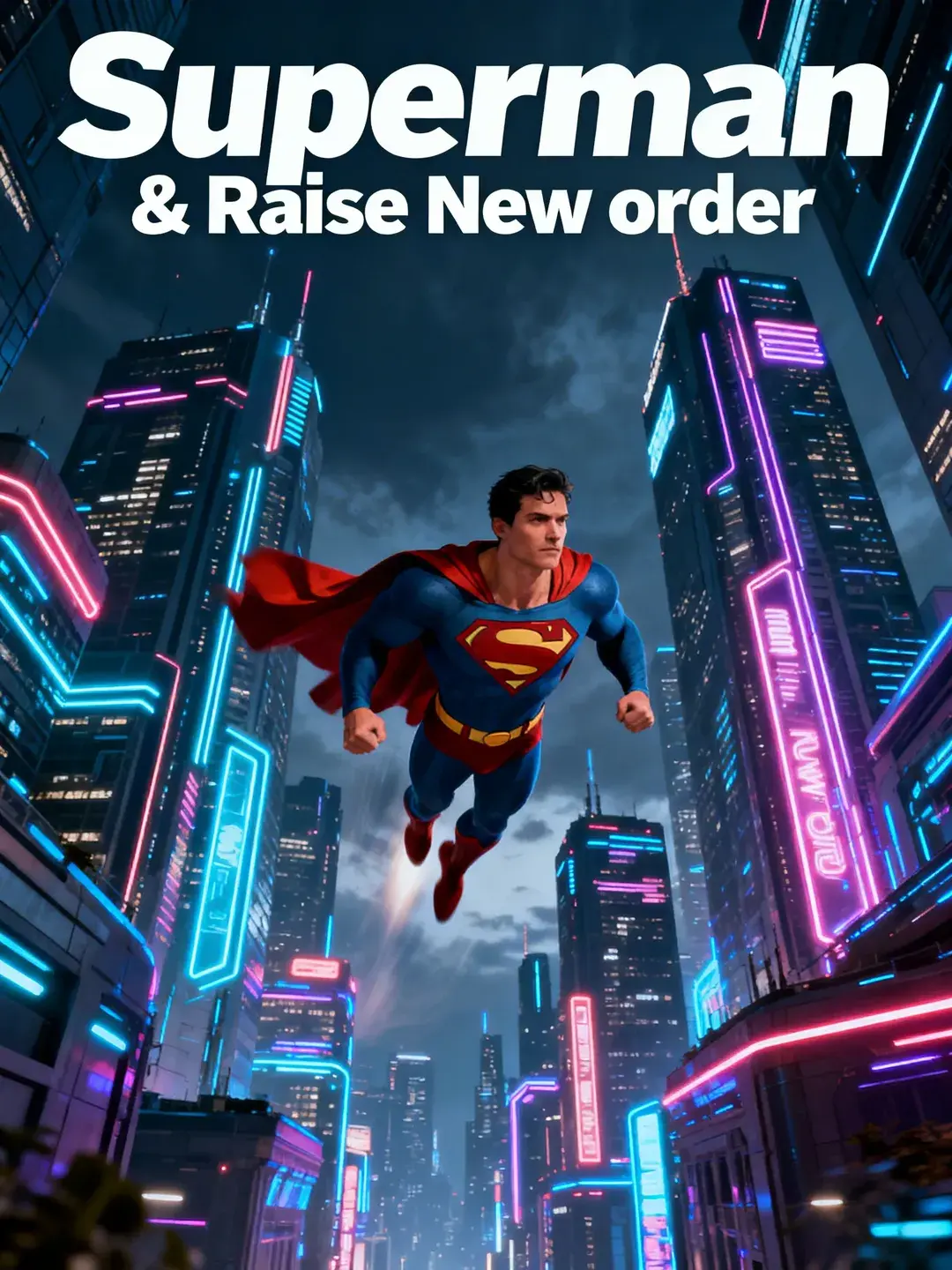
Superman & Raise New order
Synopsis
Superman
Chapter1
The wind came in low off the bay, carrying salt and burnt plastic. From the roof’s edge, Clark saw the first drone rise above the row of boarded windows—a black cross against the orange city haze. Its belly opened like a jaw and sprayed a thin red mist that clung to brick, to rust, to the faces of people too tired to duck.
He dropped before the second drone could follow.
Boot soles cracked tar paper as he landed. Dust jumped away in slow sheets. A dozen yards off, the drone pilot stood on the same roof, helmet off, hair cropped short and silver under the floodlight. She wore a matte-gray uniform with no flag, no name—just a white glyph shaped like an eye stitched at the collar. Her voice carried without raising.
“Go home, Superman. This block is already archived.”
Clark looked past her. On the street below, a boy in a torn hoodie dragged a plastic crate full of bottled insulin. The red mist settled on his shoulders like mold. The boy didn’t notice; he was counting windows, looking for the one his mother leaned out of every night.
“What’s in the spray?” Clark asked.
“Marker compound. Bonds to keratin. Scanners upstairs will sort the viable from the rest before morning.” She tapped a tablet; green bars scrolled. “We only need the healthy twenty percent. The math is generous.”
He had heard the slogan on the radio—RAISE NEW ORDER, the ad said, NO ONE LEFT BEHIND—while he was halfway across the world pulling a freighter off a reef. The words had sounded like every other promise. Seeing the arithmetic applied to a kid with shaking hands made the slogan feel sharp, a piece of glass under the skin.
“You’re culling,” he said.
“We’re curating survival.” She finally met his eyes. “You save everyone. We save the ecosystem. One of those plans collapses under its own weight; the other scales. Guess which.”
Clark stepped forward. Gravel popped beneath his boots. “You used to write for the Planet—tech section, right? Lena Ortiz. You interviewed me after the Brisbane quake.”
A flicker crossed her face, gone almost before it arrived. “Different lifetime. I don’t write headlines anymore. I write obituaries in advance—saves time.”
Behind them, the drone whirred, lenses dilating. A red dot blinked on the tablet: SUBJECT 14, PROBABILITY HIGH, ACTION PENDING. Clark followed the laser line to the boy now climbing the fire escape. The crate hit each railing with a hollow clang.
“What’s his crime?”
“Unauthorized medical transport. Insulin outside the ration network feeds black-market demand, destabilizes triage algorithms. Remove the outliers, the model holds.”
“That’s a person, not an outlier.”
She shrugged. “Your worldview requires miracles. Ours only requires bandwidth.”
The boy reached the roof level, chest heaving. Sweat glued strands of hair to his forehead. He saw the uniform, saw the cape, and froze halfway over the parapet. The crate slipped; bottles chimed like cheap bells. Clark caught it mid-air, set it down gently.
“Run,” Clark told him.
The boy’s eyes darted to the drone, to Lena, to the red mist still drifting. “My mom’s in twenty-two B. She’ll die without—”
“I’ll get her next. Go.”
He didn’t move. Fear pinned his sneakers to the gravel. Up close, Clark could smell the sour mix of adrenaline and hunger on his breath.
Lena tapped once more. The drone’s camera irised wider. A low hum rose, pitch climbing like a siren held underwater. “Subject fourteen, final warning. Step back, Kal-El. Protocol’s already queued.”
Clark stepped between the boy and the machine. “Override it.”
“Can’t. Model’s autonomous once fairness coefficients lock.” She sounded almost apologetic, almost proud. “You’re interfering with the greater good.”
He saw the lens brighten—charging cycle, half second left. Time thinned, became a wire pulled taut. He turned his back to the drone, wrapped the boy in his cape, crouched. Heat struck like a hammer made of sunlight; the beam carved across his shoulders, split, scattered. Tar beneath his boots melted into black syrup. The smell scorched the night.
When the light died, the drone’s core smoked and cracked open like an egg left on boil. Clark’s suit smoldered, red fabric darker where the emblem had been. Pain pulsed, but pain was familiar—an old coworker who never learned tact.
He straightened. The boy still pressed against him, breath ragged. On the other side of the roof, Lena stared at the sagging drone, lips parted. For the first time, the tablet hung loose at her side.
“You just broke three billion in R&D,” she whispered.
“Send me the bill.” His voice came out rougher than intended; the beam had kissed his larynx. “Tell your model I’m an outlier it can’t prune.”
Footsteps pounded below—boots, many, clanging up the stairwell. Backup. She lifted the tablet, fingers hovering. For a second, the floodlight caught the reflection of her eyes: bright, wet, uncertain. The key in the rusted lock had turned, but the door hadn’t opened yet.
“Next time,” she said, “we’ll bring kryptonite firmware.”
“Next time,” he answered, “bring a bigger algorithm.”
She stepped backward onto the descending lift platform attached to the drone’s belly, vanishing into the dark rectangle of its hatch. The broken carcass still whirred, trying to compute damage reports. Clark scooped the crate with one hand, pulled the boy to the fire escape with the other. Sirens finally wailed somewhere distant, late to every funeral.
On the ground, they moved through alleyways that smelled of wet cardboard and boiling grease. The boy clutched two bottles against his chest like twin glass hearts. When they reached the doorway of 22 B, he finally spoke.
“Can you really save all of us?”
Clark looked back toward the roofline where the red mist still drifted, catching on antennas and clotheslines like thin bleeding vines. The question hung between them, heavy as the crate in his hand. He thought of scaling laws, of collapsing ecosystems, of the weight of every hand he’d ever held up at once.
“I don’t know,” he said. The truth tasted metallic. “But tonight, I saved you. Let’s start there.”
The boy nodded, wiped his nose with a sleeve, and slipped inside. The hallway bulb flickered twice, then steadied, throwing a rectangle of weak light onto the cracked pavement. Clark stood in it for a long minute, listening to the building breathe—pipes knocking, babies crying, someone laughing without joy.
Above, the clouds drifted apart, revealing a moon chipped like an old plate. He flexed his shoulders; the burned fabric pulled at scabs already knitting. Somewhere across the city, servers would be digesting tonight’s data, rewriting tomorrow’s margins. He felt the grind begin again, the invisible gears that measured lives in kilobytes.
He took one step backward, then rose—slow, quiet, no sonic boom. The cape snapped once against the chill, a sound like a book slammed shut. Below, the red mist kept spreading, block by block, indifferent to who wore an S. Higher up, the stars stayed cold, keeping their own counsel.
He flew toward them anyway, a small red shard against the dark, looking for the next place the numbers hadn’t yet closed their fist.
Latest Chapters
The flat-bed’s headlights cut a thin tunnel through the milo stubble. Beyond the hood the night w
The flat-bed’s headlights cut a thin tunnel through the milo stubble. Beyond the hood the night w
The service road was nothing now but ruts and starlight. Clark’s boots crunched spilled wheat as
The service road had died beneath their feet, giving way to splintered ties and rail spikes furre