
The Crimson Requiem
Synopsis
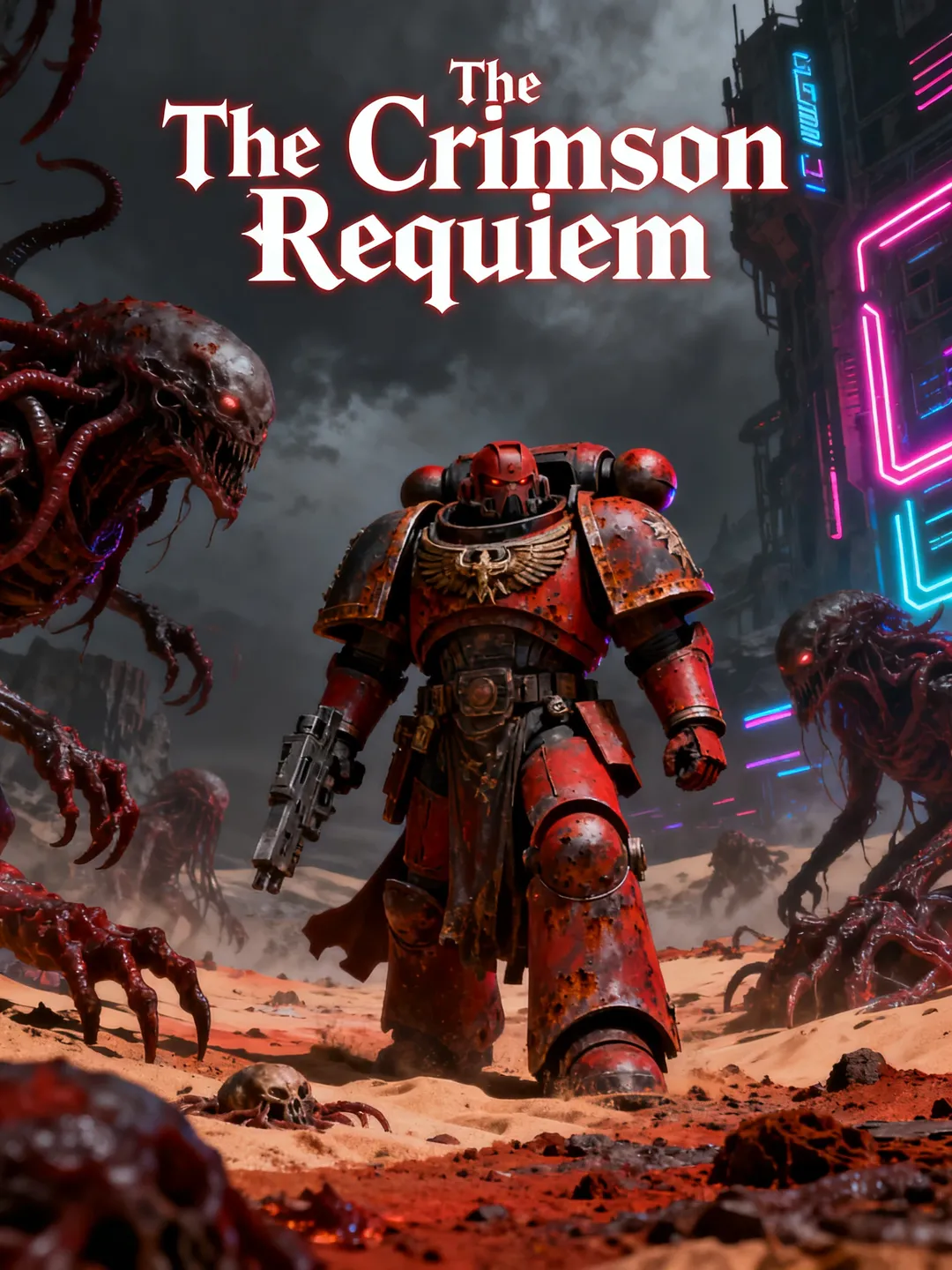
On the toxic, rust-sand expanse of Veridian VI, the stalwart Iron Wardens wage a grinding war of attrition. Led by the weary Battle-Captain Kaelen, their sacred mission is to purge the world of the Rapturous Carrion, a depraved Chaos warband that has turned the planet into a shrine of pain.
But as Kaelen risks everything on a final, decisive strike, a far older and more absolute horror awakens. From deep beneath the war-scorched earth, the Void Locusts erupt—a dormant xenos swarm driven by a singular, ravenous hunger. The two-sided war becomes a three-way slaughter.
With the planet lost and his forces being annihilated, Kaelen makes an impossible choice: the mission is abandoned. The only objective left is survival. What follows is a desperate, harrowing retreat against an unending tide of alien horrors, where the only victory is a tomorrow paid for with the blood of heroes. In this grim, dark universe, even escape is a kind of damnation.
Chapter1
The bulb over the table flickered like a dying heart, throwing long shadows across the cracked rockcrete walls. Captain Carion leaned over the makeshift desk, his breath clouding in the cold. The dagger’s edge scraped skin as much as blood; the stuff had dried to black flakes on his cheek and neck, itching like insect shells. He shaved it off in short, angry strokes, letting the bits fall onto the map below. The parchment was already ruined—a greenish stain from the fog had eaten through half the streets of the Spire—and he watched the flakes join the corrosion as if his own dead blood could finish what the poison had started.
The vox-bead in his ear crackled again. Same three words, same flat voice from the fleet somewhere beyond the clouds. “Hold the line.” No name, no explanation, no promise of relief. Carion pressed the blade harder, felt skin give, welcomed the sting. He drove the dagger down. The point punched through the map and into the tabletop, pinning the parchment like a butterfly. A thin line of fresh blood ran over the old brown stains and pooled at the dagger’s guard.
The curtain of tarp that served as a door was shoved aside. Terminator Sergeant Talos ducked inside, his bulk filling the narrow space. Frost glinted on the ceramite seams of his crimson armour; the suit’s power unit whined unevenly, an old man wheezing after a run.
“Report,” Carion said without looking up.
Talos pulled off his helm. The face beneath was pale, shaved scalp crisscrossed with old scars and new soot. “Three suits started the night. One still walks at full power. Mine.” He said it plainly, the way a man counts dead relatives. “The others seized up. Joints froze. Maybe the mist, maybe bad grease. Doesn’t matter. They’re monuments now.”
Carion wiped the remaining blood from his jaw with the back of his hand. The cut stung; he could feel it pull every time he spoke. “Ammo?”
“Enough for one hard push. After that we throw rocks.”
“Then we’ll make it count.” Carion’s voice came out rough, as if the dagger had scraped his throat as well. He lifted the map, tore it free of the blade, and folded the torn piece so the hole sat over the Augustine Spike— the tallest shard of wreckage at the city’s heart. “Gather the squad leaders. Dawn briefing.”
Talos nodded, replaced his helm, and stepped back into the night. The curtain flapped shut, cutting off the cold but not the sound: the never-ending murmur of artillery far away, like a tired god clearing his throat.
Outside the command hole, the world was black dust and dying embers. Elvar pressed his back to the trench wall and tried to breathe shallow. The filter in his helmet was clogged; every inhale tasted of metal and old burning. He unscrewed the cylinder, shook out grey ash, screwed it back, hands trembling just enough that the threads missed twice. Third time it seated. He told himself it was the cold making him shake, not fear. He was nineteen, had survived three weeks, and still told himself things like that.
Across the cratered street, half a building stood against the night, its ribs of rebar showing like broken fingers. From the hollow inside came voices—not ork, not human either. Slaves, he guessed, though the word felt too gentle. They sang the old triumph hymn of Phlox, but the tune had slipped, notes stretched too wide, tempo dragged until it sounded like a dirge played underwater. The words came distorted: “…golden day… golden day…” over and over, until the syllables lost meaning and became just wet mouths moving.
Elvar’s gauntlet found the grip of his lasrifle. He peered over the sandbags. The dust fog shifted, opened, closed. For a moment he saw the singer: a shape nailed high on a bent iron rod, arms spread wide, head sagging. A captive, still alive, chest hitching. The song gurgled out of him through torn lips. Elvar raised the rifle, finger on the trigger, not sure whether to silence the man or save him. Then the captive lifted his face—eyes already pecked hollow by birds—and shouted, voice cracking like dry wood: “Don’t trust the wall!”
The wind carried the words straight to Elvar. He felt them hit his stomach more than his ears. Behind him something clattered; he spun, heart hammering, but it was only a spent casing rolling in the gutter. When he looked back, the fog had swallowed the singer. The hymn had stopped. The night felt suddenly larger, as if the crater had become the mouth of something getting ready to close.
Boots crunched beside him. Elvar jerked the rifle up. Librarian Moriane stood there, robe torn at the hem, hood thrown back. In his gauntleted arms he carried a block of crystal the size of a munition box, its heart glowing a sickly blue. Veins of frost spider-webbed the surface even though the air was not cold enough for ice. Inside the shard, a mouth floated—human lips, no teeth, opening and closing in perfect slow rhythm, as though the crystal itself were breathing.
Moriane did not greet the sentry. He walked past Elvar as if the boy were part of the rubble and ducked through the tarp into the command post. Elvar stayed outside, but the image of that mouth stayed with him, kissing the inside of his eyelids every time he blinked.
Inside, Carion had lit a single lumen-candle. The tiny flame shivered whenever the walls shook, which was often. Moriane set the crystal on the floor between them. At once the frost thickened, racing outward in white threads that spelled no language and yet looked like a scream. The mouth inside quickened its pace, lips pulling back, though there was still no sound.
Carion crouched, elbows on knees. “What is it?”
“Not the Archenemy,” Moriane said. His voice was soft, almost conversational, which made it worse. “Not mankind either. Something beneath us, breathing in. Dreaming, perhaps. Hungering, certainly.” He tapped the crystal; the blue light flared, showed the veins in his wrist black instead of red. “The choir on the ship felt it first. Then the astropaths bled from the ears. Now the stone itself remembers.”
Carion stared at the frost-scream. “Can we kill it?”
“If we can find its throat.” Moriane straightened. “I will walk with your assault, Captain. The thing has no name, but names can be given in the moment of death.” He lifted his hood, turned, and was gone, leaving the crystal on the floor. The frost had already reached the walls, painting them with frightened faces that vanished when the flame moved.
Talos returned, bringing the others: three squad leaders, their armour patched with different shades of red, all carrying the same tired eyes. They filled the narrow space with the smell of oil and sweat. Carion stood before the half-burned icon of the Emperor that leaned against the wall. The painting was scorched from chin to crown, leaving the Saviour’s face split into light and charcoal. A rusted nail lay on the ground beneath, fallen from the ceiling some time during the night.
Carion spoke quietly, no sermons, no shouting. “At second dawn we break the spine of the Spike. Sergeant Talos leads First. One squad, one push, straight through the heat tunnels. We cut the head off whatever still pretends to command this ruin. No reserves. No retreat.”
The silence that answered was heavier than any oath. Each man understood: this was the last cart of powder wheeled to the cannon’s mouth.
As the words left Carion’s mouth, the ground gave a small jerk, like a man twitching in dream. Dust sifted from the ceiling. The nail rolled, chimed once against the icon’s splintered frame, and stuck point-first into the painted eye that remained. The sound was tiny, almost polite, yet every head turned. No one crossed himself; they had forgotten how. Instead they looked at the nail, then at Carion, waiting for him to give the moment meaning.
Carion only pulled the dagger free of the table, wiped it on his thigh, and sheathed it. “Be ready,” he said. “When the sirens rise, we walk.”
Outside, the night seemed to lean closer, listening through the cracks. Elvar tightened his grip on the rifle and tried not to think about walls, or mouths, or songs that never ended.
Latest Chapters
The hiss of the regeneration casket lasted longer than the tech-priest promised. When the
The corridor stretched longer than a graveyard at midnight. White lumen-strips flickered
The shrieking stopped so sudden the air itself seemed to miss a heartbeat. One moment the sky was
The tower lights had gone out for good; what remained was the greenish glow of acid burn-off and