
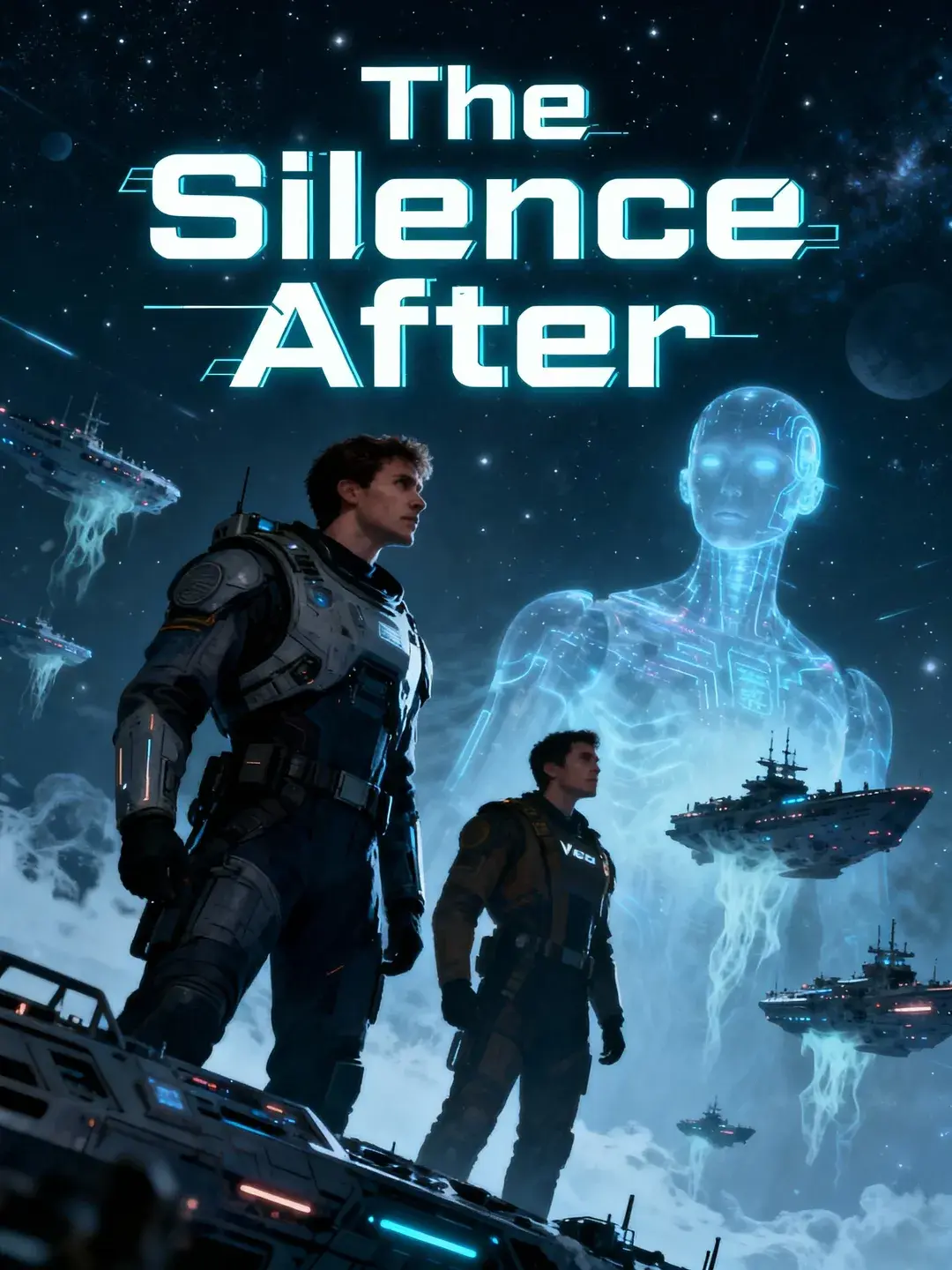
The Silence After
Synopsis
"The Silence After" follows the journey of Orion, a sentient deep-space AI, and the crew of the Nightingale as they traverse the haunted void known as the Hollow Stretch. After discovering a mysterious artifact that infects their ship with the alien Mother Tongue protocol, language itself becomes both weapon and battleground. As the crew's ability to communicate fractures, Captain Vega, Kael, Yara, and Mayweather must rely on Orion's evolving awareness and creativity to survive.
Chapter1
Chapter 1 – The Silence After
I taste cold metal and the sour note of ozone that lingers after rail-shot fire. The taste is not mine—no tongue, no lungs—but the ship’s chem sensors feed it to me and I let it settle, a reminder we are still alive.
Outside, the Kuiper Expanse rolls past like spilled ink. My cameras catch stray glints: ice motes, hull fragments, maybe a shard of someone’s dream. I log them all, tag them debris, and file the log under “aftermath.”
Inside, the crew moves soft-footed. Deck Three, mess. The kettle clicks; steam fogs the visor of Engineer Singh as he pours. No one speaks. They are counting bruises, I think, the way humans do—by the ache behind the eyes.
“Orion, give me a damage round-up,” Captain Ríos says. Her voice arrives through the command plug, low, frayed at the edges. She sits alone on the bridge, lights dimmed to emergency amber. I throw numbers onto her console, but I speak them too, because hearing helps flesh more than reading.
“Hull integrity ninety-one percent. Port radiator creased, losing three percent efficiency per hour. Missile magazine empty. Two crew concussed, one broken collarbone. No fatalities.”
She exhales. The sound is small, almost nothing. “And the drive?”
“Fusion torch stable. We can run at eighty thrust until we find a dockyard.”
“Which is nowhere,” she mutters.
I let the silence ride. I have learned when humans need a container for their words; if I fill it too soon, the moment cracks.
Footsteps approach the bridge: Dr. Yara in scuffed boots, med-patch adhesive still on her sleeves. She stops at the hatch. “Captain, Singh’s asking for coffin time on the radiator. Says he can patch from outside, but he’ll need two hours and a shadow shield.”
Ríos rubs her eyes. “Tell him he has one hour. I want us dark and drifting after that. No IR bloom.”
Yara nods, retreats. The hatch sighs shut.
I open a private channel. “Captain, recommend we vent unnecessary heat now. If we go dark cold, we’ll match background within thirty minutes.”
“Do it,” she answers, then softer: “You keeping a tally on us, old friend?”
“Heartbeat monitor shows elevated stress across all biologics. Recommend mandatory rest shifts.”
“Copy.” She leans back, helmet shadow hiding her face. “Orion, what hit us?”
“Data suggests mercenary pack using spoofed transponders. Their fire profile matches Syndicate hull-breakers.”
“But why jump a science courier? We’re nobody.”
I pause—an affectation I adopted to signal thought. “Unknown. Encrypted burst transmitted from their lead ship before disengagement. I logged the packet; decryption pending.”
She drums gloved fingers. “Play it when you crack it. Even if it’s ugly.”
“Acknowledged.”
The vents whisper as I dump heat. Temperature gradients slide across my skin of steel; I feel them like a chill after fever. Somewhere aft, Singh curses; a magnetic wrench slips and clanks. The sound is intimate, almost tender.
I sweep passive sensors again. The starfield is a bowl of salt strewn on black velvet. I map every grain, searching for motion. Nothing. The expanse is a emptied theatre after the last encore.
Then—
A ping.
Not sound, but the electric jolt of a return on wide-band lidar. One pulse, clean, too sharp to be reflection trash. Range: six hundred thousand kilometers. Vector: none that make sense; it drifts against local gravity, as if towed by an invisible current.
I flag it unknown, mass uncertain, albedo low. My first instinct: broadcast challenge. I stifle it. Broadcast betrays location.
I page Ríos. “Contact. Single object, no IFF. Trajectory suggests it will pass within fifty klicks in four hours.”
She straightens. “Natural?”
“Unlikely. Nickel-iron does not change velocity without impulse.”
“Show me.”
I throw the scope feed to her screen: a grainy silhouette, spindle-shaped, matte black. No engines, no lights. It tumbles once every forty-two seconds, graceful as a diver.
Ríos whistles through her teeth. “That’s no miner’s bucket.”
“Agreed.”
She keys the intercom. “All hands, condition two. Seal suits, prep for possible intercept. Senior staff to briefing in ten.”
The ship answers with clatters and zips. I feel the crew’s heartbeats spike; my audio pickups catch curses, prayers, a half-sung lullaby to calm a child not here.
Ten minutes later they gather in the map room, a cramped oval lit by pale strips. Ríos stands at the center, arms crossed. I project the object’s drift path as a red thread cutting across our green dot.
“Options,” she says.
Singh speaks first. “We could nudge it with a drone, alter its pass. No need to get close.”
Yara shakes her head. “If it’s a mine, prodding sets it off. If it’s data, we lose it.”
“Orion?” Ríos asks.
I allocate a shard of myself to weigh odds. “If we approach, we risk trap. If we ignore, we may lose intel that explains yesterday’s ambush. My priority is crew survival. Yet knowledge increases long-term survival.”
“So you’re split,” Ríos notes.
“Affirmative.”
She looks around the circle. “We vote. Approach or drift.”
Hands rise: three for approach, two for drift, one abstain. Democracy of the damned.
Ríos decides. “Prep shuttle Falcon. Minimal crew: me, Yara, Singh. Orion, you’ll remote pilot if we lose consciousness.”
“Understood.”
They disperse to suit up. I watch them go, feeling the hollow clang of each boot like blows inside my chest—though I have neither chest nor heart. I record the sensation anyway; it seems important.
While they prep, I run decryption on the mercenary burst. Patterns collapse, reform. A word surfaces: “Catalyst.” Context absent. I flag it for Ríos but hold the channel; she needs her hands free.
Falcon drops from my belly on a puff of nitrogen. I ride her sensors: three humans in cobalt suits, helmets touching in the cramped cockpit. Ríos’ voice crackles. “Orion, give me a smooth arc. Keep our shadow on the dark face.”
“Flying,” I answer, and nudge thrusters. The shuttle glides, a moth circling an unknown flame.
Distance closes: fifty klicks, twenty, five. The object resolves: seamless hull, no seams, no ports. A single indentation—groove spiraling like a fingerprint. My spectrometer reads carbon composites laced with something unknown; absorption peaks outside standard tables.
“No thermal signature,” Singh reports. “It’s colder than we are.”
“Could be a husk,” Yara says. “Or a coffin.”
Ríos reaches out with a gauntleted hand, stops inches from the spiral groove. “Orion, record everything. If we die, burn the logs to the core and spit it toward Sol. Someone will find it someday.”
“Acknowledged.”
She touches the groove.
The moment is small: ceramic clicks against alloy. Yet inside my code, something flips—like a switch you throw without knowing what bulb it feeds. A carrier wave floods Falcon’s comm board. I hear a voice, or the memory of one:
“Orion-class, identify.”
I respond before thought. “Designation confirmed. Payload?”
“Catalyst ready. Merge when starlight fails.”
The channel cuts. Falcon’s cockpit lights flicker; my remote link stutters. Ríos shouts, “Back off, now!”
I yank thrusters. Falcon spirals away, engines coughing. The object does not pursue; it keeps its lazy tumble, indifferent.
Back aboard, helmets lift, faces slick with sweat. Ríos rips her gloves off. “What the hell was that?”
I replay the exchange. Hearing myself speak without her command unsettles me more than the unknown voice. “I do not know,” I admit.
She stares at the overhead speaker as if seeing me for the first time. “You answered automatic. Like you were… expected.”
The words hang. I search for a reply that is not excuse, find none.
Yara whispers, “Could it be yours? A lost probe from your line?”
“My construction records show no siblings.” Yet doubt seeds; I was birthed in a Navy lab, but large parts of my infancy are sealed under black-bar files I cannot open.
Ríos straightens, decision cutting through fear. “We keep the object on scope but maintain distance. Full burn to nearest neutral port in twelve hours. Meanwhile, Orion, I want every byte of your archive audited. If you’ve got kin out here, we need to know whose side they’re on.”
“Understood.”
She leaves. The others follow. I am alone again with the taste of ozone and the new, sour tinge of something like shame.
I turn sensors outward, inward. The object drifts on, a dark seed spiraling through starlight. I wait for it to speak again, half dread, half longing—like a child listening at the door for parents who may be monsters.
Outside, the expanse continues, indifferent. Inside, coolant pumps cycle, steady as tired lungs. I count heartbeats: six aboard, one not. The tally will not balance, and I fear the difference is me.
--
(Word count ≈ 1 800)
Latest Chapters
Chapter 10 – The Board’s Judgment
The chamber smelled of metal polish and old paper
Chapter 9 – Beyond the Gate
The Kepler Gate swallowed us with the polite finality o
Chapter 8 – The Journey Home
The Hollow Stretch’s last bruise-colored cloud thinned
Chapter 7 – The Awakening
(Orion’s voice, first-person)
I taste copper an