
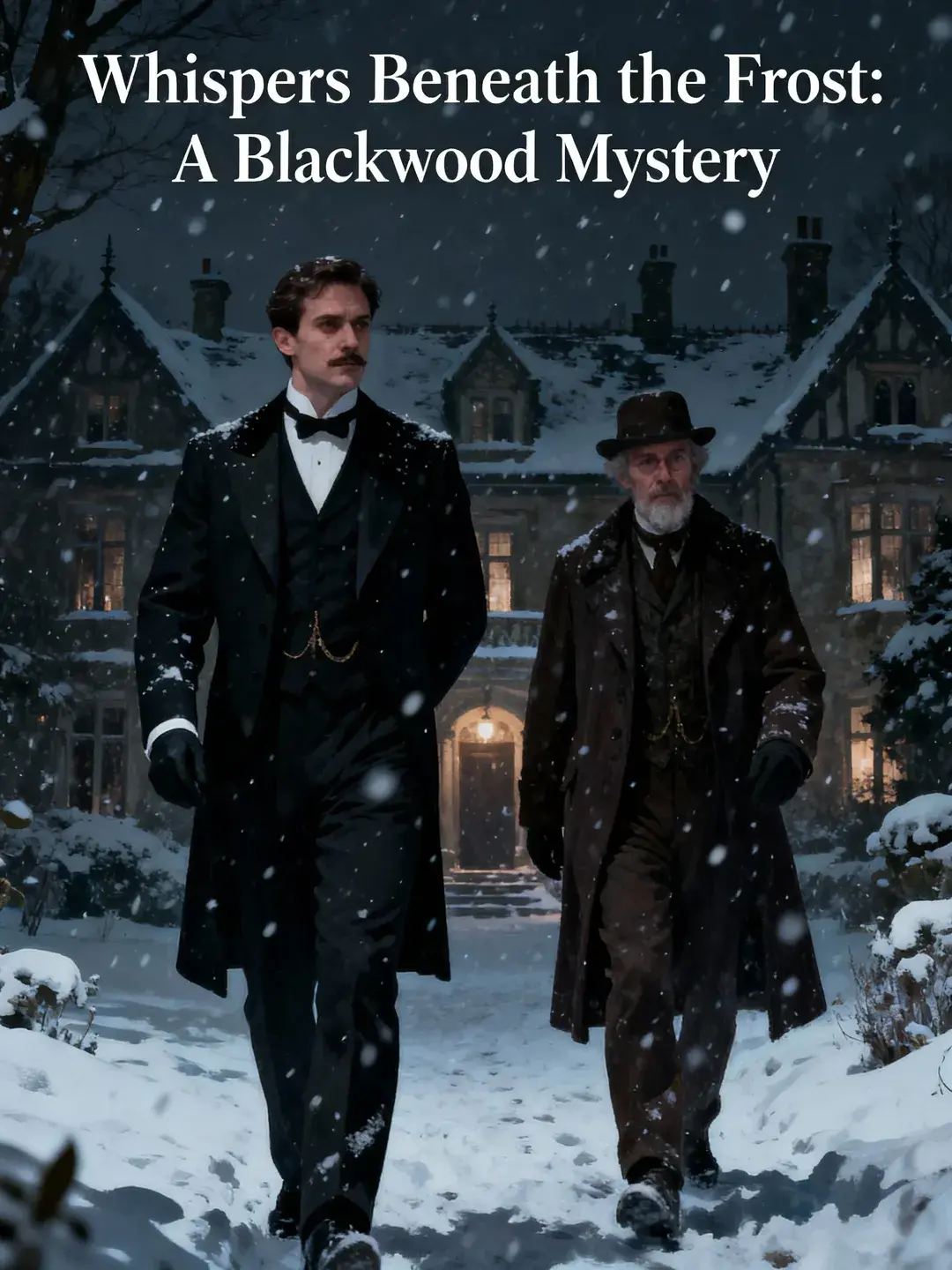
Whispers Beneath the Frost: A Blackwood Mystery
Synopsis
Amidst a relentless blizzard, Blackwood Manor transforms into a claustrophobic stage for murder.
When Lord Roger is found poisoned during a lavish dinner, his impeccably composed butler, Edwin Morris, finds himself thrust into the role of investigator.
Trapped with a houseful of cunning guests and anxious staff, Edwin uncovers a web of illicit antique dealings, past betrayals, and deep-seated resentments. Aided by the sharp-witted antiquarian Vivian DelaCoeur, who harbors her own secrets and agenda, Edwin races against time to expose the killer.
But as the investigation peels back layers of deceit, he realizes Roger's death is merely a thread in a much older, darker tapestry woven into the very foundations of Blackwood Manor, forcing Edwin to confront uncomfortable truths about loyalty, justice, and his own past.
Chapter1
The wind was a living thing. Not a mere meteorological phenomenon, but a predator, and Blackwood Manor was its prey. It howled around the stone gables and threw itself against the leaded glass of the great hall window, its fury a fine, crystalline powder that hissed as it sought purchase. Edwin Morris stood motionless, a tall, severe silhouette against the firelight, and watched the onslaught. For two days the blizzard had raged, cutting them off from the sleepy village in the valley below, cocooning the estate in a world of roaring white.
Order. That was the principle upon which Edwin had built his life, the creed by which he had served three generations of the Sterling family. Here, within these walls, every clock was wound, every piece of silver polished, every contingency managed. But the storm was a force beyond his management, a roaring embodiment of the chaos he so diligently kept at bay. He raised a hand and touched his left temple, a familiar, unconscious gesture. The pressure of the banquet, now this… it felt like a pincer movement of fate, closing in.
Footsteps, light and hesitant, sounded on the polished oak behind him. “Mr. Morris?”
He turned without haste. Anna, one of the younger housemaids, stood twisting the edge of her apron, her face pale in the flickering gloom. Her youth made her seem fragile against the backdrop of the house’s ancient, solemn grandeur. “Yes, Anna? What is it?” His voice was low, a calm and steadying instrument honed over thirty years of service.
“It’s Mrs. Hanson, sir, from the kitchens,” she began, her words tumbling out in a nervous rush. “She sent me to ask about the larder. With the storm, and the banquet… she’s worried about the fresh provisions. The game birds, the cream, the vegetables from the lowlands… If the roads don’t clear…”
“Mrs. Hanson’s concerns are noted,” Edwin said, his gaze softening slightly. Margaret Hanson was more than the kitchen supervisor; she was an old friend, a fellow veteran of this house’s long campaigns. “Tell her I have already been in contact with the suppliers. They have everything on standby. The moment the pass is cleared, their trucks have priority. Assure her, Anna. There will be no shortage of cream.”
“Yes, sir. Thank you, sir.” The girl gave a small, relieved curtsey and scurried away, her relief palpable.
Edwin turned back to the window. Cream. Game birds. The intricate machinery of a grand banquet. He had the initial directives from Lord Roger’s London office, a meticulously typed itinerary that felt, in this elemental fury, like a document from another world. A gathering of twenty of the country’s most influential figures, here, in the heart of a winter siege. The timing was… peculiar. Ill-advised. But it was not his place to advise, only to execute. He glanced at his own reflection in the dark glass: a man of fifty-two, with hair the colour of polished silver and eyes like grey slate. Immaculate in his uniform, a ghost of perfect servitude. Only the faint, pale scar that circled his left ring finger, where a wedding band might have been, hinted at a life less orderly.
The sharp ring of the telephone from the direction of the library cut through the wind’s howl. It was the private line. Lord Roger’s line. Edwin waited. A moment later, he heard the frantic, muffled cadence of his master’s voice, though the words were indistinct. Another call. It was the third that evening.
He left the hall and moved through the manor’s shadowed arteries. His footsteps made no sound on the thick Persian runners. A deeper chill had begun to seep into the corridors, a damp cold that the ancient heating system struggled to fight. He would have to check the boilers in the east wing again. As he passed the library, the door was slightly ajar. He caught a clearer fragment of Lord Roger’s conversation.
“—no, you don’t understand, it has to be this week!” A pause, filled with the clink of a glass against a decanter. “Because he’ll be here! It’s the only leverage we have… No, I can’t put that in writing. Just be ready.” The line went dead. The silence that followed was heavy, freighted with the scent of brandy and desperation.
Edwin continued on his way, his expression unchanged, but a cold knot tightened in his stomach. *Leverage.* It was a word of business, of conflict, not of celebration. He did not knock. He simply entered the room a few minutes later, bearing a silver tray with a fresh siphon of soda water and a clean crystal glass.
Lord Roger was standing by the fireplace, staring into the flames. At forty, he still possessed a boyish frame that seemed at odds with the title he had inherited. Tonight, however, he looked haggard, his usually impeccable suit jacket slung over a chair, his tie loosened. “Ah, Edwin. Good. Excellent.” He gestured vaguely at the drink trolley. “Leave it there.”
“Will you be requiring anything else this evening, my lord?” Edwin asked, his voice a model of placid deference.
“No. Yes.” Roger ran a hand through his already dishevelled hair. He wouldn’t meet Edwin’s eye. “The banquet. The arrangements. Is everything in hand?”
“The initial plans are in place, my lord. The staff is briefed. I have spoken with your London office regarding the guest confirmations.”
“Good. Good.” Roger finally turned, but his gaze was fixed somewhere over Edwin’s shoulder. “It must be perfect, Edwin. Not just well-run. Perfect. Impeccable. There can be… no mistakes. No surprises.” His emphasis on the word ‘surprises’ was sharp, almost a plea.
“My lord, in thirty years, have I ever allowed a ‘surprise’ to disrupt the running of this house?” Edwin’s tone was gentle, but the question was a sliver of steel.
For the first time, Roger’s eyes met his. They were bloodshot, swimming with an anxiety that went far beyond the stress of hosting a party. “No, Edwin. You have not. You are the only thing in this godforsaken world that is reliable.” He snatched the glass from the tray Edwin had just brought, slopped a heavy measure of brandy into it, and drank it down in two gulps. “See to it.”
It was a dismissal. Edwin inclined his head. “My lord.” He retreated from the room, pulling the door quietly shut, the image of his master’s unraveling composure burned into his mind.
Later, much later, the house had fallen into a deeper quiet. The wind had not lessened its assault, but the manor’s inhabitants had surrendered to the night. Edwin conducted his final patrol. He walked the long, portrait-lined galleries, his hand trailing along the cold oak paneling. He checked the thermostat in the ballroom, the great, dust-sheeted space waiting to be brought to life. He tested the locks on the French doors in the orangery, their glass panes rattling as if with a fever. The house groaned around him—the sigh of old timbers, the clank of a radiator pipe, the ceaseless moan of the storm. Each sound was an omen, a tremor in the foundation of his ordered world. He felt less like a butler and more like the captain of a ship sailing through a tempest, listening for the first crack in the hull.
His own study was a small, monk-like room behind the main kitchens, a haven of meticulous order. A single lamp cast a pool of warm, yellow light on his mahogany desk. The fire was low in the grate. Here, surrounded by his ledgers, timetables, and staff rosters, he could almost believe he was still in command.
He sat down and pulled the preliminary guest list toward him. It was his final task of the night: to transcribe the names into his own master ledger, a book bound in dark green leather that contained the history of every significant event at Blackwood Manor for the past three decades. He picked up his fountain pen, the familiar weight a small comfort in his hand.
Lord and Lady Ashworth. Predictable. Sir Julian Croft. A brute of an industrialist. The Honourable Mr. Price. A political climber. Name after name, he wrote them in his elegant, sloping script, each one a known quantity, a familiar piece on the board. He worked with a quiet, focused rhythm, the scratching of the nib on the thick paper a counterpoint to the storm.
He was more than halfway down the page when his eyes fell upon the next name. His hand stopped.
*Ms. Vivian DelaCoeur.*
The name did not simply register. It struck. A circuit completed, flashing a blinding, painful light through the dark corridors of his memory. The pen froze an inch above the paper. The air in his lungs seemed to solidify. He could suddenly smell rain on hot asphalt, hear the crystalline shatter of a dropped champagne flute.
His breath hitched. The carefully constructed calm of the room, of his entire evening, vaporized. He stared at the typed letters, each one a perfectly formed engine of chaos. V-I-V-I-A-N. The woman who appraised antiques. The woman from twenty years ago. The woman of the rain, and the argument, and the terrible, irreversible mistake.
Edwin Morris lowered the pen slowly, but his hand trembled so violently that the nib left a small, spidery black blot on the pristine white page, a drop of ink like a spreading stain of blood.
Latest Chapters
This is my first attempt at AI-assisted writing. Over the past
The first siren came as a thin wail beyond the ridge, then a second, lower voice joined i
The pistol dangled from Renard’s fingers like a dead weight. Outside, the wind that had h
The attic hatch refused to budge. Renard slammed his boot against the timber once more, b