
Synopsis
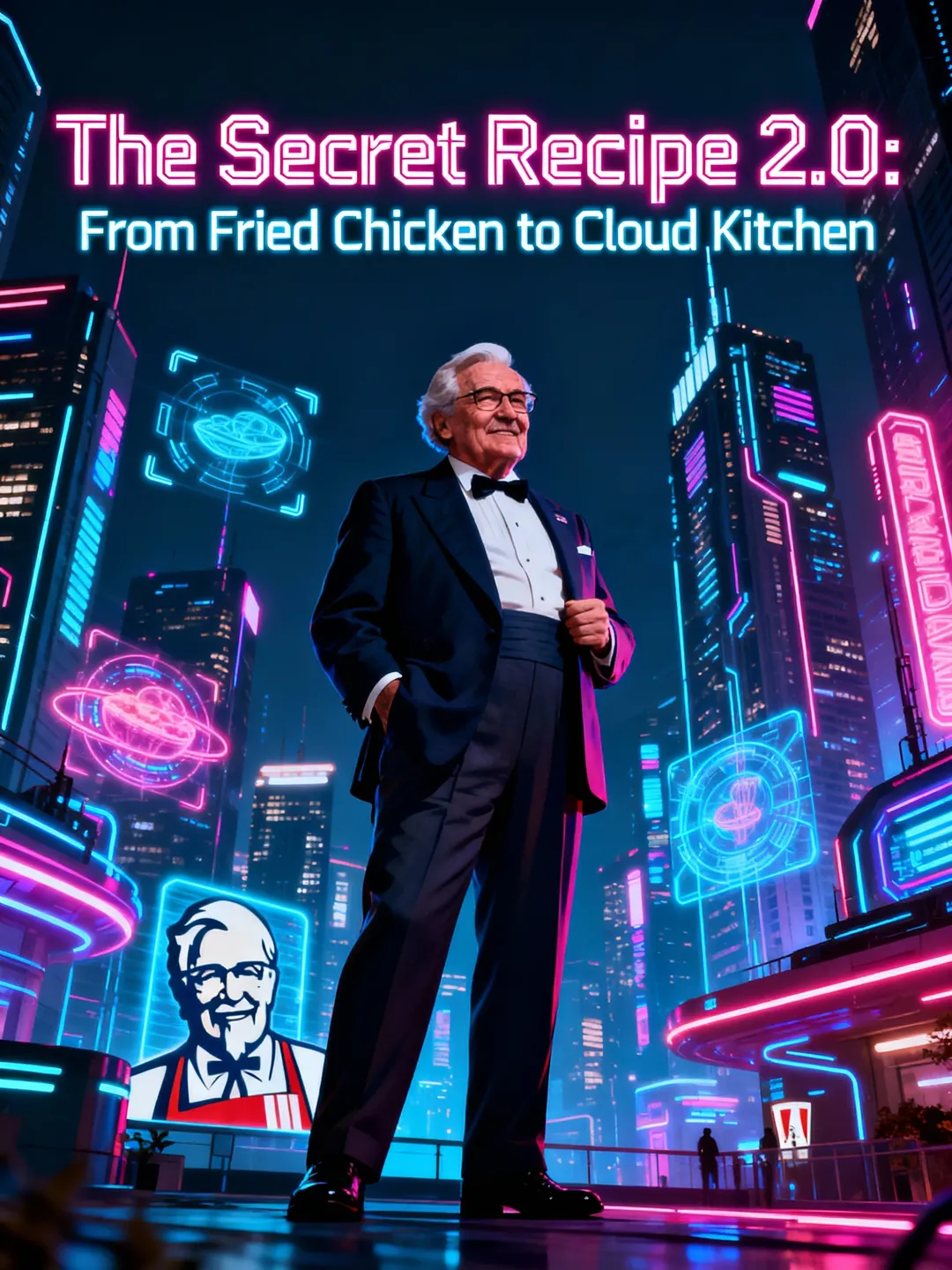
"The year is 2026. Harland Sanders, still in his pristine white double-breasted suit and black string tie, steps out of a time rift into the middle of a bustling, neon-lit metropolis. He doesn't look confused; he looks hungry for business.
Chapter1
Harland Sanders stepped out of nothingness and onto wet asphalt that glowed like a liquorice mirror. Above him the alley narrowed into a slit of neon sky—pink, cyan, ulcer-green—signs pulsing to a heartbeat that wasn’t his. The air smelled of burnt sugar and diesel, with a faint reminder of his own fryers still caught in the white fibers of his moustache. He straightened his black string tie, adjusted the collar that had been crisp in 1974, and listened. Somewhere nearby a voice chanted numbers: “Sixty-nine, ninety-nine, free ship-pin’.” It wasn’t human; it was a loudspeaker pretending to be excited.
A delivery cyclist skidded around the corner, tyres hissing. The kid wore a chrome helmet shaped like a bubble bee and a jacket that streamed moving adverts across its fabric—noodles, lipsticks, a cat playing a piano. He braked so hard his sneakers scraped sparks.
“You okay, mister?” the cyclist asked, pulling one earbud free. A tiny red light on his chest blinked LIVE.
Sanders lifted his cane, planted it between them like a flag. “Young man, I require a kitchen, a sturdy skillet, and a chicken within the hour. Can you oblige?”
The cyclist’s eyes widened, streaming reflections of the Colonel’s white suit. “Dude, sick cosplay. What convention you headed to?”
“Convention?” Sanders echoed. He noticed the boy’s wrist: a glowing bracelet showing a map, a heartbeat, and the words JAX_99. “Son, is that a timepiece or a shackle?”
Jax laughed. “It’s my phone, grandpa. Want a ride? I’m off shift.” He flicked his thumb; the bracelet projected a hologram—bucket of wings spinning like a slot machine. “See? Orders are dead tonight anyway.”
Sanders smelled opportunity the way bloodhounds smell fear. He reached into his breast pocket and produced a gold pocket-watch engraved with a tiny skillet. “Trade you this for directions and thirty minutes of your youth.”
Jax’s live-chat exploded in tiny hearts across his visor. “Chat says take the bling,” he muttered, then shrugged. “Hop on the rack, Colonel. Let’s roll.”
The bicycle seat was warm. Sanders gripped the metal ribs, felt the city blur into ribbons of light. Every billboard hawked food he didn’t recognise—purple burgers, black ice-cream, drinks that changed colour when you shook them. His mind catalogued prices, margins, labour costs. A whisper ran through him: These folks never tasted real gravy.
They stopped outside a shuttered noodle bar. The sign read GO-GO NOODLE in cracked plexiglass; inside, chairs stacked like skeletons. Jax keyed a code; the roller door lifted halfway, groaning.
“Owner skipped rent. Place still has power,” Jax said. “Kitchen’s yours, temporary-like. Wi-Fi’s called GHOST_POT.”
Sanders ducked under the door, eyes sweeping stainless counters, induction woks, a noodle robot frozen mid-bow. He tapped its head. “You’re dismissed, partner. I need elbow room.”
A square speaker on the wall crackled. “System offline. Voice authorisation required.”
Sanders removed his hat, held it over his heart. “Madam Machine, I pose a riddle. Answer, and we both stay profitable: What bird lays golden eggs yet never clucks?”
The speaker hummed. “Processing… drone delivery units match criteria.”
“Correct,” Sanders declared. “Now reboot yourself and greet the future of fried chicken.”
Lights flickered on. Exhaust fans whirred. The noodle robot’s eyes glowed blue, then Kentucky red. Jax’s bracelet pinged: NEW VENDOR DETECTED – UPLOAD MENU?
Sanders produced a folded paper square—his original 1952 recipe, ink blurred by decades. He smoothed it onto the counter like a treasure map. “We start small. Eleven herbs, eleven riddles, eleven-minute guarantee. If I fail, the meal’s free.”
Jax was already streaming. “Chat, name the first riddle prize!” Comments scrolled: ‘Give us a PS9!’ ‘Tesla coupon!’ Someone typed, ‘A bucket of truth.’ Sanders read that last one aloud, voice quavering. “Truth it is. Truth and a drumstick.”
Night deepened. Sanders tied on a borrowed apron printed with cartoon shrimp; the absurdity tickled him. He filled a pressure fryer, fingers remembering the weight of lard, the hiss of secret. While oil heated he dictated to the ceiling camera: “Greetings, future appetites. I am Harland Sanders, age one-hundred-and-thirty-five, born again inside your telephone. Solve my riddle, earn my chicken. First riddle: I grow when shared, die when spoken. What am I?” He pressed POST. The video uploaded faster than a hiccup.
Orders pinged like summer rain. Within sixty seconds: forty-eight requests. The kitchen printer spat receipts faster than it could cut. Jax danced between shelves, bagging boxes that the noodle robot filled. Sanders’ hands moved independent of thought—dredge, shake, lower, lock, listen for the pressure song. Grease kissed his wrists; each burn felt like a handshake with destiny.
At 2:07 a.m. the city outside erupted in a thunder of bass from a passing low-rider. Neon reflections rippled across the fryer’s curved belly like northern lights. Sanders lifted the first batch: mahogany crust, scent thick enough to butter bread. He tore one piece open, steam rushing out like a sigh across decades. The taste—salt, pepper, marrow-deep umami—sent tears down his cheeks before he could stop them. Not sadness; calibration. He was still alive, still measuring the world by flavour.
Jax noticed. “You crying, Colonel?”
“No, son. Leaking gratitude.” Sanders wiped his face with the shrimp apron. “Help me record this.” He balanced the drumstick on a steel tray like a newborn, hit SELFIE. “To whoever doubts time travel: I was born in 1890 and reborn every time someone eats honest food. Tonight I’m thirty-three again. Thank you for the mileage.” He posted; hearts flooded in—thousands, then tens. Someone donated three digital coins shaped like tiny chickens.
By dawn the noodle bar’s windows fogged. A queue of night-shift taxi drivers snaked around the block, drawn by the smell and the stream. Each customer received a box inked with a fresh riddle: What coat is best put on wet? Answer: A coat of paint—and extra hot sauce. Drivers laughed, tipped, filmed. The algorithm noticed; delivery apps reshuffled rankings. At 5:59 a.m. “Harland’s Underground” hit #1 on Trending Eats, unseating a unicorn-branded boba chain.
Jax collapsed onto a flour sack, exhausted. “We did it, man. You’re viral.”
Sanders poured two coffees, added a spoon of chicory the way his mother did during the Depression. “Viral sounds like sickness. I prefer ‘welcome.’” He handed a cup to the boy. “Drink. Then we clean, prep, and open again at dusk. Cities never stop chewing.”
Outside, the sky shifted from bruised neon to pale electric blue. Delivery drones zipped overhead like lazy wasps, carrying boxes stamped with his face—white suit, cane pointed like a conductor’s baton. Sanders stepped into the alley, craned his neck, and addressed the sky. “I don’t know who’s listening up there, but if you’re the one who tore the hour open, thank you. I still have work.”
He turned back inside, wiped a smear of grease from the START KITCHEN button, and pressed it again. The neon bucket sign outside flickered once, twice, then burned steady—a white heart beating inside a chrome bucket, guiding the next wave of hungry strangers toward the smell of yesterday reinvented.
Latest Chapters
Harland’s Underground was still breathing steam when the city showed up.
The sun had
Harland Sanders stepped out of nothingness and onto wet asphalt that glowed like a liquorice mir