

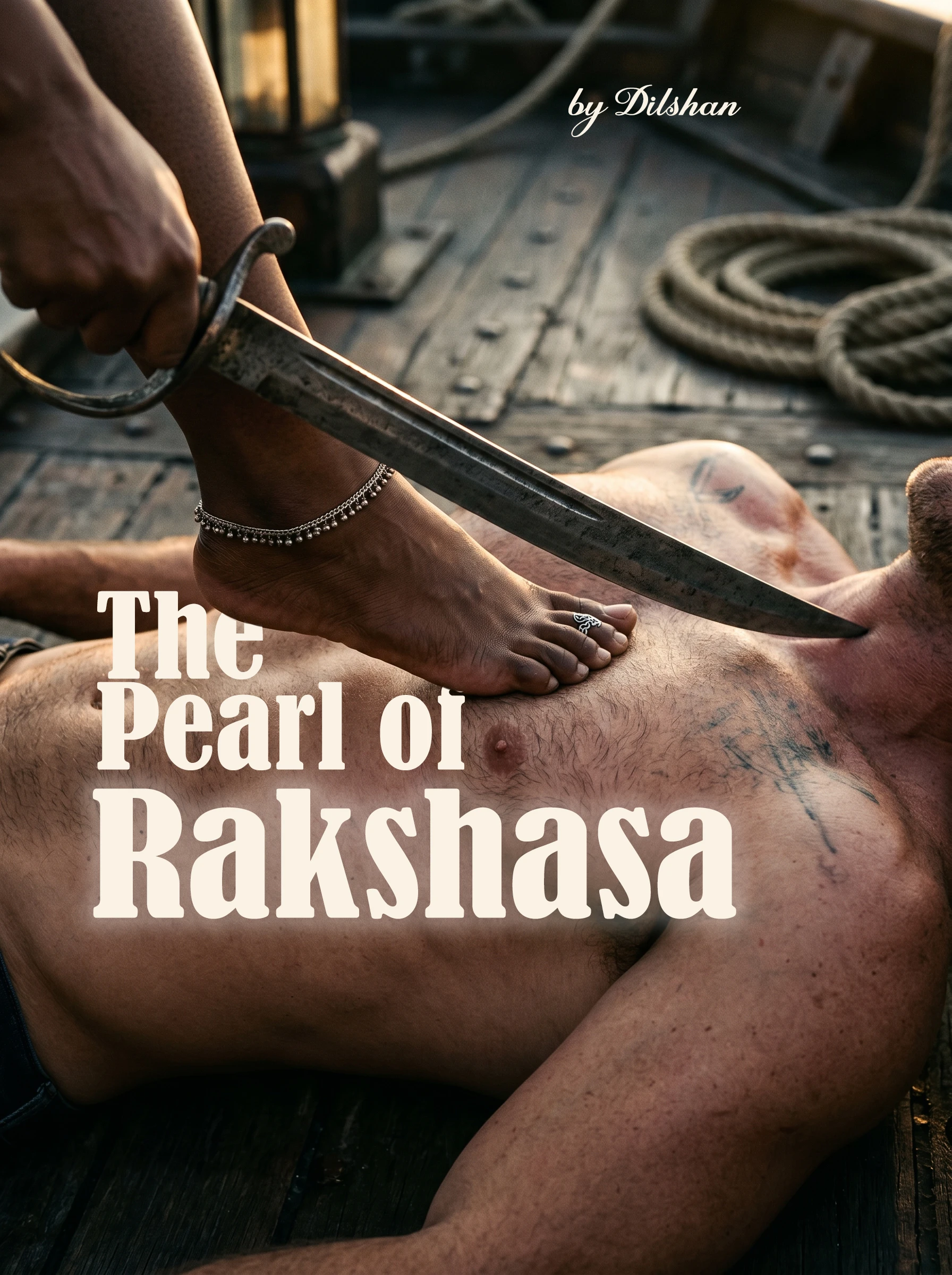
The Pearl of Rakshasa
Zusammenfassung
In the 17thCentury, the Indian Ocean is torn between colonial war and ancient terror. Kavya is a Yakshini-a supernatural predator dwelling inside the borrowed body of a drowned Sri Lankan princess. To stave off the cold ash creeping across her skin, she must feed on human memories and wills. She commands the privateer vessel Dark Mare, bound to a crew of outcast sailors through white cowrie shells hanging above her bunk. Only her first mate, Jayasena, fiercely protects his own soul, refusing to kneel - serving as Kavya’s sole unyielding anchor.
When word reaches her of a lost Portuguese ship carrying a condemned **black pearl** in the treacherous Maldivian atolls of Huvadhu, Kavya steers her crew into the reef passes. The pearl is no mere relic, but a debt of the sea capable of breaking her cyclical curse. Pursued by Admiraal Pieter Brouwer and the Dutch East India Company, Kavya must confront colonial broadsides, ancient ocean spirits, and the true price of her thousand-year hunger.
Kapitel1
The sea gave no light that night, and Kavya had chosen the night for that reason.
It was the dark of the moon in the eleventh month, the hour when the old women of the western shore said the yakshas walked, and no fisherman put out from the beach. The northeast wind had only begun to turn. It came over the swell in small cold breaths, smelling of salt and distant rain, and it carried the little boat she lay in a hand's breadth at a time towards the lantern on the Portuguese galliot.
She lay in the bottom of the boat with her gown spread around her like something spilled. It was a good gown, a Lisbon gown of grey silk, cut for a lady of the Estado da Índia, and it was perfectly dry. The sea never marked what she wore. She had tried, once, to let it, and the sea had simply declined, as a servant declines an order too foolish to carry out. So she had given up that small art of the drowned and lain there in her dry silk with her hair loose and her hands folded on her breast, a lady cast up by the Devil's own tide.
Beneath her, forty fathoms down, the water kept its own counsel. It had kept her once, for a long time, before a princess of Kotte came down through the grey of the Arabian Sea in the year 1621 and gave her a body to wear. The princess had not given it willingly. No one ever gave her anything willingly. But the princess was dead, and the body was warm, and a thing that has waited long enough under the sea learns not to be proud.
Under her ribs, where the princess's skin lay over her like a cloth over a table, there was a place that had begun to feel cold. Not ash yet. Ash would come in a month, if she did not feed, creeping up from the ribs to the throat until the face that the Portuguese had called the loveliest in Goa crumbled to a grey mask. But she knew the cold the way a sailor knows the first turn of a tide. It was the clock, and it ticked in her. Tonight was the dark of the moon. Tonight she would eat.
“Boat ahoy!” The voice came thin and Portuguese from the galliot. “Boat there! Name yourself!”
She said nothing. She let the swell lift her and drop her.
“Senhor Capitão! A boat, adrift. There is a woman in it.”
“A woman?” A second voice, a deeper one, with the lazy contempt of a man who has never been refused at his own rail. “Dead?”
“I think so. No—” A pause. “Her hand moved, Senhor.”
It had. She had moved it exactly then.
They brought her aboard on a rope sling, as one brings aboard a wounded man, and she kept her eyes closed until the planks were under her. The galliot was called the São Brás. She had read the name on the stern as the boat drifted under it, and she had read the faces on the rail by lantern light, one after another, the way a farmer reads a field. Twenty Portuguese, most of them young, most of them afraid of the dark. Thirty lascarins, Sinhala and Tamil and Malabari, with their hair knotted at the nape and their faces shut. A priest's boy. A cook. A surgeon who smelled of vinegar.
And one man who mattered.
He came down from the quarterdeck slowly, with his thumbs in his sword belt. Capitão Rui Barreto was a broad man of forty or so, with a black beard threaded grey and a scar that ran from the jaw into the collar of his coat. His eyes were the colour of old bronze. He wore a gold cross at his breast and a sword at his hip, and he wore both in the same manner, as instruments of the same authority.
She knew him by his reputation before she knew him by his face. Everyone on that coast did. A year before, he had burned a fishing village north of Chilaw because it had sold rice to the Kandyans, and he had stood on the beach and watched the nets burn with the huts. After the rout at Randeniwela he had hanged eleven lascarins from the foreyard of a galliot much like this one, men who had run when the Sinhalese came down out of the trees, and he had kept the cord. It lay on his table in the cabin still, a coil of twisted coir. He said it reminded him of his duty.
He stopped before her and looked down.
“A lady,” he said. “Alone on the water, and not a mark of the sea on her gown.” He crossed himself with an easy, mocking hand, and she saw him decide to be amused rather than afraid. “The Devil keeps better tailors than God, Senhora.”
She opened her eyes and let them fill with a lady's terror. It was not difficult. The princess's memories were very good at terror.
“I am Dona Luísa,” she said, in a voice made small and hoarse with thirst. “The Santa Rita went down three nights ago, out of Goa. I do not know if anyone else lived. I—” She let her hand tremble towards him. “Please. I cannot stand.”
He took the hand. He held it a moment longer than courtesy allowed. Behind him a lascarin, an old man with a face like folded leather, looked at her features, and Kavya saw him see them: the Kotte cheekbones, the Sinhala eyes under the Portuguese gown. His gaze skittered away. He crossed himself, but in the Sinhala fashion, a quick touch to the lips, a gesture older than the Portuguese cross. He had understood something. He would not say it.
“You will sleep in my cabin,” Barreto said. “I will have the surgeon see you.”
“I have no need of a surgeon.”
“No?” He smiled. “Then of wine.”
The cabin was low-ceilinged, stifling, and thick with the heavy reek of tallow, pitch, and sour Portuguese wine. A single brass lamp swung from a beam above, throwing long, restless shadows against the bulkheads. On the table lay an unrolled chart of the Ceylon coast, a half-filled pewter cup, and beside them, a stiff, dark coil of twisted coir rope—the cord from the foreyard that had taken eleven lives at Colombo harbour. Above a small wooden prie-dieu hung an ivory crucifix from Goa, yellowed with age and salt. At the far end of the cabin, a stern window of thick, greenish glass looked out onto the black wake, dark as the inside of a bell.
Kavya paused at the threshold. She stood as a lady of Goa would, with her eyes lowered and one dry hand pressed to her throat, her grey Lisbon silk falling around her in pristine, unmarked folds. But it was not modesty that held her feet. It was the ancient, inescapable law: no threshold could be crossed by her kind unless the man within summoned her with a genuine, unprompted wish rising from the root of his being.
“Well, Senhora?” Barreto stood by the table with his thumbs in his sword belt, his broad chest rising and falling. “Are you afraid of me, or of the sea? Come in. I will not eat you.”
“Invite me in, Capitão,” she murmured softly, her hoarse voice catching like dry silk. “Say that you wish it.”
He laughed—a short, arrogant sound, though behind his eyes flickered a brief shadow of the old terror the priests had put into him as a boy in the Minho. He took inventory of her slowly, his gaze lingering on her waist, her bare throat, her loose hair.
“I wish it,” he said, his voice dropping into a thick, confident rumble. “Come in. And kneel if you must. There is a prie-dieu.”
The threshold gave way under her foot like a held breath let out.
“No,” said Kavya, and as she stepped across the wooden sill, the heavy oak door swung shut behind her without a hand touching it, clicking softly into its latch. “Tonight you will kneel.”
The laugh died in Barreto’s throat. Kavya walked past him toward the table. As she brushed his shoulder in the narrow space, the physical contrast was shocking: heat radiated off him in waves—the fierce, heavy warmth of a living man wrapped in a wool coat soaked in iron, wine, sweat, and gunpowder. Against his stifling warmth, her grey silk was cold and dry as winter leaf-mould. She let her fingers trail across the coil of coir, smelling the boiled tar baked into its strands.
“You hanged men with this,” she said quietly.
“I hanged cowards. Eleven too few.” He closed the distance behind her, his heavy boots thudding on the planks. She could feel his breath against the nape of her neck, thick with brandy. “Who are you, Senhora? Truly?”
“You have not asked me for my hand again,” she said, turning to face him.
“What?”
“You held it on the deck. You held it longer than courtesy allowed. You want it again. Ask.”
He stared at her, his jaw tightening. He was a man accustomed to taking what he wished, but the strange, quiet command in her voice worked upon him like a slow fever.
“May I,” said Barreto, with the stiff, humouring grace of a soldier, “take your hand?”
“No.”
His eyes widened in genuine astonishment. Kavya raised her chin, letting the lady’s terror dissolve completely from her face.
“Ask again, Capitão.”
The temperature in the cabin plummeted instantaneously. The swinging lamp flame leaned toward her as if drawn by an invisible current, shrinking to a tiny, blue-beaded point. Across the thick, dark glass of the stern window behind Barreto, a thin white rime of salt began to creep—spreading in intricate, fern-like frost patterns across the pane, crackling softly as the sea air froze in the enclosed room.
“May I,” Rui Barreto whispered, his voice breaking on the second word as the sudden, unnatural cold seized his lungs, “touch your hand?”
“Yes.”
She extended her hand, and he took it in both of his. His palms were broad, rough, and trembling. As he held her fingers, he looked down—and in the dark, frosted glass of the stern window, his own reflection stared back beside hers.
The Lisbon lady was gone.
In the dark glass, her skin had drained to the pale, dead grey of cold ash. Her pupils dilated until they swallowed the iris whole, burning in the dimness like two dying embers banked in a furnace. Her fingers, lying resting upon his knuckles, elongated by a full joint, ending in curved, dark claws that rested as lightly as a cat’s paw upon a bird.
Barreto tried to pull back, but his muscles refused him. The strength was draining out of his shoulders in long, heavy surges.
“Kneel,” she said softly.
“No—”
“Kneel.”
His knees buckled. He went down heavily onto the scrubbed planks beneath the ivory crucifix, the knees of his breeches striking the wood with a hollow thud. Tears of sheer, primal horror sprang into his eyes and ran down his dark beard, but his hands remained locked around hers.
“Ave Maria,” Rui Barreto rasped, his mouth working in desperate, shuddering gasps, “cheia de graça, o Senhor é convosco...”
“Louder.”
“—bendita sois vós entre as mulheres!” He was sobbing now, praying to the empty ivory figure on the wall while his hands clutched her claws. “Please! I will give you anything—do not make me—”
“I do not make you,” Kavya said, her voice dropping into a resonant, ancient register like the sound of a heavy tide dragging at shingle. “You have been giving it for years. I have only come to collect.”
She bent her head and pressed her mouth against his brow.
The cabin fell into total, suffocating darkness as the lamp drowned. The salt crusting the window pane thickened into a solid, opaque sheet of white ice. The reek of tallow, stale wine, and old sweat vanished—drowned instantly under a heavy, intoxicating scent that rose between them like a mist: the suffocatingly sweet smell of crushed jasmine in a rain-drenched garden.
She felt his will come unspooling out of him in long, luminous, golden threads. It came in flood-tides of memory and grief: the eleven lascarins swinging from the yardarm at Colombo, their bare feet turning in the salt air; the roar of burning thatch in the village north of Chilaw; his childhood terror of the black-robed Jesuits in the dark of a church; and beneath it all, the clear, distant melody of his mother singing a cradle-song in a village in the Minho.
She drank them all in. Under her ribs, where the cold ash had begun to creep toward her throat, a deep, radiant warmth flared to life—filling the hollow place behind her heart until her dead pulse thudded once, twice, strong and living in her breast.
Outside the door the sentry heard a prayer begin and falter and break off in the middle of a word.
He stood a moment, listening. Then he crossed himself and walked to the far end of the deck. On the forecastle, an old lascarin with a face like folded leather sat down with his back to the cabin and pressed his palms over his ears. He did not look round. He had seen what he had seen.
When it was done she stood a long time with her hand against the bulkhead and her head bowed.
He knelt before her still. The salt on the window had begun to fall away like dust. Her skin was returning to its lady's colour, the grey ebbing from her hands and the burn dying out of her eyes. It was always like this after: a great stillness, a glow in the blood, and under it, so small she could almost pretend it was not there, a sense of having been fed on something that did not entirely agree with her.
“Capitão.”
He raised his head. His eyes were open and perfectly clear and there was nobody behind them. His mouth hung a little open. The rest of the prayer had gone out of it.
“What is your name?” she said.
A long pause. A frown, like that of a child asked to count past ten.
“Rui,” he said, slowly. “Rui. B—”
He stopped. His eyes went to the crucifix above him, then to the coil of cord, then to her face, and in all of them there was nothing but mild and patient puzzlement.
“I do not—” he began, and did not finish.
She reached down and touched his cheek with the back of her hand. It was a gentle gesture, almost tender, and it was the cruellest thing she did all night.
There was a letter on the table beneath the chart. She had seen its seal when she crossed the threshold, a red wafer stamped with the arms of the Captain-General at Colombo, and she had known by its folds that it had been read many times. She took it and held it to the dead lamp, then lit the lamp again with a breath, and read.
It was brief. A squadron of three naus had left Colombo in the month of June, in flight from the Dutch, with the treasure of the Estado da Índia in their holds, and had been lost in a storm off the southern atolls of the Maldives. All hands had perished. The chief cargo had been a reliquary of sealed lead, containing a pearl of the Mannar banks, black as pitch, which the Holy Office of Goa had condemned as a devil's relic and ordered brought to Lisbon for burning. It had been in the charge of Dom Fernão de Castro, capitão of the São Cristóvão. The Captain-General required Capitão Barreto to patrol the western coast and watch for wreckage, bodies, or any rumour of the lost vessels, and to send word at once, by the fastest boat, if the pearl should surface.
She read it twice, slowly, as one reads a prescription.
Then she folded the letter and put it in the breast of her dry grey gown and went up on deck.
The wind had freshened. The stars were thick overhead, and the galliot's lantern swung against them like a small gold tooth. The sentry kept his back turned. The lascarins on the forecastle did not look at her as she passed, and she understood that they had agreed, without a word, to see nothing at all. It was the oldest bargain of the conquered, and it was kept easily that night: the Portuguese were asleep below on their captain's wine, and the deck belonged to the lascarins until dawn.
She went to the rail and looked down at the black water. Somewhere below, the sea had begun its slow, indifferent breathing. She leaned over it and spoke a name into the dark, very softly, as one speaks into a well.
“Rui Barreto.”
She waited. In the old days, in the first years, the sea had given a name back. It had sent it up in a ripple, in a silver shiver on the water, like a fish turning, and she had always found a strange comfort in that, as though something were keeping the accounts.
The water lay still. The name sank into it and did not return.
She took the small lantern from its hook on the galliot's stern rail, and held it three times over the water. Far out in the dark a light answered, once, twice, thrice. Oars began to creak. The Dark Mare was coming.
Kavya stood at the rail of the São Brás with the letter against her heart and the warmth in her blood, and she looked out over the empty sea towards the south, where a black pearl lay waiting for her under the water.
He had been strong, the Capitão. But not strong enough.
She would need a great deal more than this.
Neueste Kapitel
He learned to read the word in the second monsoon, and it took him a year.
He had not expec
He was thirteen years old on the morning the fort at Galle fell, and he would remember the smell of
His hands were warm, and she held on to them as a drowning woman holds a spar. They stood in the mid
He watched her kneel, and he watched her fall, and there was nothing in the world he could do. He st