

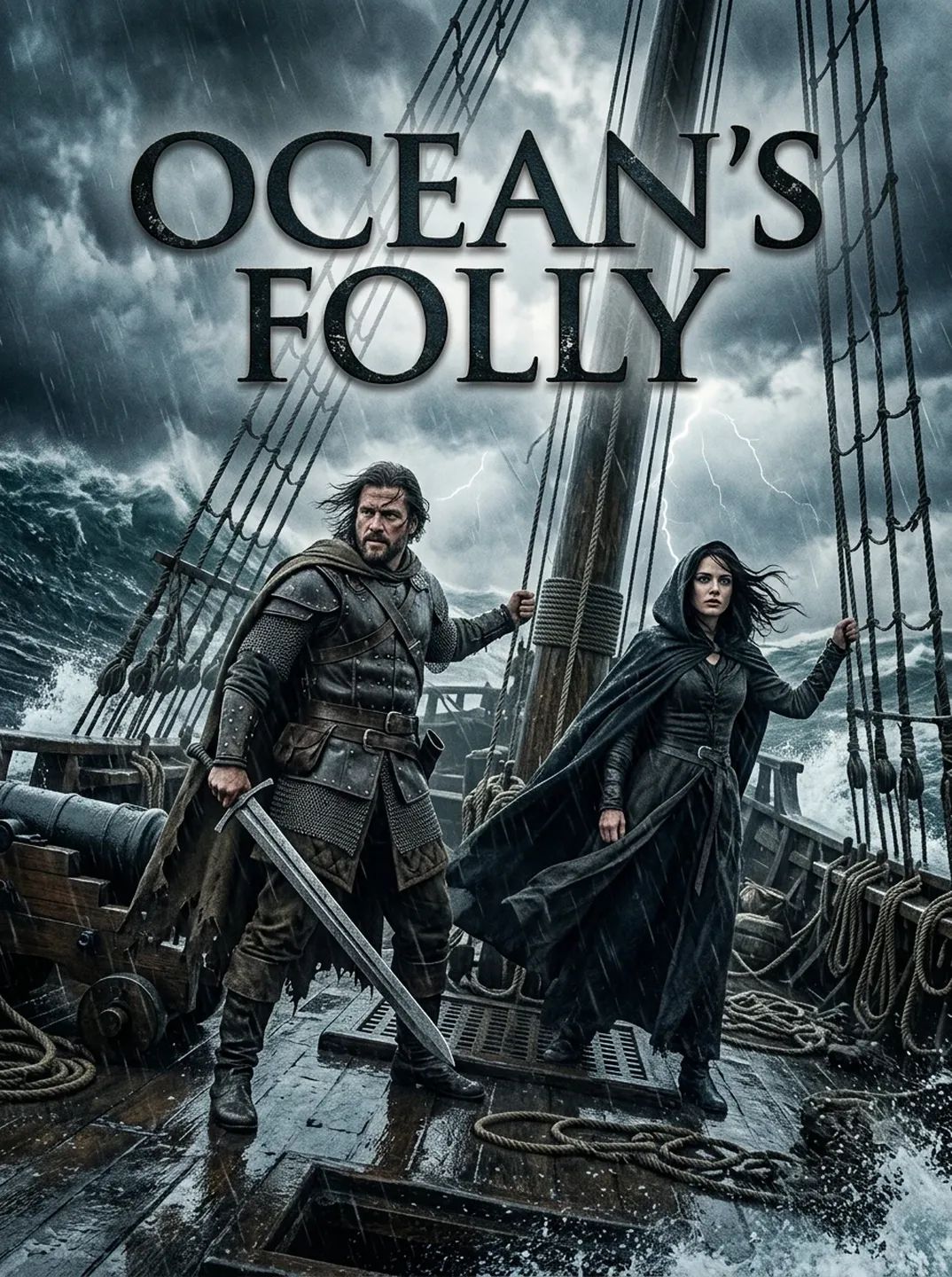
Ocean's Folly
Zusammenfassung
He is the hero everyone trusts, the Dragon-Slayer of legend. But only she knows the truth: his crown was forged in betrayal and paid for with blood.
She is the ghost from his past, the one loose end he could never tie off.
Now, drawn together by a new conspiracy that threatens to expose every lie, they must walk the razor’s edge between trust and betrayal. On a ship of assassins and secrets, will the pain that once broke them now be the only thing that can make them whole?
Kapitel1
The first thing Alex Sterling did every dawn was tap the scarred aluminum case beneath his cot to be sure the vials still sang their faint glassy song. Real heroes prepare, not just swing harder—the words were etched into the lid with the point of a bayonet, and he repeated them like a prayer while the mountain wind outside the tent tried to flatten the canvas. Two years of running off-the-books logistics for Captain Kal Mitchell’s merc squad had taught him that ammunition, morphine, and luck all ran out at the same moment; the trick was to stack the first two so high that the third felt obliged to stay.
He rolled off the cot, boots finding their exact footprints in the dust, and opened the case. Twelve potion ampoules remained, each no longer than his little finger, filled with something the color of liquid sunset. Three months earlier there had been forty. Father Quinn O’Lendy—combat medic, priest, and the only man who could tease laughter out of a corpse—had carried half the stock into the Mambhaling civil war and never brought any back. Alex closed the lid, snapped the latches, and swallowed the metallic taste that rose whenever he pictured Quinn’s gloved hand going limp on the radio switch.
Outside, the camp stirred. The squad’s newest patch of nowhere was a quarry scooped from the belly of the Slatebacks, a ridge so barren even goats filed complaints. Convoy tracks braided the gravel like black scars. Alex moved among them, clipboard tablet in one hand, infrared stylus clamped between teeth. Every crate he checked off was another brick in the wall between his people and the reaper. Rations, water filters, replacement batteries for the exo-frames, a single collapsible altar for the chaplain who had replaced Quinn—item by item, the list grew into a fortress.
Captain Mitchell waited by the fuel drums, coat collar high, eyes hidden behind scratched amber lenses. He greeted Alex with the same nod he used for incoming gunships. “Sterling, we’re heavy on armor plate but light on coagulant patches. Thought you ordered more.”
“I did,” Alex answered, scrolling. “Supplier short-shipped. I’ll reroute through Redhaven Express, but they want hazard pay for the mountain pass.”
Mitchell’s jaw flexed. “Pay it. I’d rather haggle with accountants than body-bag manufacturers.” He paused, lowered his voice. “How many potions we sitting on?”
Alex felt the number click behind his ribs. “Twelve.”
“Think it’ll hold?”
“Only if nobody bleeds,” Alex said, and the captain walked off, boots scattering stones like broken promises.
By midday the sun became a white coin pressed against slate clouds. Alex rode the cargo lift down the quarry face to meet a battered six-wheeler named Gretchen . Her driver, a wiry woman called Jessa with a tattoo of a raven that flapped when she shifted gears, thumped the door. “Payload from Blackwater Station,” she announced. “Plus one mystery box addressed to you personally.”
Alex’s eyebrows twitched. Personal mail was a myth in their line of work. He slit the tape with his stylus and lifted out a small cedar coffin—not a gesture box, not military issue. Inside, nestled on crimson velvet, lay a single potion ampoule identical to his dwindling stock. No note. No sender stamp. Just Quinn’s dog-tag cross soldered around the neck of the vial like a morbid necklace. Alex’s throat narrowed; the quarry air suddenly tasted of copper. He snapped the coffin shut before Jessa could glimpse the tag. “Log it as medical surplus,” he told her, voice steady only because he forced it through a sieve of professionalism. Yet his pulse drummed the question: who possessed the formula, and why return it one drop at a time?
Night fell early in the mountains. Alex sat on an ammo crate beneath a buzzing sodium lamp, tablet balanced on his knee, coffin beside him like a silent confessor. He inventoried the new vial into the system—thirteen now, still a skeleton budget against catastrophe—and opened a secure ledger. Every expenditure of potion required dual authorization; he typed Mitchell’s name, then hesitated over the second line. Quinn’s tag glinted, catching the lamp’s orange glare. Without thinking, Alex typed: O’Lendy, Quinn T. The system accepted the ghost signature with a cheerful beep. Cold slid along his spine.
Footsteps approached—Delgado, the squad’s youngest rifleman, barely old enough to buy courage legally. His left hand was wrapped in gauze already blooming crimson. “Got careless on the obstacle wire,” he muttered, embarrassed. Alex unclipped a potion, thumbed the neck, and poured the liquid over the tear. Delgado hissed as skin knitted, pink and tender. “Thanks, Hero,” he said, the nickname now half gratitude, half brand. When he left, Alex updated inventory: twelve. He stared at the cedar coffin, half expecting it to refill itself like a magician’s pitcher. It remained obstinately empty.
A gale rose, rocking the lamp so shadows jittered across the quarry walls. Alex pulled his coat tighter and reopened the mystery coffin. Quinn’s tag bore a microscopic inscription he hadn’t noticed before: coordinates, etched with a scalpel’s precision. He cross-referenced them against satellite tiles—deep inside Mambhaling, a region labeled “Contested—No Extraction.” His heartbeat began counting distance, risk, fuel load, probability of ambush. Real heroes prepare, not just swing harder. But preparation without answers was just hoarding fear.
He found Mitchell in the command container, hunched over thermal maps. Alex laid the tag on the acrylic table. The captain’s reflection stared at it for a long moment. “Could be a trap,” Mitchell said. “Could be Quinn’s last will.”
“Either way, it’s unfinished business.”
Mitchell removed his lenses, eyes bloodshot. “We ride at dawn. Two gunships, six volunteers. You’re on lead bird.”
Alex exhaled relief and dread in equal measure. “I’ll prep emergency packs.”
“Take an extra potion,” Mitchell added quietly. “For the road.”
Alex shook his head. “We’re already spending tomorrow’s miracles.” He left before the captain could argue.
Back at his cot he inventoried again—eleven potions, because Delgado’s flesh had demanded one. He packed six into a shock-proof rack, slid the mystery vial into a side sleeve, and hesitated over the remaining four. If the squad suffered casualties while they chased ghosts, those four might spell the difference between letters home and folded flags. He locked the case, then unlocked it, then locked it once more, each click echoing Quinn’s old joke: “Indecision is just a hemorrhage in slow motion.”
Sleep evaded him. Instead he ran scenarios on the ceiling canvas: convoy hit, rotor failure, child soldier with a grenade, every permutation ending in red numbers. Around 0300 he gave up, walked to the chapel tent, and set the cedar coffin on the altar. The chaplain, a quiet man named Morris, prayed over it while Alex stood at parade rest. When the amen came, Alex felt no lighter, but the coffin somehow seemed heavier, as if it had absorbed the weight of every unsaved life.
Dawn bled over the ridge like a wound. The gunships— Valkyrie One and Valkyrie Two —crouched on the gravel, rotors slicing cold air. Alex secured his medical ruck, climbed into the bay, and buckled opposite Jessa, who winked. “Heard we’re chasing ghosts,” she shouted over engine whine.
“Ghosts bleed too,” Alex replied, surprising himself. The case of potions lay between his boots, glass whispering against foam. As the bird lifted, quarry walls dropping away, he touched the scarred lid and repeated the credo, louder this time, as though the mountains themselves might listen. Eleven vials, a set of coordinates, and a dead man’s tag—ingredients for either resurrection or ruin. The horizon cracked open, revealing Mambhaling’s bruised sky, and Alex Sterling began preparing for every kind of bleeding.
The war in the north had been a whisper for three seasons, then a shout, then a scream that stripped every depot from here to the Ice-Bite Range. Now the squad—what was left of it—shipped out in seven days for a continent that did not exist on any admiral’s chart, and the only medical cargo was a dented tin of bandage strips and a chaplain’s promise that gods still listened.
Kael hunched on the sagging motel mattress, Harbor District rain ticking against the cracked pane like spent casings. Three glass vials lay in his palm, each no longer than a finger joint, each hollow. The labels had peeled away months ago; the ink that once read “Antivenin” or “Coagulant” or maybe “Hope” had smeared into bruise-colored clouds. He turned the vials over, hearing the faint cling of glass on callus, and wondered how many lives he could have stuffed inside them if physics allowed such compression.
A knock—three soft, two hard—interrupted the inventory of emptiness. Kael’s shoulders jerked; the vials chimed. He swept them into a sock drawer already crowded with unposted letters and a child’s tin soldier missing its head.
“Come.” His voice cracked like old leather.
The door sighed open on humid salt air. Remi Hart ducked under the lintel first, mandolin case thumping his hip, copper curls plastered to his forehead. Behind him Arwen Vale glided, cloak the color of deep water, midnight hair braided with tiny shells that clicked when she moved. The elf’s eyes reflected the single bulb, twin green moons.
“Still moping over your chemistry set?” Remi asked, kicking the door shut with his heel. He smelled of dockside taverns—fried eel, ale, and someone else’s pipeweed.
Kael rubbed the hollow at the base of his throat. “Inventory’s done. We’re down to wishes and pocket lint.”
Arwen drifted to the map nailed over the water-stained headboard. She traced the parchment’s edge where the known world ended and the cartographer had drawn a dragon coiled around the phrase Here Be Profit. “Twelve weeks to Tisah Peninsula,” she murmured, voice soft as falling ash. “Assuming the wind stays curious and the captain doesn’t sail us off the edge of his hangover.”
Remi flopped cross-legged onto the carpet, mandolin across his knees. “Twelve weeks without a single potion, salve, or elf-root lozenge. If the plague ship finds us, we’ll fight fever with sea shanties.” He strummed a minor chord that sounded like a laugh giving up.
Kael’s stomach folded in on itself. He pictured the squad—thirty-seven souls when they’d marched out of Iron Vale, nineteen after the siege of Red Reef, now twelve packed into a leaky frigate whose name changed every time the quartermaster got drunk. He saw limbs swollen with coral poison, tongues blackening, the deck becoming a chessboard of the dying and the merely terrified.
He stood so fast the chair toppled. “There has to be something.” He yanked the drawer, produced the vials again. “These held the last doses of Siren’s Bane. If I can reverse-engineer the residue—”
Arwen touched his wrist. Her fingers were cool, pulse slow as kelp in tide. “You’ll poison yourself sniffing glass. The formula died with the alchemist.”
“Then we find another alchemist.”
“On a continent that forgets to exist?” Remi plucked a descending scale. “Kael, the only thing growing out there is cartographers’ regret.”
Kael’s answer was to cross to the corner where his pack leaned like a tired drunk. He unbuckled the flap, revealing a velvet roll. Inside lay six scalpels, a collapsible tripod, and a notebook swollen with pressed herbs and marginalia. He peeled a page carefully; crushed star-thistle sprinkled the carpet like yellow snow.
“I still have tools,” he said. “And a memory.” He tapped his temple. “I watched Mother brew Siren’s Bane when I was nine. I know the color it turns when copper sulfate kisses sea-ivy oil. I know the smell just before it clarifies—like bruised pears and lightning.”
Remi’s jesting grin softened. “You’re talking about cooking blindfolded on a moving stove.”
“Better than humming requiems over corpses.”
Arwen closed her eyes. For a moment the only sound was rain and the faint heartbeat of Remi’s thumb brushing strings. When she opened them, the green had sharpened to blade edges. “There may be a way,” she said, “but it requires a debt you won’t want to pay.”
Kael’s spine iced. “Name it.”
She moved to the window, parted the curtain. Below, Harbor District’s maze of piers flickered with storm lanterns. A ship horn moaned, low and mournful as a whale mourning its calf. “My patron whispers of a reef twelve days west—unmapped, unnamed. Coral there sings at dusk. If you harvest a single branch, it will amplify any salve a hundredfold. One thimble of mixture could heal a legion.”
Remi’s chord died with a sour twang. “Also rumored to shred the minds of anyone who dives without a soul-anchor. We’d arrive at Tisah drooling in circles.”
Kael weighed the vials in his palm, feeling the ghost of liquid shift that wasn’t there. “Show me the sigil,” he said to Arwen.
She lifted her cloak. Etched into the pale skin beneath her collarbone was a spiral of runes that hurt to perceive directly. Kael’s eyes watered, but he memorized the twist at the center—a hook shaped like a question mark.
“That’s the price,” Arwen said. “Carry the sigil. Let my patron ride your dreams until the coral is harvested. You may wake speaking languages that predate stone. You may not wake at all.”
Thunder cracked so near the bulb flickered. In the brief darkness Kael felt the room tilt, as if the motel itself had slipped moorings. He thought of the squad boys playing dice belowdecks, of the fresh-faced scout who’d asked him yesterday whether sea-serpents really wept before they devoured you. He thought of empty vials clinking like toast glasses at a funeral.
“Done,” he said.
Remi shot to his feet. “Kael—”
“Done,” he repeated, louder, as though volume could weld courage to bone. He crossed to the washbasin, filled a cracked mug with rainwater dipped from the windowsill. He held it toward Arwen. “Blood seal?”
She shook her head. “Words are enough. My patron prefers voluntary chains.” She touched two fingers to his forehead. The runes burned cold, then sank inward, a brand no mirror would show. Kael felt them coil behind his eyes like smoke rings.
Remi exhaled through his teeth. “Well, if we’re trading sanity for supplies, let’s at least write the will in style.” He flipped his mandolin, scribbled across the soundboard with a dockworker’s charcoal stub: IOU one soul, payable upon coral retrieval. He signed it with a flourish, then clapped Kael’s shoulder. “Welcome to the suicide club, mate. Meetings every sunset.”
Kael managed a shaky laugh. He corked the empty vials with bits of candle wax and slipped them into an inner pocket, close to his heart. They rattled like tiny war drums.
Arwen produced a shard of obsidian, its surface swimming with starlight. “When the time comes, break this on the reef. It will part the song long enough to cut the coral. After, crush it into powder and mix with whatever base you devise. The rest—” She paused, listening to a silence only she could hear. “The rest is survival.”
Kael took the shard. It weighed more than physics allowed, as if it carried the gravity of every choice that had led him here. “Twelve days west,” he echoed. “Then twelve weeks east to Tisah. The squad ships out in seven. That leaves us negative five days.”
“Time,” Arwen said, “is negotiable if you’re willing to sail against the world’s spin.”
Remi packed his mandolin. “I’ll charm the captain. Tell him we’re hunting mermaids to boost morale. He’ll tack west for a lark if I promise him a lullaby that makes gold coins fall from the sky.”
Kael looked once more at the drawer, at the letters he’d never sent, at the headless soldier guarding nothing. He closed it gently, as if shutting a coffin. “Then we move tonight,” he said. “Before I remember why doctors swear oaths.”
They left the motel single file, boots splashing through puddles that reflected lightning like shattered mirrors. Somewhere a gull screamed. Somewhere else, a recruiting drum began its slow heartbeat, calling the squad to a ship that would leave half of them ghosts. Kael touched the vials through his shirt, feeling their emptiness echo like a promise waiting to be filled.
The infirmary smelled of scorched linen and iron.
Remi pressed a trembling palm to the gash along Alex’s ribs, whispering a mending charm she had only practiced on apples.
A weak green spark sputtered, sealing half the wound before the spell coughed itself out.
Alex hissed, more from the sting of failure than from pain.
“Duct tape?” she asked through clenched teeth.
Remi tore a strip with her teeth, slapped it across the seam, and muttered an apology to whatever gods watched over half-trained apprentices.
Outside the canvas flap, the rest of the company argued under a sky the color of old bruises.
Arwen stood on an overturned crate like a general surveying a losing battlefield, arms folded so tight the leather of her coat squealed.
In a half-circle before her, the newest healer hopeful shifted from foot to foot: a lanky man in sunflower-yellow robes who kept smiling as if auditioning for a children’s festival.
“Name,” Arwen snapped.
“Brother Cael of Liora’s Gentle Hand.”
“Previous campaign?”
“I tended pilgrims crossing the Ashen Flats. Sunstroke, scorpion stings, existential dread.”
Arwen’s eyebrow arched like a drawn bow. “Ever held a man’s intestines in your palms while ogre drums shook the ground?”
Brother Cael’s smile wilted. “I—I believe every ailment is simply a conversation the body—”
“Next.”
The sunflower robes retreated. The company muttered.
Someone coughed up a laugh that sounded more like a sob.
Three nights earlier, Quinn had taken a javelin meant for Kal and bled out before anyone could even scream.
The hole she left was wider than a body; it was a rupture in the rhythm of the whole squad.
Kal still charged ahead each dawn, but now the front line felt like a guillotine waiting for gravity to notice.
Arwen rubbed the heel of her hand against her brow.
“Anyone else?” she asked the emptying row of candidates.
A woman with silver face paint stepped forward, swirling a crystal-topped staff.
“High Arcanist Veyra. I convert fatal wounds into harmless music.”
To demonstrate, she flicked the crystal; a faint lullaby hummed, then died when a gust of wind snuffed it.
Arwen stared. “Music?”
“Yes. The victim merely hums themselves to—”
“Next.”
The line shortened, then vanished.
Arwen kicked the crate, sending splinters into the dust.
“Sketchy, arrogant, or just plain dumb,” she growled. “Pick your poison.”
Remi emerged from the infirmary, hands tacky with blood and tape residue.
“Captain, we’re out of linen. Also out of luck. Alex is patched but she’ll reopen the moment Kal drags her into another skirmish.”
Arwen’s glare could have curdled water.
“Then Kal keeps his damn shield up.”
“Kal thinks shields are cowardly fashion accessories,” Remi answered.
From the sparring yard came the metallic clang of Kal testing that theory against a training dummy.
Every impact rattled teeth.
Alex limped out, pressing a wad of gauze beneath her borrowed jerkin.
She studied the deserted recruiting space: overturned stools, a dropped pamphlet promising MIRACLES FOR THE MODERN MERCENARY, the lingering scent of anxious sweat.
“Zero hires?” she asked.
“Negative five,” Arwen corrected. “I’d un-hire some if I could.”
Alex exhaled through her nose. “We ride at dawn. If nobody fills Quinn’s spot, Kal’s signature frontal charge becomes a suicide sprint. Clock’s screaming, Arwen.”
“I hear it,” the captain said, voice suddenly thin.
For a heartbeat, the mask slipped and Alex saw the raw calculation: how many seconds a healer’s absence cost, how many centimeters of steel could slip past guard because a blade’s edge no longer feared reprisal.
Remi tugged Alex aside. “We could try the back-alley herbalist in Dock Ward. The one with the glass eye that winks when she lies.”
“She winks constantly,” Alex reminded.
“Exactly. We’ll know when she’s telling the truth—never.”
Alex almost laughed, but pain stapled her side. “We’re patching wounds with children’s rhymes and tape. We need competence, not carnival tricks.”
Across the yard, Kal split the dummy’s wicker head. Splinters haloed in the air like angry bees.
He stomped toward them, sweat painting pale lines through the dust on his throat.
“Heard the last songbird flew off,” he barked. “No healer?”
“Working on it,” Arwen muttered.
Kal spat. “Work faster. I’m not hugging the shield line like some court page.”
“You’ll hug dirt if you keep swinging that ego,” Arwen shot back, but the words lacked heat.
Kal’s knuckles flexed, leather gloves creaking. He looked at Alex’s taped flank, at Remi’s blood-flecked sleeves, at the crate Arwen had reduced to kindling.
Then he strode away, shoulders squared for tomorrow’s death race.
Night slid in, thick and starless.
Inside the command tent, lanterns hissed.
Alex sat on a bench, rolling linen strips because idle hands remembered too much.
Remi hunched over a spell primer the size of a prayer book, lips moving:
“Close the wound, knit the flesh, restore the flow—”
She botched the third syllable; the candle guttered, wax splattering like hot milk.
Alex caught the droplets before they hit the parchment.
“You’ll set the tent on fire.”
“Fire might cauterize something,” Remi said, half-hysterical.
Alex rested her forehead against her knuckles. “Remember Quinn’s rule? ‘Never practice on the living unless you’ve failed on the dead.’ We’re reversing it.”
Remi’s eyes shone wet. “I keep hearing her voice—‘Pressure and patience, girls. Flesh remembers kindness.’ My cantrips aren’t kind; they’re desperate.”
Alex laid a hand on the younger woman’s wrist. “Desperation keeps hearts pumping. We’ll make do.”
She hoped the words sounded more convincing inside her own skull.
Outside, bootsteps approached.
Arwen ducked in, cheeks wind-chapped.
She tossed a parchment onto the table; it slid to a stop beside the candle.
“New applicant,” she announced.
Remi perked. “Competent?”
“Unknown. Name’s Serrin. No references, no fixed address. Claims to have learned surgery on whaling ships north of the Frostbite Sea.”
Alex lifted an eyebrow. “What’s the catch?”
“Wears a veil, won’t show face. Insists payment be buried in a lead box before each battle.”
Remi wrinkled her nose. “That’s not sketchy at all.”
Arwen’s mouth twisted. “But the hands—” she held up her own, miming dexterity, “—fast as minnows. I watched him stitch a sliced orange rind back seamless in the dark.”
Alex considered. “We’re down to superstition and oranges. Bring him at dawn. If Kal survives the first charge, we’ll know Serrin’s real.”
Remi swallowed. “And if Kal doesn’t?”
Arwen already headed for the flap. “Then we hire the next veiled miracle worker who can raise the dead—or we follow Quinn straight into whatever quiet place she found. Either way, the bar stays where it is.”
The tent closed behind her, leaving Alex and Remi with the smell of wax, blood, and a future taped together one heartbeat at a time.
Alex blew out the candle.
Darkness felt kinder; it hid how little separated them from the abyss.
She whispered to the ashes, “Hold the line, Quinn. We’re still too stubborn to join you.”
Somewhere beyond canvas and campfires, midnight tightened like a wire.
Tomorrow would come sharpening its knives, and the company would meet it with half-learned cantrips, duct tape, and a prayer wrapped in a veil—hoping the wire would hold one more day.
Neueste Kapitel
Olivia’s fingers were still damp from the espresso machine when she slid the job sheet across the sc
The wind screamed like a living thing, clawing at the rail, at the sails, at the woman who hung half
The wind off the Atlantic tasted of rust and brine, the kind of metallic chill that clung to the ton
The loft above the river smelled of wet stone and candle smoke when Sophia Sterling stepped inside,